Biography
Early Learning and Influential Mentors
Yang Wanli was born on October 29, 1127, in Lantang Village, Zhonggu Township, Jishui County, Jizhou (modern Bantang Village, Huangqiao Town, Jishui County, Jiangxi Province). His birth coincided with the national catastrophe of the Jingkang Incident, the fall of Northern Song, and the southern flight of Emperor Gaozong. This backdrop of enduring territorial loss and displacement profoundly shaped his consciousness. His father, Yang Fei, was a learned scholar who possessed a private collection of several thousand volumes and chose a life of frugal teaching in local academies. Under strict paternal tutoring and the loving guidance of his mother Lady Mao and stepmother Lady Luo, Yang Wanli cultivated unbending personal integrity and academic rigor.
In his youth, Yang Wanli studied under respected regional scholars including Gao Shoudao, Wang Tinggui, and Liu Anshi. Wang Tinggui had faced severe punishment and political banishment under the despotic councilor Qin Hui for penning a farewell verse to the exiled anti-peace statesman Hu Quan; his moral fortitude left an indelible mark on young Yang Wanli. In 1150, Yang Wanli passed the provincial examinations at age twenty-four. Although he failed the metropolitan examination on his first attempt in 1151, he redoubled his academic efforts without losing heart. In the third month of 1154, he returned to the imperial capital Lin'an, passed the metropolitan and palace examinations, and received his jinshi degree.
Following his graduation, Yang Wanli was appointed Administrative Assistant of Ganzhou. During his tenure, his father accompanied him to pay respects to the eminent Neo-Confucian scholar Zhang Jiucheng, who was then exiled in Gan County, as well as Hu Quan, who was passing through Ganzhou during his long exile. The profound philosophical insights, uncompromising moral backbone, and resolute patriotic zeal of these senior mentors deeply influenced Yang Wanli, setting the foundational principles for his lifelong commitment to national recovery and administrative honesty.
Official Career and Fearless Remonstrances
In 1159, Yang Wanli was appointed Vice Magistrate of Lingling in Yongzhou. At the time, the illustrious anti-Jin statesman Zhang Jun was residing in forced retirement in Yongzhou. Admiring Zhang Jun's towering moral authority, Yang Wanli sought audience three times. Initially skeptical of the young official, Zhang Jun was astounded upon examining the literary treatises and memorials Yang presented. Zhang invited him into his inner quarters, conversed extensively about state affairs, and exhorted him to ground his learning in sincere mind and upright will. Deeply moved, Yang Wanli embraced this admonition as his guiding star, christening his study Chengzhai (Studio of Sincerity) and styling himself Chengzhai Yeke, by which he became widely known. He also forged a lifelong friendship with Zhang Jun's son, the prominent philosopher Zhang Shi.
Following Emperor Xiaozong's ascension in 1162, the court adopted a firmer stance against the Jin empire, revitalizing national morale. In 1167, Yang Wanli presented his monumental thirty-chapter political treatise, Qianlü Ce (Thousand Reflections). Covering sovereign ethics, fiscal management, civil examination systems, bureaucratic redundancy, and frontier defense, the work urged the court to avoid rash military gambles like the earlier defeat at Fuliyi, advocating instead internal consolidation, economic replenishment, and steady defensive strength. The treatise was hailed across the capital for its visionary insight.
In 1170, upon the enthusiastic recommendation of Prime Minister Yu Yunwen, Yang Wanli was summoned to Lin'an and appointed Professor in the Directorate of Education, soon advancing to Erudite of the Court of Imperial Sacrifices. During his central court tenure, he tirelessly fulfilled his remonstrative duties. He frequently rebuked bureaucratic lethargy and court complacency, demanding imperial patronage for deceased patriots and openly defending orthodox Confucian principles. Knowing that his outspoken views alienated high officials, Yang Wanli always kept travel funds locked in a trunk in his lodgings, fully prepared to resign and return home at a moment's notice.
Pacifying Banditry and Governing Lingnan
In 1179, Yang Wanli was appointed Superintendent of Ever-Normal Granaries, Tea, and Salt in Guangdong. The regional salt administration was plagued by extortionate fees and bureaucratic embezzlement. Yang Wanli swiftly restructured the apparatus, abolishing illicit levies, curbing corrupt exactions, and stabilizing regional granaries and commodity prices. In 1181, his exceptional administrative achievements earned him promotion to Judicial Commissioner of Guangdong, entrusting him with judicial supervision and public order.
Around this time, a massive rebel army led by the Tingzhou bandit Shen Shi invaded mountainous territories spanning Chaozhou, Meizhou, Xunzhou, and Huizhou. Relying on treacherous mountain terrain and dense jungles, the rebels repeatedly routed regional imperial forces, throwing the provinces into panic. Although Judicial Commissioners were traditionally military officers, Yang Wanli accepted the mandate as a civil official, displaying remarkable military composure.
Yang Wanli personally inspected the front lines. He devised a strategy combining structural fortification, logistical interdiction, and political conciliation. By erecting fortified outer posts to block strategic choke points, cutting off rebel supplies, and granting clemency to entice surrenders, he isolated Shen Shi's inner core. He then led government troops on a direct assault, capturing Shen Shi and extinguishing the rebellion. Following the pacification, Yang Wanli visited Meizhou to reorganize regional defenses, exempt impoverished border residents from arrears in taxes, and construct local schools. Overjoyed by the swift victory, Emperor Xiaozong praised him as possessing the true courage of the benevolent and ordered him recalled to the capital for higher office.
Secretarial Duties and Clashes with the Court
In 1184, Yang Wanli was summoned to Lin'an as Vice Director of Personnel, and soon promoted to Reviewer in the Bureau of Military Affairs and Compiler in the Bureau of National History. In 1186, he advanced to Right Bureau Director of Military Affairs concurrently serving as Lecturer-in-Waiting to the Crown Prince. When Emperor Xiaozong inquired about the foremost priority of a prime minister, Yang Wanli responded unequivocally that cultivating and employing virtuous talent was the most urgent task, presenting his Chunxi Roster of Worthies to recommend sixty outstanding men of integrity, including Ye Shi and Xu Yi. Impressed by his wisdom, Emperor Xiaozong personally brushed the two characters Chengzhai as an imperial plaque.
In the third month of 1188, Hanlin Academician Hong Mai memorialized that pro-peace courtiers should be granted posthumous enshrinement in the ancestral temple of Emperor Gaozong. Yang Wanli stood up in fierce opposition, arguing vehemently that Zhang Jun alone had sustained the southern empire through its darkest trials and deserved temple honors. He publicly denounced Hong Mai as deceiving the throne and calling a stag a horse. Offended by his unvarnished tone, Emperor Xiaozong revoked Yang's secretarial title and banished him to govern Junzhou. In Junzhou, Yang Wanli governed with characteristic compassion, rebuilding municipal schools and winning universal acclaim.
In 1189, Emperor Xiaozong abdicated in favor of Crown Prince Zhao Dun (Emperor Guangzong). The new monarch immediately recalled his former tutor, restored his rank, and appointed him Junior Lord of the Imperial Library and Compiler in the Hall of Veritable Records. In 1190, holding the honorary title of Auxiliary Academician of the Hall of Shining Culture, Yang Wanli served as Reception Envoy for the Jin New Year embassy. Traveling along the Huai River, he witnessed firsthand the divided homeland and the tears of northern refugees living under foreign rule. Overcome by grief and indignity, he composed numerous stirring patriotic poems, including Four Quatrains on Entering the Huai River, sharply mocking the Southern Song court's appeasement policies.
Defiance over Iron Currency and Retirement
In 1192, Yang Wanli assumed office as Fiscal Vice Commissioner of Jiangdong. Seeking to replenish dwindling state coffers, the grand councilors ordered the mandatory introduction of debased iron currency across Jiangnan, commanding citizens to surrender their copper coins. Jiangnan's thriving commerce depended entirely on circulating copper specie; forcing heavy, depreciating iron coins into trade would trigger rampant inflation, ruin merchants, and destabilize society. Recognizing the disastrous consequences, Yang Wanli openly refused to execute the imperial edict, ordering all subordinate prefectures to prohibit the distribution of iron money.
Yang Wanli submitted a searing memorial outlining the grave perils of the iron coinage policy. He argued that forcing iron coins upon the fertile Jiangnan economy would cripple commerce, impoverish common households, and shatter the fiscal foundations of the state. This defiance infuriated the grand councilors, who retaliated by reassigning him to serve as Prefect of Ganzhou. Seeing the court blinded by venality, Yang Wanli adamantly refused the new assignment and requested retirement with a sinecure temple title. The court conferred on him the title of Drafter in the Secretarial Hall and Intendant of the Wanshou Temple. He promptly relinquished his duties and retired to his rural home in Bantang, cutting off all engagement with officialdom.
Upon completing his handover as Fiscal Vice Commissioner, official accounting revealed a legitimate surplus of ten thousand strings of cash in the treasury reserve. While standard bureaucratic practice allowed departing officials to pocket such surpluses as private perquisites, Yang Wanli tallied every coin into official logs, left the entire sum in the treasury, and departed with simple baggage. His friend Xu Ji wrote in admiration that his threshold was as clear as pure water and his only wealth was the golden metal of his official belt.
Defiance of Han Tuozhou and Patriotic Demise
Following the enthronement of Emperor Ningzon, royal relative Han Tuozhou monopolized imperial authority, orchestrating the Qingyuan factional ban to purge Zhu Xi, Zhao Ruyu, and other upright scholars. The court repeatedly issued imperial decrees summoning Yang Wanli to Lin'an, bestowing titles such as Waiting-in-Attendance in the Hall of Shining Culture, and ennobling him as Baron of Jishui and later Marquis of Luling. However, fully aware of Han Tuozhou's tyrannical intent, Yang Wanli steadfastly declined every summons.
Seeking to cultivate a veneer of refined culture, Han Tuozhou constructed the lavish South Garden in the scenic West Lake district. Coveting Yang Wanli's literary prestige, he repeatedly dispatched envoys laden with gold and silks, entreating him to compose an inscription for the garden and promising high ministerial posts in return. Yang Wanli indignantly refused, declaring firmly that while an official post could be accepted, an unprincipled essay could never be penned. Thwarted and resentful, Han Tuozhou permanently barred Yang Wanli from office. Yang remained in his village retreat along the Nanxi River for fifteen years, completely shunning urban life.
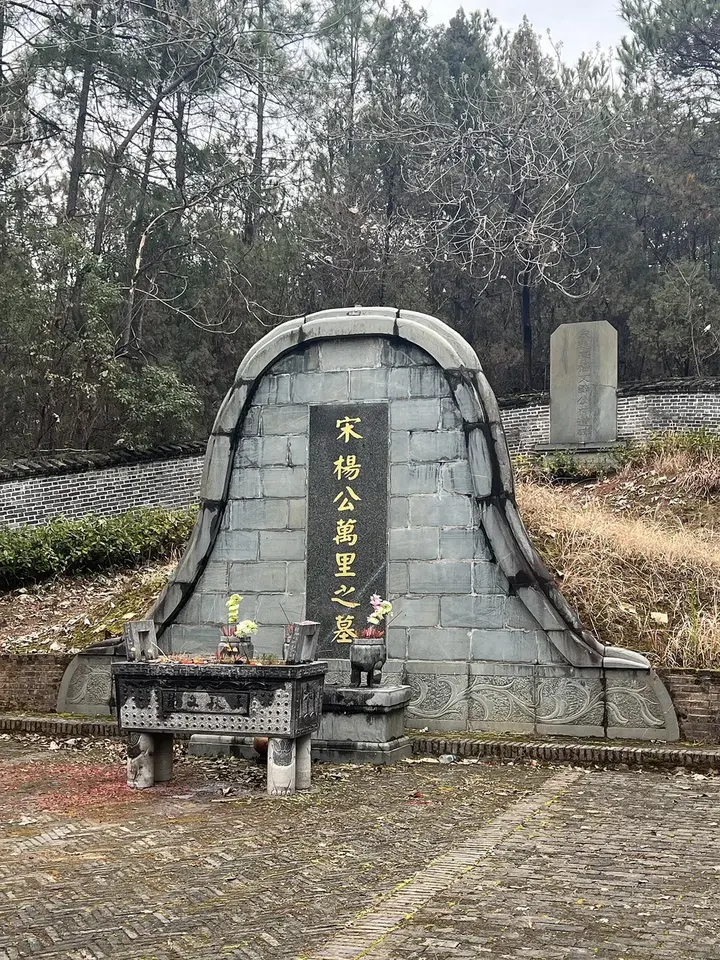
In the spring of 1206, driven by personal vanity and without adequate logistical or military preparation, Han Tuozhou rashly launched the Kaixi northern expedition. Yang Wanli followed developments with agonized foreboding. Soon, reports reached him that Song armies across multiple routes had suffered catastrophic collapses, leaving tens of thousands slaughtered. Shattered by grief and outrage, Yang Wanli fell gravely ill and refused all food. On June 15, 1206 (8th day of the 5th month), sitting upright in his library, he wrote his final testament condemning Han Tuozhou for recklessly plunging the empire into ruination. He dropped his brush and passed away peacefully at the age of eighty. The court later posthumously honored him as Grand Master of Splendid Happiness and conferred the posthumous title Wenjie.
Major Achievements
Founding the Chengzhai Style in Southern Song Poetry
Yang Wanli was an innovative master whose creative vigor fundamentally reshaped Chinese poetry, earning him recognition alongside Lu You, Fan Chengda, and You Mao as one of the Four Great Masters of Southern Song. In his formative years, he thoroughly studied the Jiangxi poetic style of Huang Tingjian and Chen Shidao, emphasizing meticulous craftsmanship, intertextual allusions, and metric precision, later shifting toward late Tang forms. However, in 1162, he made the daring decision to burn over a thousand poems composed in his youth. By the age of fifty, during his service in Jiangdong and Yongzhou, he recognized that uncritical bookish imitation stifled artistic truth. He broke free from classical shackles and embraced the doctrine that nature itself should be the sole teacher.
The resulting Chengzhai style achieved immense distinction in classical Chinese verse. Its defining principle was huofa (the living method), which concentrated on capturing fleeting, vivacious impressions of nature and daily life with sharp agility. The renowned modern scholar Qian Zhongshu aptly remarked that while Lu You excelled at scenic painting like fine-line brushwork, Yang Wanli captured life with the speed of a camera lens, catching the sudden flight of a falcon or the leap of a fish precisely before the moment faded.
Yang Wanli composed over twenty thousand poems during his lifetime, with four thousand two hundred surviving today. Iconic masterpieces such as Small Pond with its line "The little lotus has just revealed its sharp tender tip, already a dragonfly perches on its top", and Leaving Jingci Temple at Dawn to See Off Lin Zifang with its line "Lotus leaves touch the horizon in boundless green, lotus blossoms bathed in the sun shine uniquely red", remain household lines throughout China. By infusing colloquial idiom and playful humor into refined metrics, he vastly broadened the expressive horizon of Chinese poetry.
Expressing Compassion for the Rural Peasantry
Despite rising to high ministerial standing, Yang Wanli maintained a modest and heartfelt rustic attachment throughout his career. While serving in the capital and provincial circuits, he frequently ventured into agricultural fields to inspect farming conditions, harboring genuine empathy for the impoverished peasantry who endured exhausting toil. In his poem Late Spring Walking in the Fields of Nanyuan, he wrote in honest self-examination, questioning why a scholar who never stained his ten fingers with mud could wear fine clothes while the farmers suffered.
Yang Wanli wrote a vast corpus of pastoral verse reflecting agricultural labors, seasonal changes, and peasant hardships, such as Songs of Baisha Bamboo Stems, Song of the Four Seasons, The Rice-Planting Song, and Notes on the Road Entering the City After the Solstice. In these verses, he depicted the urgent labor of transplanting seedlings, guarding canal waters on rainy nights, and operating irrigation wheels. He praised the diligence of farming families while scathingly criticizing predatory tax collectors who ruined rural households. These accessible, vibrant verses serve as an authentic historical portrait of Southern Song rural life.
Leading the Literary Circles and Nurturing Talents
From the Qiandao through the Shaoxi eras, Yang Wanli stood as the undisputed leader of the Southern Song literary world by virtue of his towering literary accomplishments and moral stature. Lu You voiced deep admiration in verse, observing that when Master Chengzhai presided over the poetic fraternity, his single word of praise commanded universal assent, acknowledging that his own prose could not match Chengzhai's justice. Fan Chengda similarly praised the Chengzhai style as an unprecedented triumph. Other prominent literati, including Jiang Kui and Lou Yue, extolled him as having literature that eclipsed an entire era and moral purity that inspired all generations.
In his role as literary leader, Yang Wanli demonstrated an insatiable desire to nurture talented youths. While presiding over civil examinations and holding secretarial offices, he discarded factional biases and elevated candidates solely on moral character and practical ability. Eminent figures such as the Yongjia school thinker Ye Shi, Xu Yi, Zhao Fan, and Xu Ji all received his generous guidance and promotion. He not only steered literary trends but also championed orthodox Neo-Confucian scholarship, setting an enduring standard of upright civic morality for the Southern Song scholar-gentry.
Visionary Statecraft Treatises and Unflinching Integrity
Beyond his literary renown, Yang Wanli was a statesman of profound strategic insight and pragmatic administrative capability. In his political philosophy, he insisted that Confucian moral principles had to be realized in practical measures that enriched the country and protected the people, firmly condemning vacuous metaphysical debates. His thirty-chapter treatise Qianlü Ce provided an extensive blueprint addressing imperial statecraft, military reorganization, personnel evaluation, bureaucratic downsizing, and fiscal policy, showcasing remarkable clarity and depth of governance.
Throughout the enduring confrontation with the Jin empire, Yang Wanli remained steadfastly patriotic. Drawing rigorous lessons from past military debacles, he rejected both defeatist surrender and reckless adventurous gambles. He consistently maintained that rigorous internal reform, domestic agricultural recovery, and strategic patience formed the indispensable foundation for recovering the northern heartland. Whether decrying diplomatic humiliation in his envoy verses, risking dismissal to block iron currency, or scorning Han Tuozhou's garden commission and dying in patriotic protest, Yang Wanli embodied the highest moral ideal of the traditional Chinese scholar-official who sacrificed his life for righteousness.