Birth in Shanghai
Born into an agrarian family in Shanghai; assisted his father with farming, developing practical agricultural knowledge.
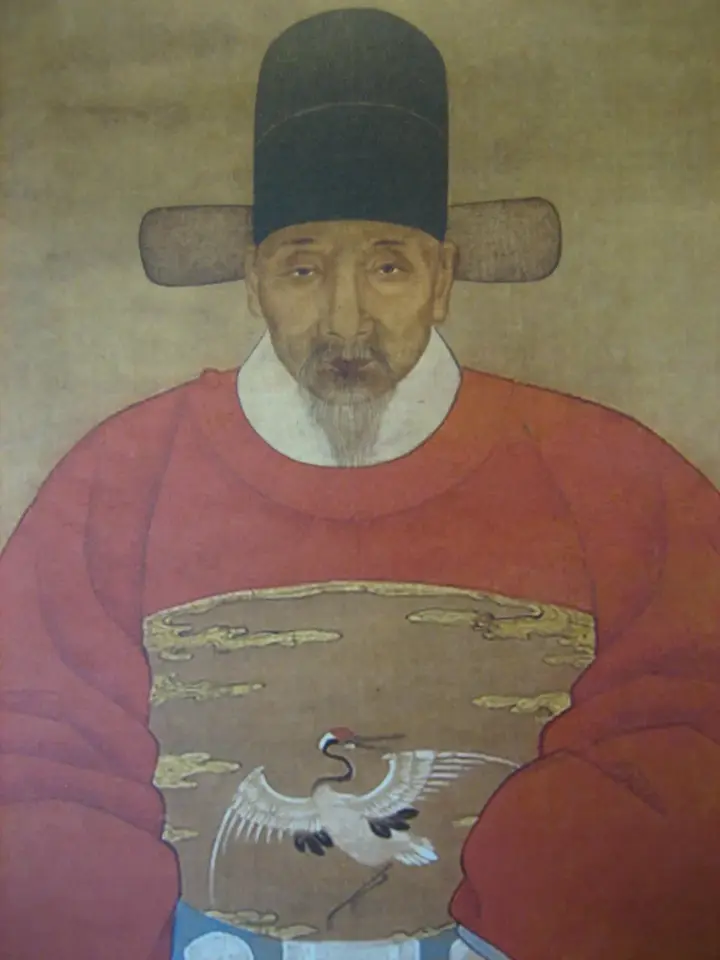
1562 CE–1633 CE
徐光启
Xu Guangqi (徐光启, April 24, 1562 – November 8, 1633), courtesy name Zixian, art name Xuanhu, and Christian baptismal name Paul, was a native of Shanghai County, Songjiang Prefecture (modern Xuhui District, Shanghai). He was a preeminent scientist, agricultural pioneer, astronomer, mathematician, and senior grand secretary during the late Ming dynasty, rising to Minister of Rites and Grand Secretary of Wenyuan Pavilion.…
Xu Guangqi (徐光启, April 24, 1562 – November 8, 1633), courtesy name Zixian, art name Xuanhu, and Christian baptismal name Paul, was a native of Shanghai County, Songjiang Prefecture (modern Xuhui District, Shanghai). He was a preeminent scientist, agricultural pioneer, astronomer, mathematician, and senior grand secretary during the late Ming dynasty, rising to Minister of Rites and Grand Secretary of Wenyuan Pavilion. Posthumously honored as Wending, he is celebrated as the "Pioneer of East-West Cultural Exchange" and the foundational figure of early modern science in China. Earning his Jinshi degree in 1604, Xu entered the Hanlin Academy. Meeting Jesuit missionary Matteo Ricci in Nanjing, he was baptized into Catholicism and dedicated his intellect to synthesizing Western empirical science with traditional Chinese scholarship. In mathematics, he collaborated with Ricci to translate the first six books of Euclid's Elements, inventing standardized Chinese mathematical terminology including "point, line, surface, angle, triangle, and parallel lines," introducing axiomatic geometry to China. In agriculture, Xu conducted empirical reclamation experiments in Tianjin and Shanghai, authoring the monumental sixty-volume Complete Treatise on Agriculture (Nongzheng Quanshu), while vigorously promoting sweet potatoes and cotton to combat famine. In astronomy, Emperor Chongzhen commissioned him to direct the Calendar Bureau, where he enlisted Adam Schall von Bell to compile the 137-volume Chongzhen Calendar, incorporating telescopes and Keplerian planetary calculations. In military defense, he advocated casting European-style cannons to fortify Great Wall passes against the Later Jin. Xu established an enduring legacy of empirical verification and intercultural synthesis.
Born into an agrarian family in Shanghai; assisted his father with farming, developing practical agricultural knowledge.
Passed the county examination; taught in local village academies across Guangdong and Guangxi to support his family.
Placed first as Jieyuan in the Shuntian provincial examination after examiner Jiao Hong recognized his genius.
Met Jesuit scholar Matteo Ricci in Nanjing, deeply impressed by European astronomy, geography, and mathematics.
Baptized as Paul in Nanjing; passed the metropolitan examination in 1604, entering the Hanlin Academy.
Collaborated with Matteo Ricci to translate Euclid's Elements, publishing the first six books in 1607.
Retired on sick leave to conduct agricultural reclamation in Tianjin, testing paddy cultivation and writing Treatise on Sweet Potatoes.
Following the Ming disaster at Sarhu, petitioned to drill new battalions in Tongzhou, urging the import of European artillery.
Successfully predicted a solar eclipse with Western methods; commissioned by Emperor Chongzhen to direct the Calendar Bureau.
Elevated to Minister of Rites and Grand Secretary of Dongge Hall, subsequently promoted to Wenyuan Pavilion.
Passed away on November 8 in Beijing at seventy-two; Emperor Chongzhen suspended court audiences, conferring the title Junior Protector.
Xu Guangqi was born on April 24, 1562, in Fahuahui, Shanghai County, Songjiang Prefecture (modern Xujiahui, Shanghai). His family had farmed the fertile delta for generations, occasionally engaging in small commerce. His father Xu Sicheng was a licentiate who abandoned scholar studies to farm after floods impoverished the household. Accompanying his father in the fields from early boyhood, Xu absorbed practical agrarian knowledge, developing a keen fascination with hydraulic tools, crop yields, and seasonal cycles.
In 1581, at twenty, Xu earned the county degree. However, over the next decade and a half, he failed the provincial examinations repeatedly. To sustain his impoverished parents, he accepted teaching posts in distant prefectures, including Shaoguan in Guangdong and Xunzhou in Guangxi. In the southern maritime provinces, Xu encountered European clocks, sundials, and world maps brought by Jesuit missionaries, broadening his intellectual horizons beyond traditional examinations.
In 1597, thirty-six-year-old Xu journeyed to Beijing for the Shuntian provincial examination. Prominent scholar and chief examiner Jiao Hong retrieved Xu's discarded paper from the reject pile, struck by its profound statecraft and unvarnished prose. Hailing Xu as an extraordinary talent, Jiao ranked him first among all candidates as Jieyuan.
In the autumn of 1600, while traveling through Nanjing, Xu visited the Italian Jesuit missionary Matteo Ricci. The two intellectuals forged an instantaneous friendship, discussing astronomy, cartography, Euclidean geometry, and mechanical engineering. Ricci's rigorous deductive mathematics and precision instruments demonstrated empirical methods that contrasted sharply with late Ming scholarly abstraction. In 1603, Xu was baptized by Jesuit priest Jean de Rocha in Nanjing, adopting the Christian name Paul.
In 1604, forty-three-year-old Xu passed the metropolitan examination in Beijing, chosen as a bachelor in the Hanlin Academy. Because Ricci had also received permission to reside in Beijing, Xu visited Ricci's residence daily after official duties, systematically examining Western scientific manuscripts.
Xu recognized that Western technological achievements in astronomy, surveying, and machinery were grounded upon Euclidean geometry. In the autumn of 1606, Xu and Ricci began translating the ancient Greek mathematician Euclid's Elements (Elementa). Ricci translated the Latin text orally, while Xu transcribed, scrutinized, and formulated the Chinese prose. Drawing upon classical philology and acute mathematical intuition, Xu coined foundational Chinese mathematical terms that remain universally standard, including "point, line, surface, angle, right angle, triangle, polygon, and parallel line."
In the spring of 1607, the first six volumes of Elements were published. In his celebrated preface, Xu made a prophetic deduction: "The utility of this book is boundless, addressing urgent practical statecraft... Those who master this book can master anything. A century from now, everyone will study it; it is merely a matter of sooner or later!" The translation marked the formal introduction of Western deductive logic into Chinese thought. Following this, Xu collaborated with Sabbathino de Ursis to translate Hydromethods of the Great West (Taixi Shuifa), advancing empirical engineering in China.
In 1613, frustrated by court factional purges, Xu obtained sick leave to conduct agricultural reclamation experiments in Tianjin. Aware that northern China was afflicted by seasonal droughts and overly reliant on Jiangnan grain transported via the Grand Canal, he explored whether wet-rice cultivation could succeed in northern saline soils.
Purchasing marshland near Tianjin, Xu surveyed water gradients, dug drainage channels, used fresh river waters to leach alkali from the soil, and built sluice gates against sea tides. His demonstration paddies yielded bumper rice harvests in northern clay. Simultaneously, he experimented with sweet potatoes, an American crop recently brought to Fujian. He authored the Treatise on Sweet Potatoes (Ganshu Shu), outlining thirteen advantages of the crop, including drought resistance, high yields, and famine resilience, becoming the primary pioneer promoting sweet potatoes across northern China.
Between 1621 and 1624, while in retirement in Shanghai, Xu synthesized his lifelong agricultural research and voluminous historical texts into the sixty-volume Complete Treatise on Agriculture (Nongzheng Quanshu). Exceeding five hundred thousand characters across twelve broad divisions—including agricultural foundations, land tenure, water conservancy, farm implements, sericulture, planting, and famine relief—the work synthesized empirical observation with Western hydraulic mechanics, standing as the supreme peak of pre-modern Chinese agronomy.
In March 1619, Nurhaci's Later Jin cavalry crushed Ming expeditionary armies at the Battle of Sarhu, capturing Shenyang and threatening the capital. Bypassing bureaucratic protocol, Xu petitioned Emperor Wanli, volunteering to organize defensive training in Tongzhou.
Promoted to supervisory censor, Xu recognized that traditional infantry and obsolete firelances could not halt Jurchen heavy cavalry. He argued for adopting Western tactics and heavy artillery. Through contacts in Macao, he recruited Portuguese artillery instructors and imported advanced muzzle-loading smoothbore cannons ("Red Barbarian Cannons"), establishing military foundries in Beijing and authoring treatises including Methods of Firing (Dingfa).
In 1622, generals Sun Chengzong and Yuan Chonghuan adopted Xu's doctrine of "holding fortifications with heavy artillery" along the Liaodong front. Mounted atop the ramparts of Ningyuan and Jinzhou, Western-style cannons decimated Later Jin assaults during the Battle of Ningyuan in 1626, wounding Nurhaci and securing Shanhaiguan Pass. However, during the height of eunuch dictator Wei Zhongxian's terror, Xu refused to flatter the eunuch faction, resigning to his Shanghai residence in 1623.
In 1628, Emperor Chongzhen destroyed the eunuch faction, recalling veteran statesmen. In May 1629, the Imperial Astronomical Bureau miscalculated a solar eclipse, whereas Xu Guangqi's predictions based on Western computational models proved flawless. Impressed, Emperor Chongzhen established the Calendar Bureau in July, appointing sixty-eight-year-old Xu as Director General to oversee astronomical reform.
Xu adopted an open, interdisciplinary philosophy: "To achieve superiority, one must first synthesize; before synthesizing, one must first translate." Overriding conservative objections, he recruited German Jesuit Adam Schall von Bell, Swiss scientist Johann Schreck, and Italian priest Niccolo Longobardo to translate European astronomical treatises.
Xu introduced Galileo's telescope into Chinese astronomy, building the first celestial telescopes in China. He incorporated Copernican models, Keplerian planetary laws, and spherical trigonometry into solar calculations. Over several years, the bureau produced the monumental 137-volume Chongzhen Calendar (Chongzhen Lishu). This work established modern Chinese calendrical science, later adopted by the Qing dynasty as the Shixian Calendar.
In May 1632, Emperor Chongzhen elevated Xu to Minister of Rites and Grand Secretary of Dongge Hall, entering the inner cabinet; the following year, he was made Grand Secretary of Wenyuan Pavilion. Amid peasant rebellions and frontier invasions, the septuagenarian scholar labored tirelessly over imperial defense and astronomical calculations.
Xu lived with pristine simplicity, donating his salary to scientific instruments and famine relief. On November 8, 1633, Xu Guangqi passed away at his Beijing residence at the age of seventy-two.
Beside his deathbed lay only coarse blankets and the unfinished manuscripts of his agricultural and astronomical treatises. Grieving the loss of his premier counselor, Emperor Chongzhen suspended court audiences, conferring the posthumous title Wending and Grand Preceptor. Xu Guangqi's legacy of intellectual synthesis remains the eternal beacon of early modern science in China.
Between 1606 and 1607, Xu Guangqi and Matteo Ricci translated the first six books of Euclid's Elements, an epochal event in Chinese intellectual history.
Xu coined standardized mathematical terminology—such as point, line, surface, angle, and parallel—introducing deductive reasoning and axiomatic proof to Chinese scholarship.
Xu spent decades investigating empirical agricultural techniques, producing the 60-volume, 500,000-character Complete Treatise on Agriculture.
The encyclopedia combined traditional agrarian techniques with Western hydraulic engineering, advocating sweet potato cultivation and disaster preparation to become the pinnacle of Chinese agronomic literature.
Directing the Calendar Bureau under Emperor Chongzhen, Xu supervised the compilation of the 137-volume Chongzhen Calendar.
Enlisting European astronomers like Adam Schall von Bell, he built China's first astronomical telescopes and introduced Kepler's laws and spherical trigonometry, modernizing traditional East Asian astronomy.
Following the Sarhu disaster, Xu recognized the superiority of European firearms, pioneering the importation of Portuguese cannons from Macao.
His tactical manuals and foundries established the artillery defenses at Ningyuan and Jinzhou, checking nomadic invasions along northern frontiers.
Xu formulated the legendary philosophical doctrine: "To achieve superiority, one must first synthesize; before synthesizing, one must first translate."
Across mathematics, astronomy, agronomy, hydraulics, and military technology, he built an enduring bridge between East and West, standing as the supreme pioneer of the scientific awakening in late Ming China.
| Relationship Type | Name | Historical Intersection and Factual Context |
|---|---|---|
| European Partner | Matteo Ricci | Italian Jesuit missionary and Xu's close friend; translated Euclid's Elements, opening East-West cultural exchange. |
| European Partner | Sabbathino de Ursis | Jesuit scholar; collaborated with Xu to translate Hydromethods of the Great West, introducing European water-lifting machinery. |
| Calendar Bureau Partner | Johann Adam Schall von Bell | German Jesuit astronomer; recruited by Xu to compile the Chongzhen Calendar, later publishing the treatise under the Qing. |
| Calendar Bureau Partner | Johann Schreck | Swiss polymath and physician; recruited by Xu to translate European physics and astronomical treatises for the Calendar Bureau. |
| Scholar Comrade | Li Zhizao | Prominent scholar; baptized Catholic and collaborated with Ricci to translate mathematical texts, sharing the title "Pillar." |
| Scholar Comrade | Yang Tingyun | Ming scholar-official; allied with Xu and Li Zhizao as the "Three Pillars of the Catholic Church" in late Ming China. |
| Sovereign and Patron | Emperor Chongzhen | Reinstated Xu, entrusting him with the Calendar Bureau and elevating him to Grand Secretary. |
| Imperial Examiner | Jiao Hong | Distinguished philosopher; served as examiner in 1597, retrieving Xu's discarded paper to rank him first as Jieyuan. |
| Frontier Commander | Sun Chengzong | Commander of Liaodong; coordinated with Xu to deploy Western artillery along the Ningyuan-Jinzhou defensive line. |
FIGURES ASSOCIATED WITH THIS DYNASTY