Birth into Imperial House
Born in Jiankang as grandson of Emperor Gao of Southern Qi and eighth son of Xiao Yi, Prince Wenxian of Yuzhang; later created Marquis of Ningdu County.
萧子显
Xiao Zixian (489–537 CE), courtesy name Jingyang, was a native of Lanling County, Donghai Commandery (present-day Lanling, Shandong). He was an imperial prince of Southern Qi and an eminent historian, literary theorist, and high-ranking statesman of the Southern Liang Dynasty. Born into the pinnacle of aristocratic imperial nobility, he was the grandson of Emperor Gao of Southern Qi (Xiao Daocheng) and the eighth son of Xiao…
Xiao Zixian (489–537 CE), courtesy name Jingyang, was a native of Lanling County, Donghai Commandery (present-day Lanling, Shandong). He was an imperial prince of Southern Qi and an eminent historian, literary theorist, and high-ranking statesman of the Southern Liang Dynasty. Born into the pinnacle of aristocratic imperial nobility, he was the grandson of Emperor Gao of Southern Qi (Xiao Daocheng) and the eighth son of Xiao Yi, Prince Wenxian of Yuzhang. In his youth under the Southern Qi, he was enfeoffed as Marquis of Ningdu County. When Xiao Yan overthrew Southern Qi and established the Liang Dynasty in 502 CE, the thirteen-year-old Xiao Zixian entered the new dynasty as a scion of the fallen royal house, winning the profound esteem, trust, and patronage of Emperor Wu of Liang through his towering erudition, poetic grace, and transcendent bearing. In the Liang court, Xiao Zixian advanced through prestigious posts including Middle Equerry to the Crown Prince, Chancellor of the National University, Palace Attendant, and Minister of Personnel, concluding his administrative career as Governor of Wuxing. Passionately dedicated to historiography throughout his life, he received imperial approval to compile the history of his own ancestral dynasty. He authored the sixty volumes of the Book of Southern Qi, becoming the sole historian among the authors of the Twenty-Four Dynastic Histories to write the official history of a dynasty founded by his own imperial family. Beyond this canonical masterpiece, he composed four other major historical works—including a one-hundred-volume Book of Later Han, a thirty-volume Draft History of Jin, the five-volume Records of the Putong Northern Expedition, and the thirty-volume Biographies of the Noble and Frugal—alongside a twenty-volume literary collection. Renowned for his serene, unconstrained bearing, refined aesthetic sensibility, and aloof independence, Xiao Zixian was also a leading authority on phonological metrics and literary criticism, whose Treatise on Literature in the Book of Southern Qi remains a seminal milestone in Six Dynasties literary theory. He passed away in office in 537 CE at the age of forty-nine, receiving the imperial posthumous title "Jiao" (signifying unyielding pride), cementing his extraordinary legacy as a pivotal figure in Chinese historiography and literature.
Born in Jiankang as grandson of Emperor Gao of Southern Qi and eighth son of Xiao Yi, Prince Wenxian of Yuzhang; later created Marquis of Ningdu County.
Following Xiao Yan's founding of the Liang Dynasty, the thirteen-year-old Xiao Zixian entered official service under the new sovereign, receiving high imperial favor.
Commissioned to compile the official history of Southern Qi, synthesizing existing treatises by Tan Chao and Jiang Yan to produce the sixty-volume Book of Southern Qi.
Served as Middle Equerry to the Crown Prince, Chancellor of the National University, and Major, accompanying northern military campaigns and authoring the Records of the Putong Northern Expedition.
Appointed Palace Attendant and Minister of Personnel, directing empire-wide appointments with legendary aristocratic aloofness before being assigned Governor of Wuxing.
Passed away in office as Governor of Wuxing at forty-nine; Emperor Wu of Liang granted funerary regalia and bestowed the posthumous name "Jiao."
Xiao Zixian was born in 489 CE during the prosperous Yongming era of the Southern Qi Dynasty. As the grandson of the founding sovereign Emperor Gao (Xiao Daocheng) and the eighth son of Prince Wenxian of Yuzhang (Xiao Yi), he occupied the innermost sanctum of dynastic authority and aristocratic privilege. His father Xiao Yi had been the paramount pillar of the early Qi state, serving both Emperor Gao and Emperor Wu with exemplary prudence, administrative wisdom, and Confucian moral probity. Raised amidst vast ancestral book collections, Xiao Zixian demonstrated precocious intellectual acumen and immense literary flair from infancy. The Southern Qi court duly granted him the noble peerage of Marquis of Ningdu County.
In 502 CE, following years of violent intra-dynastic turmoil within the Southern Qi royal house, Xiao Yan, Governor of Jingzhou, assumed the imperial throne and established the Liang Dynasty as Emperor Wu of Liang. The dynastic transition presented immense peril for royal survivors. However, Emperor Wu adopted a remarkably benevolent policy toward the surviving members of the Yuzhang princely branch, admiring their cultural achievements and civic rectitude.
Endowed with stately aristocratic manners, eloquent wit, and extraordinary scholarship, the thirteen-year-old Xiao Zixian quickly earned Emperor Wu's warm admiration and unconditional patronage. Entering Liang officialdom, he was first appointed Editorial Assistant in the Palace Library, participating in dynastic record-keeping and state document preparation. Over the subsequent two decades, he rose steadily through refined court offices including Middle Equerry to the Crown Prince and Director in the Ministry of Personnel, becoming a shining cultural luminary in the early Liang court.
Like the classical Western Han historians Sima Qian and Ban Gu, Xiao Zixian regarded historical writing as his paramount life vocation. During the Tianjian era of Emperor Wu (502–519 CE), the twenty-something Xiao Zixian received formal imperial authorization and support to author the comprehensive official history of the fallen Southern Qi Dynasty. Undertaking this historical project required extraordinary political tact and historiographical skill: as an imperial grandson of Southern Qi, he was obliged to preserve the dignity and virtues of his ancestral house, while as a loyal minister of Liang, he needed to affirm the political legitimacy of Emperor Wu's dynastic founding.
Xiao Zixian systematically gathered and scrutinized imperial archives, secret edicts, and private chronicles composed since the founding of Southern Qi. He reviewed the historiographical outlines formulated by imperial historians Tan Chao and Jiang Yan during the reign of Emperor Ming of Qi, and critically incorporated research from Xiong Xiang's Qi Dian, Shen Yue's Qi Ji, Wu Jun's Qi Chunqiu, and Jiang Yan's ten treatises of Qi history. Refining and modifying earlier organizational principles, he laboured tirelessly to complete the sixty-volume Book of Southern Qi (Qi Shu, subsequently termed Nan Qi Shu to distinguish it from Li Baiyao's Bei Qi Shu).
The grand work encompassed eight volumes of Imperial Annals, eleven volumes comprising eight specialized Treatises, forty volumes of Biographies, and one volume of Preface. Chronicling the twenty-three years from Emperor Gao's accession in 479 CE to the abdication in 502 CE, the work constructed an authoritative historical record of the Southern Qi state, establishing Xiao Zixian's permanent reputation as a master historian.
Following the completion of his dynastic history, Xiao Zixian's reputation as both an intellectual authority and high minister expanded across the empire. He was appointed Chancellor of the National University, overseeing classical instruction and educational reforms for the imperial nobility. During the Putong era, when Liang armies launched extensive northern military expeditions against the Northern Wei, Xiao Zixian accompanied the imperial entourage, compiling the five-volume Records of the Putong Northern Expedition to document the military strategy, terrain, and operational engagements of the southern forces.
In the 530s, Xiao Zixian reached the pinnacle of his political career when Emperor Wu elevated him to Palace Attendant and concurrently appointed him Minister of Personnel. The Ministry of Personnel stood as the supreme administrative body overseeing empire-wide evaluations, recommendations, and appointments of the bureaucracy, and prospective office-seekers besieged the ministry's gates daily. Yet Xiao Zixian remained fundamentally detached from bureaucratic politics and sycophantic entanglements. Historical accounts record that whenever he received visitors, petitioners, and scholars of diverse social strata, he sat in aloof, silent dignity, never exchanging idle pleasantries, merely waving his white feather fan once to signal their dismissal.
While this aristocratic coolness offended careerist flatterers, the imperial court and literati circles profoundly admired his untarnished integrity, moral independence, and ethereal refinement, celebrating him as the preeminent cultural virtuoso of the southern realm. Emperor Wu held him in immense affection, frequently inviting him into the private palace chambers to debate poetic aesthetics and Buddhist metaphysics.
In his final years, weary of court intrigues and bureaucratic routine, Xiao Zixian requested an external administrative posting where he could immerse himself in natural landscapes. Emperor Wu granted his wish, appointing him Governor of Wuxing Commandery. Wuxing was renowned for its enchanting waterways, lush mountains, and poetic serenity, and Xiao Zixian governed the commandery with tranquil, non-intrusive benevolence, spending his leisure exploring rivers and temples. In his poignant Self-Preface, he wrote movingly of his deep resonance with nature, recalling how gazing across vast waters, welcoming spring breezes, or listening to early wild geese beneath an autumn moon unfailingly evoked boundless poetic creation.
In 537 CE (third year of Datong), Xiao Zixian succumbed to illness while governing Wuxing, passing away at the age of forty-nine. News of his death plunged Emperor Wu into profound grief. The emperor issued an imperial edict granting an East Garden imperial coffin and bestowed upon him the posthumous title "Jiao" (Proud), an evocative testament to his unbending aristocratic haughtiness and soaring artistic independence.
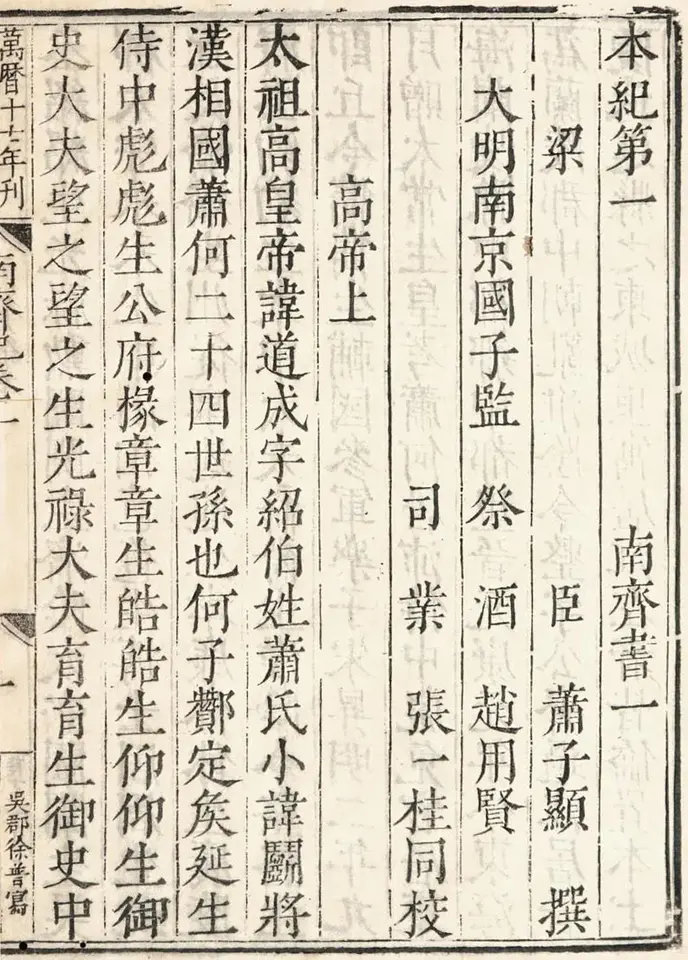
Xiao Zixian's most illustrious historical legacy lies in his authorship of the Book of Southern Qi (Nan Qi Shu), enshrined as one of China's official Twenty-Four Dynastic Histories. Throughout imperial historiographical history, official dynastic histories were almost universally produced by succeeding dynasties or commissioned bureaucrat historians. Xiao Zixian stands uniquely alone as an imperial grandson writing the history of his own ancestral dynasty, offering an invaluable insider perspective on the inner workings, palace culture, and political tragedies of the Southern Qi court.
The sixty volumes of the text are distinguished by their structural balance and narrative rigor. The eight volumes of Imperial Annals open with Emperor Gao Xiao Daocheng's consolidation of power during the late Song Dynasty and chronicle the political fortunes of subsequent sovereigns over twenty-three turbulent years. The eight Treatises in eleven volumes cover Rites, Music, Astronomy, Geography, and Officialdom, preserving vital institutional developments despite the short duration of the dynasty. The forty volumes of Biographies record the lives of regional magnates, loyal ministers, rebel commanders, and northern opponents in the Biographies of the Wei Barbarians.
In his narrative technique, Xiao Zixian displayed unmatched subtlety. Qing Dynasty historian Zhao Yi in his Notes on the Twenty-Two Dynastic Histories singled out Xiao Zixian's portraits of ministers Chu Yuan, Wang Yan, Xiao Chen, and Xiao Tanzhi for high praise. When recounting these treacherous ministers who repeatedly betrayed royal benefactors and orchestrated palace assassinations, Xiao Zixian refrained from overt moralizing; instead, he skillfully juxtaposed their early oaths of loyalty against their subsequent treasonous acts, allowing their self-evident baseness to emerge entirely through historical facts. This method of "embedding judgment within factual narration" directly inherited the subtle historiographical spirit of Sima Qian's Records of the Grand Historian.
Beyond the Book of Southern Qi, Xiao Zixian maintained an extraordinarily prolific scholarly output across his forty-nine years. He produced four other monumental historical works: the one-hundred-volume Book of Later Han examining the Eastern Han Dynasty, the thirty-volume Draft History of Jin surveying the political transformations of the Western and Eastern Jin, the five-volume Records of the Putong Northern Expedition recording Liang military campaigns against Northern Wei, and the thirty-volume specialized biographical compendium Biographies of the Noble and Frugal examining the virtues of frugality and the perils of luxury across successive dynasties.
In addition, Xiao Zixian compiled twenty volumes of his own literary essays, poems, and state memorials. Although most of these works were lost during the destructive upheavals of the late Southern Dynasties and Sui unification, the surviving catalogues and citations reveal the immense breadth of his intellectual ambition and encyclopedic scholarship, placing him on equal footing with contemporaries such as Shen Yue and Pei Songzhi.
Xiao Zixian epitomized the highest cultural ideals of the Six Dynasties aristocracy, characterized by historical chronicles as possessing "a tranquil, unconstrained spirit, leisurely elegance, and complete freedom from superstitious fears." He loved landscape poetry and possessed an acute sensitivity to nature and musical metrics, producing poetry and parallel prose celebrated for luminous diction, structural symmetry, and tonal resonance. Shen Yue, author of the Book of Song and a revered arbiter of southern literature, lavishly praised Xiao Zixian's prose, equating its balance and classical gravitas directly to the masterpieces of the Eastern Han master Ban Gu.
In literary theory, Xiao Zixian formulated pioneering aesthetic frameworks in his famous Treatise on Literature in the Book of Southern Qi. He provided a trenchant, systematic survey of poetic evolutions from the Jian'an period, the Zhengshi era, and the Western Jin masters Pan Yue and Lu Ji, down to Xie Lingyun and Yan Yanzhi in the Liu Song. Xiao Zixian argued vigorously that literature must reconcile dazzling verbal elegance and tonal harmony with internal moral bone and genuine emotional authenticity. His theoretical insights served as a foundational cornerstone for Qi and Liang literary criticism, exerting a lasting impact on subsequent generations of Chinese aesthetic thinkers.
FIGURES ASSOCIATED WITH THIS DYNASTY