Imperial Birth
Born in Southern Lanling as the seventh son of Emperor Ming of Western Liang (Xiao Kui).
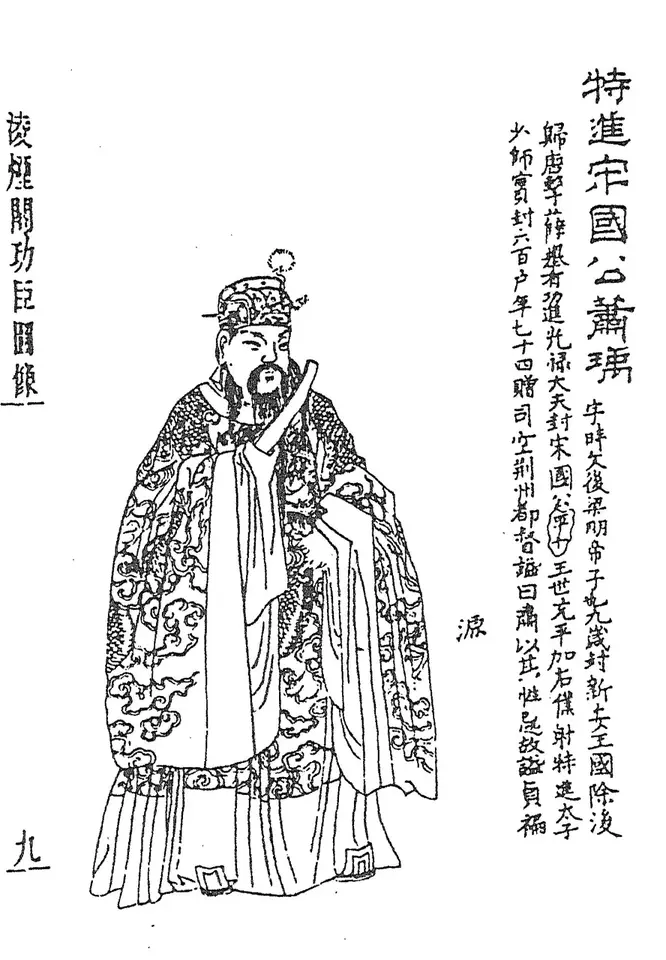
575 CE–648 CE
萧瑀
Xiao Yu (萧瑀, 575–648), courtesy name Shiwen (时文), was a royal prince of the Western Liang Dynasty, an imperial relative of the Sui Dynasty, and a founding chancellor of the Tang Dynasty. He was the seventh son of Emperor Ming of Western Liang (Xiao Kui) and the younger brother of Empress Xiao, consort of Emperor Yang of Sui. Born into southern imperial nobility, he was celebrated from youth for filial devotion, classical…
Xiao Yu (萧瑀, 575–648), courtesy name Shiwen (时文), was a royal prince of the Western Liang Dynasty, an imperial relative of the Sui Dynasty, and a founding chancellor of the Tang Dynasty. He was the seventh son of Emperor Ming of Western Liang (Xiao Kui) and the younger brother of Empress Xiao, consort of Emperor Yang of Sui. Born into southern imperial nobility, he was celebrated from youth for filial devotion, classical erudition, and adherence to Buddhist principles. Entering Sui service following the abolition of Western Liang, he served as Vice Director of the Palace Secretariat. In 615, during the Siege of Yanmen, he counseled Emperor Yang to grant an amnesty to Goguryeo to rally troops against the besieging Turks; though the siege was lifted, the emperor resented the counsel and demoted him to Governor of Hechi. In 617, when Li Yuan (Emperor Gaozu of Tang) captured Guanzhong, Xiao Yu surrendered Hechi Commandery and joined the Tang dynasty. Highly trusted as a dynastic founder, he was created Duke of Song and appointed Director of the Palace Secretariat, meticulously reviewing imperial decrees and rectifying legislative oversights. During the succession struggle between Li Jiancheng and Li Shimin, Xiao Yu resolutely supported Li Shimin. Upon ascending the throne, Emperor Taizong elevated him to Left Vice Director of the Department of State Affairs and ranked him ninth among the twenty-four meritorious statesmen of the Lingyan Pavilion, bestowing upon him the famous poem: "Only in the fiercest wind do we know the hardy grass; only in times of dynastic turmoil do we recognize the faithful minister." Known for an uncompromising moral rectitude and an austere, impatient temperament, Xiao Yu was dismissed and restored to the chancellorship six times during his career. He passed away at the Yuhua Palace in 648 at the age of seventy-four, was posthumously honored as Minister of Works, and was granted the posthumous name Zhenbian with burial at the Zhao Mausoleum.
Born in Southern Lanling as the seventh son of Emperor Ming of Western Liang (Xiao Kui).
Ennobled as Prince of Xin'an Commandery at age nine during the Western Liang reign.
Following the abolition of Western Liang, moved to the Sui capital of Changan with his brother Xiao Cong.
Advised Emperor Yang to pardon Goguryeo to relieve the siege of Yanmen; demoted to Governor of Hechi.
Submitted Hechi Commandery to Li Yuan upon the founding of the Tang; created Duke of Song.
Appointed Director of the Palace Secretariat; supervised imperial edicts and judicial administration under Emperor Gaozu.
Supported Prince Li Shimin during the succession crisis; bestowed imperial verses celebrating his unwavering loyalty.
Ranked ninth among the twenty-four founding contributors in the Lingyan Pavilion; appointed Grand Tutor to the Crown Prince.
Died at the Yuhua Palace at seventy-four; posthumously granted the rank of Minister of Works and the posthumous name Zhenbian.
Xiao Yu was born in the fourth year of Jiande (575) under the Northern Zhou, as the seventh son of Emperor Ming of Western Liang (Xiao Kui) and Empress Zhang. From his early years, he was renowned among imperial relatives for filial devotion, profound mastery of the Confucian classics, elegant literary composition, and deep adherence to Buddhist teachings. In disposition, he was austere, unbending, and aloof, disdaining superficial court flattery and conducting himself with modest restraint despite his royal lineage. In the twenty-second year of Tianbao (583) of Western Liang, at the age of nine, he was enfeoffed as Prince of Xin'an Commandery.
In the seventh year of Kaihuang (587), Emperor Wen of Sui abolished the Western Liang puppet state, and Xiao Yu accompanied his elder brother, the former sovereign Xiao Cong, to the Sui capital of Changan. Xiao Yu's elder sister was chosen as consort to Yang Guang, Prince of Jin. In 604, upon ascending the throne as Emperor Yang of Sui, Yang Guang created Lady Xiao as his empress and appointed Xiao Yu as Chief of the Imperial Wardrobe concurrently Acting Colonel of the Left Wing Guard, entrusting him with confidential palace responsibilities before promoting him to Vice Director of the Palace Secretariat.
Although favored as an imperial brother-in-law, Xiao Yu possessed an uncompromisingly frank temperament. Witnessing Emperor Yang's massive palace construction projects, relentless foreign warfare, and tyrannical extravagance, Xiao Yu repeatedly offered blunt admonitions, gradually incurring the emperor's displeasure. In August of the eleventh year of Daye (615), while Emperor Yang was touring the northern frontier, Shibi Khagan of the Eastern Turks launched a surprise assault with hundreds of thousands of cavalry, trapping the emperor inside Yanmen Fortress. As arrows landed before the imperial throne and defenders grew terrified, Xiao Yu stepped forward to deliver strategic counsel.
Xiao Yu urged the sovereign to proclaim lavish rewards for the soldiers and issue an immediate decree pardoning the Goguryeo campaigns, thereby unifying civilian and military resolve against the nomadic besiegers. Emperor Yang adopted the counsel, prompting regional relief armies to assemble and forcing the Turks to lift the siege. Once the peril passed, however, Emperor Yang regretted making concessions that compromised his imperial dignity, blaming Xiao Yu for the perceived humiliation and exiling him to govern the distant mountainous commandery of Hechi. At Hechi, Xiao Yu governed with scrupulous discipline, pacifying local unrest and earning the deep affection of the populace.
In 617, Li Yuan, Duke of Tang, launched his uprising from Jinyang and occupied Changan. Li Yuan and Xiao Yu were tied by close maternal cousin relations through the prominent Dugu clan, their mothers both being daughters of Northern Zhou general Dugu Xin. Upon entering Changan, Li Yuan dispatched a warm personal letter urging Xiao Yu to join him. Xiao Yu immediately mobilized his garrison and surrendered Hechi to the Tang cause. Li Yuan was overjoyed, appointing Xiao Yu as Grand Master for Splendid Happiness, ennobling him as Duke of Song, and naming him Minister of Revenue.
Upon the formal establishment of the Tang Dynasty in 618, Emperor Gaozu appointed Xiao Yu as Director of the Palace Secretariat. Gaozu treated him as an intimate confidant, affectionately calling him "Minister Xiao" and relying upon his administrative wisdom as a foundation of the realm. Whenever imperial decrees were drafted, Xiao Yu examined previous statutory precedents with utmost scrutiny; if he detected any inconsistency or violation of fundamental law, he returned the drafts with written objections, refusing to execute them until clarified. When Gaozu occasionally reproached him for administrative delays, Xiao Yu stood firm, explaining that the collapse of the Sui Dynasty was caused by contradictory, unstable edicts that confused all ministries, prompting Gaozu to express profound admiration. In the late Wude period, as the rivalry between Crown Prince Li Jiancheng and Prince Li Shimin intensified, Xiao Yu remained unswervingly loyal to Li Shimin, repeatedly arguing before Emperor Gaozu that Li Shimin's unmatched military merits made him the rightful heir to the dynastic throne.
Following Emperor Taizong's accession, Xiao Yu was promoted to Left Vice Director of the Department of State Affairs, standing at the summit of the civil administration. However, possessed of proud aristocratic lineage and unyielding personal standards, Xiao Yu was impatient, suspicious, and intolerant of perceived flaws in others. He frequently regarded rising civilian statesmen like Fang Xuanling, Du Ruhui, and Wei Zheng as superficial bureaucrats, rebuking them sharply during council meetings. In 627, Xiao Yu clashed fiercely with Chen Shuda in the imperial presence, both men losing composure. An enraged Taizong dismissed both ministers from office, though he soon recalled Xiao Yu as Junior Tutor to the Crown Prince.
In 634, following the mourning period for the retired Emperor Gaozu, Emperor Taizong recalled Xiao Yu to the grand council. Remembering his steadfast loyalty during the dynastic founding and the succession crises, Taizong presented Xiao Yu with an imperial five-character poem: "Only in the fiercest wind do we know the hardy grass; only in times of dynastic turmoil do we recognize the faithful minister. How could a mere brave warrior comprehend righteousness? A truly wise man must embody benevolence." The verse celebrated Xiao Yu's resolute fidelity. Nevertheless, due to recurrent friction with Fang Xuanling and other grand councilors, Xiao Yu was reassigned as Regional Inspector of Qizhou within a year.
In the seventeenth year of Zhenguan (643), Emperor Taizong commissioned the portraits of twenty-four founding contributors for the Lingyan Pavilion, ranking Xiao Yu ninth. In the same year, when Li Zhi was created Crown Prince, Xiao Yu was appointed Grand Tutor to the Crown Prince and concurrently restored as Chancellor, directing central affairs alongside Fang Xuanling. During the Liaodong expedition against Goguryeo in 645, Xiao Yu governed Luoyang as imperial defender, managing logistical supplies with impeccable efficiency.
In 646, persistent policy disagreements with fellow ministers led Xiao Yu to submit harsh criticisms that irritated the emperor, resulting in his dismissal from the chancellorship and the temporary revocation of his noble fief, with orders to retire to Shangzhou. The following year, remembering his unbending integrity and founding contributions, Taizong restored his titles and recalled him to court. In the summer of 648, while accompanying the emperor to the Yuhua Palace, Xiao Yu's illness worsened, and he passed away on July 19 at the age of seventy-four. A lifelong devotee of Buddhism, he left instructions for a simple burial in unadorned robes. Emperor Taizong was deeply grieved, suspending court audiences and posthumously conferring the rank of Minister of Works with burial at the Zhao Mausoleum. While court scribes initially proposed the posthumous title Su (Solemn), Taizong amended it to Zhenbian (Faithful yet Impatient), commemorating his lifelong fidelity while noting his contentious disposition.
Xiao Yu joined the Tang Dynasty during its earliest inception, winning the profound trust of Emperor Gaozu. Serving as Director of the Palace Secretariat in the early Wude era, he enforced rigorous statutory review over all imperial edicts, eliminating contradictory laws and laying the groundwork for Tang legal consistency. During the civil wars to reunify the Central Plains, he managed logistics and stabilized newly occupied regions. During the pivotal succession crisis, his staunch advocacy for Prince Li Shimin provided crucial legitimacy and stability for the transition of power following the Xuanwu Gate Incident.
Throughout the Zhenguan reign, Xiao Yu was appointed and dismissed as chancellor six times, holding paramount positions including Left Vice Director of the Department of State Affairs, Censor-in-chief, and Grand Tutor to the Crown Prince. He contributed significantly to state ceremonial codes, legal statutes, and princely fief policies. Proud and incorruptible, he refused to flatter powerful ministers or pander to the sovereign, relentlessly pointing out administrative defects. Ranked ninth in the Lingyan Pavilion in 643, his career stood as an enduring monument to early Tang institutional statecraft.
Despite his royal lineage and high marital connections, Xiao Yu lived frugally, treating personal wealth with utter indifference. When Emperor Gaozu restored his vast ancestral estates, Xiao Yu distributed them entirely among clan members, keeping only the ancestral temple for seasonal sacrifices. A devout Buddhist who authored scriptural commentaries, he ordered a plain burial without lavish burial objects. His moral stature established the foundation for the enduring prominence of the Lanling Xiao clan, which produced eight prominent chancellors across the Tang Dynasty, becoming one of the most celebrated aristocratic houses in medieval Chinese history.
FIGURES ASSOCIATED WITH THIS DYNASTY