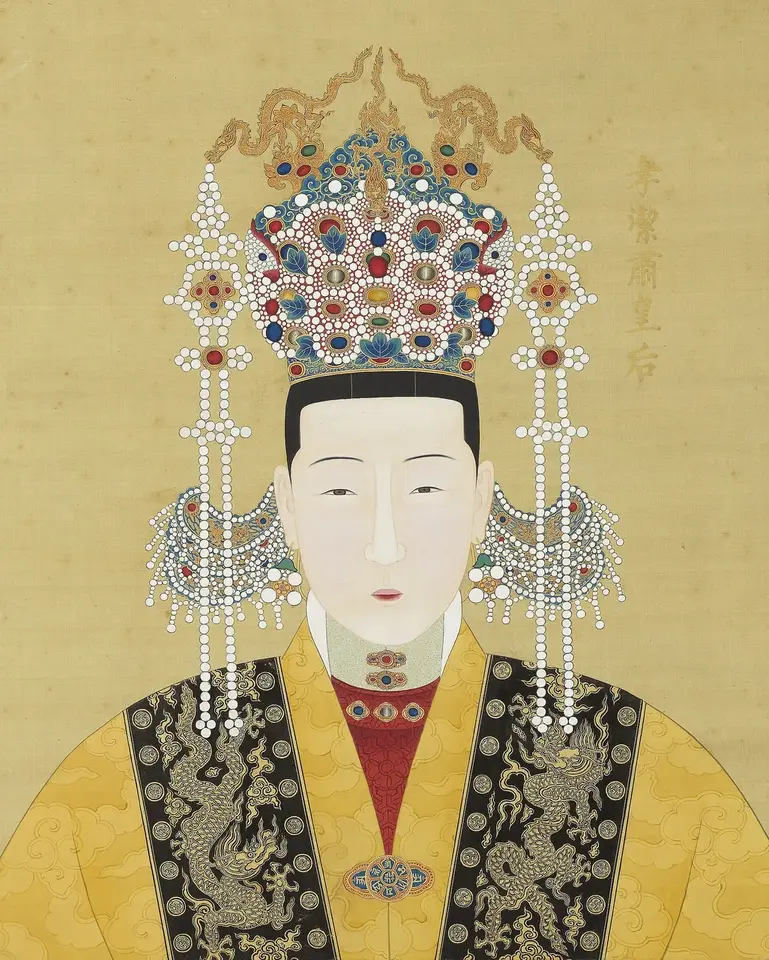
Biography
Virtuous Lady of Yuancheng and Investiture in the Central Palace
Empress Xiaojie Su, Lady Chen, was a native of Yuancheng County, Daming Prefecture, Northern Zhili (present-day Daming County, Handan City, Hebei Province), born in the third year of the Zhengde era of Emperor Wuzong of Ming (1508). Her father Chen Wanyan was a local licentiate (Shengyuan) of Yuancheng County, and her mother was Lady Ji. In the fourth month of the sixteenth year of the Zhengde era (1521), the fifteen-year-old hereditary prince of Xing, Zhu Houcong, entered the capital from Anlu in Huguang and ascended the throne as Emperor Shizong of the Jiajing era. In the spring of the first year of the Jiajing era (1522), Empress Dowager Zhaosheng (Lady Zhang, Empress of Emperor Xiaozong) presided over an empire-wide selection of fair maidens to establish a primary consort and Central Palace Empress for the young Emperor Shizong; the fifteen-year-old Lady Chen was chosen to enter the palace for her beauty and poised bearing. On Day Wuzi of the ninth month of that year, Lady Chen formally received the gold patent and gold seal and was invested as Central Palace Empress.
After Lady Chen took her place in the Central Palace, Emperor Shizong lavished generous rewards upon her natal family: he first appointed his father-in-law Chen Wanyan as Chief Minister of the Court of State Ceremonial and invested his wife Lady Ji as Madam; in the third month of the second year of the Jiajing era (1523), he exceptionally enfeoffed Chen Wanyan as Earl of Taihe and bestowed upon him a palatial residence outside Xi'an Gate built at a cost of several hundred thousand taels of silver, while Empress Chen's elder brother Chen Shaozu was appointed Assistant Director of the Imperial Seal Office. During the court struggles of the early Great Rites Controversy, because Empress Chen was a daughter-in-law personally selected by Empress Dowager Zhaosheng (Lady Zhang), Emperor Shizong's resentment toward Empress Dowager Zhang gradually extended to Chen Wanyan's family, leading him to repeatedly reject Chen Wanyan's memorials requesting hereditary succession and interfering in local judicial cases; prior to the seventh year of Jiajing, however, marital relations between Emperor Shizong and Empress Chen remained generally harmonious, and early in the seventh year of the Jiajing era (1528) Empress Chen became pregnant.
Throwing the Cup, Miscarriage from Shock, and Secret Discussions of Deposition
By nature stern, self-willed, and autocratic, Emperor Shizong brooked not the slightest defiance from the consorts of his inner court. In the spring of the seventh year of the Jiajing era (1528), the pregnant Empress Chen was sitting and chatting with Emperor Shizong in the palace when Consort Shun (Lady Zhang, later the deposed Empress Zhang) and Consort Gong (Lady Wen) stepped forward holding cups of tea to wait upon them; seeing how fair and delicate the two consorts' wrists were, Emperor Shizong reached out to stroke and admire their hands. Watching from her seat, Empress Chen was seized with jealousy and anger: she flung her teacup heavily onto the table and abruptly rose to leave. Seeing that Empress Chen dared to embarrass him in front of his consorts, Emperor Shizong flew into a thundering rage and subjected Empress Chen to a harsh, blistering reprimand.
Already pregnant at the time, Empress Chen was so terrified and shaken by Emperor Shizong's wrath that she suffered severe abdominal pain and bleeding upon returning to her bedchamber, resulting in a tragic miscarriage. Devastated in both body and spirit after losing her child, Empress Chen fell gravely ill and remained bedridden for months on end. Far from feeling pity for his ailing wife after her miscarriage, however, the ruthless Emperor Shizong remained furious: he ordered Empress Chen moved out of Kunning Palace, the main hall of the Central Palace, and summoned Senior Grand Secretary Yang Yiqing and others, issuing a series of secret edicts (preserved in Yang Yiqing's Record of Secret Edicts) proposing to depose Empress Chen on the grounds that she was "jealous, shrewish, disrespectful, and unworthy of the Central Palace." In his secret replies, Yang Yiqing tactfully remonstrated with Emperor Shizong, pointing out that Empress Chen was already critically ill and at death's door; if the Emperor forcibly issued an edict deposing her now, it would provoke criticism across the empire and blemish his imperial virtue, whereas it would be better to wait until after her passing to handle the matter—whereupon Emperor Shizong dropped the idea of deposing her during her lifetime.
Meager Burial as "Daoling" and Posthumous Restoration in the Longqing Reign
On the second day of the tenth month of the seventh year of the Jiajing era (October 21, 1528), the twenty-one-year-old Empress Chen passed away in desolation amid fear and illness. Driven by lingering anger, Emperor Shizong ordered a drastic reduction in Empress Chen's funeral rites: he not only instructed the Ministry of Rites to devise the pejorative posthumous title "Empress Daoling," but also refused to bury her within the imperial mausoleum precinct, interring her instead at reduced rank in Ao'eryu on Mount Tianshou, a burial ground reserved for Imperial Noble Consorts and prematurely deceased crown princes. On the day of the funeral, Empress Chen's coffin was carried out through a side gate (the Princely Gate), the court officials wept in attendance for only a single day, and Emperor Shizong ordered officials to wear narrow-sleeved blue cloth robes rather than mourning dress on her death anniversary; when Supervising Secretary of Rites Wang Rumei and others submitted memorials earnestly remonstrating that the funeral of a primary consort empress should not be treated so ungraciously, the still-angry Emperor Shizong ignored them altogether. Just one month after Empress Chen's death, in the eleventh month of that same year, Emperor Shizong lost no time in investing Consort Shun (Lady Zhang)—who had presented the tea that day—as his succeeding Empress (though Lady Zhang too was deposed by Shizong in the thirteenth year of Jiajing).
As the years passed, Emperor Shizong's anger toward Empress Chen gradually faded. In the ninth month of the fifteenth year of the Jiajing era (1536), Minister of Rites Xia Yan submitted a memorial stating that since the late Empress Lady Chen was His Majesty's primary consort of the Central Palace, the posthumous title "Daoling" conferred back then was ritually inappropriate, earnestly requesting a favorable posthumous title; readily accepting the advice, Emperor Shizong issued an edict revising Empress Chen's posthumous title to "Empress Xiaojie." When Emperor Shizong died in the twelfth month of the forty-fifth year of the Jiajing era (1566), his testamentary edict originally ordered that his third Empress, Empress Xiaolie (Lady Fang), be enshrined with him in the Imperial Ancestral Temple; after Emperor Muzong (Zhu Zaiji) ascended the throne, however, officials of the Ministry of Rites deliberated in the first and second months of the first year of the Longqing era (1567) and pointed out: "Empress Xiaojie was the primary consort and orthodox Empress of the Late Emperor (Emperor Shizong), and by ritual law ought to be buried with him in the Yongling Mausoleum and enshrined in the Imperial Ancestral Temple; to cast aside the primary consort and enshrine a succeeding empress would violate ancient ritual." Approving the memorial, in the second month of the first year of Longqing Emperor Muzong formally conferred upon Empress Chen the posthumous title "Empress Xiaojie Gongyi Cirui Anzhuang Xiangtian Yisheng Su," solemnly escorted her coffin from Ao'eryu for joint burial with Emperor Shizong at the Yongling Mausoleum in Changping, Beijing, and elevated her spirit tablet into the Imperial Ancestral Temple.
Major Achievements
Selected and Invested in the Central Palace in the First Year of Jiajing as Primary Consort to Emperor Shizong
During the first empire-wide wedding selection held in the first year of the Jiajing era (1522) after Emperor Shizong succeeded to the throne, the fifteen-year-old Lady Chen—born into a scholarly household in Yuancheng County, Daming Prefecture, Northern Zhili—stood out among numerosos candidates and received the gold patent and seal in the ninth month of that year as primary consort and Empress to Emperor Shizong, elevating her father Chen Wanyan from a local licentiate to Chief Minister of the Court of State Ceremonial and Earl of Taihe. As the first mistress of the Central Palace in the Jiajing reign, she presided over the rituals of the six palaces for six years during the early Jiajing period.
Miscarrying and Dying After the "Teacup Incident," Reflecting the Harsh Harem Environment of the Jiajing Reign
In the spring of the seventh year of the Jiajing era (1528), while pregnant, Empress Chen saw Emperor Shizong stroke and examine the hands of Consort Shun (Lady Zhang) and Consort Gong (Lady Wen) as they served tea; throwing down her cup in a moment of jealousy as she rose, she was subjected to a thundering reprimand by the autocratic and hot-tempered Emperor Shizong, suffering a miscarriage from shock and falling fatally ill. Emperor Shizong not only secretly plotted with Senior Grand Secretary Yang Yiqing to depose the gravely ill Empress Chen, but after her death at age twenty-one gave her the pejorative posthumous title "Daoling," sent her coffin out through the Princely Gate, and buried her at reduced rank in Ao'eryu. This tragedy marked the beginning of the perilous plight of inner-court consorts under the Jiajing reign—where the second Empress Lady Zhang was later deposed and died in misery, and the third Empress Lady Fang perished in a palace fire after the "Renyin Palace Rebellion," leaving not a single one of Shizong's three empresses with a peaceful end—epitomizing the vulnerability of the Central Palace under the extreme expansion of imperial autocracy in the mid-to-late Ming.
Posthumous Rehabilitation in the Fifteenth Year of Jiajing and Enshrinement as Primary Consort in the First Year of Longqing
Although subjected to humiliation at the time of her death, the Ming ritual tradition prizing the "primary legitimate wife" ultimately restored Empress Chen's historical honor. In the fifteenth year of the Jiajing era (1536), Minister of Rites Xia Yan successfully petitioned to revise her posthumous title from "Daoling" to "Empress Xiaojie"; after Emperor Muzong ascended the throne in the second month of the first year of the Longqing era (1567), court officials overturned Emperor Shizong's testamentary order to enshrine Empress Fang, honoring Empress Chen as Emperor Shizong's sole enshrined primary consort under the posthumous title "Empress Xiaojie Gongyi Cirui Anzhuang Xiangtian Yisheng Su" and reburying her in the Yongling Mausoleum.