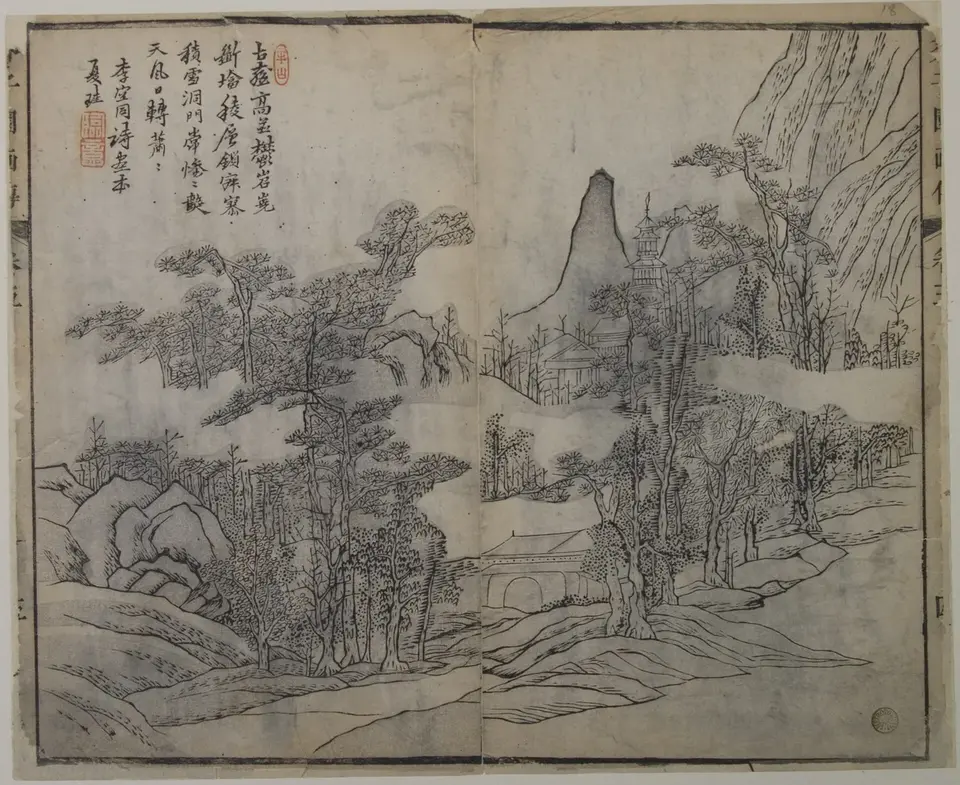
PROFILE
Xia Gui (夏圭, fl. late 12th–early 13th century), courtesy name Yuyu, was an illustrious Southern Song imperial court landscape painter and one of the Four Masters of the Southern Song, hailing from Qiantang. He served during the reigns of Emperor Xiaozong, Emperor Guangzong, and Emperor Ningzong, reaching the esteemed rank of Painter-in-Attendance in the Hanlin Academy of Painting and receiving the prestigious Golden Belt.
Xia originally practiced figure painting before dedicating himself to landscape art, studying the legacy of Li Tang while developing an innovative personal style. He mastered vigorous, dry blunt-brush strokes and broad axe-cut texture strokes, rendering Jiangnan waterways and mist-shrouded cliffs with saturated ink washes and structural clarity. In composition, he broke away from the traditional monumental panorama, excelling in capturing intimate corners or halves of landscapes. This dynamic use of negative space earned him the enduring moniker Xia the Half-Side. Alongside Ma Yuan, with whom he formed the famous Ma-Xia school, he is celebrated alongside Li Tang and Liu Songnian as one of the Four Masters of the Southern Song. His surviving masterpieces, such as Pure and Remote View of Streams and Mountains, Twelve Views of Landscape, and Willow Boats on West Lake, exerted profound influence on the landscape painting of the Yuan, Ming, and Qing dynasties.
- Courtesy Name
- Yuyu
- Dynasty
- Southern Song
- Ancestral Home
- Qiantang (modern Hangzhou, Zhejiang Province)
- Primary Identity
- Court painter, Painter-in-Attendance
- Highest Office
- Painter-in-Attendance of the Hanlin Academy of Painting
BIOGRAPHY
Chronology
- 1160 (Shaoxing 30) | Birth in Qiantang | Born into an artisanal painting family in Qiantang, showing early talent in copying ancient masterworks.
- 1180 (Chunxi 7) | Admission to Academy | Recruited into the Hanlin Academy of Painting under Emperor Xiaozong, transitioning from figure studies to landscapes.
- 1195 (Qingyuan 1) | Painter-in-Attendance | Promoted to Painter-in-Attendance under Emperor Ningzong in recognition of his exceptional compositional mastery.
- 1205 (Kaixi 1) | Awarded the Golden Belt | Bestowed the rare imperial Golden Belt by Emperor Ningzong for his screen and scroll paintings.
- 1215 (Jiading 8) | Masterwork Completed | Produced his magnum opus handscroll, Pure and Remote View of Streams and Mountains, solidifying the southern landscape aesthetic.
- 1225 (Baoqing 1) | Demise in Qiantang | Passed away at his residence in Qiantang, revered as a quintessential master of Chinese ink painting.
Biography
Early Training and Imperial Academy Admission
Xia Gui was born in Qiantang, the metropolitan prefecture of the Southern Song capital Lin'an. Following the southern flight of the Song court, Lin'an became the vibrant political and cultural hub of the empire. The misty landscapes of the West Lake and surrounding peaks provided court painters with boundless inspiration. In his youth, Xia dedicated himself to meticulous narrative figure painting, exhibiting crisp line work and vivid characterization.
During the Chunxi reign of Emperor Xiaozong, the court reorganized the imperial painting academy. Xia passed the competitive examination on the strength of his exceptional technique and entered imperial service. Soon after his appointment, Xia recognized that landscape art offered far greater expressive possibilities and shifted his artistic focus entirely to landscape painting. He studied the vigorous brushwork of Northern Song master Li Tang, adopting the powerful axe-cut texture stroke and adapting it into a lighter, more fluid idiom suited to the moist climate of southern China.
Zenith under Emperor Ningzong and Imperial Honors
Following the accession of Emperor Ningzong, imperial patronage of the arts reached a new height. Between the Qingyuan and Jiading reigns, Xia entered the most prolific phase of his career. His expansive compositions and minimalist brushwork earned high praise from Emperor Ningzong and Empress Yang, leading to his appointment as Painter-in-Attendance, the pinnacle of professional advancement for court artists.
During the Kaixi reign, Xia completed multiple sets of imperial screens for palace chambers. Highly pleased with the results, Emperor Ningzong awarded Xia the Golden Belt, an exceedingly rare honor reserved for artists of transcendent skill. Xia's fame spread widely across the capital, and he stood alongside his academy colleague Ma Yuan as the premier artistic talent of the era, eagerly sought after by imperial princes, grandees, and literati collectors.
Late Mastery and Enduring Renown
In his later years, Xia continued to live quietly in Qiantang, frequently boating on the West Lake and Qiantang River to observe shifting cloud formations and diurnal variations in light and mist. His late style discarded youthful sharp angularity in favor of profound atmospheric simplicity and wash-laden expansiveness. He passed away peacefully in Qiantang during the Baoqing reign. Xia's life work established an enduring spatial paradigm in classical Chinese ink painting.
Major Achievements
The Pioneer of the Corner Composition and Xia the Half-Side
Xia Gui's most revolutionary contribution to world art history was his dismantling of the monumental, symmetrical, and enclosed panoramic compositions favored since the Sui, Tang, and Northern Song periods. Instead, he pioneered open, suggestive, corner-based landscape arrangements.
In his layouts, Xia concentrated primary landscape features—crags, twisted pines, and waterside pavilions—in a lower corner or along one side of the scroll, leaving the remainder as open watery expanse or misty sky. This innovative technique, known as Xia the Half-Side and paired with Ma Yuan's One-Corner Ma, transformed empty space from mere void into evocative atmospheric depth. This aesthetic aligned closely with Daoist philosophy, which valued the generative resonance between form and emptiness.
The Artistic Pinnacle of Pure and Remote View of Streams and Mountains
Xia Gui's greatest surviving handscroll is Pure and Remote View of Streams and Mountains, preserved in the National Palace Museum in Taipei. Measuring nearly nine meters in length, the paper scroll depicts winding rivers, towering cliffs, and distant horizons on a clear day.
The scroll unfolds through dramatic compositional rhythms. Xia applied sharp large axe-cut strokes and rapid dragged-mud-and-water washes with extraordinary control. Nestled among cliffs and riverbanks are thatched cottages, wooden bridges, solitary traveler skiffs, and bamboo groves, all rendered with succinct, blunt brushwork. The work achieves a sense of vast distance across intimate dimensions and is universally acknowledged as a crowning achievement of Chinese ink monochrome painting.
Formative Role in the Four Masters of the Southern Song
Xia Gui, alongside Li Tang, Liu Songnian, and Ma Yuan, constitutes the Four Masters of the Southern Song. Their collective achievement marked an epochal transition from the weighty, dense landscapes of the north to the lyrical, atmospheric visions of the south.
Xia's distinctive brushwork exerted an immense influence across subsequent centuries. Early Ming masters of the Zhe School, such as Dai Jin and Wu Wei, as well as Ming imperial court painters, took Xia's texture methods as their primary foundation. His revolutionary approach to pictorial space remains a cornerstone of Asian art history.
Personal Relationships
- Artistic Contemporary: Ma Yuan, fellow court master with whom he shared the Ma-Xia designation in developing corner compositions.
- Stylistic Precursor: Li Tang, senior master of the Southern Song Four Masters whose texture techniques Xia adapted.
- Academy Peer: Liu Songnian, distinguished fellow member of the Southern Song Four Masters.
- Imperial Patron: Emperor Ningzong of Song, who appointed Xia Painter-in-Attendance and bestowed the Golden Belt.
Historical Evaluations
- Tuhui Baojian (Xia Wenyan): Xia Gui was a native of Qiantang and a Painter-in-Attendance in the Ningzong court, granted the Golden Belt. In landscape painting he directly studied Li Tang, reaching heights that none in the academy could rival; his brushwork was clean and forceful, his ink resonance extraordinarily rich.
- Gegu Yaolun (Cao Zhao): The landscapes of Xia Gui capture misty ridges with vast and lush tranquility. By capturing a single corner of hills and rivers, he created remote poetic realms that formed a distinct school.
- Minghua Lu (Xu Qin): Among Southern Song landscapes, Ma Yuan and Xia Gui stand supreme. Xia Gui's brushwork was succinct and spirited, his vital resonance exceptionally elevated, a work of divine caliber.
Related Entries
- Four Masters of the Southern Song
- Pure and Remote View of Streams and Mountains
- Ma Yuan
- Corner Composition
Bibliography
Bibliographic information is not yet available for this entry.