Birth in Jiangnan
Born on the sixteenth day of the fifth lunar month in Dantu County, Zhenjiang Prefecture, to Wu Yanming and Lady Shen.
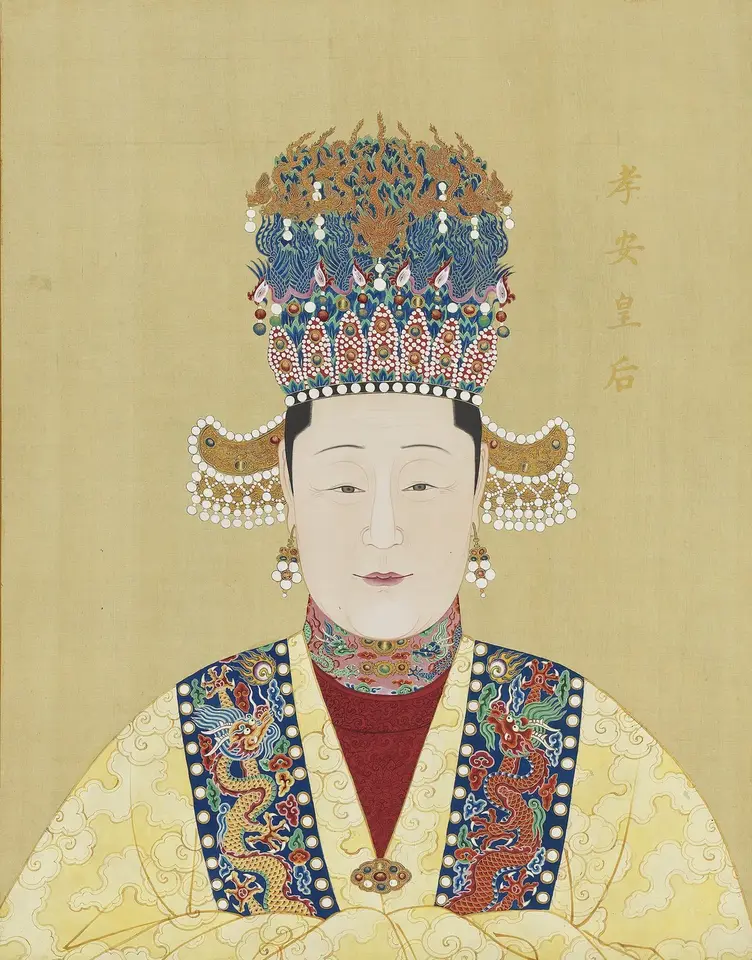
吴贤妃
Wu Xianfei (June 11, 1397 – January 16, 1462), a native of Dantu County, Zhenjiang Prefecture (modern Dantu District, Zhenjiang, Jiangsu Province), was the daughter of Wu Yanming and his wife, Lady Shen. She was an important consort of Emperor Xuanzong of Ming (Zhu Zhanji), the biological mother of Emperor Daizong of Ming (Zhu Qiyu, the Jingtai Emperor), and one of the most poignant figures in the tumultuous dynastic…
Wu Xianfei (June 11, 1397 – January 16, 1462), a native of Dantu County, Zhenjiang Prefecture (modern Dantu District, Zhenjiang, Jiangsu Province), was the daughter of Wu Yanming and his wife, Lady Shen. She was an important consort of Emperor Xuanzong of Ming (Zhu Zhanji), the biological mother of Emperor Daizong of Ming (Zhu Qiyu, the Jingtai Emperor), and one of the most poignant figures in the tumultuous dynastic succession crises of the mid-fifteenth-century Ming court. Lady Wu was selected into the imperial palace in 1412 during the Yongle era, serving Zhu Zhanji while he was still Imperial Grandson. In 1428, she gave birth to Xuanzong's second son, Zhu Qiyu, and was formally invested as Worthy Consort (Xianfei). Following Emperor Xuanzong's death in 1435, Consort Wu accompanied her young son to reside outside the Forbidden City in the Prince of Cheng mansion. Following the cataclysmic Tumu Crisis of 1449, in which Emperor Yingzong (Zhu Qizhen) was captured by the Oirat Mongols, Minister of War Yu Qian and the court enthroned Zhu Qiyu as emperor. Consort Wu was elevated to Empress Dowager, sharing equal honors with Xuanzong's primary spouse, Empress Dowager Sun, while her brother Wu An was ennobled as Earl of Anping. In January 1457, General Shi Heng and allied plotters orchestrated the Wresting the Palace Gate Coup, restoring Emperor Yingzong. The Jingtai Emperor was deposed as Prince of Cheng and died shortly thereafter in confinement. Empress Dowager Wu was stripped of her imperial titles and demoted to Worthy Consort of the Xuanzong Temple, while her brother was reduced to an imperial guard commander. On January 16, 1462, Consort Wu passed away in quiet isolation at the age of sixty-five. Emperor Yingzong conferred the posthumous title of Rongsi ("Glorious Remembrance") and interred her at Jinshan near Beijing. In 1644, the Southern Ming Hongguang Emperor posthumously rehabilitated Emperor Daizong's lineage, elevating Consort Wu as Empress Dowager Xiaoyi.
Born on the sixteenth day of the fifth lunar month in Dantu County, Zhenjiang Prefecture, to Wu Yanming and Lady Shen.
Selected into the imperial quarters on the second day of the eighth lunar month at age sixteen, serving Imperial Grandson Zhu Zhanji.
Gives birth to Xuanzong's second son, Zhu Qiyu, on the third day of the eighth lunar month, receiving the title of Worthy Consort.
Emperor Xuanzong passes away; seven-year-old Zhu Qiyu is created Prince of Cheng, and Consort Wu departs the palace to reside with her son.
Following Yingzong's capture at Tumu, Zhu Qiyu ascends the throne as the Jingtai Emperor, elevating Consort Wu to Empress Dowager.
The Wresting the Palace Gate Coup restores Yingzong; the Jingtai Emperor is deposed and dies; Lady Wu is demoted to Worthy Consort.
Dies in the inner palace on the sixteenth day of the twelfth lunar month at age sixty-five; Yingzong grants the posthumous title of Rongsi.
The Southern Ming court formally rehabilitates her status, posthumously conferring the title Empress Dowager Xiaoyi.
Wu Xianfei was born on June 11, 1397 (the sixteenth day of the fifth lunar month in the thirtieth year of the Hongwu era) in Dantu County, Zhenjiang Prefecture, into a respectable civilian family. Her father, Wu Yanming, was an upright and dutiful householder, and her mother, Lady Shen, managed the family with gentle propriety.
On September 7, 1412 (the second day of the eighth lunar month in the tenth year of the Yongle era), the imperial court conducted a selection of daughters from respectable families across the Jiangnan region to replenish palace attendants. Renowned for her gentle modesty and refined deportment, the sixteen-year-old Lady Wu was selected into the imperial quarters. At that time, Emperor Taizu's grandson Zhu Zhanji was deeply cherished by Emperor Chengzu (the Yongle Emperor) and had already been installed as Imperial Grandson, residing in the Eastern Palace quarters. Emperor Chengzu specially assigned palace maidens to attend the Imperial Grandson's daily needs, and Lady Wu was designated to serve Zhu Zhanji, winning his lasting trust and favor through years of dedicated attendance.
In 1425, following the brief reign of Emperor Renzong, Zhu Zhanji ascended the imperial throne as Emperor Xuanzong. The early Xuande era saw the formal investment of imperial consorts.
On September 11, 1428 (the third day of the eighth lunar month in the third year of the Xuande era), Lady Wu gave birth to an imperial prince in the palace, whom Emperor Xuanzong named Zhu Qiyu. He was the emperor's second son; prior to this, Xuanzong had fathered only one male heir, Zhu Qizhen (the future Emperor Yingzong), born in 1427 to Noble Consort Sun (later Empress Xiaogong).
The birth of a second prince brought great joy to Emperor Xuanzong, who promptly issued an imperial decree elevating Lady Wu to the prestigious rank of Worthy Consort (Xianfei). Throughout her tenure in the inner court, Consort Wu served Grand Empress Dowager Zhang (Empress Chengxiao) and Empress Sun with consummate deference and humility, gaining a widespread reputation for quiet discretion.
On January 31, 1435, Emperor Xuanzong passed away suddenly in the Qianqing Palace at the age of thirty-eight. In his final hours, the emperor entrusted his domestic affairs to his mother, Grand Empress Dowager Zhang, specifically asking her to safeguard his seven-year-old younger son, Zhu Qiyu, and Consort Wu.
Following Xuanzong's death, his eldest son, eight-year-old Zhu Qizhen, assumed the throne as Emperor Yingzong, inaugurating the Zhengtong era. Grand Empress Dowager Zhang faithfully honored Xuanzong's dying request: she formally created Zhu Qiyu the Prince of Cheng and granted special permission for Consort Wu to depart the Forbidden City to live with her son in the newly constructed princely mansion outside the palace walls.
Under the rigid palace regulations of the early Ming, consorts who did not bear children were frequently compelled into lifetime seclusion or human sacrifice, and only mothers of adult feudatory princes who departed for distant provinces were allowed to accompany their sons. Because Prince of Cheng Zhu Qiyu remained resident in the capital due to his youth, Consort Wu enjoyed the rare privilege of residing in an independent mansion within Beijing, living a peaceful, unmolested life with her son for fourteen tranquil years.
During these years, Consort Wu focused entirely on raising and educating Zhu Qiyu in classical learning and moral temperance. Prince Zhu Qiyu grew into a gentle, modest, and upright prince, steering clear of court factionalism and winning high praise from Grand Empress Dowager Zhang.
In the autumn of 1449, Esen Tayishi, grand preceptor of the Oirat Mongols, launched a massive invasion across the northern frontiers. Urged on by his chief eunuch Wang Zhen, the twenty-two-year-old Emperor Yingzong recklessly decided to lead a five-hundred-thousand-man expedition in person. Before departing, Yingzong appointed his younger brother, Prince of Cheng Zhu Qiyu, to serve as imperial regent in Beijing.
On September 1, 1449, the retreating Ming army was encircled and annihilated by Oirat cavalry at Tumu Fortress in Huailai. Tens of thousands of elite troops and senior chancellors perished, and Emperor Yingzong was captured alive by the Mongols, precipitating the infamous Tumu Crisis.
When news of the catastrophe reached Beijing, panic engulfed the court. Some courtiers advocated abandoning Beijing to flee south, but Vice Minister of War Yu Qian stepped forward to denounce defeatism, advocating resolute defense of the capital. With Emperor Yingzong's infant son, Zhu Jianshen, barely two years old, the realm required an adult monarch to confront the Mongol invasion and prevent Esen from using the captive sovereign for extortion. Supported by Empress Dowager Sun and senior ministers, Yu Qian led the court in petitioning the twenty-one-year-old Prince of Cheng to ascend the throne.
On September 22, 1449, Zhu Qiyu ascended the imperial throne as Emperor Daizong, adopting the reign title of Jingtai and honoring the captive Yingzong as Grand Emperor Emeritus.
Upon his accession, Emperor Daizong held solemn court rituals, officially elevating his biological mother, Consort Wu, to Empress Dowager. Empress Dowager Wu was accorded equal ceremonial standing and honors alongside Xuanzong's primary wife, Empress Dowager Sun.
Her maternal lineage was showered with imperial honors: her brother Wu An was ennobled as Earl of Anping and granted hereditary command of the Imperial Embroidered Uniform Guard. Rising from a modest princely mother to the supreme status of empress dowager, Consort Wu reached the pinnacle of worldly honor during the Jingtai reign.
Throughout the intense years of the Beijing Defense Campaign and frontier warfare, Empress Dowager Wu maintained a modest and frugal demeanor within the inner apartments, refusing to intervene in ministerial governance and dedicating herself to Buddhist prayers for her son's stability.
However, dynastic fortunes shifted violently. In August 1450, having failed to break Ming defenses during the Battle of Beijing, Esen returned the deposed Emperor Yingzong to China. Desperate to safeguard his crown, the Jingtai Emperor placed his returned elder brother under close house arrest in the Southern Palace for seven years.
In early 1457, thirty-year-old Emperor Daizong fell gravely ill, and the succession remained precarious following the premature death of his only son, Zhu Jianji. Seizing this window of instability, General Shi Heng, Commissioner Cao Jixiang, and courtier Xu Youzhen formed a conspiracy. On the night of February 11, 1457, the plotters breached the walls of the Southern Palace, escorted Yingzong to the Fengtian Gate, and staged a restoration known as the Wresting the Palace Gate Coup.
Upon resuming power, Emperor Yingzong initiated a merciless purge. On February 28, Yingzong formally deposed the dying Jingtai Emperor, reducing him back to Prince of Cheng and banishing him to the Western Park, where he died abruptly days later at the age of thirty. Yingzong conferred upon his brother the derogatory posthumous title of "Li" (meaning rebellious) and denied him burial in the imperial Ming Ancestral Tombs, burying him unceremoniously in the Western Hills.
The collapse of the Jingtai regime precipitated Consort Wu's immediate downfall.
Emperor Yingzong issued an imperial proclamation declaring that her elevation to empress dowager had been an illegitimate usurpation. The emperor stripped her of her imperial seals, revoked her title of empress dowager, and demoted her back to her former rank of Worthy Consort of the Xuanzong Temple. Her brother Wu An was stripped of his earldom and reduced to an ordinary guard commander.
Deprived of her royal status, Consort Wu was moved to secluded palace quarters. The allies who had surrounded her during the Jingtai era were scattered, the mausoleum of her late daughter-in-law Empress Hang was demolished, and Daizong's favorite consort, Lady Tang, was forced into human sacrifice.
Enduring the agonizing grief of surviving her only child and the constant surveillance of the restored court, Consort Wu displayed extraordinary stoicism. Recognizing the lethal nature of dynastic vendettas, she secluded herself in her chambers, avoiding all complaint or political contact.
On January 16, 1462 (the sixteenth day of the twelfth lunar month in the fifth year of the Tianshun era), Consort Wu passed away quietly in the palace at the age of sixty-five.
Reflecting on his father Xuanzong's memory and acknowledging Consort Wu's lifelong discretion and blameless conduct during the usurpation, Emperor Yingzong suspended court audiences for one day and ordered her buried according to the standard rites for former imperial consorts, bestowing the posthumous title of Rongsi ("Glorious Remembrance").
In 1463, Consort Wu was interred on the slopes of Jinshan in the western suburbs of Beijing, near the Jing Mausoleum. Her excavated tomb epitaph, Epitaph of Worthy Consort Rongsi of the Xuan Temple, records: "The consort sprang from an illustrious lineage... With gentle clarity she cultivated her character; with reverent harmony she preserved her person. Enjoying prosperity, she achieved longevity and a virtuous end." Written with diplomatic delicacy, this stone epitaph obscured the violent coups of the Jingtai and Tianshun eras, yet accurately reflected Consort Wu's enduring survival strategy of modesty and forbearance.
Following Emperor Yingzong's death, his son Emperor Xianzong (Zhu Jianshen) remembered his uncle Emperor Daizong's protection during his perilous youth, officially restoring Daizong's imperial status and refurbishing his tomb in 1475. However, inner court designations for Daizong's consorts remained unstandardized.
It was not until October 1644, following the fall of Beijing to the Manchus, that the Southern Ming Hongguang Emperor (Zhu Yousong) ascended the throne in Nanjing. Seeking to rally dynastic loyalty and rectify historical injustices, the Hongguang Emperor conducted a comprehensive rehabilitation of Emperor Daizong's lineage.
The court promulgated an imperial decree officially honoring Emperor Daizong's biological mother, Consort Wu, with the exalted title of "Empress Dowager Xiaoyi Wenhui Shushen Ciren Kuangtian Xisheng," known concisely as Empress Dowager Xiaoyi. Spanning more than two centuries, Consort Wu's historical identity—from a modest palace maid to empress dowager, from a disgraced demoted consort back to an officially honored imperial matriarch—finally achieved full historical vindication.
The early lineage of Consort Wu formed one of the most contentious controversies in Ming court historiography, characterized by starkly contradictory records across official and private histories.
The official History of Ming followed the official Court Veritable Records, asserting that Lady Wu was a respectable native of Dantu who entered the palace in 1412 to serve Xuanzong in the Eastern Palace, giving birth to Daizong in 1428 and receiving the title of Worthy Consort.
Conversely, the prominent late Ming historian Zha Jizuo advanced a sensational claim in his private history Zuiwei Lu (Records of Guilt and Remorse). Zha alleged that during the rebellion of Prince of Han Zhu Gaoxu in 1426, Emperor Xuanzong crushed the uprising and seized the prince's household, condemning his consorts to servitude. Zha claimed that Lady Wu had been a favored concubine of the rebel Prince Zhu Gaoxu; enamored of her beauty, Xuanzong pardoned her and hid her secretly in the private residence of eunuch Chen Fu, only acknowledging her and her child on his deathbed.
This historical controversy was conclusively resolved in the 1950s when Chinese archaeologists excavated the Ming consort cemetery at Jinshan in the western suburbs of Beijing, discovering the intact stone inscription Epitaph of Worthy Consort Rongsi of the Xuan Temple. The contemporary epitaph explicitly states: "On the second day of the eighth month of the tenth year of Yongle, she was selected into the palace at the age of sixteen, serving Emperor Xuanzong in the Eastern Palace." This unassailable physical artifact definitively disproved the sensational private assertions that she had been Zhu Gaoxu's concubine, confirming that she was indeed a commoner selected through standard imperial procedures during the Yongle era.
Living through the reigns of six successive emperors—Yongle, Hongxi, Xuande, Zhengtong, Jingtai, and Tianshun—Consort Wu stood at the very epicenter of the two most violent political upheavals of the mid-Ming dynasty: the Tumu Crisis and the Wresting the Palace Gate Coup.
Following her elevation to empress dowager during the Jingtai reign, her brother Wu An received the earldom of Anping. Unlike many imperial in-laws who exploited dynastic patronage to amass fortunes or meddle in bureaucratic appointments, Consort Wu imposed strict restraint upon her relatives. Throughout the eight years of the Jingtai era, the Wu clan refrained from political interference and court intrigue.
Her lifelong humility proved to be her family's salvation. When the 1457 restoration coup triggered the execution of ministers Yu Qian and Wang Wen and the violent desecration of Empress Hang's tomb, Emperor Yingzong spared Consort Wu from personal violence. Demoted back to Worthy Consort, she was granted a dignified domestic retirement, while her brother Wu An was permitted to retain his high rank as commander of the Embroidered Uniform Guard. Consort Wu's ability to preserve her family amidst catastrophic regime changes stands as a testament to her profound wisdom of modesty and self-preservation.
FIGURES ASSOCIATED WITH THIS DYNASTY