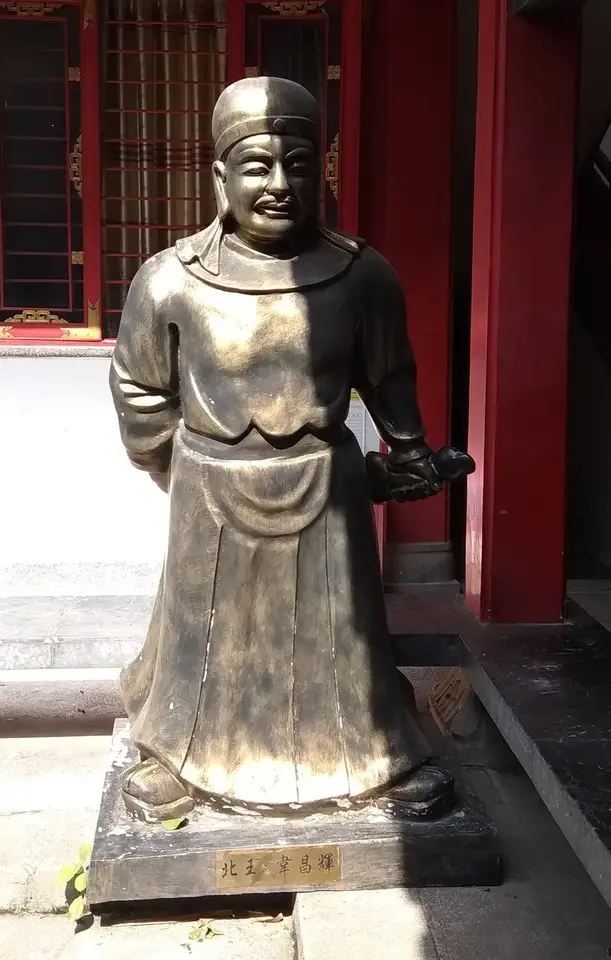
Life
Feudal Oppression and Joining the God Worshippers
Wei Changhui was born in 1823 into a relatively wealthy agrarian household in Jintian Village, located in the Pingzaishan region of Guiping County, Guangxi. His family owned over two hundred and sixty mu of fertile rice paddies and operated local businesses. However, within the rigid hierarchies of nineteenth-century Guangxi rural society, the Wei family was viewed by old-money scholar-gentry lineages as uncultured upstarts devoid of imperial academic prestige. Local gentry figures, notably Xie Qifa of Jintian and the Lan lineage of neighboring Jiedong, systematically abused the Weis, corrupting tax collectors to demand double assessments and harassing Wei women in public markets.
Seeking to shield his family, Wei's father, Wei Yuanjie, purchased an Imperial Academy student (Chengjun Jianshi) title for Changhui and hung an honorific tablet outside their residence. Local gentry maliciously gouged out the characters for Chengjun under cover of darkness, leaving only Jianshi (metropolitan graduate), and falsely hauled Wei Yuanjie before the county magistrate for impersonating an imperial jinshi. The family was forced to pay three hundred taels of silver in extortion to secure his release. Disgraced and radicalized by this injustice, Wei Changhui harbored a visceral hatred toward the Qing imperial socio-political order.
In 1848 (twenty-eighth year of Daoguang), missionary leaders Feng Yunshan and Hong Xiuquan arrived in the Thistle Mountain region to propagate the egalitarian tenets of the God Worshipping Society. Recognizing in their apocalyptic vision an instrument for systemic vengeance and social overthrow, Wei Changhui persuaded his father to commit their entire wealth to the movement. Possessing extraordinary executive energy and local prestige, Wei quickly rose to become the chief administrative manager of the society in Jintian. He excavated secret subterranean workshops beneath his family compound to smelt weapons day and night, muffling the clanking iron by raising flocks of geese and ducks, and distributed food to recruit destitute miners, charcoal-burners, and Hakka laborers.
The Jintian Uprising and Investiture as Northern King
By late 1850, over ten thousand God Worshippers had converged upon the Wei family compound in Jintian. On January 11, 1851 (Hong Xiuquan's thirty-eighth birthday), the congregation formally proclaimed the founding of the Taiping Heavenly Kingdom, launching the Jintian Uprising. Wei Changhui served as commander of the mobilization.
During the hard-fought defense of Jintian and Da Huangjiangkou, Wei led his personal kinsmen in desperate charges against imperial troops under Xiang Rong. That autumn, the Taiping army stormed Yongan (modern Mengshan). During the institutional consolidation at Yongan in December 1851, Hong Xiuquan issued royal proclamations establishing the leadership hierarchy. Wei was consecrated as the Northern King (Bei Wang), Commander of the Rear Army, and Right Assistant Military Strategist (Youzheng Junshi), ranking fifth after the Heavenly King, Eastern King Yang Xiuqing, Western King Xiao Chaogui, and Southern King Feng Yunshan.
When the Taiping forces executed their legendary breakout from Yongan in April 1852, Wei Changhui commanded the rear guard, repelling elite imperial battalions under General Ulanantai to protect civilian families. Throughout the arduous campaigns across Hunan—including the tragic deaths of Feng Yunshan at Suoyidu and Xiao Chaogui at Changsha—Wei's status within the core command council escalated rapidly, making him the third most powerful leader in the rebellion behind Hong Xiuquan and Yang Xiuqing.
Conquest of the Yangzi and Defending the Capital
In the winter of 1852, following the capture of Yuezhou, the Taiping armies sailed down the Yangzi River in a colossal armada, capturing Hanyang and laying siege to Wuchang. Wei Changhui directed sapper operations, digging underground tunnels beneath the massive stone ramparts and detonating gunpowder mines to breach the city walls, spearheading the capture of the provincial capital.
In March 1853, the Taiping forces captured Nanjing, renaming it Tianjing (Heavenly Capital). In the early months following the capital's founding, Wei was tasked with internal administration. He coordinated the construction of government offices, organized communal treasuries (Shengku), fortified external ramparts, and directed operations repelling the Qing forces of the Great Encampment South of the River (Jiangnan Daying). Between 1854 and 1855, when Zeng Guofan's Xiang Army counter-attacked in Hubei and Anhui, Wei personally led expeditionary forces to western fronts, fortifying Jiujiang and Hukou and facilitating Shi Dakai's decisive naval triumph over the Hunan flotilla.
Escalating Antagonism and the Tianjing Coup
Despite exterior military triumphs, personal hatreds festered within the supreme leadership in Tianjing. Eastern King Yang Xiuqing possessed supreme military command and routinely invoked "Heavenly Father possessions" to demand absolute obedience, publicly chastising Heavenly King Hong Xiuquan and humiliating fellow kings.
On one occasion, a legal dispute erupted between Wei Changhui's brother and a relative of Yang Xiuqing. Yang demanded severe punishment. Terrified for his survival, Wei engaged in abject sycophancy: he personally bound his brother, dragged him to the Eastern King's palace for execution, and prostrated himself before Yang, shouting praises to the Heavenly Father. Whenever Yang traveled through the city, Wei knelt subserviently by the road. Beneath this grotesque façade of groveling submission, Wei nurtured homicidal vengeance.
In the summer of 1856, Taiping armies annihilated the Jiangnan Encampment. Drunk on supremacy, Yang Xiuqing staged another Heavenly Father trance, summoning Hong Xiuquan and coercing the Heavenly King to bestow upon him the sovereign title of "Ten Thousand Years" (Wansui), directly challenging Hong's throne. Fearing deposition, Hong Xiuquan secretly dispatched trusted couriers to front-line commanders—Northern King Wei Changhui in Jiangxi, Wing King Shi Dakai in Hubei, and General Qin Rigang—commanding them to march immediately upon Tianjing to purge the Eastern King.
Receiving the imperial summons, Wei recognized his hour of vengeance had arrived. On the night of September 1, 1856, Wei led three thousand picked shock troops in a forced march from Ruizhou, infiltrating Tianjing under cover of darkness. In the early hours of September 2, joined by Qin Rigang, Wei sealed the city gates and encircled the Eastern King's palace. Brandishing his sword, Wei led the assault into Yang's inner chambers, slaughtering Yang Xiuqing and executing thousands of guards and attendants within the compound.
Degeneration into Mass Slaughter and Execution
What began as a targeted dynastic purge swiftly mutated under Wei Changhui's psychopathic fury into an indiscriminate bloodbath. Concealing his intentions, Wei announced that only Yang was guilty and staged a reconciliation ceremony, inviting over twenty thousand disarmed veteran troops of the Eastern King to the palace, where he locked the gates and systematically butchered them all. Blood choked the Qinhuai River, and the streets of Tianjing were littered with dismembered corpses.
In October, Wing King Shi Dakai rushed back to Tianjing from Hubei. Witnessing the horrific devastation, Shi vehemently denounced Wei for his gratuitous brutality and betrayal of revolutionary brotherhood. Paranoid and power-mad, Wei resolved to assassinate Shi Dakai. Forewarned of the plot, Shi scaled the city walls by rope under cover of darkness and fled to Anqing, where he rallied hundreds of thousands of veteran troops to march against the capital, demanding Wei's severed head.
In retaliation, Wei butchered Shi Dakai's entire family, including elderly parents, wives, and infant children left behind in Tianjing, and dispatched assassins in pursuit. Completely unhinged, Wei turned his artillery against Hong Xiuquan's Heavenly Palace, accusing Hong of conspiring with Shi Dakai and demanding complete executive control. Hong Xiuquan's palace guards resisted fiercely. Disgusted by his psychotic sadism, the surviving garrisons and citizens of Tianjing rallied around Hong Xiuquan to crush the Northern King's cabal.
On November 2, 1856 (fifth day of the tenth lunar month), loyalist forces breached Wei's inner redoubts. Captured while attempting to flee, Wei Changhui was dismembered alive (lingchi), and his severed head was dispatched to Anqing to appease Shi Dakai's advancing legions. He was thirty-three years old. The catastrophic bloodbath orchestrated by Wei decimated the veteran core of the Taiping leadership and fatally damaged public morale, initiating the irreversible demise of the Heavenly Kingdom.
Major Contributions
Underwriting the Material Infrastructure of the Jintian Uprising
Wei Changhui's indispensable early contribution was his comprehensive financial and logistical sponsorship of the Jintian Uprising. In mid-nineteenth-century China, peasant rebellions routinely collapsed due to an immediate shortage of capital, weapons workshops, and defensible operational bases.
As a wealthy rural landowner, Wei sacrificed his family inheritance for the movement. Utilizing his status to deflect imperial scrutiny, he established clandestine armories beneath his estate, smelting matchlocks, pikes, and swords while amassing grain reserves. He sheltered revolutionary leaders Hong Xiuquan and Feng Yunshan from imperial arrest warrants. Without Wei's complete financial commitment, the God Worshipping Society could not have achieved the rapid military mobilization required to withstand initial Qing encirclement campaigns.
Military Command during the March on the Yangzi
As Commander of the Rear Army, Wei played an integral tactical role in the rapid expansion of the Taiping state from Guangxi to the lower Yangzi. He repeatedly executed the most hazardous rear-guard actions, shielding the main column during the breakout from Yongan and through hostile territory in Hunan.
During the siege of Wuchang in 1853, Wei spearheaded the innovative use of subterranean sapper warfare, detonating massive explosive charges beneath city battlements to force the first breach of a provincial capital. Later, as commander of western campaigns in Anhui and Jiangxi, his tactical coordination repelled Xiang Army advances, securing the grain-rich Yangzi corridor and establishing Tianjing's defensive perimeter.
Execution of the Secret Edict Against Yang Xiuqing
In September 1856, Wei executed Hong Xiuquan's secret mandate to eliminate the overweening Eastern King Yang Xiuqing. Yang's usurpation of divine authority and demand for the "Ten Thousand Years" title posed an immediate existential threat to Hong Xiuquan and other royal factions.
Leading three thousand shock troops across hundreds of miles in absolute secrecy, Wei breached Tianjing's gates and decapitated the Eastern King's palace hierarchy within hours. From a purely tactical standpoint, the coup displayed remarkable planning and ruthless lethality, temporarily eliminating the autocratic threat to the Heavenly King.
Catastrophic Fratricide and the Ruin of the Taiping Revolution
Wei Changhui's subsequent descent into uncontrolled mass slaughter stands as the single most ruinous disaster in the history of the Taiping rebellion. Driven by personal sadism and paranoia, Wei transformed a political coup into the wholesale slaughter of over twenty thousand seasoned comrades.
His murder of Shi Dakai's family and armed siege of the Heavenly King's palace precipitated the near-total disintegration of central authority. The resulting bloodbath permanently destroyed the brotherhood of the original leadership, caused the subsequent departure of Shi Dakai and his veteran armies, and granted the Qing imperial forces of Zeng Guofan a critical strategic respite. Wei Changhui's cruelty converted the golden age of the Taiping Heavenly Kingdom into an inescapable path toward dynastic destruction.