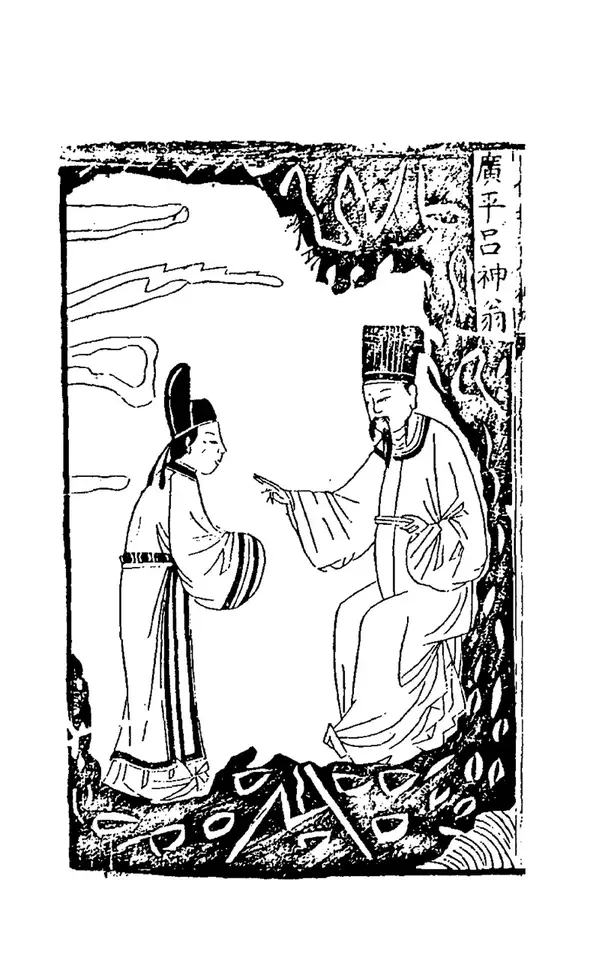
Historical portrait of Shen JijiImage creditsThis image has been extracted from another file · Public domainImage source
Historical figure
Shen Jiji (沈既济)
沈既济
Shen Jiji (dates of birth and death unrecorded, active mid-to-late 8th century to early 9th century) was a native of Wukang, Wuxing (present-day Deqing, Zhejiang; alternative tradition records Wu County, Suzhou). He was an illustrious Middle Tang historian, master of prose fiction, and court official. Born into the eminent Jiangnan aristocratic Wuxing Shen lineage, he inherited profound family traditions in classical…
Tang Dynasty (唐朝)
PROFILE
Shen Jiji (dates of birth and death unrecorded, active mid-to-late 8th century to early 9th century) was a native of Wukang, Wuxing (present-day Deqing, Zhejiang; alternative tradition records Wu County, Suzhou). He was an illustrious Middle Tang historian, master of prose fiction, and court official. Born into the eminent Jiangnan aristocratic Wuxing Shen lineage, he inherited profound family traditions in classical scholarship and historical writing. In 779 CE (fourteenth year of Dali under Emperor Daizong), he served as Harmony-Adjusting Director in the Court of Imperial Sacrifices, submitting his celebrated Discourse on the Examination and Selection System (Xuanju Yi) criticizing administrative recruitment flaws. In 780 CE, Chief Minister Yang Yan recommended him as "possessing talents worthy of historical office," prompting his appointment as Left Reminder and Compiler in the Institute of National History.
In 781 CE, when Yang Yan was purged and executed during factional power struggles, Shen Jiji was severely implicated and banished to become Revenue Manager of Chuzhou. In 784 CE (first year of Xingyuan), upon the strong recommendation of Imperial Hanlin Academician Lu Zhi, Shen Jiji was recalled from exile to the imperial capital, resuming duties in the history bureau and eventually rising to Vice Director in the Ministry of Rites, passing away in office. Following the elevation of his son Shen Chuanshi to regional military commissioner and vice minister, the Tang throne posthumously honored Shen Jiji with the title Junior Protector of the Crown Prince. As an imperial historiographer, he authored the ten-volume Veritable Records of the Jianzhong Era, heavily utilized by Sima Guang in the Zizhi Tongjian and by compilers of both the Old Book of Tang and New Book of Tang.
In Chinese literary history, Shen Jiji occupies an epoch-making summit as the definitive founder of classical Tang narrative romance (Chuanqi), steering early medieval supernatural tales toward mature psychological realism. His masterpiece Story of the Pillow (Zhenzhong Ji) established the immortal cultural archetype of the "Yellow Millet Dream" (Huangliang Yimeng), lauded by contemporary critic Li Zhao in Guoshi Bu as "a parabolic masterwork worthy of Zhuangzi, created with the craft of an excellent historian." His companion work Biography of Miss Ren (Ren Shi Zhuan) revolutionized Chinese folklore by imbuing a supernatural vixen with unyielding moral chastity and tender humanity, establishing the foundational prototype for Pu Songling's Strange Tales from a Chinese Studio (Liaozhai Zhiyi). By uniting historiographical rigor with artistic imagination, Shen Jiji profoundly shaped the subsequent evolution of Chinese classical fiction and drama.
Period
Tang Dynasty (Middle Tang)
Ancestral Home
Wukang, Wuxing (present-day Deqing, Zhejiang)
Highest Office and Status
Vice Director in the Ministry of Rites, Compiler in the Institute of National History; posthumously granted Junior Protector of the Crown Prince; celebrated Tang Dynasty historian, prose stylist, and founding patriarch of classical Tang narrative fiction (Chuanqi); author of Story of the Pillow (Zhenzhong Ji), Biography of Miss Ren (Ren Shi Zhuan), and Veritable Records of the Jianzhong Era (Jianzhong Shilu)
LIFE TIMELINE
Classical Erudition and Examination Success
Passed the imperial civil examinations as an Advanced Scholar; served as Harmony-Adjusting Director in the Court of Imperial Sacrifices, presenting Discourse on the Examination and Selection System in 779 CE.
Appointment to History Bureau
Recommended by Chief Minister Yang Yan for his historiographical brilliance; appointed Left Reminder and Compiler in the Institute of National History.
Political Implication and Banishment
Following Yang Yan's downfall and execution, banished to Chuzhou as Revenue Manager; composed Biography of Miss Ren and Story of the Pillow during the river voyage.
Pardon and Imperial Recall
Vindicated through the memorials of Hanlin Academician Lu Zhi; recalled to Chang'an to resume historical compilation.
Service in Ministry of Rites
Rose to Vice Director in the Ministry of Rites; authored the ten-volume Veritable Records of the Jianzhong Era; passed away in office, posthumously honored as Junior Protector of the Crown Prince.
Relationship graph
BIOGRAPHY
Life and Career
Classical Lineage and Administrative Critiques
Shen Jiji was born into the prestigious Wuxing Shen clan, one of the foremost aristocratic cultural houses south of the Yangtze River. The Wuxing Shen family had maintained illustrious scholarly traditions in Confucian exegesis and classical prose across the Southern Dynasties and early Tang. Nurtured within this learned environment, Shen Jiji mastered Confucian canonical texts and institutional histories from early youth. During the Dali reign of Emperor Daizong, he passed the imperial civil examinations as an Advanced Scholar (Jinshi), entering the imperial bureaucracy.
In 779 CE (fourteenth year of Dali), Shen Jiji held the post of Harmony-Adjusting Director in the Court of Imperial Sacrifices, responsible for attuning ceremonial music. Perceiving the deep-seated institutional decay that followed the An Lushan Rebellion, he went beyond technical musical duties to submit his renowned memorial, Discourse on the Examination and Selection System (Xuanju Yi).
In this treatise, Shen Jiji systematically diagnosed the recruitment mechanisms of the Tang dynasty, identifying four structural excesses: "excessive avenues of entry, excessive favoritism toward aristocratic houses, excessive emoluments for bureaucratic sinecures, and excessive laxity in supervisory discipline." He warned that unchecked patronage was flooding the bureaucracy with incompetent nobles while shutting out talented commoners. He urged the throne to evaluate officials based upon three clear criteria—"virtue, administrative capability, and arduous service"—and recommended granting regional prefects authority to recruit lower-ranking magistrates. Although conservative interests obstructed full adoption of his proposals, his penetrating institutional analysis won wide acclaim among statesmen.
Imperial Favor and Historiographical Service
In 780 CE, Emperor Dezong ascended the throne, elevating reform-minded minister Yang Yan as Chief Minister. Yang Yan instituted the monumental Double Tax System (Liangshui Fa) and sought erudite scholars to record contemporary dynastic history. Recognizing Shen Jiji's rare combination of historical insight and literary brilliance, Yang Yan submitted an urgent memorial to Emperor Dezong, asserting that Shen Jiji's "talents are singularly suited for historical compilation." The emperor immediately appointed Shen Jiji Left Reminder and concurrently Compiler in the Institute of National History.
As Left Reminder, Shen Jiji was tasked with offering critical moral advice to the sovereign, while his concurrent role as compiler gave him direct responsibility for drafting imperial diaries and dynastic annals. Shen Jiji championed uncompromising factual accuracy in historical writing, composing influential state papers such as Deliberation that Empress Wu Should Not Be Accorded Imperial Annals and Memorial on Appointing Attendant Officials. He argued passionately that imperial chronicles must embody the righteous praise and censure of the Spring and Autumn Annals, recording historical truths without flattery or concealment.
During his years in Chang'an, Shen Jiji moved in elite intellectual circles. He formed close bonds with Xiao Cun, son of Confucian scholar Xiao Yingshi, and respected statesman Xu Mengrong, all three winning fame for literary erudition. He engaged in intellectual exchanges with institutional historian Du You, author of Tongdian, assisting in historical research on institutional evolution, while trading poetry with prominent ministers such as Quan Deyu.
Banishment to Chuzhou and Creation of Masterpieces
However, court factionalism in the Middle Tang was ruthless. In 781 CE (second year of Jianzhong), Chief Minister Yang Yan fell victim to political intrigues orchestrated by rival minister Lu Qi. Yang Yan was abruptly stripped of office, exiled to Yazhou, and strangled en route. Following his patron's downfall, Lu Qi purged officials associated with Yang Yan. Having risen through Yang Yan's direct recommendation, Shen Jiji became a prime target, suffering immediate demotion and banishment as Revenue Manager of Chuzhou.
Confronted with this sudden descent from the central court into remote provincial exile, Shen Jiji displayed remarkable philosophical equanimity. Traveling eastward along rivers alongside fellow banished literati, including Pei Ji, Sun Cheng, Cui Xu, and Lu Chun, the companions shared wine and traded supernatural tales to alleviate their sorrow.
Possessing exceptional narrative skill, Shen Jiji recounted the mesmerizing tale of a supernatural fox spirit during an evening gathering aboard the boat. Captivated by its emotional depth and dramatic shifts, his companions urged him to commit the narrative to writing. Amidst the rocking of the cabin, Shen Jiji penned Biography of Miss Ren (Ren Shi Zhuan). Soon afterward, reflecting upon the sudden rise and tragic demise of Chief Minister Yang Yan, he channeled his disillusionment with political ambition into the timeless masterpiece Story of the Pillow (Zhenzhong Ji).
Imperial Restoration and Final Years
In 784 CE (first year of Xingyuan), having survived the devastating mutinies of Zhu Ci and Li Huaiguang, Emperor Dezong dismissed the treacherous Lu Qi and elevated virtuous ministers including Lu Zhi to direct the government. Recognizing Shen Jiji's innocence and historical genius, Lu Zhi submitted eloquent memorials pleading for his recall, arguing that so gifted an imperial historian should not be abandoned in provincial obscurity.
Emperor Dezong approved Lu Zhi's request and recalled Shen Jiji to Chang'an. Reinstated in the bureaucracy, Shen Jiji served as Senior Compiler in the Institute of National History and was subsequently promoted to Vice Director in the Ministry of Rites. During these final years, he dedicated himself to compiling contemporary records, authoring the monumental ten-volume Veritable Records of the Jianzhong Era (Jianzhong Shilu), meticulously detailing the political crises, economic measures, and regional rebellions of Emperor Dezong's early reign.
Shen Jiji passed away in office in Chang'an while serving in the Ministry of Rites. His son Shen Chuanshi inherited the family's intellectual legacy, advancing to Advanced Scholar, Vice Minister of Personnel, and Regional Surveillance Commissioner, celebrated as one of the great calligraphers and historians of the late Tang. Honoring the distinguished service of father and son, the imperial court posthumously conferred upon Shen Jiji the prestigious rank of Junior Protector of the Crown Prince.
Major Achievements
The Yellow Millet Dream and Story of the Pillow
Shen Jiji's most renowned literary masterpiece is Story of the Pillow (Zhenzhong Ji), universally hailed as the absolute apex of classical Tang narrative fiction. Composed in crystalline classical prose, the story recounts the journey of the impoverished scholar Lu Sheng, who meets the Daoist immortal Elder Lü at an inn along the Handan road during the Kaiyuan reign. While the innkeeper prepares a pot of yellow millet porridge over the hearth, Lu Sheng laments his poverty and thwarted ambitions. Elder Lü hands him a glazed porcelain pillow, inviting him to rest.
Entering the pillow's aperture in a dream, Lu Sheng experiences an entire lifetime spanning over fifty years: he marries a beautiful daughter of the aristocratic Cui clan, passes the imperial examinations, ascends from commandery magistrate to Prime Minister, directs major canal construction, and leads imperial armies to victory against border invaders. Yet he also falls victim to court jealousies, suffering two harrowing banishments to the southern wastes and narrowly escaping execution. Ultimately cleared of treason, he is restored as Chancellor, enfeoffed as Duke of Yan, and blessed with five sons who become high ministers, passing away peacefully at over eighty years of age. Awaking with a start, Lu Sheng finds himself lying in the same roadside inn, while the innkeeper's pot of yellow millet has not yet finished cooking.
Through this breathtaking narrative design, Shen Jiji compressed decades of worldly triumph and political terror into a single fleeting moment, laying bare the illusory nature of imperial power and status. Tang scholar Li Zhao in Guoshi Bu lauded the work as "a parabolic masterpiece of the Zhuangzi variety, demonstrating the craft of a superior historian." The story established the permanent cultural archetype of the "Yellow Millet Dream," inspiring Ma Zhiyuan's Yuan drama The Yellow Millet Dream, Tang Xianzu's Ming masterpiece Handan Dream, and Pu Songling's Qing tale The Continuation of the Yellow Millet.
Revolutionizing Fox Spirit Literature: Biography of Miss Ren
Shen Jiji's companion masterpiece, Biography of Miss Ren (Ren Shi Zhuan), represents a revolutionary turning point in the history of Chinese supernatural fiction. In pre-Tang Six Dynasties anomalies (Zhiguai), fox spirits were uniformly depicted as malevolent, parasitic beasts that deceived humans and brought disaster. Shen Jiji radically overturned this centuries-old convention, transforming the fox spirit Miss Ren into an avatar of supreme beauty, noble character, and emotional fidelity.
The tale chronicles the love between the impoverished scholar Zheng Liu and Miss Ren, a vixen who has taken human form. When Zheng's wealthy relative Wei Yin attempts to force himself upon her, Miss Ren defends her chastity with moral eloquence, winning Wei Yin's lifelong respect and friendship. Miss Ren subsequently uses her supernatural foresight to enrich Zheng Liu and introduces refined companions to Wei Yin. When Zheng Liu receives an official appointment in the provinces and insists that she accompany him, Miss Ren foresees fatal danger but loyally accompanies her lover, only to be torn apart by hunting hounds at Mawei, sacrificing her life for love.
At the tale's conclusion, Shen Jiji sighed that Miss Ren "refused to surrender her virtue when facing violence, remaining faithful unto death—qualities in which many contemporary human women fall short." By presenting the first deeply humanized, sympathetic portrait of a supernatural vixen in Chinese literature, Shen Jiji created the definitive literary model that directly inspired Pu Songling's masterpieces in Strange Tales from a Chinese Studio.
Historical Compilation and the Veritable Records of the Jianzhong Era
Beyond his pioneering fiction, Shen Jiji achieved lasting distinction as an imperial historiographer. His ten-volume Veritable Records of the Jianzhong Era provided a definitive chronicle of Emperor Dezong's foundational years, documenting the financial transition to the Double Tax System, the shifting balances between court and warlords, and the military operations surrounding the Jingyuan Mutiny.
Northern Song historian Sima Guang relied heavily upon Shen Jiji's records when compiling the Tang chronicles of the Zizhi Tongjian, regarding his accounts of the Yang Yan-Lu Qi conflict as the most authoritative available primary evidence. In addition, Shen Jiji composed the ten-volume Treatise on the Examination and Selection System and the single-volume Chronicle of Liu Zhan's Rebellion, confirming the high praise in the Old Book of Tang that he was "deeply versed in all canons, with exceptional skill in the historical brush."
Personal Relationships
Shen Chuanshi: Eldest son. Renowned Tang calligrapher, historian, and statesman who served as Vice Minister of Personnel and Surveillance Commissioner, securing his father's posthumous rank.
Yang Yan: Chief Minister and patron. Formulated the Double Tax System and recommended Shen Jiji to the Institute of National History; his political downfall caused Shen Jiji's banishment.
Lu Zhi: Respected statesman and savior. Hanlin Academician and Chief Minister who submitted memorials exonerating Shen Jiji and securing his recall to the capital.
Du You: Intimate intellectual friend. Eminent Middle Tang statesman and author of the institutional encyclopedia Tongdian, who collaborated with Shen Jiji on institutional history.
Xiao Cun: Close literati associate. Son of the revered scholar Xiao Yingshi; celebrated alongside Shen Jiji and Xu Mengrong as literary masters of the capital.
Xu Mengrong: Trusted colleague. High Tang minister and prose writer, who maintained close artistic and political ties with Shen Jiji.
Historical Evaluation
**Old Book of Tang (Jiu Tang Shu, Biographies of Shen Jiji)*: "Shen Jiji was comprehensively versed in the ancient texts and possessed singular skill in historical composition. He authored the Veritable Records of the Jianzhong Era and the Treatise on the Examination and Selection System*, distinguished by precise and upright language, earning wide praise throughout his generation."
Li Zhao (Tang History Supplement / Guoshi Bu, Tang Dynasty): "Shen Jiji composed the Story of the Pillow, which belongs to the category of Zhuangzi's parables; with its refined and elegant prose, it demonstrates the talents of a truly excellent historian."
Lu Xun (A Brief History of Chinese Fiction / Zhongguo Xiaoshuo Shilüe, Modern scholar): "With Shen Jiji's composition of Story of the Pillow and Biography of Miss Ren, writers consciously set out to create fictional narratives. Rich in delicate psychological nuance and vibrant emotional truth, fiction with Shen Jiji truly achieved the status of an independent literary art."
Cheng Yizhong (History of Tang Dynasty Fiction, Modern scholar): "The Story of the Pillow and Biography of Miss Ren stand as monumental landmarks of Middle Tang fiction, signaling that the creation of classical Tang tales had entered its golden zenith."