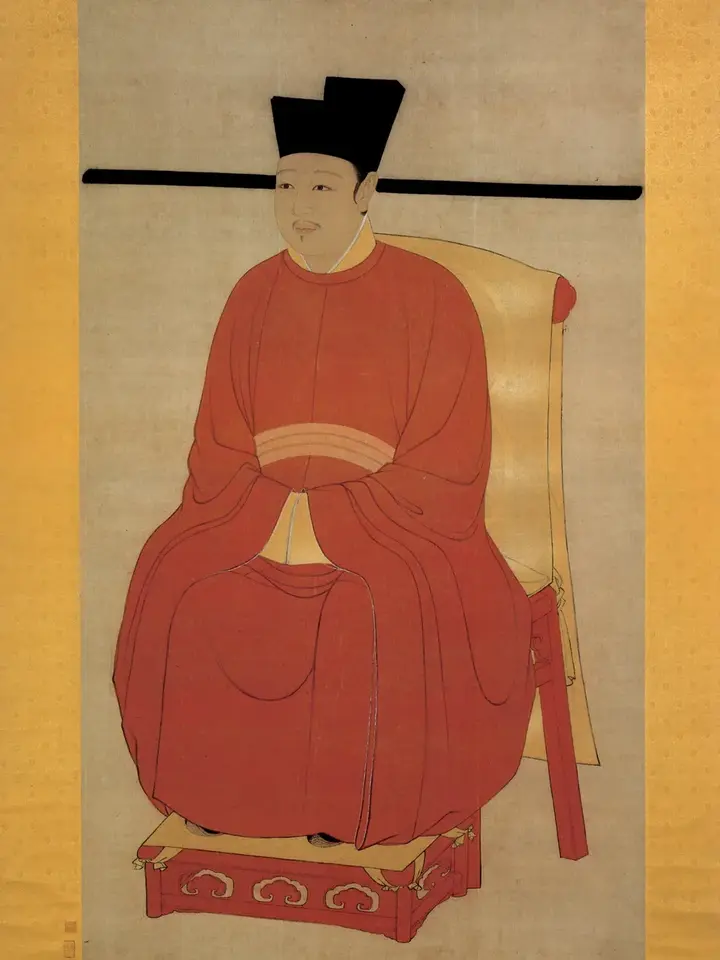
PROFILE
Ren Xun (任薰, 1835–1893), courtesy name Fuchang and pseudonym Shunqin, was a native of Xiaoshan County in Shaoxing Prefecture, Zhejiang Province (modern Xiaoshan District, Hangzhou). He was a distinguished late Qing painter and an influential pioneer and core master of the modern Shanghai School (Haipai). Alongside his elder brother Ren Xiong, his nephew Ren Yi (Ren Bonian), and Ren Yu, he was celebrated in Chinese art history as one of the "Four Rens of the Shanghai School," enjoying high esteem during an era of dynamic Sino-Western cultural transformation.
Immersed in family artistic traditions from childhood, Ren Xun studied directly under his elder brother Ren Xiong, rapidly developing his technical skill. He mastered figure painting, flower-and-bird compositions, landscapes, and animals, excelling particularly in historical narrative subjects and depictions of ladies. His style inherited the archaic, monumental spirit of late Ming master Chen Hongshou while incorporating the meticulous detail of Song and Yuan academic painting. His brushwork featured firm, angular lines executed with decorative and vibrant mineral pigments. Residing primarily in Suzhou and Shanghai to sell paintings, he created a vast corpus of art while systematically mentoring his nephew Ren Yi, providing the crucial foundation for Ren Yi's rise as a leading master of modern Chinese painting.
In his later years, Ren Xun suffered from cataracts that severely impaired his eyesight. Relying on decades of muscle memory and intuitive brush control, he continued painting despite near blindness, producing works characterized by vigorous, weathered brushwork. In 1893, Ren Xun passed away in Suzhou at the age of fifty-nine.
- Courtesy Name
- Fuchang (阜长)
- Pseudonym
- Shunqin (舜琴)
- Dynasty
- Qing
- Ancestral Home
- Xiaoshan County, Shaoxing Prefecture, Zhejiang (modern Xiaoshan, Hangzhou, Zhejiang)
- Birth Date
- 1835 (15th year of the Daoguang reign, Qing)
- Death Date
- 1893 (19th year of the Guangxu reign, Qing)
- Age at Death
- 59
- Historical Identity
- Painter, Master of the Shanghai School
BIOGRAPHY
Chronology
- 1835 (15th year of the Daoguang reign) | Birth in Xiaoshan | Born in Xiaoshan County, Zhejiang, studying painting under his father and elder brother.
- 1850 (30th year of the Daoguang reign) | Painting in Ningbo | Established an independent studio in Ningbo at age sixteen, selling paintings to local literati.
- 1857 (7th year of the Xianfeng reign) | Death of Ren Xiong | Assumed family responsibilities following the early death of his elder brother Ren Xiong from illness.
- 1868 (7th year of the Tongzhi reign) | Relocating to Suzhou | Moved to Suzhou with his nephew Ren Yi, selling paintings and instructing Ren Yi in figure painting.
- 1875 (1st year of the Guangxu reign) | Renown in Jiangnan | Traveled frequently between Suzhou and Shanghai, receiving extensive commissions from merchants and literati.
- 1888 (14th year of the Guangxu reign) | Painting Through Impaired Sight | Continued painting despite severe cataracts, producing works of uninhibited vigour.
- 1893 (19th year of the Guangxu reign) | Passing in Suzhou | Passed away at his residence in Suzhou at the age of fifty-nine.
Life and Career
Artistic Enlightenment and Fraternal Mentorship
Ren Xun was born in 1835 in Xiaoshan County, Shaoxing Prefecture, into a family of professional artisans. His father, Ren Chun, specialized in folk portraits and decorative murals. His elder brother, Ren Xiong (courtesy name Weichang), was twelve years his senior and recognized as one of the most brilliant painters of the late Qing period.
From early childhood, Ren Xun exhibited sensitivity to linear rhythm and mineral pigments. Under Ren Xiong's guidance, he methodically studied the academic realism of the Song court, Ming master Qiu Ying, and the eccentric figurative style of Chen Hongshou. He mastered line delineation, wash shading, and literati compositional theory. In 1850, at sixteen, Ren Xun traveled to Ningbo to establish an independent studio, honing his skills through commercial portraiture and literati commissions.
Assuming Lineage Responsibilities and Mentoring Ren Yi
In 1857, Ren Xiong died of pulmonary illness at the age of thirty-five. His sudden passing deprived the family of its principal provider and left the late Qing art world without a leading figure. Overcoming grief, Ren Xun assumed responsibility for supporting his brother's dependents and preserving the family's artistic heritage.
In 1868, Ren Xun relocated to Suzhou, bringing his young nephew Ren Yi (Ren Bonian). Sharing a studio in the ancient city, Ren Xun instructed Ren Yi daily in structural anatomy, linear dynamism, and color application. He guided Ren Yi to transcend mechanical copying, encouraging him to absorb elements from Western watercolor and folk visual culture. Under Ren Xun's tutelage, Ren Yi's technique matured rapidly, enabling him to emerge as a master of the Shanghai School.
Practicing in Suzhou and Shanghai and Defying Failing Vision
During the Tongzhi and Guangxu reigns, the treaty port of Shanghai grew into China's commercial and artistic center. Ren Xun traveled frequently between Suzhou and Shanghai, participating in literati gatherings alongside prominent artists such as Hu Gongshou, Xugu, and Qian Hui'an. He became widely recognized as an essential founder of the emerging Shanghai School.
In his later years, Ren Xun settled permanently in Suzhou. Decades of working under dim oil lamps took a toll on his eyes, and around 1888 he developed severe cataracts, reducing his vision to discerning mere light and shadows. Refusing to cease painting, he relied on tactile familiarity with the paper edges and muscle memory to guide his brush. His late works, executed with trembling strokes and concentrated ink, displayed an unadorned, monumental grandeur that was prized by contemporary connoisseurs.
In 1893, Ren Xun passed away peacefully at his Suzhou residence at the age of fifty-nine.
Major Achievements
Innovating an Archaic and Vigorous Figure Style
Ren Xun's foremost contribution to nineteenth-century Chinese art was developing a figurative style that combined classical austerity with modern urban aesthetics. Resisting the prevailing tendency toward delicate, formulaic figures in late Qing court and gentry painting, Ren drew inspiration from Chen Hongshou's eccentric style while avoiding excessive anatomical distortion.
His figures featured exaggerated, expressive proportions and crisp drapery lines, executed with dynamic nail-head and iron-wire line techniques. His celebrated masterpieces, such as Heavenly Official Bestowing Blessings, The Injustice to Dou E, and the Water Margin Character Album, balanced gravity and humor. By combining rich mineral coloration with refined composition, he elevated narrative figure painting beyond decorative commercial art.
Expanding Decorative Aesthetics in Flora and Landscape
Ren Xun achieved comparable success in flower-and-bird and landscape genres. His flower-and-bird paintings synthesized the precise naturalism of Song academic painting with the expressive brushwork of Ming master Chen Daofu, juxtaposing delicate blossoms and insects with weathered stones and gnarled branches.
His compositions utilized bold spatial contrasts, employing generous negative space to accentuate dense foliage, rendered in luminous yet balanced colors. In landscape, he drew upon Yuan masters Huang Gongwang and Wu Zhen alongside late Ming individualist Lan Ying, employing dry brush texturing, heavy moss dotting, and serpentine tree trunks to evoke desolate, expansive atmospheres. Works such as Album of Figures and Landscapes and Playing the Zither Under the Pines remain touchstones of Shanghai School expression.
Anchoring Shanghai School Prosperity and Cultivating Masters
Ren Xun played a vital transitional role in the development of the Shanghai School. He served as the primary stylistic conduit between the early, folk-influenced Zhejiang style represented by Ren Xiong and the mature urban aesthetic championed by Ren Bonian.
By embracing the tastes of the emerging urban merchant class, Ren Xun incorporated popular narrative appeal into elite literati painting. Most significantly, his years of instruction provided Ren Bonian with foundational mastery of figurative brushwork, which Ren Bonian later combined with Western perspective and shading. Modern art historians consistently recognize Ren Xun as a foundational mentor who enabled the flourishing of the modern Shanghai School.
Personal Relationships
- Elder Brother: Ren Xiong, courtesy name Weichang, prominent late Qing painter and head of the "Four Rens"; instructed Ren Xun in painting during his youth.
- Nephew: Ren Yi, Ren Bonian, renowned master of the modern Shanghai School; raised and mentored in artistic technique by Ren Xun.
- Nephew: Ren Yu, courtesy name Lifan, son of Ren Xiong and member of the "Four Rens"; guided in painting by Ren Xun following Ren Xiong's death.
- Artistic Colleague: Hu Gongshou, prominent Shanghai painter and early leader of the Shanghai School; maintained a close professional friendship with Ren Xun.
- Artistic Contemporary: Xugu, Buddhist monk and eminent late Qing individualist painter; leading peer within the early Shanghai School circle.
Historical Evaluations
- Yang Yi, Haishang Molin: "Ren Xun, courtesy name Fuchang, was a native of Xiaoshan and the younger brother of Weichang. He was adept at figures, landscapes, flowers, and birds. His brushwork was profound and his colors were moist and elegant, commanding great esteem in Suzhou."
- Pan Tianshou, History of Chinese Painting: "The brothers and nephews Ren Xiong, Ren Xun, and Ren Yi excelled in figure painting, displaying eccentric brushwork and archaic coloration, opening a new era for late Qing painting under the collective name 'Four Rens of Shanghai'."
- Zheng Zhenduo, Studies in Chinese Literature: "Master Fuchang's painting possessed deep skeletal strength, transcending conventional paths. His figurative characterizations were incisive and penetrating; he was truly the fountainhead from which Master Ren Bonian emerged."
Related Entries
- Ren Xiong
- Ren Yi
- Ren Yu
- Shanghai School
- Four Rens of the Shanghai School