Birth in Eastern Zhejiang
Born into a respected clan in Shagang Village, Yin County, Ningbo Prefecture, Zhejiang.
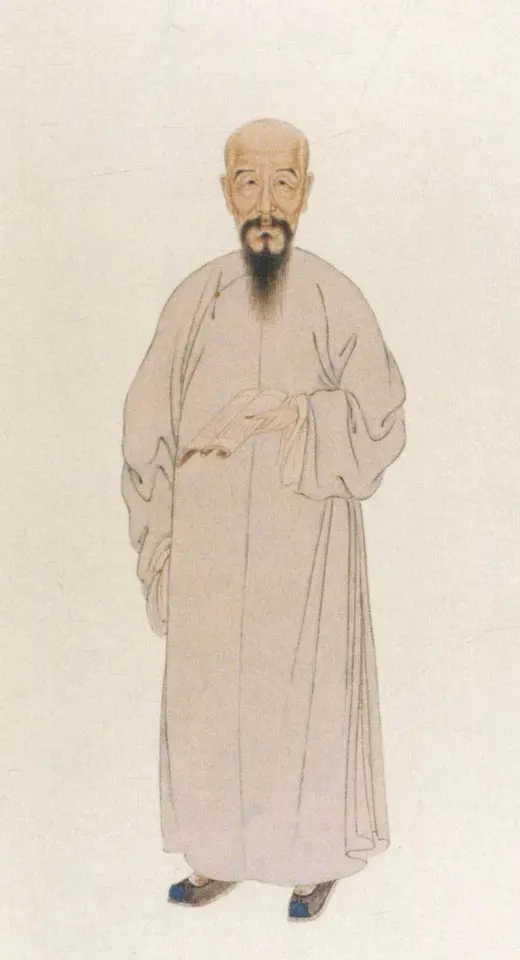
全祖望
Quan Zuwang (全祖望, 1705–1755), courtesy name Shaoyi, art name Xieshan, and self-styled Master of Jieqiting, was a native of Yin County, Ningbo Prefecture, Zhejiang Province. He was an epochal historian, textual critic, epigrapher, and literary master during the Qianlong era, celebrated as the supreme synthesiser of the Eastern Zhejiang Historical School (Zhedong Shixue) and venerated by contemporaries as the "Pillar of…
Quan Zuwang (全祖望, 1705–1755), courtesy name Shaoyi, art name Xieshan, and self-styled Master of Jieqiting, was a native of Yin County, Ningbo Prefecture, Zhejiang Province. He was an epochal historian, textual critic, epigrapher, and literary master during the Qianlong era, celebrated as the supreme synthesiser of the Eastern Zhejiang Historical School (Zhedong Shixue) and venerated by contemporaries as the "Pillar of Historiography" and the "Commoner Grand Historian." Inheriting the practical statecraft tradition of Huang Zongxi and the fearless biographical integrity of Wan Sitong, Quan Zuwang was an intellectual prodigy deeply versed in Confucian canonical literature and dynastic history. Selected as an imperial tribute student in 1729, he achieved the jinshi degree in 1736 and was admitted as a Hanlin bachelor, winning the profound esteem of Vice Minister Li Fu. However, because Li Fu clashed politically with Grand Secretary Zhang Tingyu, Zhang maliciously suppressed Quan Zuwang, blocking him from the prestigious Boxue Hongci special imperial examination and maliciously degrading him to a low-ranking candidate county magistrate in 1737. Outraged by bureaucratic depravity, Quan Zuwang resigned his appointment, renounced officialdom forever, and spent his remaining life as an independent private scholar, lecturing at the Jishan Academy in Shaoxing and the Duanxi Academy in Guangdong. Risking political retribution under Qing literary inquisitions, Quan Zuwang dedicated himself to salvaging historical records of Southern Ming loyalists and Ming-Qing transition resistance heroes. Traveling across eastern China to inspect ruined steles and deserted tombs, he composed biographical accounts characterized by profound pathos and historical fidelity; his collected writings, Jieqiting Ji, represent the absolute pinnacle of Qing epigraphic prose. His academic output was staggering: he spent three decades collating the ancient geographical classic Shui Jing Zhu across seven successive revisions, establishing a rigorous modern methodology for historical hydrology; he single-handedly supplemented and reorganized Huang Zongxi's unfinished hundred-volume Song Yuan Xue'an, illuminating the intellectual transmission of Song and Yuan Neo-Confucianism; and he authored the critical commentary Kunxue Jiwen Sanjian and historical dialogues in Jingshi Wenda, totaling thirty-five distinct works across four hundred volumes. Despite enduring lifelong poverty and leaving behind no funds for his own funeral, his devotion to truth and moral courage established him as an enduring titan of Chinese historiography.
Born into a respected clan in Shagang Village, Yin County, Ningbo Prefecture, Zhejiang.
Entered Sanyu Thatched Cottage under scholar Dong Zhengguo, demonstrating unmatched critical acuity in historical debates.
Selected as an imperial tribute student and journeyed to the capital, earning widespread acclaim among eminent ministers.
Passed the Shuntian provincial civil service examinations, earning the deep patronage and lifelong friendship of Vice Minister Li Fu.
Resided at Li Fu's Zitengxuan study, reading twenty volumes of the Yongle Dadian daily and launching his lifelong collation of the Shui Jing Zhu.
Passed the metropolitan and palace examinations, entering the Hanlin Academy; maliciously barred from the Boxue Hongci exam by Grand Secretary Zhang Tingyu.
Framed during the Hanlin graduation evaluation and demoted to county magistrate; indignantly resigned and returned home, renouncing bureaucratic life.
Traveled throughout Jiangsu and Zhejiang to survey loyalist tombs, collecting first-hand inscriptions of anti-Qing resistance martyrs.
Visited an ailing Li Fu in Nanjing, witnessing bureaucratic fragility and cementing his determination to preserve unvarnished history.
Appointed head of Jishan Academy in Shaoxing by Prefect Du Jia; organized a public memorial for late Ming martyr Liu Zongzhou.
Journeyed to Zhaoqing in Guangdong to direct Duanxi Academy, but was forced to step down after suffering a debilitating stroke and coughing blood.
Finished his definitive seventh critical collation of the forty-volume Shui Jing Zhu after thirty years of labor.
Battled illness to reconstruct and expand Huang Zongxi's unfinished manuscripts into the monumental hundred-volume Song Yuan Xue'an.
Grieving the premature death of his young son, entrusted his literary manuscripts to his disciple Dong Bingchun and passed away in extreme poverty at fifty-one.
Quan Zuwang was born into a cultured gentry lineage in Shagang Village, Yin County, Ningbo Prefecture, Zhejiang Province. The Shagang Quan clan had produced distinguished scholars since the Song and Yuan dynasties and was celebrated in the late Ming for its unyielding moral integrity. In Shagang, the clan operated traditional brick and tile kilns, and village elders were known locally as the "Eighteen Patriarchs." Endowed with exceptional memory, Quan Zuwang mastered the Confucian Classics and dynastic histories in early childhood. Local tradition recounts that when elders tested his wits by pointing at the rising smoke of the village kilns, the young boy instantly improvised an elegant verse linking the kiln smoke to the mythological moon palace, astounding local scholars.
At fourteen, Quan Zuwang enrolled in the Sanyu Thatched Cottage under classical scholar Dong Zhengguo. Dong was an austere and demanding teacher whom most students feared, yet Quan Zuwang boldly engaged him in rigorous debate over ancient institutions and historical interpretations. Rather than taking offense, Dong was deeply impressed, praising Quan as an extraordinary historical talent born once in centuries.
During his formative years, Quan Zuwang was profoundly shaped by the scholarly legacy of Eastern Zhejiang luminaries Huang Zongxi and Wan Sitong. Emulating Wan Sitong's noble example of declining official Qing emoluments to author the private History of Ming as a commoner, Quan Zuwang pledged his life to advancing the Eastern Zhejiang historiographical mission, gaining widespread renown across Jiangnan before reaching adulthood.
In 1729, twenty-five-year-old Quan Zuwang was selected by Provincial Education Commissioner Wang Lansheng as an imperial tribute student and summoned to the Imperial Academy in Beijing. Arriving in the northern capital, his encyclopedic learning captivated the intellectual elite, winning him the friendship of prominent ministers such as Fang Bao and Hang Shijun.
In 1732, Quan Zuwang passed the Shuntian provincial civil service examination. Although he was unsuccessful in the metropolitan examination the following year, his examination essay drew the astonished admiration of chief examiner Li Fu, Vice Minister of Rites. Li Fu declared Quan Zuwang the foremost intellectual prodigy to emerge from Eastern Zhejiang since Wang Yinglin and Huang Zhen, and insisted that he remain in Beijing to prepare for the court's upcoming special recruitment. During this period, Quan Zuwang resided in Li Fu's private Beijing residence, known as the Purple Wisteria Study (Zitengxuan).
Leveraging Li Fu's official access to imperial archives, Quan Zuwang consulted the surviving manuscript volumes of the Yongle Dadian. Imposing a strict daily regimen upon himself, he read and verified twenty volumes every day, hiring scribes to transcribe rare Song and Yuan historical treatises. While immersed in this vast ocean of primary documents, he identified pervasive errors in traditional historical geography, formally launching his three-decade project to collate the Shui Jing Zhu.
In 1736, Quan Zuwang passed both the metropolitan and palace examinations in the first year of the Qianlong Emperor's reign, earning the jinshi degree and being appointed a Hanlin bachelor. At that time, the court opened the prestigious Boxue Hongci examination to recruit the empire's most distinguished scholars, and senior ministers submitted joint memorials recommending Quan Zuwang.
However, Grand Secretary Zhang Tingyu exercised dominant influence over the inner cabinet and harbored deep political animosity toward Li Fu. Viewing Quan Zuwang as Li Fu's foremost protégé, Zhang Tingyu intervened to suppress Quan's recommendation memorials, arbitrarily barring him from the Boxue Hongci examination.
In 1737, during the Hanlin graduation evaluation, Zhang Tingyu struck another blow. Abusing his position as chief evaluator, Zhang deliberately graded Quan Zuwang's performance as inferior and ordered the Ministry of Personnel to appoint him as an expectant county magistrate in a remote province. Deeply disgusted by this blatant political persecution and refusing to compromise his integrity, Quan Zuwang immediately resigned his post and returned south, vowing never again to seek office in the imperial bureaucracy.
In 1740, Quan Zuwang traveled to Nanjing to visit Li Fu, who was presiding over the Jiangnan provincial examinations. Finding his revered mentor weakened by chronic illness and worn down by court intrigue, Quan Zuwang recognized the futility of seeking moral governance within officialdom, solidifying his resolve to pursue historical truth exclusively outside the state apparatus.
Upon retiring to his native village, Quan Zuwang focused his full energy on the salvage of vanishing historical records. More than a century after the Manchu conquest, the Qing court maintained rigorous literary inquisitions, ruthlessly confiscating and burning works concerning the Southern Ming resistance and loyalist scholars. Literati lived in terror, and the heroic deeds and graves of late Ming martyrs were rapidly falling into oblivion.
Driven by a profound historical conscience, Quan Zuwang accepted severe political risks to preserve the memory of fallen loyalists. Armed with a walking stick and straw sandals, he journeyed across rugged mountains, ruined temples, and deserted battlefields throughout Zhejiang, Jiangsu, and northern Fujian, interviewing surviving descendants and copying eroded stele inscriptions, private memoirs, and family archives.
He composed numerous stirring biographies and spirit-way stele inscriptions commemorating figures such as Shi Kefa, Zhang Huangyan, Gu Yanwu, Huang Zongxi, Feng Jingdi, Qu Shisi, and the Three Martyrs of Guanjiang. Written in an austere, tragic, and unvarnished style, his narratives dismantled the omissions and distortions of official Qing histories, preserving the core moral spirit of the Chinese people for future generations.
Although Quan Zuwang remained a private citizen, his intellectual renown spread throughout the empire. In 1748, Prefect Du Jia invited him to assume the directorship of the renowned Jishan Academy in Shaoxing, where late Ming philosopher Liu Zongzhou had once taught. Upon his arrival, Quan Zuwang noted that it was the centennial of Liu Zongzhou's martyrdom, an anniversary that local officials had cowardly ignored out of fear of imperial censors.
Undaunted by official timidness, Quan Zuwang organized a solemn public memorial service at the academy. Presiding in person and reciting an eloquent funeral oration, he moved hundreds of gathered scholars to tears. During his tenure at Jishan, he reformed empty examination writing, advocating that genuine learning must serve human welfare and emphasize personal moral integrity. When local officials subsequently meddled in academy governance and attempted to curtail ancestral rites for loyalists, Quan Zuwang resigned in protest, firmly declining the prefect's lucrative offers to return.
In 1752, Quan Zuwang accepted the invitation of Guangdong Provincial Governor Su Chang to assume the leadership of the Tianzhang Academy (Duanxi Academy) in Zhaoqing. He actively reformed scholarship across Lingnan, but the grueling travels and relentless night-time writing took a disastrous toll on his health. Stricken by a severe stroke and recurring hemoptysis, he was forced to relinquish his post and return to Zhejiang.
During his final years, Quan Zuwang suffered from acute physical infirmity and deep destitution. Having never accumulated property and spending his meager academy earnings on purchasing rare books, he lived in bare rooms without adequate food or firewood. Yet even while bedridden, he worked ceaselessly to complete his scholarly projects.
For over thirty years, Quan Zuwang had collated Li Daoyuan's ancient masterwork Shui Jing Zhu. By cross-referencing Song editions, Yuan manuscripts, and stone inscriptions, he carried out seven comprehensive revisions, ultimately completing the forty-volume Qijiao Shui Jing Zhu.
Simultaneously, Quan Zuwang took upon himself the completion of Huang Zongxi's unfinished Song Yuan Xue'an. Gathering writings from over fifteen hundred Song and Yuan scholars, he reconstructed missing chapters and drafted detailed introductory essays, transforming the fragmented manuscript into a monumental hundred-volume history of Song-Yuan philosophy.
In the spring of 1755, Quan Zuwang's thirteen-year-old son Zhaode tragically died of illness, dealing him an unbearable emotional blow. Composing ten mournful elegies and a burial inscription, he realized his life was ending. He summoned his foremost disciples, including Dong Bingchun, Lu Hao, and Jiang Xueyong, to his bedside, working day and night to collate his lifetime manuscripts and entrusting his literary legacy to Dong. On August 9, 1755, Quan Zuwang passed away peacefully in extreme poverty at the age of fifty-one. Lacking funds for a coffin, his funeral was paid for through the collective contributions of his devoted disciples and friends.
Quan Zuwang's foremost historiographical achievement was his tireless labor in completing Huang Zongxi's unfinished hundred-volume masterpiece, Song Yuan Xue'an (The Records of Song and Yuan Scholars).
Following the completion of The Records of Ming Scholars (Mingru Xue'an), Huang Zongxi laid the foundation for analyzing Chinese philosophical history through intellectual lineages. However, Huang and his son Huang Baijia died before completing the Song and Yuan compilation, leaving behind scattered, incomplete drafts that were in grave danger of being lost. Quan Zuwang recognized the preservation of this work as his sacred mission, spending over two decades collecting surviving papers and independently executing a comprehensive expansion.
Quan Zuwang made four pivotal contributions to Song Yuan Xue'an: first, he composed thirty-two entirely new intellectual schools omitted in Huang's original outline, incorporating Wang Anshi's Jinggong New Learning, the Su family's Shu School, Fan Zhongyan's Gaoping School, and the utilitarian schools of Jinhua, Yongjia, and Yongkang; second, he authored incisive introductory essays (Xulu) for every volume to map the ideological evolution of Song and Yuan Neo-Confucianism, pioneering the inclusion of scholarly lineage transmission charts; third, he corrected textual errors throughout Huang's surviving drafts; and fourth, he utilized hundreds of primary stone inscriptions and private anthologies to resolve numerous biographical omissions found in the official History of Song.
Quan Zuwang's evaluations maintained exemplary neutrality, impartially weighing the merits of the Cheng-Zhu school, Lu-Wang mind philosophy, and Eastern Zhejiang utilitarian traditions. His completion of Song Yuan Xue'an established the definitive model for Chinese intellectual historiography, standing alongside The Records of Ming Scholars as twin monuments of traditional Chinese scholarship.
Another monumental peak in Quan Zuwang's evidentiary scholarship was his completion of the forty-volume Qijiao Shui Jing Zhu (Seven Collations of the Commentary on the Water Classic), achieved over thirty years of relentless textual analysis.
Li Daoyuan's Shui Jing Zhu is not only China's greatest ancient geographical masterpiece, but an indispensable foundation for studying medieval administrative boundaries, settlement archaeology, and historical hydrology. However, centuries of scribal transmission had corrupted the text, conflating Sang Qin's original Classic with Li Daoyuan's Commentary and introducing tens of thousands of errors that confounded generations of readers.
Beginning during his days in Beijing reading the Yongle Dadian, Quan Zuwang conducted seven systematic, comprehensive collations. He tracked down ancient Song prints, Yuan hand-copied editions, and early Qing versions, cross-checking every passage against dynastic geographic treatises and local epigraphy to trace the historical courses of hundreds of rivers.
Quan Zuwang pioneered the evidentiary principle of "using the classic to correct the commentary, using the commentary to correct the classic, and using physical topography to verify maps." He resolved thousands of corrupted passages and disentangled centuries of scribal confusion. In History of Chinese Scholarship in the Past Three Hundred Years, Liang Qichao celebrated Quan Zuwang alongside Dai Zhen and Zhao Yiqing as the three supreme masters of Qing hydrological philology.
Beyond his rigorous evidentiary scholarship, Quan Zuwang was an illustrious master of Chinese classical prose. His lifetime literary output was compiled into Jieqiting Ji (thirty-eight volumes), Waishu (fifty volumes), and Shiji (ten volumes), occupying a singular place in Qing literary history.
Quan Zuwang's prose inherited the austere narrative vigor of Sima Qian's Shiji and the stylistic power of Han Yu and Ouyang Xiu, reaching its artistic zenith in his commemorative spirit-way steles, tomb epitaphs, and scholarly prefaces. In his historical biographies, he insisted on absolute evidentiary precision, verifying every fact against primary sources and purging the hyperbolic flattery common in contemporary funerary writings.
Crucially, Jieqiting Ji pulses with an uncompromising spirit of national loyalty. His moving tributes to Southern Ming martyrs, including Meihualing Ji (Record of Plum Blossom Ridge), the spirit-way inscription for Zhang Huangyan, and his biography of Censor-in-Chief Xu Fuyuan, were composed with heartbreaking emotional intensity. Late Qing scholar Hang Shijun praised his prose as matching the grandeur of the Grand Historian, while modern master Zhang Binglin declared that Quan Zuwang's epigraphic essays represented the highest artistic achievement of Qing dynasty prose.
Southern Song scholar Wang Yinglin's Kunxue Jiwen is an encyclopedic classic of Song dynasty textual criticism, covering the Classics, dynastic history, institutional evolution, and astronomy. Due to its concise and difficult phrasing, it had long posed enormous challenges for commentators. Although Qing scholars Yan Ruoju and He Chuo had previously attempted annotations, their notes remained incomplete.
Quan Zuwang drew upon his vast command of the four bibliographic divisions to compile Kunxue Jiwen Sanjian in twenty volumes. Building upon and refining Yan's and He's commentaries, he added hundreds of detailed textual emendations based on historical phonology and archaic institutional records, bringing Wang Yinglin's profound work to unprecedented clarity.
Additionally, Quan Zuwang gathered his insights on the thirteen Confucian Classics and twenty-four dynastic histories into the ten-volume dialogue Jingshi Wenda. Utilizing a question-and-answer format, he analyzed ancient ritual systems, bureaucratic offices, and penal codes across the Zhou, Qin, Han, and Tang dynasties, demonstrating the seamless synthesis of classical philology and historiography that defined the Qianjia evidential tradition.
In Chinese intellectual history, Quan Zuwang served as the vital bridge linking the foundational Eastern Zhejiang thought of Huang Zongxi and Wan Sitong with the later historiographical philosophy of Zhang Xuecheng.
Quan Zuwang steadfastly defended the Eastern Zhejiang maxim that "historical inquiry is fundamentally the study of practical statecraft," rejecting the trivial pedantry of scholars who isolated themselves from societal realities. He argued that classical exegesis must be grounded in historical evolution and aimed at practical administration. During his tenures at the Jishan and Duanxi academies, he prioritized the development of unbending moral character alongside rigorous archival training.
His disciples, including Dong Bingchun, Lu Hao, and Jiang Xueyong, inherited his exacting archival standards and philosophical commitments. Following Quan Zuwang's death, Dong Bingchun and his fellow students overcame immense hardships to preserve, edit, and publish his dispersed manuscripts, ensuring that Jieqiting Ji and Song Yuan Xue'an were permanently transmitted to posterity.
FIGURES ASSOCIATED WITH THIS DYNASTY