Succession to Rulership
Elder brother Shi Fu yielded the heirship to avenge their grandfather; Duke Xiang ascended as leader of the Qin people
771 BCE–766 BCE
秦襄公
Duke Xiang of Qin (秦襄公, died 766 BCE), Ying clan, Zhao lineage, was the pivotal founding monarch who elevated Qin from an attached frontier dependency into an independent feudal lord during the late Western Zhou and early Spring and Autumn period. He was the second son of Duke Zhuang of Qin. His elder brother Shi Fu voluntarily yielded the heirship to him in order to dedicate himself to fighting the Western Rong (Xirong) who…
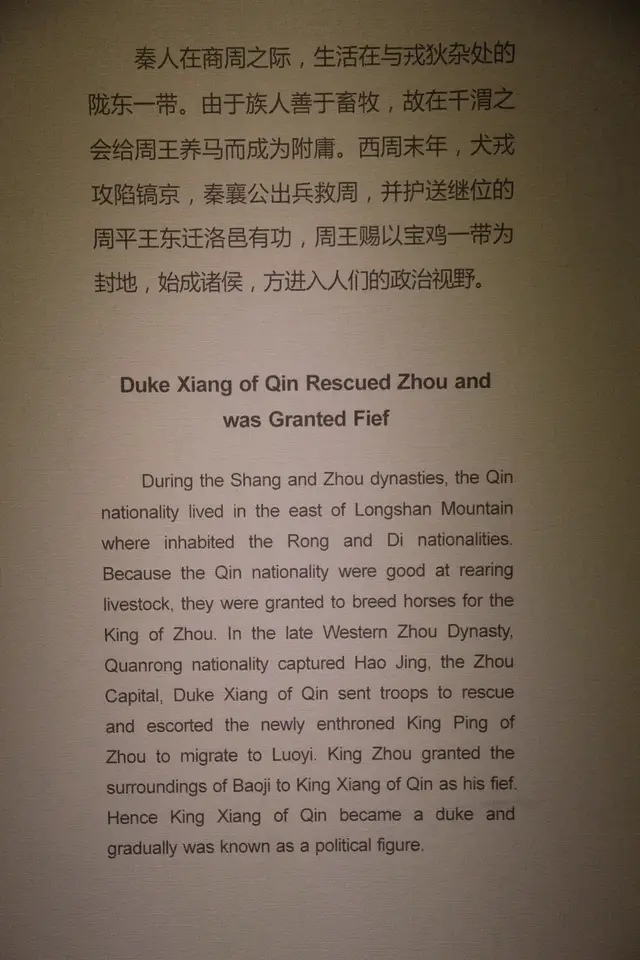
Duke Xiang of Qin (秦襄公, died 766 BCE), Ying clan, Zhao lineage, was the pivotal founding monarch who elevated Qin from an attached frontier dependency into an independent feudal lord during the late Western Zhou and early Spring and Autumn period. He was the second son of Duke Zhuang of Qin. His elder brother Shi Fu voluntarily yielded the heirship to him in order to dedicate himself to fighting the Western Rong (Xirong) who had slain their grandfather Qin Zhong, allowing Duke Xiang to assume leadership of the Qin people in 778 BCE. Confronting persistent nomadic incursions, Duke Xiang utilized astute diplomacy by marrying his younger sister Mu Ying to the Rong King of Feng to divide hostile tribes, and relocated the Qin capital eastward from Quanqiu to Qianyi, opening Qin's historic march into the Guanzhong Basin. In 771 BCE, when the Marquis of Shen allied with the Quanrong to sack the Western Zhou capital of Haojing and slay King You of Zhou at Mount Li, Duke Xiang acted with resolute courage, mobilizing Qin's veteran cavalry to relieve the capital and expel the nomads while other lords hesitated. In 770 BCE, Duke Xiang personally commanded heavy forces to escort the newly enthroned King Ping of Zhou on his eastward migration to Luoyi. In profound gratitude for his vital salvation of the royal house, King Ping formally invested Duke Xiang as a feudal lord with the rank of Earl, and granted him royal domain lands west of Mount Qi previously overrun by nomadic tribes. Returning to Qianyi, Duke Xiang constructed the Western Altar (Xizhi) and sacrificed black and yellow livestock to the White Emperor (Baidi), asserting direct cosmic mandate and sovereign independence. In 766 BCE, Duke Xiang passed away while actively campaigning against the Rong at Mount Qi.
Elder brother Shi Fu yielded the heirship to avenge their grandfather; Duke Xiang ascended as leader of the Qin people
Married his younger sister Mu Ying to the Rong King of Feng and relocated the Qin center to Qianyi to prepare eastward expansion
The Quanrong besieged Quanqiu; Shi Fu resisted bravely and was captured, being released the following year as Qin drilled troops
Marquis of Shen allied with Quanrong to sack Haojing; Duke Xiang led Qin armies across the frontier to relieve the royal house
Personally escorted King Ping eastward to Luoyi; King Ping created him a formal feudal lord and granted him the lands west of Mount Qi
Built the Western Altar at Qianyi to worship the White Emperor, sacrificing black and yellow livestock to proclaim dynastic mandate
Led a major military expedition against the Western Rong to Mount Qi, dying of illness in the ranks; succeeded by Duke Wen of Qin
The ancestors of the Qin people originated from the eastern Ying clan, tracing their lineage to Emperor Zhuanxu and Boyi. Honored for their exceptional skill in domesticating birds and beasts and assisting Yu the Great in taming the floods, they were bestowed the surname Ying by Emperor Shun. During the reign of King Xiao of Western Zhou, Qin chieftain Feizi demonstrated outstanding merit in breeding warhorses for the royal house in the valleys between the Qian and Wei rivers. In reward, King Xiao granted Feizi an attached fief at Qinyi (modern Qingshui, Gansu), making Qin a frontier dependency of Western Zhou.
During the reign of King Xuan of Western Zhou, the Western Rong grew increasingly aggressive, launching repeated raids into the Guanzhong Basin. Duke Xiang's grandfather Qin Zhong was appointed Grandee by King Xuan and commanded royal armies against the Rong, but was killed in an ambush while campaigning deep in enemy territory. Qin Zhong's son Duke Zhuang of Qin led his five brothers and seven thousand royal troops in a fierce campaign, shattering the Rong tribes, recovering ancestral lands at Quanqiu, and winning appointment as Grandee of Xichui.
Duke Zhuang had three sons, the eldest of whom was Shi Fu. Grieving bitterly over his grandfather's death, Shi Fu made a solemn vow: "The Western Rong barbarians killed my grandfather Qin Zhong. If I do not slay the Rong king with my own hands, I will never re-enter our walled cities!" Shi Fu petitioned to dedicate his life exclusively to military expeditions against the nomads, yielding the crown heirship to his astute younger brother Xiang. In 778 BCE, Duke Zhuang passed away, and Duke Xiang ascended as monarch of Qin with broad tribal support.
Upon his accession, Duke Xiang confronted a severe existential crisis. Internal corruption and imperial negligence during the late reign of King Xuan and the tyranny of King You had hollowed out Western Zhou frontier defenses. Taking advantage of imperial weakness, formidable Western Rong tribes along the Longyou and Guanshan ridges formed an encirclement around the Qin settlements. Realizing that Qin military forces were not yet strong enough to wage a war of annihilation against the nomadic confederation, Duke Xiang pursued a policy of strategic flexibility.
In 777 BCE, Duke Xiang broke through traditional ethnic boundaries by arranging the marriage of his younger sister Mu Ying to the powerful King of Feng, chieftain of the paramount Western Rong tribe. This marriage alliance neutralized the immediate nomadic military threat, giving the Qin people breathing room to reorganize their armed forces and develop their economy.
Immediately following the marriage, Duke Xiang made a fateful strategic decision: he relocated the Qin political and military center eastward from the narrow, isolated valleys of Quanqiu to Qianyi (modern Longxian, Shaanxi). Situated in the fertile Qian River basin, Qianyi possessed dependable water resources, rich grazing lands, and formidable defensive defiles. This migration brought Qin to the northwestern threshold of the eight-hundred-li Guanzhong Basin, creating a vital forward staging base for observing royal Zhou politics and advancing eastward.
King You of Zhou proved an incompetent and reckless monarch, indulging his favorite concubine Baosi, trifling with royal beacon fires to entertain her, and deposing Queen Shen and Crown Prince Yijiu. In 771 BCE, Queen Shen's father, the Marquis of Shen, allied with the Quanrong and the state of Zeng to storm the Western Zhou capital of Haojing. King You fled in panic and was slain by nomadic warriors at the foot of Mount Li, terminating over two centuries of Western Zhou dynastic rule.
Following the fall of Haojing, Quanrong hordes plundered royal palaces, looted ancestral temples, and occupied the Guanzhong heartland. Faced with this cataclysm, eastern vassal lords such as Zheng, Wei, and Jin hesitated due to distance or narrow self-interest. In contrast, Duke Xiang recognized a historic opportunity to alter his people's destiny. Marshalling the entire Qin army, Duke Xiang marched under the banner of defending the Son of Heaven, rushing day and night toward the smoldering capital.
Along the banks of the Wei River, Duke Xiang deployed hardened Qin shock cavalry in savage combat against nomadic forces. Fighting with desperate bravery, Qin warriors overran multiple Quanrong encampments, beheading thousands of enemy fighters. Joining forces with converging detachments under Marquis Wen of Jin and Duke Wu of Wei, Duke Xiang successfully forced the nomads to retreat, securing the survival of the royal Zhou bloodline.
Following the demise of King You, allied feudal lords proclaimed Crown Prince Yijiu as King Ping of Zhou. Because Haojing had been burned to ashes and remained vulnerable to nomad raids, King Ping resolved to abandon the western capital and transfer the seat of dynastic power eastward to Luoyi.
In 770 BCE, King Ping embarked upon his eastward journey. With the Guanzhong roads infested with nomadic raiders, the royal entourage was gripped by panic. Duke Xiang personally led elite Qin infantry and cavalry to escort the royal carriage along both flanks, hacking through defiles, repelling nomadic ambushes across hundreds of li, and safely delivering the monarch and his ministers to the gates of Luoyi.
Profoundly grateful for this preservation of the dynasty, King Ping conducted an extraordinary investiture ceremony in Luoyi. He issued an imperial decree officially creating Duke Xiang a feudal lord with the rank of Earl, elevating Qin to legal parity with venerable vassal states like Qi, Lu, Jin, and Wei, and permanently shedding its subordinate dependency status.
Furthermore, recognizing that royal lands west of the capital were occupied by nomads beyond royal power to reclaim, King Ping bestowed an imperial covenant upon Duke Xiang: "The Rong barbarians act with lawless violence, usurping our royal lands west of Mount Qi and the Feng River. If Qin can wage punitive war and expel the Rong, all lands west of Mount Qi shall belong to Qin forever!" King Ping sealed the covenant by presenting Duke Xiang with ceremonial red bows and arrows, conveying full royal authority to conduct punitive campaigns.
Duke Xiang returned to Qianyi laden with royal regalia and dynastic legitimacy. To assert sovereign independence in religious and political realms, Duke Xiang established the Western Altar (Xizhi) on the sunny northern banks of the Qian River. He conducted solemn state sacrificial rites to the White Emperor (Baidi), offering the three prime domestic animals: a red horse with a black mane, a yellow bull, and a black ram. This ritual marked the institutional maturation of Qin as a sovereign state, endowing its people with sacred purpose and setting them on the path of territorial expansion.
Having attained the status of a feudal lord and established the Western Altar rites, Duke Xiang possessed undisputed legitimacy to recover the western lands. Rather than resting upon royal decrees, Duke Xiang immediately mobilized Qin's entire manpower to launch sustained campaigns to reclaim the territories promised by King Ping.
Between 769 and 766 BCE, Duke Xiang led his forces on repeated eastward campaigns, striking nomadic encampments around modern Baoji, Qishan, and Fengxiang. Utilizing Qianyi as a fortified logistics base, Qin armies combined disciplined infantry phalanxes with swift cavalry detachments, steadily pushing nomadic tribes into the rugged mountainous peripheries and reclaiming fertile agricultural valleys for Qin settlement.
In 766 BCE, Duke Xiang led a massive expedition that advanced directly to the foot of Mount Qi. During the arduous campaign, exhausted by decades of relentless military exertion, Duke Xiang fell gravely ill and passed away in his campaign tent. His body was transported back to the ancestral homeland for burial, and the entire state went into deep mourning. His son Duke Wen of Qin succeeded him, carrying out his father's strategic vision by recovering the entirety of the Qi-Feng valleys and establishing Qin hegemony across western China.
At the critical historical juncture when Western Zhou collapsed and Quanrong invaders ravaged Haojing, Duke Xiang marched his army into the royal domain, fighting ferocious battles to repel the nomads. He subsequently led elite forces to escort King Ping eastward to Luoyi, saving the royal Zhou lineage and winning the gratitude of the central plains.
Following the eastward migration, King Ping formally invested Duke Xiang as an Earl, elevating Qin from a frontier horse-breeding dependency into a sovereign feudal lord on equal standing with Qi and Jin. The royal covenant granting all lands west of Mount Qi provided Qin with the indisputable political and territorial legitimacy required for continental conquest.
Upon succeeding his father, Duke Xiang relocated the Qin capital from rugged Quanqiu to the fertile Qian River basin at Qianyi, using marriage diplomacy to divide nomadic alliances. This strategic relocation shifted Qin from nomadic pastoralism toward settled agrarian statehood, creating an indispensable forward base for penetrating the Guanzhong heartland.
Following his investiture, Duke Xiang erected the Western Altar at Qianyi to worship the White Emperor, performing solemn sacrificial rites. This revolutionary act broke the royal Zhou monopoly on cosmic communication, asserting that Qin possessed direct mandate from Heaven and galvanizing the martial spirit of its population.
FIGURES ASSOCIATED WITH THIS DYNASTY