Age one | Born in Qin, son of King Huiwen of Qin and Empress Huiwen.
310 BCE–307 BCE
Emperor
King Wu of Qin
嬴荡
King Wu of Qin (329–307 BCE), of the Ying clan and Zhao lineage and named Dang, was also known as King Wulie of Qin and King Daowu of Qin. He was the twenty-seventh ruler of Qin during the Warring States period and the son of King Huiwen of Qin and Empress Huiwen. He reigned from 311 to 307 BCE, for four years. King Wu was said to possess great natural strength and to prize courage and physical power. He favored strongmen…
310 BCE–307 BCEQin Dynasty
PROFILE
King Wu of Qin (329–307 BCE), of the Ying clan and Zhao lineage and named Dang, was also known as King Wulie of Qin and King Daowu of Qin. He was the twenty-seventh ruler of Qin during the Warring States period and the son of King Huiwen of Qin and Empress Huiwen. He reigned from 311 to 307 BCE, for four years. King Wu was said to possess great natural strength and to prize courage and physical power. He favored strongmen such as Wu Huo, Ren Bi, and Meng Ben. During his reign he established the Grand Councilor system, sent Zhang Yi to Wei to stabilize the diplomatic situation, and employed Gan Mao to capture the key Han stronghold of Yiyang, opening Qin's route eastward into the Central Plains. In the eighth month of 307 BCE, at Luoyang, King Wu competed with Meng Yue in lifting a red tripod decorated with dragons. The tripod crushed and broke his shin, and he died that night at the age of twenty-three. His half-brother Ying Ji was then brought back and installed as King of Qin, becoming King Zhaoxiang of Qin.
- Other name
- Ying Dang
- Period
- Qin
- Date of Birth
- 329 BCE
- Date of Death
- 307 BCE
- Dynasty/Polity
- Qin
- Identity
- Emperor
- Ethnicity/Ethnic affiliation
- Not recorded in historical sources
- Native place
- Not recorded in historical sources
- Place of birth
- Not recorded in historical sources
- Reign
- 311–307 BCE
- Predecessor
- King Huiwen of Qin (Ying Si)
- Successor
- King Zhaoxiang of Qin (Ying Ji)
- Era name
- Not recorded in historical sources
- Temple name
- Not recorded in historical sources
- Posthumous name
- Not recorded in historical sources
- Major achievements
- Son of King Huiwen of Qin; fond of martial strength and feats of force; died after breaking his shin while lifting a tripod at Luoyang; his reign was brief.
LIFE TIMELINE
Age nineteen | King Huiwen of Qin died; Ying Dang succeeded him as King Wu of Qin.
Age twenty | Expelled Zhang Yi and Wei Zhang to Wei; met King Xiang of Wei at Linjin; received envoys from Yue and concluded a secret agreement aimed at restraining Chu; sent Gan Mao to suppress a rebellion in Shu and execute Chen Zhuang; attacked Yiqu and Danli.
Age twenty-one | Established the office of Grand Councilor, with separate Left and Right Grand Councilors; appointed Chuliji as Right Grand Councilor and Gan Mao as Left Grand Councilor; ordered Gan Mao and others to revise agricultural regulations and dredge waterways.
Age twenty-two | Gan Mao traveled to Wei and concluded an alliance to attack Han; King Wu and Gan Mao made the Covenant of Xirang; Gan Mao and Shuzhang Feng were sent to attack Yiyang.
Age twenty-three | Qin captured Yiyang, beheaded sixty thousand, and seized Wusui; in the eighth month King Wu competed with Meng Yue in lifting a dragon-patterned red tripod, suffered a shattered knee and died; he was buried at Yongling, and his half-brother Prince Ji succeeded him as King Zhaoxiang of Qin.
BIOGRAPHY
Biography
Family Background and Early Life
King Wu of Qin was born in 329 BCE, the ninth year of King Hui of Qin, as the son of King Huiwen of Qin and Empress Huiwen. King Huiwen was one of Qin's accomplished rulers. During his reign he employed Zhang Yi to promote the strategy of horizontal alliances, broke the vertical alliance of the eastern states, took Hanzhong in the south, Ba and Shu in the west, and fertile territories in the east, laying a strong foundation for Qin's hegemony. King Wu grew up within this royal environment and was deeply influenced by Qin's martial tradition. He was said to possess exceptional natural strength and from childhood enjoyed contests of physical power with warriors. Wu Huo and Ren Bi had already been favored under King Huiwen for their bravery in battle; after King Wu's accession, he favored them even more. Meng Ben of Qi was renowned locally for his strength and, hearing that King Wu was recruiting strongmen from across the realm, came to Qin. After testing him, King Wu appointed him to high office, and he too enjoyed favor alongside Wu Huo and Ren Bi.
Even as crown prince, King Wu disliked Zhang Yi. Zhang Yi had been a major minister under King Huiwen and had won substantial advantages for Qin through the strategy of horizontal alliances, but he had a reputation among the states for unreliability and opportunism. After King Wu succeeded to the throne, many ministers seized the opportunity to criticize Zhang Yi, saying that he lacked trustworthiness, constantly changed position, and betrayed states for personal favor. When the other rulers heard that relations between Zhang Yi and King Wu had deteriorated, they abandoned the horizontal-alliance policy and revived the vertical alliance. Fearing execution, Zhang Yi offered King Wu a plan and requested permission to go to Wei. He claimed he could exploit the King of Qi's hatred for him to induce Qi to attack Wei, allowing Qin to attack Han while the two states fought, approach the Zhou capital, seize the Son of Heaven, and achieve imperial power. King Wu found the argument persuasive and prepared thirty war chariots to escort Zhang Yi to Wei. King Min of Qi, hearing that Zhang Yi was in Wei, did indeed send troops against Wei. Zhang Yi then sent his retainer Feng Xi to persuade the Qi ruler through a Chu envoy, resolving the crisis.
Accession and Early Government
In 311 BCE, the fourteenth year after King Huiwen's change of era, King Huiwen died and Ying Dang succeeded him as King Wu of Qin. According to the “Basic Annals of Qin” in the Records of the Grand Historian, Han, Wei, Qi, Chu, and Yue all sent missions. With a new ruler on the throne, neighboring states watched Qin closely, and King Wu stabilized the situation through a series of diplomatic measures. In 310 BCE, the first year of his reign, he met King Xiang of Wei at Linjin, east of present-day Dali in Shaanxi, and strengthened the Qin-Wei alliance. King Wu's mother was a woman of Wei, while Chuliji's mother was from Han. King Wu used these kinship ties, sending Chuliji to cultivate good relations with Han envoys and keep Han aligned with Qin. He also personally received an envoy from Yue and reached a secret agreement to attack Chu from two directions. After King Goujian's destruction of Wu, Yue had become a major southeastern power, second only to Chu in strength. Chu and Yue had long been hostile, so a Qin-Yue understanding placed pressure on Chu.
In the same year, Chen Zhuang, the chief minister of Shu, rebelled and killed the Marquis of Shu, Tongguo. King Wu sent Gan Mao to suppress the rebellion and execute Chen Zhuang, and also sent forces against Yiqu and Danli.
In 309 BCE, the second year of his reign, King Wu established the office of Grand Councilor in Qin and divided it into a Left and Right Grand Councilor. Chuliji became Right Grand Councilor and Gan Mao Left Grand Councilor. The source describes this as the first establishment of the Grand Councilor system in Chinese history, splitting the earlier office of state chancellor into left and right posts and refining the central administration. It further states that the system continued for nearly sixteen hundred years until it was abolished by Zhu Yuanzhang in the Ming dynasty. That same year, King Wu ordered Gan Mao and others to revise agricultural regulations, adjust territorial boundaries, dredge waterways, and build dikes and bridges, further strengthening internal administration.
Battle of Yiyang
King Wu aspired to dominate the Central Plains and soon after his accession began planning an attack on Han. Yiyang, a major Han stronghold west of present-day Yiyang in Henan, was the most important barrier by which Zhou and Han blocked Qin's eastward movement. If the Qin army was to move beyond Hangu Pass, it first had to control Yiyang to secure the movement of supplies and manpower. King Wu consulted his two Grand Councilors, Gan Mao and Chuliji. Chuliji opposed the campaign, arguing that Han was far away, the expedition would exhaust troops and resources without guaranteeing success, and Zhao and Wei might attack Qin from behind. Gan Mao, by contrast, argued that taking Yiyang and securing Sanchuan was essential if Qin wished to advance into the Central Plains and achieve imperial power. He volunteered to go to Wei and obtain its assistance.
In the autumn of 308 BCE, the third year of King Wu's reign, Gan Mao traveled to Wei. By promising shared benefits from attacking Han and applying political and military pressure, he won the Wei ruler's support and formed a Qin-Wei alliance. After returning to Qin, Gan Mao concluded the Covenant of Xirang with King Wu. Using the story of Zeng Shen being falsely accused of murder, Gan Mao warned that repeated slander could undermine trust and expressed concern that Chuliji, Gongsun Shi, and others would obstruct the campaign and shake King Wu's resolve. King Wu pledged full support and swore an oath with him, then sent Gan Mao and Shuzhang Feng to attack Yiyang.
After five months of fighting Gan Mao still had not captured Yiyang. Chuliji and Gongsun Shi did indeed object, and King Wu at one point considered recalling Gan Mao and withdrawing the army. Gan Mao reminded him of the Covenant of Xirang and asked him not to forget it. King Wu therefore sent an additional fifty thousand troops and dispatched Wu Huo to assist. Gan Mao also distributed his private wealth as rewards to his men. Qin morale rose, and the army repelled Han reinforcements.
In 307 BCE, the fourth year of King Wu's reign, Qin captured Yiyang and beheaded sixty thousand. Qin forces then crossed the Yellow River, seized Wusui, southeast of present-day Yuanqu in Shanxi, and built fortifications there. King Xiang of Han was forced to send Gongzhong Peng to Qin to apologize and negotiate peace. The victory at Yiyang opened Qin's route eastward into the Central Plains and is presented in the source as an important foundation for Qin's later unification.
Death While Lifting a Tripod
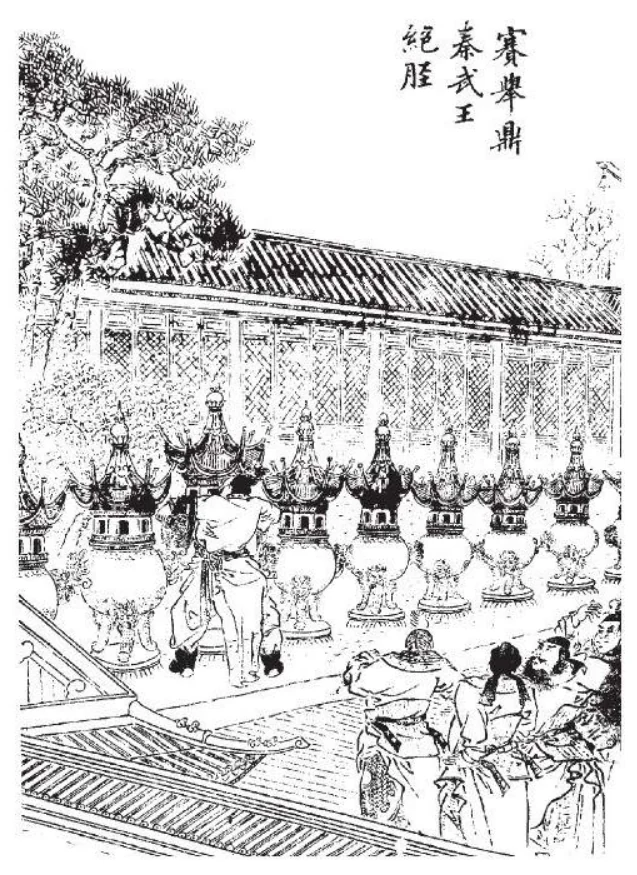
King Wu was competitive and prized displays of strength, and strongmen such as Meng Yue therefore held high office. In the eighth month of 307 BCE, the fourth year of his reign, King Wu competed with Meng Yue in lifting a red tripod decorated with dragons. His eyes bled, his shin was broken, and he died that night at the age of twenty-three. According to the Strategies of the Warring States, the physician Bian Que once treated King Wu and advised early intervention. King Wu hesitated after listening to close attendants, and Bian Que angrily threw down his needle, saying that the king discussed illness with those who understood medicine and then allowed ignorant men to ruin the treatment. From this, he said, one could understand Qin's internal government: one reckless action by the king might endanger the entire state. Although this story appears in the Strategies of the Warring States, it is nearly fifty years removed from the story of Bian Que visiting Duke Huan of Cai in the Han Feizi and may have been a mistaken tale transmitted by persuaders.
King Wu had no son. The ministers brought back his half-brother Prince Ji, who had been a hostage in Yan, and installed him as King Zhaoxiang of Qin. King Zhaoxiang's mother was from Chu, surnamed Mi, and was known as Queen Dowager Xuan. King Wu was buried at Yongling, south of Zhouling Village in present-day Zhouling Township, Xianyang, Shaanxi. King Wuling of Zhao sent Zhao Gu, chancellor of Dai Commandery, to escort Prince Ji back to Qin. Meng Yue, blamed for encouraging King Wu to lift the tripod, had his three clans exterminated.
Major Activities
Political Institutions
King Wu's most important political institution-building measure was the establishment of the Grand Councilor system. In 309 BCE, the second year of his reign, he divided the Qin office of state chancellor into separate Left and Right Grand Councilors, appointing Chuliji as Right Grand Councilor and Gan Mao as Left Grand Councilor. The source describes this as the first establishment of the Grand Councilor system in Chinese history and states that it continued for nearly sixteen hundred years until being abolished by Zhu Yuanzhang in the Ming dynasty. The measure refined Qin's central administration and had a lasting influence. King Wu also ordered Gan Mao and others to revise agricultural regulations, adjust territorial boundaries, dredge waterways, and build dikes and bridges, strengthening domestic governance.
Diplomacy
King Wu conducted active diplomacy. At the beginning of his reign he met King Xiang of Wei at Linjin to strengthen the Qin-Wei alliance, sent Chuliji to cultivate relations with Han envoys, and personally received an envoy from Yue, with whom he reached a secret agreement to attack Chu from two directions. These measures stabilized Qin's neighbors and reduced the possibility that they would exploit the accession of a new ruler. In 310 BCE, the first year of his reign, Han, Wei, Qi, Chu, and Yue came for different reasons to congratulate Ying Dang on his accession. King Wu personally received the Yue envoy and concluded the anti-Chu agreement. The same year, after Chen Zhuang rebelled in Shu, King Wu sent Gan Mao to suppress the rebellion and execute Chen Zhuang, preserving Qin control over the Ba-Shu region.
Military Campaigns
The major military operation of King Wu's reign was the attack on Yiyang in Han. Yiyang was a strategic Han stronghold that concentrated the manpower and wealth of Shangdang and Nanyang. Though called a county, the source describes it as effectively a commandery and as the most important barrier by which Zhou and Han blocked Qin's eastward advance. In 308 BCE, King Wu sent Gan Mao to attack it. After more than a year of campaigning, Qin captured Yiyang in 307 BCE and beheaded sixty thousand. Qin forces crossed the Yellow River, seized Wusui, and built a city there. King Xiang of Han was forced to send an envoy to apologize and negotiate peace. The victory opened Qin's route eastward into the Central Plains and is presented as an important foundation for later unification. King Wu also sent troops against Yiqu and Danli, strengthening the western frontier.
Travels
Important movements associated with King Wu included his meeting with King Xiang of Wei at Linjin, east of present-day Dali in Shaanxi, in 310 BCE. In 308 BCE he again met King Xiang of Wei outside Linjin; the source also records that the Wei River turned red for three days that year. After the capture of Yiyang in 307 BCE, he sent Chuliji with one hundred chariots ahead to the Zhou royal city, near present-day Wangcheng Park in Luoyang. King Nan of Zhou sent soldiers to line the road in a highly deferential welcome. King Wu later reached the Zhou royal city and competed with Meng Ben in lifting the dragon-patterned red tripod, suffering the fatal injury.
Relations with Contemporaries
King Wu's relations with his ministers were complex. He had disliked Zhang Yi since his time as crown prince and expelled him to Wei after accession. He favored the strongmen Wu Huo, Ren Bi, and Meng Ben, all of whom held high positions. He trusted Gan Mao and concluded the Covenant of Xirang with him, fully supporting his campaign against Han, which ultimately captured Yiyang. He also relied heavily on Chuliji. Chuliji's mother was from Han and King Wu's mother from Wei, so their political partnership also existed within a network of interstate marital ties. After King Wu's death, Chuliji helped install his half-brother Prince Ji as successor.
The other measures of his four years on the throne can be set out by year: in 310 BCE (first year of King Wu) he drove Zhang Yi and Wei Zhang to Wei, met King Xiang of Wei at Linjin, received envoys from Yue and concluded a secret agreement against Chu, sent Gan Mao to put down the revolt in Shu and kill Chen Zhuang, and attacked Yiqu and Danli; in 309 BCE (second year) he created the chancellorship and ordered Gan Mao and others to revise the field statutes and clear waterways; in 308 BCE (third year) Gan Mao went to Wei to form an alliance against Hann, the king and his minister swore the oath of Xirang, and Gan Mao and the senior officer Feng were sent against Yiyang; in 307 BCE (fourth year) the Qin army took Yiyang, killing sixty thousand and seizing Wusui, and in the eighth month of the same year he died of a broken knee while competing with Meng Yue in lifting the Longwen bronze cauldron, being buried at the Yong Mausoleum, his half-brother Gongzi Ji succeeding as King Zhaoxiang of Qin. The creation of the chancellorship, the oath of Xirang and the campaign at Yiyang are the three most concentrated pieces of business of his brief reign.
His reign lasted only four years, yet its measures were dense: the victory at Yiyang gave Qin the road into the Central Plain, while the creation of the chancellorship changed the structure of its central government thereafter.
After his death his half-brother Gongzi Ji came to the throne as King Zhaoxiang, under whom Qin continued to combine the chancellorship with campaigns abroad, the office becoming a permanent part of the Qin centre.
The arrangement of left and right chancellors he established continued after the Qin unification until it was abolished in the Ming, one of the longest-lived institutions in the history of Chinese officialdom.
The direction of his campaigns turned from the Central Plain towards the corridors leading to Hann and Wei: the victory at Yiyang gave Qin the road into the Central Plain, while the expulsion of Zhang Yi, the meeting with King Xiang of Wei at Linjin, the reception of the Yue envoys and the secret agreement against Chu show Qin using military and diplomatic means together in its dealings with the eastern states. The arrangement of left and right chancellors he established continued long after the Qin unification until its abolition in the Ming; after his death his half-brother Gongzi Ji came to the throne as King Zhaoxiang, under whom Qin continued to combine the chancellorship with campaigns abroad.
Personal Relations
- Grandfather: Duke Xiao of Qin
- Father: King Huiwen of Qin
- Mother: Empress Huiwen, a woman of Wei
- Half-brother: King Zhaoxiang of Qin, Ying Ji
- Wife: Queen of King Wu of Qin, a woman of Wei
- Gan Mao: Left Grand Councilor and commander in the campaign against Han; concluded the Covenant of Xirang with King Wu.
- Chuliji: Right Grand Councilor and senior Qin royal minister trusted by King Wu.
- Bian Que: famous physician said to have treated King Wu.
- Zhang Yi: disliked by King Wu since his time as crown prince and expelled to Wei after accession.
- Wu Huo: strongman and military figure favored by King Wu.
- Ren Bi: strongman and military figure favored by King Wu.
- Meng Ben (Meng Yue): strongman who competed with King Wu in lifting the tripod; after King Wu's death, Meng Yue's three clans were exterminated.
- Zhang Yi: conflict between ruler and minister; expelled.
- Chuliji and Gongsun Shi: opposed Gan Mao over the Han campaign and argued against attacking Yiyang.
Historical Assessment
Warring States and Qin Periods
- Jia Yi wrote in “The Faults of Qin”: after Duke Xiao died, Huiwen, Wu, and Zhaoxiang inherited his achievements and followed his policies, taking Hanzhong in the south, Ba and Shu in the west, fertile lands in the east, and strategic commanderies in the north. The passage places King Wu alongside King Huiwen and King Zhaoxiang as rulers who inherited Duke Xiao's achievements and expanded Qin territory.
- Sima Qian wrote in the “Basic Annals of Qin” of the Records of the Grand Historian that “King Wu was strong and loved contests.” The brief remark emphasizes his exceptional physical power while also implying criticism of his delight in reckless demonstrations of strength.
- The story of Bian Que and King Wu in the Strategies of the Warring States uses Bian Que's words to criticize King Wu for listening to close attendants and hesitating over medical advice, and predicts that reckless action could bring destruction to Qin. It reflects an early interpretation of weaknesses in King Wu's personality.
Han and Tang Periods
- Han scholars often assessed King Wu from the perspective of Qin's later unification, holding that he continued the expansionist policy begun under Duke Xiao and that taking Yiyang laid a foundation for Qin's eastward advance.
- The Tang historian Sima Zhen, in the Shiji Suoyin, cited the Shiben in calling him King Wulie of Qin and examined the variant posthumous titles applied to him, reflecting later concern with his historical status.
- Liu Zongyuan discussed Qin institutions in “Discourse on Feudalism.” Although he did not directly assess King Wu, the discussion touched on the Grand Councilor institution associated with his reign and argued that Qin's failures lay in defects of governance rather than simply in the virtue or incompetence of individual rulers.
Song, Yuan, Ming, and Qing Periods
- The Song historian Sima Guang recorded King Wu's activities in detail in the Zizhi Tongjian, including the Covenant of Xirang and the Battle of Yiyang, while maintaining a relatively objective narrative tone.
- In chapter 92 of Feng Menglong's Ming novel Chronicles of the Eastern Zhou States, “King Wu of Qin Breaks His Shin in a Tripod-Lifting Contest; King Huai of Chu Recklessly Attends a Meeting and Is Trapped in Qin,” King Wu is portrayed as relying on physical strength, competing recklessly, and possessing courage without sufficient judgment. His death while lifting the tripod became a later cautionary example against aggressive displays of bravery.
- The Qing thinker Wang Fuzhi, discussing King Wu in Du Tongjian Lun, argued that establishing the Grand Councilor offices and attacking Yiyang benefited Qin, but that the fatal tripod-lifting episode showed recklessness inconsistent with the qualities of an enlightened ruler.
Modern Period
- Modern historian Lü Simian, in History of the Pre-Qin Period, argued that although King Wu's reign was short, establishing the Grand Councilor offices and taking Yiyang both contributed to Qin's strength, and that his sudden death deprived Qin of a potentially active ruler.
- Lin Jianming, in Draft History of Qin, argues that King Wu's love of martial strength and his favor toward strongmen were consistent with Qin's martial tradition, while his death lifting the tripod exposed a lack of the self-restraint expected of a ruler.
- Contemporary scholars often assess King Wu from the perspective of institutional history, regarding the establishment of the Grand Councilor system as an important milestone in Chinese political institutions with deep influence on later periods.
FIGURES ASSOCIATED WITH THIS DYNASTY
Bibliography
- Sima Qian, Records of the Grand Historian, vol. 5, “Basic Annals of Qin”
- Sima Qian, Records of the Grand Historian, vol. 70, “Biography of Zhang Yi”
- Sima Qian, Records of the Grand Historian, vol. 71, “Biographies of Chulizi and Gan Mao”
- Chang Qu, Huayang Guozhi, vol. 3, “Records of Shu”
- Lü Simian, History of the Pre-Qin Period
- Lin Jianming, Draft History of Qin