Born in Xianyang Palace, the eldest legitimate son of King Huiwen of Qin and Queen Huiwen.
310 BCE–307 BCE
Monarch of the State of QinSecond sovereign to bear the royal title
King Wu of Qin (嬴荡)
嬴荡
Ying Dang (329 BC – August 307 BC), historically known as King Wu of Qin (秦武王), was a pivotal monarch of the State of Qin during the mid Warring States period. He was the eldest legitimate son of King Huiwen of Qin and Queen Huiwen. Endowed with colossal physical strength and a passionate fondness for martial prowess, King Wu possessed remarkable geopolitical strategic foresight. Upon his accession to the royal throne at age…
310 BCE–307 BCEQin Dynasty (秦朝)
PROFILE
Ying Dang (329 BC – August 307 BC), historically known as King Wu of Qin (秦武王), was a pivotal monarch of the State of Qin during the mid Warring States period. He was the eldest legitimate son of King Huiwen of Qin and Queen Huiwen. Endowed with colossal physical strength and a passionate fondness for martial prowess, King Wu possessed remarkable geopolitical strategic foresight. Upon his accession to the royal throne at age nineteen, he skillfully accommodated the departure of strategist Zhang Yi to the State of Wei, while pioneering the monumental administrative creation of the dual Chancellor system—appointing Chulizi as Right Chancellor and Gan Mao as Left Chancellor—which established the institutional cornerstone for bureaucratic centralization across the subsequent Qin and Han empires. Throughout his four-year reign, King Wu implemented assertive diplomatic and military initiatives that transformed Qin into the dominant superpower of the Central Plains. He dispatched Sima Cuo to quell internal rebellions in Shu, securing the agricultural hinterland of southwestern China. Abroad, he orchestrated alliances with Wei and Yue to neutralize the anti-Qin coalitions led by Chu and Qi. In 308 BC, King Wu entered into the renowned Covenant of Xirang with Left Chancellor Gan Mao, guaranteeing unyielding royal trust during the arduous siege of the Korean stronghold at Yiyang. Following a five-month campaign, Qin forces stormed Yiyang, severed the overland corridor between Han and Wei, and established Sanchuan Commandery at the gateway to the Zhou royal domain. In August 307 BC, while visiting the Zhou royal ancestral temple in Luoyi, King Wu attempted to lift the massive bronze Dragon Cauldron of the Nine Cauldrons, suffering fatal fractures to his shins and dying at age twenty-three. His aggressive expansion laid the strategic bedrock for Qin's eventual unification of China under his successor, King Zhaoxiang of Qin.
- Alternate Names
- King Wu of Qin, King Wulie of Qin, King Daowu of Qin
- Courtesy Name
- Not reliably confirmed
- Posthumous Name
- King Wu (later honored as King Wulie and King Daowu)
- Era / Period
- Warring States period
- Dynasty
- Qin State
- Identity
- Monarch of the State of Qin, Second sovereign to bear the royal title
- Ancestral Home / Place of Origin
- Xianyang, Guanzhong (modern Weicheng District, Xianyang, Shaanxi Province)
- Date of Birth
- 329 BC (King Xian of Zhou 40)
- Date of Death
- August 307 BC (King Nan of Zhou 8, Eighth Month)
- Reign Period
- 310 BC – 307 BC (Reigned 4 years; Era name: Gengyuan)
- Highest Office Held
- King of Qin (King Wu of Qin)
- Major Offices and Titles
- Crown Prince of Qin, King of Qin
LIFE TIMELINE
Accession to the Throne
King Huiwen passed away; nineteen-year-old Crown Prince Ying Dang ascended the royal throne and permitted Zhang Yi to depart for Wei.
Creation of the Dual Chancellorship
Pioneered the dual Left and Right Chancellor system, naming Chulizi Right Chancellor and Gan Mao Left Chancellor.
Covenant of Xirang and Shu Campaign
Dispatched Sima Cuo to crush the rebellion in Shu; swore the Covenant of Xirang with Gan Mao to launch the eastward campaign against Han.
Conquest of Yiyang and Tragic Demise
Stormed Yiyang, established Sanchuan Commandery, and entered Luoyi; died in August from injuries sustained while lifting the royal cauldron.
Relationship graph
BIOGRAPHY
Biography
Youth, Martial Character, and Royal Accession
Ying Dang was born in 329 BC in Xianyang Palace as the eldest legitimate son of King Huiwen of Qin. From early youth, he was celebrated for his imposing physical stature, muscular vitality, and formidable bodily strength. Passionately devoted to martial exercises and military tactics, Ying Dang disdained the rhetorical sophistry of itinerant political persuaders. When King Huiwen passed away in 311 BC, the nineteen-year-old Crown Prince ascended the throne as King Wu of Qin. Recognizing that court ministers resented the political dominance of chief strategist Zhang Yi, King Wu astutely leveraged ministerial remonstrance to permit Zhang Yi to resign and relocate to Wei, thereby securing administrative transition without destabilizing the central court.
Diplomatic Counter-Alliances and Pacification of Shu
Surrounded by adversarial feudal states seeking to exploit the royal succession, King Wu demonstrated shrewd diplomatic maneuver. He met King Xiang of Wei at Linjin to cement formal friendship, while sending envoys to Qi and Chu to disassemble hostile coalitions. Simultaneously, King Wu forged secret diplomatic pacts with Yue in the southern coastal regions to threaten Chu's rear flank. Domestically, when Chen Zhuang assassinated the Marquis of Shu and attempted to secede in 310 BC, King Wu dispatched General Sima Cuo and Gan Mao over the rugged Qinling trails to crush the insurrection. The swift execution of Chen Zhuang firmly integrated the Sichuan basin into Qin's administrative domain, securing a vast agricultural granary to fuel future military expansion.
The Covenant of Xirang and Strategic Thrust Eastward
King Wu harbored the profound ambition to peer into the Zhou royal house, link the Sanchuan corridor, and dominate the Central Plains. In 308 BC, King Wu held secret strategic deliberations with Left Chancellor Gan Mao regarding an assault on Yiyang, the vital mountain fortress of the State of Han. Gan Mao cautioned that Yiyang was heavily fortified and that an extended siege would provoke slanderous obstruction from conservative factions at court. Responding with decisive conviction, King Wu made a solemn sacrificial pact with Gan Mao at Xirang, vowing never to heed court slanders or withdraw the armies until victory was achieved. Reassured by this royal vow, Gan Mao led allied Qin and Wei forces eastward across the Hangu Pass.
The Siege of Yiyang and Creation of Sanchuan Commandery
The siege of Yiyang turned into a protracted five-month trial of attrition. As expected, Right Chancellor Chulizi and royal kinsmen petitioned the throne to terminate the expedition. King Wu faithfully honored the Covenant of Xirang, firmly refusing to withdraw Gan Mao and instead mobilizing fifty thousand elite Guanzhong infantry and cavalry reinforcements to bolster the frontline. Reinvigorated by fresh troops, Qin forces launched a relentless assault in 307 BC, slaying sixty thousand Han defenders and capturing Yiyang. Following this monumental victory, Qin forces crossed the Yellow River to fortify Jiaocheng, forcing the King of Han to cede territory and sue for peace. King Wu promptly organized the conquered territory into Sanchuan Commandery, positioning Qin forces directly opposite the Zhou royal capital.
The Cauldron Incident at Luoyi and Early Demise
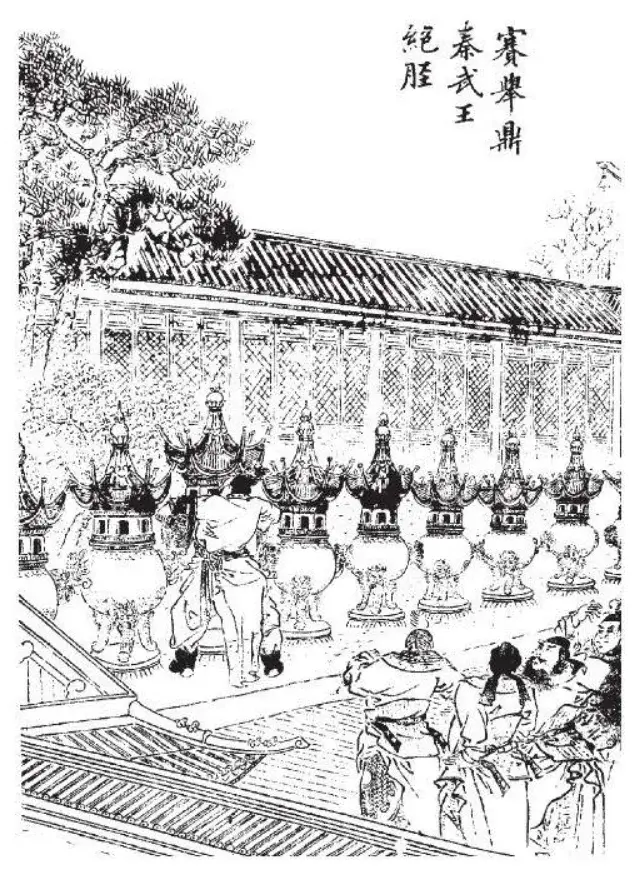
In August 307 BC, King Wu led Left Chancellor Gan Mao and an entourage of military strongmen into the Eastern Zhou capital of Luoyi. King Nan of Zhou received the Qin monarch with deferential dread. King Wu entered the Zhou ancestral temple and inspected the sacred Nine Cauldrons, inquiring of his attendants whether anyone could raise the colossal Dragon Cauldron. Court strongman Meng Yue attempted the feat, managing only to shift the vessel slightly. Driven by youthful pride and martial vigor, King Wu removed his armor and personally seized the cauldron handles. Though he managed to lift the massive bronze vessel off the stone pavement, his footing gave way; the cauldron crashed down upon his right leg, crushing his tibia and inducing massive hemorrhaging. He succumbed to his wounds that night in Luoyi at the age of twenty-three.
Major Achievements
Pioneer of the Left and Right Chancellorship
King Wu made foundational contributions to Chinese administrative institutional history. In 309 BC, he abolished the singular Xiangguo office established during Shang Yang's legalist reforms and inaugurated the dual Left and Right Chancellor structure. By appointing royal clansman Chulizi as Right Chancellor and foreign-born strategist Gan Mao as Left Chancellor, King Wu established a balanced division of civil administration and military planning. This dual executive structure prevented ministerial monopolization of royal authority while enhancing state execution, providing the organizational model for central imperial governance throughout the Qin and Han eras.
Land Law Revisions and Waterway Infrastructure
In socioeconomic policy, King Wu carried out pragmatic reforms tailored to Qin's expanding frontiers. He revised the agrarian legal codes originally promulgated by Shang Yang, strictly delineating arable field boundaries and offering fiscal incentives for peasant reclamation in Guanzhong and Shu. Furthermore, he directed extensive dyke renovations along the Yellow and Wei rivers and dredged navigational canals, dramatically reducing transport costs for military logistical supply lines. These infrastructure investments substantially enhanced Qin's grain reserves, furnishing the fiscal resilience required for King Zhaoxiang's subsequent continental campaigns.
Establishing the Foothold for Imperial Unification
Although early historiography frequently characterized King Wu as reckless due to the cauldron lifting tragedy, his substantive achievements established the essential geopolitical conditions for China's imperial unification. In four brief years, he stabilized central governance, crushed regional separatism in Shu, secured agricultural security, and established Sanchuan Commandery astride the strategic throat of the Central Plains. Han dynasty scholar Jia Yi ranked King Wu alongside King Huiwen and King Zhaoxiang as one of the visionary rulers who inherited the legacy of the six generations to overwhelm the feudal realms.
Personal Relationships
- Grandfather: Duke Xiao of Qin (Ying Quliang), visionary ruler who sponsored Shang Yang's legalist reforms.
- Father: King Huiwen of Qin (Ying Si), first monarch of Qin to adopt the royal title.
- Mother: Queen Huiwen, noblewoman of Wei and primary consort of King Huiwen.
- Half-Brother: King Zhaoxiang of Qin (Ying Ji), who succeeded King Wu and reigned for fifty-six years.
- Half-Brothers: Prince Shi and Prince Kui.
- Queen Consort: Queen of King Wu of Qin, royal princess of Wei who returned to Wei after King Wu's death without issue.
- Royal Uncle and Right Chancellor: Chulizi (Ying Ji), esteemed statesman celebrated for profound administrative wisdom.
- Left Chancellor: Gan Mao, brilliant military commander who conquered Yiyang and co-architect of Sanchuan Commandery.
- Political Advisor: Zhang Yi, master coalition strategist who departed for Wei following King Wu's accession.
- Court Strongmen: Meng Yue, Wu Huo, and Ren Bi, renowned wrestlers elevated to high rank.
Historical Assessment
- Jia Yi writes in On the Faults of Qin: Duke Xiao of Qin held the stronghold of Hangu Pass and possessed the land of Yongzhou. King Huiwen, King Wu, and King Zhaoxiang followed the established foundation and continued the inherited policies, taking Hanzhong in the south, capturing Ba and Shu in the west, acquiring fertile lands in the east, and annexing strategic commanderies in the north. Jia Yi decisively places King Wu among the key architects of Qin's imperial ascent.
- Sima Qian records in Records of the Grand Historian: King Wu was possessed of mighty physical vigor and favored martial spectacles. Strongmen like Ren Bi, Wu Huo, and Meng Yue all attained eminent ministerial offices. When the King attempted to lift the bronze cauldron with Meng Yue, his shins were fractured, and he expired in the eighth month. This account preserves both his extraordinary physical energy and the tragic circumstance of his untimely death.
- Sima Guang evaluates in Comprehensive Mirror for Aid in Government: King Wu of Qin dispatched Gan Mao to ally with Wei and strike Han. Mao successfully stormed Yiyang, severing sixty thousand heads, crossing the Yellow River to fortify Jiaocheng, whereupon King Xiang of Han sent envoys to tender apologies and sue for peace. Sima Guang underscores King Wu's unwavering strategic constancy and royal faithfulness to his generals during the critical breakthrough into central China.
Related Entries
- King Huiwen of Qin
- King Zhaoxiang of Qin
- Shang Yang Reforms
- Battle of Yiyang
- Sanchuan Commandery
FIGURES ASSOCIATED WITH THIS DYNASTY
Bibliography
- Shiji (Records of the Grand Historian), Volume 5: Basic Annals of Qin
- Shiji (Records of the Grand Historian), Volume 71: Biographies of Chulizi and Gan Mao
- Zhanguoce (Strategies of the Warring States), Volume 4: Strategies of Qin II
- Zizhi Tongjian (Comprehensive Mirror for Aid in Government), Volume 3: Zhou Chronicle III