Birth | Birth; the place is not recorded; ruler of Qin
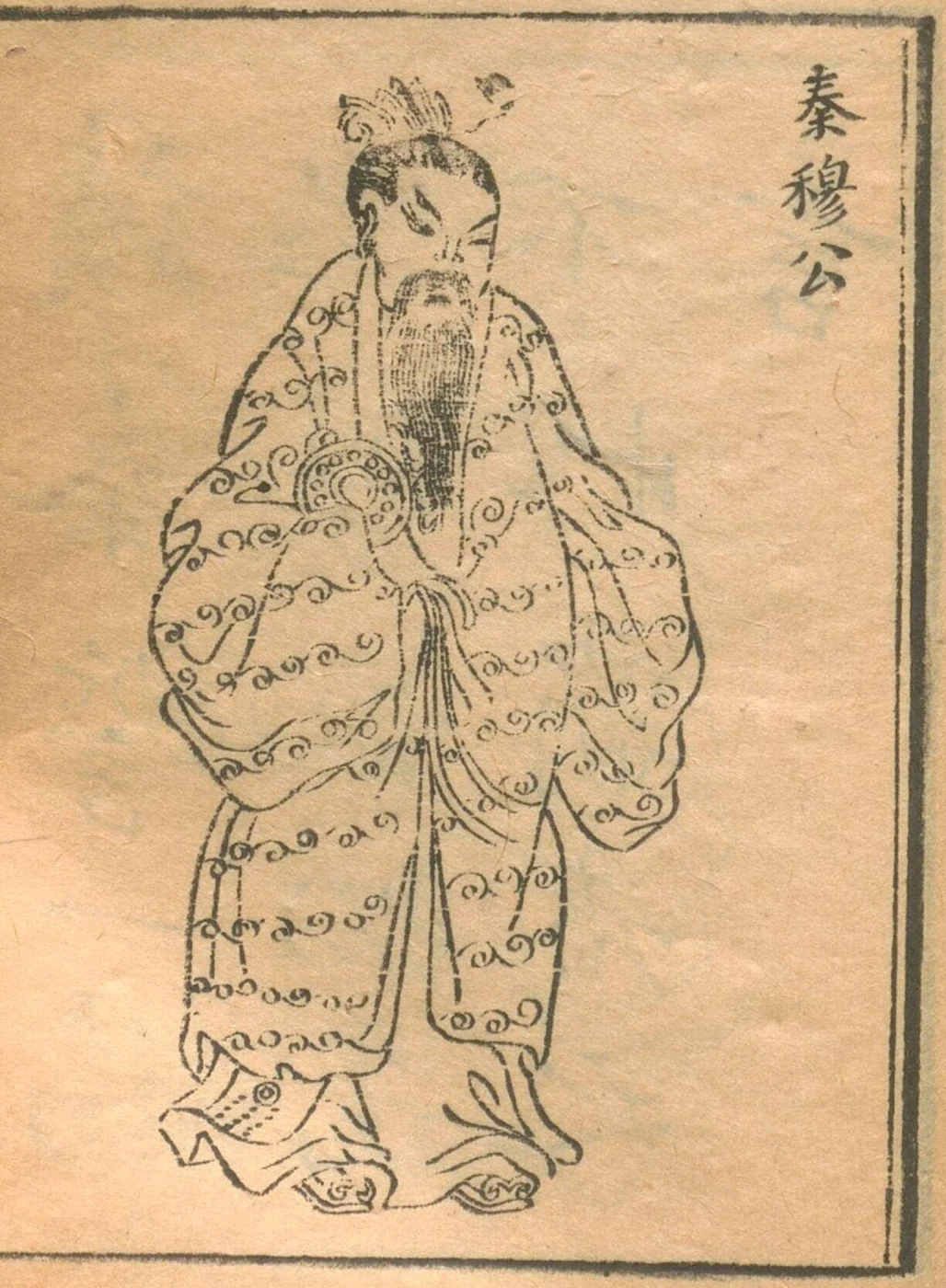
659 BCE–621 BCE
Ruler of the state of Qin
Ying Renhao
嬴任好
Counted among the Five Hegemons of the Spring and Autumn period, Ying Renhao expanded Qin's influence among the Western Rong, maintained a complex alliance and rivalry with Jin, and recruited capable men such as Baili Xi and Jian Shu, ultimately establishing Qin's dominance in the west.
659 BCE–621 BCEQin Dynasty
PROFILE
Counted among the Five Hegemons of the Spring and Autumn period, Ying Renhao expanded Qin's influence among the Western Rong, maintained a complex alliance and rivalry with Jin, and recruited capable men such as Baili Xi and Jian Shu, ultimately establishing Qin's dominance in the west.
- Alternative Name
- Ying Renhao
- Period
- Qin
- Date of Birth
- 705 BCE
- Date of Death
- 621 BCE
- Dynasty/Polity
- Qin
- Identity
- Ruler of the state of Qin
- Ethnicity
- Not recorded in historical sources
- Native Place
- Not recorded in historical sources
- Place of Birth
- Not recorded in historical sources
- Place of Death
- Not recorded in historical sources
- Reign
- 659–621 BCE
- Predecessor
- Duke De of Qin
- Successor
- Duke Kang of Qin
- Era Name
- Not applicable; years were counted by the reign of Duke Mu of Qin
- Temple Name
- Not applicable; pre-Qin rulers did not use the later temple-name system
- Posthumous Name
- Mu
- Highest Office
- See Biography and Major Deeds
- Major Achievements
- Counted among the Five Hegemons of the Spring and Autumn period; managed relations with the Western Rong and Jin; recruited capable men including Baili Xi and Jian Shu and established Qin's hegemony in the western frontier
LIFE TIMELINE
Duke De died and Ying Renhao's elder brother Duke Xuan succeeded. | Duke De died and Ying Renhao's elder brother Duke Xuan succeeded.
Duke Xuan died and another elder brother | Duke Xuan died and another elder brother, Duke Cheng, succeeded.
Duke Cheng died and Ying Renhao succeeded as ruler. | Duke Cheng died and Ying Renhao succeeded as ruler.
Personally led troops against the Rong of Maojin and won. | Personally led troops against the Rong of Maojin and won.
Married Mu Ji | Married Mu Ji, elder sister of Jin crown prince Shensheng.
Ransomed Baili Xi from Chu with five black ram skins and appointed him Wugu Dafu | Ransomed Baili Xi from Chu with five black ram skins and appointed him Wugu Dafu; also invited Jian Shu and appointed him Senior Grand Master.
After Duke Xian of Jin died and Jin fell into disorder | After Duke Xian of Jin died and Jin fell into disorder, sent Baili Xi with troops to escort Prince Yiwu back to Jin, where he became Duke Hui.
Duke Hui broke his promise to cede eight cities west of the Yellow River and killed Pi Zhe | Duke Hui broke his promise to cede eight cities west of the Yellow River and killed Pi Zheng; Pi Zheng's son Pi Bao fled to Qin and was quietly employed by Duke Mu.
Joined Duke Hui of Jin in sending troops against the Rong to assist the Zhou court. | Joined Duke Hui of Jin in sending troops against the Rong to assist the Zhou court.
During a severe famine in Jin | During a severe famine in Jin, accepted the advice of Baili Xi and Gongsun Zhi and sent grain to Jin in the “Campaign of Floating Boats.”
Qin suffered famine and Duke Hui of Jin refused to sell grain. | Qin suffered famine and Duke Hui of Jin refused to sell grain.
At the Battle of Hanyuan heavily defeated Jin and captured Duke Hui | At the Battle of Hanyuan heavily defeated Jin and captured Duke Hui; later released him, after which Jin ceded eight cities west of the Yellow River and Crown Prince Yu became a hostage in Qin.
Destroyed the states of Liang and Rui. | Destroyed the states of Liang and Rui.
Duke Hui died | Duke Hui died; Crown Prince Yu escaped back to Jin and became Duke Huai.
Sent troops to escort Prince Chong'er back to Jin | Sent troops to escort Prince Chong'er back to Jin, killed Duke Huai, and installed Chong'er as Duke Wen.
Joined Duke Wen in besieging Zheng but withdrew unilaterally after being persuaded by Zhu | Joined Duke Wen in besieging Zheng but withdrew unilaterally after being persuaded by Zhu Zhiwu.
Duke Wen of Jin died. | Duke Wen of Jin died.
Sent Meng Mingshi | Sent Meng Mingshi, Xiqi Shu, and Baiyi Bing on a surprise attack against Zheng; the attempt failed and the Qin army was destroyed at the Battle of Xiao, with all three commanders captured and later released at Wen Ying's request.
Meng Mingshi attacked Jin and was again defeated at the Battle of Pengya. | Meng Mingshi attacked Jin and was again defeated at the Battle of Pengya.
Personally campaigned against Jin | Personally campaigned against Jin, burned the boats after crossing the Yellow River, and defeated Jin at the Battle of Wangguan, avenging the defeat at Mount Xiao.
Used You Yu's strategy to attack the Western Rong | Used You Yu's strategy to attack the Western Rong, gained the submission of twelve states and expanded Qin's territory by a thousand li; King Xiang of Zhou bestowed gold drums and recognized him as hegemon of the western lords.
Death | Died and was buried at Yongcheng; 177 people were buried as human sacrifices, including the three worthy men of the Ziyu clan, for whom the people of Qin composed “Yellow Bird.”
BIOGRAPHY
Biography
Family Background and Accession
Duke Mu of Qin was the youngest son of Duke De of Qin. After Duke De died in 676 BCE, his eldest son Duke Xuan succeeded. Duke Xuan reigned for twelve years and died in 664 BCE. None of his nine sons was installed; instead, the ministers placed his younger brother Duke Cheng on the throne. Duke Cheng reigned four years and died in 660 BCE. Again, none of his seven sons was installed, and the ministers selected his younger brother Ying Renhao, who became Duke Mu. When he succeeded, Qin had experienced several generations of internal succession and remained relatively weak, with powerful Jin to the east and numerous Rong groups to the west.
Recruiting Capable Men
In 659 BCE Duke Mu personally led an attack against the Rong of Maojin and won, establishing an initial military reputation. In 656 BCE he married Mu Ji, elder sister of Crown Prince Shensheng of Jin, creating a marriage alliance with Jin.
In 655 BCE, Duke Xian of Jin destroyed Yu and Guo and captured Baili Xi, an official of Yu, sending him to Qin as one of Mu Ji's dowry servants. Baili Xi escaped on the way and reached Wan in Chu, where he was captured by frontier inhabitants. Duke Mu heard of his abilities and wished to ransom him with a large sum, but feared that Chu would recognize his value and refuse. He therefore sent men to claim Baili Xi as an escaped dowry slave and obtained him in exchange for five black ram skins. Baili Xi was then over seventy. Duke Mu freed him and asked him about state affairs. Baili Xi replied, “I am a minister of a destroyed state; what is there to ask of me?” Duke Mu answered that Yu had fallen because its ruler had failed to employ him, not because of Baili Xi's fault. The two spoke for three days, and Duke Mu was delighted. He entrusted state affairs to Baili Xi, who became known as the “Wugu Dafu.”
Baili Xi in turn recommended his friend Jian Shu, describing him as worthy but unknown to the world and recounting occasions when he had avoided disaster by following Jian Shu's advice and suffered hardship when he ignored it. Duke Mu sent generous gifts to invite Jian Shu to Qin and appointed him Senior Grand Master. Pi Bao, son of the Jin official Pi Zheng, later fled to Qin after Duke Hui of Jin killed his father. Although Duke Mu did not openly accept Pi Bao's proposal to attack Jin, he quietly employed him.
Maneuvering in Relations with Jin
In 651 BCE, after Duke Xian of Jin died, Jin fell into succession conflict. Xiqi, son of Li Ji, was killed by Li Ke; Xun Xi installed Zhuozi, who was also killed by Li Ke. Prince Yiwu, on the advice of Que Rui, asked Qin to help him return and promised to cede eight cities west of the Yellow River. Duke Mu agreed and sent Baili Xi with troops to escort Yiwu back. In 650 BCE Yiwu became Duke Hui of Jin but immediately broke his promise to cede the eight cities and later killed Li Ke. While Pi Zheng was on a mission to Qin, he plotted with Duke Mu to summon Lü Sheng and Que Rui to Qin and replace Duke Hui with Chong'er. The plan was exposed, Pi Zheng was killed, and his son Pi Bao fled to Qin.
In 648 BCE Jin suffered severe drought and asked Qin for grain. Pi Bao urged Duke Mu to attack while Jin was starving. Duke Mu consulted Gongsun Zhi, who argued that harvest and famine alternated and grain should not be withheld. Baili Xi added: “Yiwu has offended Your Lordship, but what offense have his people committed?” Duke Mu accepted their advice and sent large quantities of grain from Yong to Jiang by boat and cart in what became known as the “Campaign of Floating Boats.”
In 646 BCE Qin itself suffered famine and requested grain from Jin. Duke Hui, following Guo She's advice, not only refused but attacked Qin during the famine. In September 645 BCE the two states fought at Hanyuan. Duke Mu, pursuing Duke Hui, was surrounded and wounded. More than three hundred men from Qixia who had once stolen and eaten Duke Mu's fine horses rushed into the Jin lines and fought desperately to rescue him, enabling Qin to reverse the battle and capture Duke Hui.
Duke Mu considered sacrificing Duke Hui to Heaven, but the Zhou king interceded on the ground that Jin shared the royal Ji surname, and Mu Ji, Duke Hui's sister, put on mourning clothes and pleaded for him. Duke Mu finally made a covenant with Duke Hui at Wangcheng and released him. Jin ceded the eight cities west of the Yellow River and sent Crown Prince Yu as a hostage; Duke Mu married a woman of his clan to the prince. Qin's eastern boundary now reached the Yellow River.
In 641 BCE Qin destroyed Liang and Rui. In 638 BCE Duke Hui died and Crown Prince Yu escaped from Qin back to Jin, becoming Duke Huai. In 637 BCE Duke Mu sent troops to escort Chong'er, who had lived in exile for nineteen years, back to Jin, killed Duke Huai, and installed Chong'er as Duke Wen. The Qin–Jin alliance was briefly restored.
In 636 BCE Qin and Jin jointly besieged Zheng. The Zheng official Zhu Zhiwu was lowered from the city by night and persuaded Duke Mu that Jin's expansion would ultimately come at Qin's expense, asking: “What limit has Jin's appetite? Having made Zheng its eastern border, it will next extend its western border. If it does not diminish Qin, where can it take the land?” Duke Mu then made a separate alliance with Zheng, withdrew his troops, and left Qizi, Fengsun, and Yangsun to garrison Zheng.
Defeat at Mount Xiao and Revenge
After Duke Wen of Jin died in 630 BCE, Duke Mu again sought to push eastward. Despite the objections of Jian Shu and Baili Xi, in 627 BCE he sent Meng Mingshi, Xiqi Shu, and Baiyi Bing on a long-distance surprise attack against Zheng. At Hua they encountered the Zheng merchant Xian Gao, who presented twelve cattle to the Qin army as if on behalf of Zheng, thereby implying that Zheng was prepared. The Qin commanders abandoned the attack on Zheng, destroyed Hua, and turned back. Jin learned that the Qin army was returning and Duke Xiang of Jin set an ambush at Mount Xiao, southeast of present-day Sanmenxia in Henan. The Qin army was annihilated and all three commanders were captured. Duke Xiang's mother Wen Ying, a daughter of Duke Mu, asked that the men be released, and he agreed.
When the three returned to Qin, Duke Mu went outside the capital in plain mourning clothes to meet them and accepted responsibility: “Because I failed to follow the words of Baili Xi and Jian Shu, I brought humiliation upon the three of you. What crime have you committed? Devote yourselves to avenging this disgrace and do not slacken.” He continued to employ Meng Mingshi.
In 626 BCE Meng Mingshi again attacked Jin and was defeated at Pengya. Duke Mu still did not punish him and continued to trust him. In 624 BCE Duke Mu personally campaigned against Jin. After crossing the Yellow River he burned the boats to show determination to fight to the end. Qin captured Wangguan and its outskirts, while Jin refused to leave its defenses. The Qin army then crossed at Maojin, reached the former battlefield at Mount Xiao, raised markers over the dead, delivered an oath before the army, and returned. The campaign was presented as avenging the humiliation of Mount Xiao, after which Duke Mu concentrated on western expansion.
Hegemony over the Western Rong
Numerous Rong groups, including Mianzhu, Yiqu, Dali, Wushi, and Quyan, lived across the Longxi and Longdong regions, each with its own ruler and often raiding Qin's frontier. The ruler of Mianzhu, hearing of Duke Mu's reputation, sent You Yu as an envoy to Qin. Duke Mu received him with great ceremony, showed him Qin's palaces and stores, and questioned him about the geography and forces of the Western Rong. On the advice of the official Liao, Duke Mu detained You Yu in Qin while sending sixteen female musicians to the ruler of Mianzhu. The ruler became absorbed in entertainment and neglected government, throwing his state into disorder. Duke Mu then allowed You Yu to return. When his remonstrance failed, You Yu defected to Qin. Duke Mu treated him as an honored guest and discussed strategy against the Rong.
In 623 BCE, the thirty-seventh year of Duke Mu, Qin forces attacked the Western Rong, quickly surrounded Mianzhu, and captured its ruler alive. Pressing the advantage, Qin obtained the submission of twelve small Rong states. Its territory expanded by a thousand li, reaching the Qinling Mountains in the south, Didao, present-day Lintao in Gansu, in the west, the Quyan Rong around present-day Yanchi in Ningxia in the north, and the Yellow River in the east. King Xiang of Zhou sent Duke Shao Guo with gold drums and recognized Duke Mu as hegemon of the western lords, establishing his hegemony over the Western Rong.
Death and Human Sacrifice
Duke Mu died in 621 BCE and was buried at Yongcheng, southeast of present-day Fengxiang in Shaanxi. A total of 177 people were buried as human sacrifices, including the three worthy men Yanxi, Zhonghang, and Zhenhu of the Ziyu clan. The Zuo Tradition, under the sixth year of Duke Wen, records: “Duke Renhao of Qin died and used the three sons of the Ziche clan—Yanxi, Zhonghang, and Zhenhu—as sacrificial burials. All were worthy men of Qin, and the people mourned them.” The poem “Yellow Bird” in the Book of Songs was associated with this event and lamented, “O vast blue Heaven, you destroy our good men.” The source presents this large-scale sacrifice as having depleted Qin's human talent and harmed subsequent development.
His Accession and His Search for Talent
Duke Mu of Qin, named Renhao, of the Ying surname and the Zhao lineage, was a son of Duke De of Qin and younger brother of Duke Xuan and Duke Cheng, the ninth ruler of Qin, reigning from 659 to 621 BC. Having come to the throne in the fourth year of Duke Cheng, he ransomed the worthy Baili Xi from Chu with five black ramskins and made him the grandee of the five ramskins, and on Baili Xi's recommendation invited Jian Shu with rich gifts to be grandee of the first rank, while secretly employing Pi Bao, who had fled from Jin. In the fifth year of Duke Mu, Duke Xian of Jin destroyed Yu and Guo and took the lord of Yu and his grandee Baili Xi prisoner; and Baili Xi, sent to Qin as a slave among the dowry, fled from Qin to Wan and was seized by men of the Chu frontier. Duke Mu, hearing that Baili Xi was worthy, wished to ransom him with a heavy sum but feared the men of Chu would not part with him, and so sent to tell them that his own dowry servant Baili Xi was with them and that he asked to ransom him with five black ramskins; and the men of Chu allowed it, Baili Xi being then over seventy. Duke Mu released him from prison and spoke with him of the state's affairs, and Baili Xi excused himself, saying that he was the servant of a fallen state and not worth asking; and Duke Mu said that the lord of Yu had not employed him and so Yu had fallen, and that it was no fault of his. And pressing him, he spoke with him for three days, at which Duke Mu was greatly pleased and gave him the government of the state, calling him the grandee of the five ramskins. Baili Xi declined, saying that he was not the equal of his friend Jian Shu, who was worthy and unknown to the world; and he recounted how Jian Shu had twice dissuaded him and he had escaped by listening, and once he had not listened and met the disaster of the lord of Yu. So Duke Mu sent men with rich gifts to welcome Jian Shu and made him grandee of the first rank.
The Battle of Hanyuan and the Duke of Hui of Jin
In the ninth year of Duke Mu, Duke Xian of Jin died and Li Ke killed Xi Qi and Zhuo Zi, and Jin fell into disorder; and Yiwu sent to ask Qin to bring him into Jin, and Duke Mu agreed and sent Baili Xi with troops to escort Yiwu. Yiwu had promised to cede to Qin the eight cities west of the Yellow River, but once established he broke faith and gave no cities but killed Li Ke. After Pi Zheng's death his son Pi Bao fled to Qin and urged Duke Mu to attack Jin, and Duke Mu said that if the people found him no good, why could he kill their great ministers, and that to be able to kill their great ministers showed that they were in accord; and he would not listen, though he secretly used Pi Bao. In the fourteenth year Qin suffered famine and asked Jin for grain, and the lord of Jin consulted his ministers, and Guo She said that they should take the chance of the famine to attack, and the lord of Jin followed him; and in the fifteenth year Jin raised troops to attack Qin, and Duke Mu sent out his army, making Pi Bao commander and going himself against them. On the day renxu of the ninth month he joined battle with Duke Hui of Jin, Yiwu, at Han, and the lord of Jin, leaving his army to contend for advantage with Qin, turned back with his horses mired; and Duke Mu with his household galloped after him, could not take the lord of Jin, and was himself surrounded by the Jin army, which attacked Duke Mu and wounded him. Thereupon the three hundred men of Qixia who had eaten his fine horses dashed against the Jin army, and the Jin lines broke, so that Duke Mu escaped and the lord of Jin was taken alive. For when Duke Mu had lost a fine horse, more than three hundred rustics of Qixia had found and eaten it, and the officers seized them meaning to punish them, and Duke Mu said that a gentleman did not harm men for the sake of livestock, and that he had heard that to eat the flesh of a fine horse without drinking wine would harm a man; and he gave them wine and pardoned them. And these three hundred, hearing that Qin was attacking Jin, all begged to go, and seeing Duke Mu in straits they all pressed forward to die for him in requital of his kindness about the horse. So Duke Mu took the lord of Jin home, and proclaimed in the state that all should fast and lodge alone, for he would sacrifice the lord of Jin to the high god; and the Son of Heaven, hearing it, said that Jin was of his own surname and pleaded for the lord of Jin. And the sister of Yiwu being Duke Mu's wife, she, hearing of it, put on mourning and went barefoot, and taking the heir Ying, the prince Hong and her daughter Jianbi, climbed a terrace and stood on faggots ready to burn herself, sending men in mourning clothes to meet Duke Mu and say that if the lord of Jin entered the capital in the morning she would die in the evening, and if in the evening she would die in the morning. So Duke Mu lodged the lord of Jin at the Ling terrace. And Gongsun Zhi said that they should send him home and take his heir as hostage, which would be a great gain, for Jin could not yet be destroyed and to kill its lord would only make evil; and Duke Mu said that to take the lord of Jin was a rich return, but that if he then went home in mourning what use was it, and that the men of Jin grieved to lay weight on him and Heaven and earth had bound him by oath, and that to increase anger was hard to bear and to break faith with Heaven inauspicious, and that he must send the lord of Jin home. So peace was made with Jin, and in the eleventh month the lord of Jin, Yiwu, was sent home, and he ceded the land west of the river, and sent his heir Yu as hostage to Qin, and Qin gave him a princess in marriage; and at that time the land of Qin reached east to the river.
The Setting up of Duke Wen of Jin and the Siege of Zheng
In the thirteenth year of Duke Hui of Jin he fell ill, and the heir Yu fled home to Jin, and in the fourteenth year Duke Hui died and the heir Yu was set up, being Duke Huai. Because Yu had fled, Qin resented him, and sought the prince Chong'er to bring him in; and Duke Huai, fearing Qin's attack, ordered that all in the state who had followed Chong'er into exile should be given a term to return, and that those who did not return by the term should have their families destroyed. Hu Tu's sons Mao and Yan, who followed Chong'er in Qin, would not come at the summons, and Duke Huai in anger imprisoned Hu Tu, who would not recall his sons, and Duke Huai at last killed him. So Duke Mu sent troops to escort Chong'er in, and had the parties of Luan and Xi as his men within, and killed Duke Huai at Gaoliang and brought in Chong'er, who was set up as Duke Wen. Chong'er, coming to Qin, Duke Mu gave him five princesses of the clan, and Chong'er would not accept them, and the master of works Ji Zi said that since they were about to attack his state, how much more his former wife, and that he should accept them to bind himself to Qin and seek to enter his state, and not to cling to small propriety and forget the great shame; and so he accepted, and Duke Mu was much pleased and drank with him; and Zhao Cui sang the poem of the black millet, and Duke Mu said that he knew he wished to return home quickly, and Zhao Cui and Chong'er descended and bowed twice and said that the orphan subject looked up to their lord as the hundred grains look for the season's rain. Duke Mu also once had his army on the river, meaning to bring in King Xiang of Zhou, and was stopped by Duke Wen of Jin's bringing him in. In the ninth month of the thirtieth year of Duke Xi, the lord of Jin and the earl of Qin besieged Zheng because it had been rude to Jin and was of two minds toward Chu, the Jin army at Hanling and the Qin army south of the Fan; and Yizhi Hu told the earl of Zheng that the state was in danger, and that if he sent Zhu Zhiwu to see the lord of Qin the army would surely withdraw. And Zhu Zhiwu was let down by night from the wall and saw Duke Mu, saying that if he spared Zheng and made it the host of the eastern road, so that when envoys came and went Zheng supplied their wants, he would suffer no harm; and that he had once done a kindness to the lord of Jin, who had promised him Jiao and Xia and yet on the morning of his crossing the river had set up his ramparts in the evening, as he well knew; and that Jin would never be satisfied, for having made Zheng its eastern border it would wish to extend its western border, and unless it took from Qin whence could it take; and that to take from Qin for the profit of Jin was a thing for him to consider. Duke Mu was pleased, made a league with the men of Zheng, and left Qi Zi, Feng Sun and Yang Sun to guard it, and withdrew.
The Battle of Yao and the Campaign of Wangguan
In the winter of the thirty-second year of Duke Mu, Duke Wen of Jin died. A man of Zheng offered to betray Zheng to Qin, saying that he held the city gate and Zheng might be surprised; and Duke Mu asked Jian Shu and Baili Xi, who answered that to go a thousand li through several states to surprise men seldom brought gain, and that if a man sold Zheng how could one know that a man of Qin would not tell Zheng of their plans; but Duke Mu said that they did not understand and that he had decided. So he sent the army, making Baili Xi's son Mengmingshi, Jian Shu's son Xiqishu and Baiyibing generals. On the day of their going Baili Xi and Jian Shu wept over them, and Duke Mu in anger asked why they wept to check his army; and the two elders said that they dared not check his army, but that their sons went with it and they were old and feared not to see them again when they returned late; and going out they told their sons that if the army were beaten it would surely be at the defile of Yao. In the spring of the thirty-third year the Qin army went east, passing through Jin's land and the northern gate of Zhou, and Wangsun Man said that the Qin army was light and without propriety and must be beaten. Coming to Hua, the Zheng merchant Xian Gao, taking twelve oxen to sell in Zhou, saw the Qin army and, feigning the command of the earl of Zheng, entertained them, saying that their lord had long heard of the great state's coming and had sent him with twelve oxen to feast the soldiers, and sent a man in haste to tell Zheng; and the earl of Zheng had the guest house watched and found the bundles bound, the weapons sharpened and the horses fed, and sent Huang Wuzi to take leave of them, at which Qi Zi fled to Qi and Feng Sun and Yang Sun to Song. Mengming said that Zheng was prepared and there was no hope, that to attack would not take it and to besiege it could not be maintained, and that they had best return; and they destroyed Hua and went back. At that time Duke Wen of Jin was not yet buried, and Xian Zhen told Duke Xiang that the Qin army must be struck and asked leave to strike it; and so orders were issued, the Jiang Rong were swiftly raised, and the duke wore black mourning; and on the day xinsi of the fourth month of summer they beat the Qin army at Yao and took Baili Mengmingshi, Xiqishu and Baiyibing alive. Duke Wen's wife being a daughter of Qin, she begged for the three captive generals of Qin, and the lord of Jin allowed it and sent them home; and when they came Duke Mu met them in the suburbs in plain clothes and wept over the three, saying that it was he who had disgraced them by not heeding Baili Xi and Jian Shu, and that they were guiltless, and bade them apply their minds to wiping out the shame and not slacken; and he restored their offices and stipends and treated them the better. In the thirty-sixth year of Duke Mu, employing Mengmingshi and the others again, he sent them to attack Jin; and the Qin army, having crossed the Yellow River, burned its boats and beat the Jin army heavily, taking Wangguan and Hao, thus avenging the battle of Yao, while the men of Jin held their cities and dared not come out. Duke Mu then crossed the river at Maojin and raised a mound over the Qin soldiers who had died at Mount Yao, mourning them three days, and swore before the whole army that they should hear and not be clamorous, for he would swear to them, and that the men of old who asked counsel of the aged made no mistakes, and so he had made this oath to remind himself of his fault in not heeding Jian Shu and Baili Xi.
His Hegemony over the Western Rong
In the thirty-fourth year of Duke Mu the king of the Rong sent You Yu to Qin. You Yu's forebears were men of Jin who had fled into the Rong, and he could speak the speech of Jin, and hearing that Duke Mu was worthy he was sent to look at Qin. Duke Mu showed him the palaces and the stores, and You Yu said that if ghosts had made them they had wearied the spirits, and if men had made them they had wearied the people. Duke Mu thought him strange and asked him how it was that the central states governed by the Odes and Documents, the rites, music, law and measures, and yet were often in disorder, while the Rong and Yi had none of these and yet must find it hard to govern. You Yu laughed and said that this was just why the central states were in disorder: that from the time when the sage Yellow Emperor made rites, music, law and measures, and led the way himself, it was only a small order that was achieved; and that in after ages the rulers grew daily more arrogant and licentious, using the awe of the law to reprove and oversee those below, until those below, worn to the utmost, resented those above for not practising benevolence and righteousness, and high and low contended and hated and murdered one another even to the destruction of whole clans, all from such causes; but that the Rong and Yi were not so, for those above met those below with simple virtue and those below served those above with loyalty and good faith, so that the government of a whole state was like the ordering of a single body and men did not know what made it well ordered, which was the true government of the sages. Duke Mu then withdrew and asked the internal scribe Liao what was to be done, saying that he had heard that a sage in a neighbouring state was a sorrow to the enemy, and that You Yu's worth was his own harm. And the scribe Liao said that the king of the Rong dwelt in a remote corner and had not heard the music of the central states, that he should try sending him female musicians to take away his will, and ask honours for You Yu to estrange them, and keep You Yu and not send him back so that he broke his term; that the king of the Rong would wonder and would surely suspect You Yu, and that with a breach between lord and minister he might be taken, and that the king of the Rong loving music would surely neglect his government. Duke Mu said it was good; and he sat with You Yu on a mat side by side and passed the vessels to eat with him, asking him of the lay of the land and the state of his troops until he knew all, and then had the scribe Liao send the king of the Rong two companies of female musicians. The king of the Rong received them and was pleased, and for a whole year did not send You Yu back; and so Qin sent You Yu home, and You Yu remonstrated several times and was not heeded, and Duke Mu again and again sent men to make much of him, so that You Yu left and came over to Qin, and Duke Mu received him with the courtesy of a guest and asked him of the means of attacking the Rong. In the thirty-seventh year Duke Mu came to the Rong, and the Rong submitted, and he became hegemon over the western Rong. He also employed Jiu Fanggao, whom Bo Le recommended, to judge horses: Jiu Fanggao returned after three months and said that he had found one at Shaqiu, and being asked what kind of horse, said a yellow mare, whereas the horse fetched was a black stallion; and Duke Mu was displeased, and Bo Le sighed deeply and said that what Jiu Fanggao looked at was the heavenly mechanism, taking the essence and forgetting the coarse, the inner and forgetting the outer; and when the horse came it proved indeed a horse of the world.
His Death and the Burials with Him
Duke Mu died in the thirty-ninth year of his reign and was buried at Yong. At his death the three sons of the Ziche clan, Yanxi, Zhonghang and Zhenhu, all good men of Qin, were buried with him, and the people grieved for them and made the poem of the Yellow Bird, with its lines of them trembling at the mouth of the pit and its cry to the blue Heaven that it was destroying their good men. By the Records of the Grand Historian, Duke Wu of Qin in his twentieth year first buried men with the dead, and Duke Xian in his first year stopped the practice in 384 BC; and Duke Mu's death fell in the period when the burying of men with the dead was at its height in Qin, the number buried with him being a hundred and seventy-seven. The site called the tomb of Duke Mu of Qin takes its name from an inscription of Bi Yuan, governor of Shaanxi under the Qing; and since the discovery in the 1980s of the ducal cemeteries at Nanzhihui and Sancha south of Yong, and since the "tomb of Duke Mu" does not agree with the Qin royal burial practice of a flat mound without enclosure or trees, scholars have questioned the nature of what the ancients took to be his tomb. In the summer of 2008 the archaeological team of the Shaanxi Institute of Archaeology at the Yong city site, by detailed survey and sounding on the ground, established that the "tomb of Duke Mu" is a high terrace building of the Warring States period inside the city of Yong near the northern wall; the rammed-earth terrace is of square form with inward-stepped stages, its base side being thirty-eight metres, its number of stages and height unknown because of weathering, and its nature probably ceremonial. The team also excavated a group of remains between the first and third buildings of Majiazhuang in the core area of Yong, finding foundation trenches, rammed earth and outer bedding, and establishing that the palace area of Majiazhuang was made of an inner and outer moat forming an inner and an outer city, with dense large buildings regularly disposed about the first building; and several of the buildings west of the ancestral temple site, several times the size of the temple buildings, appear to have been terrace buildings, and from their position relative to the first temple building and the rule of the ancestral temple on the left and the altars on the right, they may have been the palace group built by Duke Mu of Qin in the Spring and Autumn period, that is the court and sleeping chambers.
Supplementary Note: The Negotiations about the Battle of Hanyuan
Before Duke Mu of Qin attacked Jin he had the diviner Tutu father take the milfoil, and the sign was auspicious: that he would cross the river and the lord's chariot be ruined. Duke Mu pressed him, and Tutu father answered that it was greatly auspicious, that after three defeats he would surely take the lord of Jin, and that the hexagram met was that of Gu, saying that a thousand chariots would go three times and that of the remainder of the three he would take their great fox, and that the fox of Gu must be their lord; that the inner sign of Gu was wind and the outer mountain, and the season being autumn, he would shake down their fruit and take their timber, and so would overcome them; and that with the fruit fallen and the timber gone, ruin was inevitable. After this the Qin army beat the Jin three times and came to Han. When Duke Hui of Jin went out against the Qin army he first sent Han Jian to observe it, and Han Jian reported that the army was smaller than theirs but that its fighting men were twice theirs; and Duke Hui asking why, Han Jian answered that they had gone out with Qin's help, come home by Qin's favour and eaten Qin's grain in famine, and that with three kindnesses unrequited the army had come, and that to strike them now, their own men being slack and the Qin keen, would be more than double; and Han Jian, withdrawing, said he was fortunate if he were merely taken prisoner. At the battle of Hanyuan the Jin horses mired and could not move, and Duke Hui of Jin called on Qing Zheng, who said that having defied remonstrance and the divination he had sought his own defeat, and asked why he should flee; and so he left him. Liang Youmi drove Han Jian's chariot with Guo She as the right, and they met Duke Mu's chariot and were about to take him, but Qing Zheng by rescuing the duke spoiled it, and so Duke Mu was lost to them. The great officers of Jin, their hair unbound and their tents pulled down, followed the Qin army, and Duke Mu sent to excuse himself, asking why they were so afflicted, and saying that his following the lord of Jin westward was but the fulfilling of Jin's evil dream, and that he would not dare go to the utmost; and the great officers of Jin bowed three times with their heads to the ground and said that their lord trod the earth behind and wore Heaven above, and that Heaven and earth had indeed heard his words. In the tenth month Yin Yisheng of Jin met Duke Mu and made a league at Wangcheng. Duke Mu asked whether Jin was at peace, and Yin Yisheng answered that Jin was not at peace, for the small men, ashamed of losing their lord and grieved at losing their kin, did not scruple to levy and repair arms to set up the heir Yu, saying that they would surely take revenge and would rather serve the Rong and Di, while the gentlemen loved their lord and knew his guilt and did not scruple to levy and repair arms to await Qin's command, saying that they would surely repay the kindness and would not be of two minds even in death. He added that to seize a man when he wavered and release him when he submitted was the deepest kindness and the most awe-inspiring punishment, that the submissive would cherish the kindness and the wavering fear the punishment, and that by this one battle Qin might become hegemon. Duke Mu said that this was his own mind; and he had the lord of Jin moved to better lodging and gave him the seven lao.
Major Activities
Policy of Employing Talent
Duke Mu broke through hereditary limitations on appointment and employed people for ability, recruiting many men from other states. Baili Xi, a minister of the destroyed state of Yu, was redeemed for five ram skins and entrusted with government. Jian Shu was recommended by Baili Xi and made Senior Grand Master. You Yu, originally an envoy of the Western Rong, defected and became a key adviser for western campaigns. Pi Bao was a refugee from Jin whom Duke Mu quietly employed, while Gongsun Zhi and the official Liao were also used according to their abilities. The source treats this policy as an early precedent for Qin's later practice of employing guest ministers. Lü Simian summarized the point by saying that one source of Duke Mu's hegemony was his ability to use talent from other states.
Qin–Jin Relations
During Duke Mu's reign, Qin–Jin relations moved through marriage, support, hostility, renewed alliance, and military confrontation. In 656 BCE Duke Mu married Mu Ji, elder sister of Crown Prince Shensheng of Jin. After capturing Duke Hui at Hanyuan he released him in exchange for the eight cities west of the Yellow River. He later escorted Chong'er back to Jin and made him Duke Wen, restoring the alliance. After Duke Wen's death, Qin and Jin again became rivals for influence in the Central Plains. Qin suffered major defeats at Mount Xiao and Pengya before obtaining revenge at Wangguan. Their relationship combined dynastic marriage with strategic rivalry and formed an important part of interstate politics in the middle Spring and Autumn period.
Western Expansion
The campaign against the Western Rong in 623 BCE was Qin's first large-scale westward expansion. Qin first attacked Mianzhu and then successively subdued Yiqu, Dali, and other Rong groups. The Records of the Grand Historian, in the “Basic Annals of Qin,” says that Duke Mu “added twelve states, opened a thousand li of territory, and thus became hegemon of the Western Rong.” The Han Feizi, in “Ten Faults,” likewise says that he “annexed twelve states and opened a thousand li.” Other texts, including the “Biography of Li Si” in the Records of the Grand Historian and Jia Yi's On the Faults of Qin, give the figure as twenty states. The source preserves both traditions. In either case, Qin's western territory expanded substantially and provided a geographic foundation for later unification.
Campaign of Floating Boats
In 648 BCE, during a severe famine in Jin, Duke Mu accepted the advice of Baili Xi and Gongsun Zhi and sent large quantities of grain from Yong to Jiang by river and overland cart. The supply convoy traveled from Yong along the Wei, Yellow, and Fen Rivers and continued to the Jin capital of Jiang. The operation became known as the “Campaign of Floating Boats.” The source presents it as a famous example of humanitarian relief between states during the Spring and Autumn period.
His Domestic Government and His Use of Men
In domestic government Duke Mu of Qin broke the limits of clan selection of officers, raising only the worthy, and began in Qin the practice of employing foreign retainers. He raised Baili Xi from among the cattle, welcomed Jian Shu as grandee of the first rank, received You Yu with the courtesy of a guest, and secretly employed Pi Bao who had fled from Jin; and his thoroughness in raising men and his singleness in trusting them were praised by the world. When Mengmingshi was first beaten at Yao, Duke Mu said that he himself had been greedy and brought disaster on him and that he was guiltless; and when he was beaten again at Pengya and a third time at Wangguan, Duke Mu did not replace Mengming, and so the government was repaired and extended. Through these measures Qin gained twelve states and opened a thousand li of land and became hegemon over the western Rong.
His Relations with Jin
In dealing with Jin Duke Mu combined alliance with contention in a long and involved course: he sent Baili Xi to escort the prince Yiwu home to Jin to be its lord; he sent grain to Jin in its famine, beginning the transport of boats on the river; he fought the battle of Hanyuan and took Duke Hui of Jin alive, but at the pleading of the Son of Heaven and of his own wife agreed to release him, treating him well, giving him the best lodging and the seven lao of a feudal lord's courtesy; he feasted the prince Chong'er, and the two used the chanting of poems to express their political aims, completing the political bargain between Qin and Jin; and he set up Chong'er as lord, throughout whose reign no war broke out between Qin and Jin. When Jin again suffered famine Duke Mu sent them grain again, saying that he resented their lord but pitied their people; and he said that he had heard that when the ancestor of Jin, Tang Shu, had been enfeoffed, Ji Zi had said that his descendants would surely be great, and that Jin was after all still full of promise, and that he would lay up some kindness toward Jin to await the coming of a man of ability. After this Duke Mu ceded the land west of the river, and Qin began to collect taxes east of the Yellow River in Jin's land and set officers to administer it.
The Rescue of the King, the Attack on Ruo, and the Battle of Chengpu
By the Zuo Commentary, in the twenty-fifth year of Duke Xi, Duke Mu of Qin had his army on the river, about to bring in King Xiang of Zhou; and Hu Yan told Duke Wen of Jin that there was no better way to win the feudal lords than to rescue the king, and that the lords would trust him and it was moreover a great righteousness. So Duke Wen of Jin declined Qin's army and came down, and on the day jiachen of the third month halted at Yangfan, the right army investing Wen and the left receiving the king, and the merit of restoring the king went to Jin. In the autumn of that year Qin and Jin attacked Ruo, and Dou Ke and Qu Yukou of Chu held Shangmi with the troops of Shen and Xi; and the men of Qin, passing through Xi, entered secretly and tied up the carters, and invested Shangmi, closing in at dusk and at night digging a pit for blood and adding the writing, feigning to have made a league with Zi Yi and Zi Bian, at which the men of Shangmi in fear said that Qin had taken Xi and the garrison had turned, and surrendered to the Qin army, which took the prince of Shen, Zi Yi, and the prince of Xi, Zi Bian, prisoners and brought them home. In the fourth month of summer of the twenty-eighth year of Duke Xi the lord of Jin, the duke of Song, Guo Guifu and Cui Yao of Qi and the young Zi Yin of Qin halted at Chengpu, the Qin army taking part with Jin in the battle that decided the hegemony of the central plains.
Personal Relations
- Father: Duke De of Qin.
- Elder brothers: Duke Xuan of Qin and Duke Cheng of Qin.
- Wife: Mu Ji, daughter of Duke Xian of Jin and elder sister of Crown Prince Shensheng.
- Sons: Duke Kang of Qin, named Ying, and Prince Hong.
- Daughters: Jianbi, Wen Ying, who married Duke Wen of Jin; Huai Ying, who first married Duke Huai and later Duke Wen of Jin; and Nongyu, who according to legend married Xiao Shi.
- Baili Xi: Wugu Dafu, entrusted by Duke Mu with government.
- Jian Shu: recommended by Baili Xi and appointed Senior Grand Master.
- You Yu: originally an envoy of the Western Rong; after defecting to Qin became an adviser on western campaigns.
- Gongsun Zhi: Qin grand master who supported sending grain to Jin during the Campaign of Floating Boats.
- Official Liao: proposed using female musicians to disrupt Mianzhu.
- Meng Mingshi, Xiqi Shu, and Baiyi Bing: captured at Mount Xiao; Duke Mu continued to employ them and eventually obtained revenge for the defeat.
- Pi Bao: refugee official from Jin whom Duke Mu quietly employed.
- Duke Hui of Jin, Yiwu: escorted back to Jin and installed with Qin support; later captured at Hanyuan and released.
- Duke Wen of Jin, Chong'er: escorted back to Jin and installed, becoming for a time Qin's ally.
- Duke Huai of Jin, Yu: had been a hostage in Qin, escaped back to Jin, and was later killed when Duke Mu supported Chong'er.
- Duke Xiang of Jin: defeated Qin at Mount Xiao and later released the three captured Qin commanders.
Historical Assessment
Spring and Autumn and Warring States Periods
- “Yellow Bird” in the Book of Songs, “Airs of Qin,” lamented Duke Mu's burial of the three worthy men as human sacrifices: “O vast blue Heaven, you destroy our good men! If they could be redeemed, we would give a hundred lives for each.”
- The Zuo Tradition, under the sixth year of Duke Wen, records: “Duke Renhao of Qin died and used the three sons of the Ziche clan—Yanxi, Zhonghang, and Zhenhu—as sacrificial burials. All were worthy men of Qin, and the people mourned them.”
- The Records of the Grand Historian, “Basic Annals of Qin,” says: “He added twelve states, opened a thousand li of territory, and thus became hegemon of the Western Rong.”
- The Han Feizi, “Ten Faults,” says that he “annexed twelve states and opened a thousand li.”
Han Period
- Jia Yi's On the Faults of Qin says that Duke Mu “annexed twenty states and thereby became hegemon of the Western Rong,” treating him as the starting point of Qin's rise.
- Sima Qian's Records of the Grand Historian counted Duke Mu among the Five Hegemons of the Spring and Autumn period and frequently praised his employment of talented men.
Modern Period
- Lü Simian, in History of the Pre-Qin Period, argued that Duke Mu's hegemony arose both from his ability to employ men from other states and from his willingness to correct his own mistakes rather than rely on rash courage. Lü regarded Duke Mu's greatest achievement not as victory over Jin but as the conquest of the Rong, because conflict with Jin merely avenged grievances while western expansion brought lasting territorial gain; he also noted the paradox that the disaster at Mount Xiao helped redirect Qin toward the west.
FIGURES ASSOCIATED WITH THIS DYNASTY
Bibliography
- Sima Qian, Records of the Grand Historian, juan 5, “Basic Annals of Qin”
- Book of Songs, “Airs of Qin: Yellow Bird”
- Xu Jialu, chief editor, Complete Translation of the Twenty-Four Histories: Records of the Grand Historian, vol. 1, Hanyu Da Cidian Press, 2004
- Wang Yundu, Chronological History of Qin, Shaanxi People's Publishing House, 1986
- Lü Simian, History of the Pre-Qin Period