Duke Jing died and Duke Ai succeeded him. | Duke Jing died and Duke Ai succeeded him.
536 BCE–501 BCE
Emperor
Duke Ai of Qin
秦哀公
Son of Duke Jing of Qin; during his reign he responded to Shen Baoxu's appeal for aid, sent troops to help restore Chu, and became associated with the story of Shen Baoxu weeping at the Qin court.
536 BCE–501 BCEQin Dynasty
PROFILE
Son of Duke Jing of Qin; during his reign he responded to Shen Baoxu's appeal for aid, sent troops to help restore Chu, and became associated with the story of Shen Baoxu weeping at the Qin court.
- Period
- Qin
- Date of Birth
- Not recorded in historical sources
- Date of Death
- 501 BCE
- Dynasty/Polity
- Qin
- Identity
- Emperor
- Ethnicity/People
- Not recorded in historical sources
- Native Place
- Not recorded in historical sources
- Place of Birth
- Not recorded in historical sources
- Reign
- Not recorded in historical sources
- Predecessor
- Duke Jing of Qin
- Successor
- Duke Yi of Qin (some sources say Duke Hui)
- Era Name
- Not recorded in historical sources
- Temple Name
- Not recorded in historical sources
- Posthumous Name
- Not recorded in historical sources
- Principal Achievement
- Son of Duke Jing of Qin; during his reign he responded to Shen Baoxu's appeal for aid, sent troops to help restore Chu, and became associated with the story of Shen Baoxu weeping at the Qin court.
LIFE TIMELINE
His daughter Bo Ying married into Chu and became a consort of King Ping of Chu. | His daughter Bo Ying married into Chu and became a consort of King Ping of Chu.
King Helü of Wu captured Ying | King Helü of Wu captured Ying, the capital of Chu, and King Zhao of Chu fled. The Chu minister Shen Baoxu went to Qin for aid and wept outside the Qin court for seven days and nights; Duke Ai responded by reciting "Wuyi" ("No Clothes").
Qin and Chu forces defeated Wu armies | Qin and Chu forces defeated Wu armies; Wu withdrew and King Zhao returned to Chu.
Duke Ai died. Because his heir Duke Yi had died earlier | Duke Ai died. Because his heir Duke Yi had died earlier, he was succeeded by his grandson, Duke Hui of Qin.
BIOGRAPHY
Biography
Family Background and Accession
Duke Ai of Qin was a son of Duke Jing of Qin and belonged to the Ying clan. Historical sources differ on his personal designation: the Records of the Grand Historian, "Basic Annals of the First Emperor of Qin," calls him Duke Bi; Shiji Suoyin gives another form, and the Spring and Autumn Annals of Wu and Yue calls him Duke Bai. Duke Jing died in 537 BCE after forty years of rule, and Duke Ai succeeded him. In the same year, his uncle Houzi Zhen, Duke Jing's full brother, returned to Qin from Jin after an earlier exile caused by conflict with Duke Jing. The source interprets his return as suggesting a more conciliatory posture under Duke Ai.
At Duke Ai's accession, the Spring and Autumn period was already in its middle-to-late phase. Jin and Chu, the two major hegemonic states, had both declined because of internal conflicts. In 546 BCE, before Duke Ai's accession, Xiang Xu of Song mediated a disarmament conference at which the smaller states, except Qi and Qin, were expected to pay equal tribute to Jin and Chu. Large interstate wars in the Central Plains then declined for more than fifty years. Qin, as a western great power neighboring Jin, was therefore able to recuperate in a relatively peaceful environment.
Marriage Alliance with Chu
During Duke Ai's reign, relations between Qin and Chu grew closer. In 523 BCE, King Ping of Chu sent Fei Wuji to Qin to obtain Duke Ai's daughter Bo Ying, also called Meng Ying, as a wife for Crown Prince Jian. After Bo Ying arrived in Chu, however, Fei Wuji praised her beauty to King Ping and persuaded the king to marry her himself. King Ping took Bo Ying as his own consort and arranged another bride for Crown Prince Jian. Bo Ying later gave birth to King Zhao of Chu. In the same year, King Ping sent the chief minister Zixia to Qin on a formal visit to thank Duke Ai for the marriage.
The marriage made Duke Ai the father-in-law of King Ping and maternal grandfather of King Zhao. The source also treats King Ping's appropriation of his son's bride as one cause of later political turmoil in Chu. Fei Wuji, fearing Crown Prince Jian's revenge, repeatedly slandered the prince and his tutor Wu She. Crown Prince Jian fled to Song; Wu She and his eldest son Wu Shang were killed, while his younger son Wu Zixu fled to Wu. Wu Zixu later became an important minister of Wu, and his desire for revenge is presented here as directly contributing to Wu's capture of Ying in 506 BCE.
Shen Baoxu Weeps at the Qin Court and the Rescue of Chu
After King Ping died, King Zhao of Chu succeeded him. In 506 BCE, King Helü of Wu, assisted by Wu Zixu and Sun Wu and allied with Tang and Cai, launched a major invasion of Chu. Wu won five successive battles and captured Ying. King Zhao fled to Sui. Wu Zixu opened King Ping's tomb and, according to the source, flogged the corpse three hundred times.
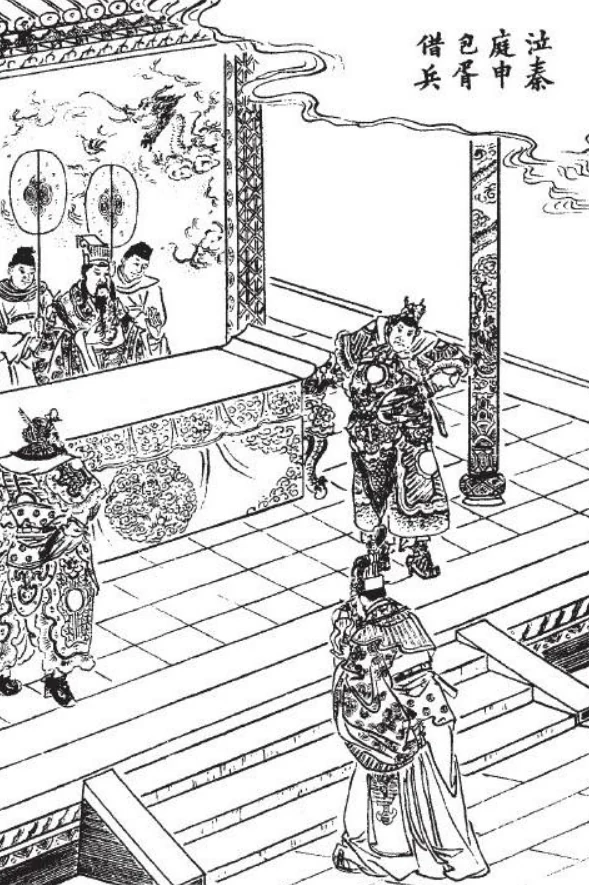
Shen Baoxu, a Chu minister and old friend of Wu Zixu, went to Qin to request help. Duke Ai initially hesitated because of King Ping's misconduct and because Qin itself was said to have limited military resources. Shen Baoxu therefore stood outside the Qin court without eating or drinking and wept day and night for seven days and nights. Moved by his loyalty, Duke Ai declared that a state with such a worthy minister could not simply be allowed to perish. He recited "Wuyi" from the Airs of Qin and sent Zipo and Zihu with five hundred chariots to aid Chu.
In 505 BCE, Qin troops joined Chu forces and defeated a Wu army under Fugai at Ji and won additional engagements at Junxiang and Gongxu Stream. King Helü was forced to withdraw and King Zhao returned to Ying. The source says Qin's intervention checked Wu's expansion, limited opportunities for Jin to profit from Chu's collapse, and brought Qin the territory of Shangyu as compensation from Chu.
Death and Succession
Duke Ai died in 501 BCE, the thirty-sixth year of his reign, and was buried north of Cheli. His son Duke Yi had died earlier and never ruled, so Duke Yi's son—Duke Ai's grandson—succeeded as Duke Hui of Qin.
Major Activities
Reciting "Wuyi" and Aiding Chu
The best-known episode of Duke Ai's reign is his response to Shen Baoxu's seven days of weeping at the Qin court, after which he recited "Wuyi" and sent troops to rescue Chu. The Zuo Commentary under Duke Ding, year four, records that Duke Ai "recited 'Wuyi' for him." Later scholars often linked this poem in the Book of Songs with Duke Ai's decision to answer Shen Baoxu's plea and rally Qin troops. The Chinese source cites its language about sharing robes and taking up arms as an expression of common purpose and resistance to a shared enemy and treats the episode as an example of using poetry to inspire military resolve.
Marriage Alliance with Chu
In 523 BCE Duke Ai sent his daughter Bo Ying to Chu, where she became the wife of King Ping. Although King Ping's taking of the woman originally intended for his son violated ritual norms, the marriage strengthened the political connection between Qin and Chu. The source interprets Duke Ai's later rescue of Chu as influenced both by Shen Baoxu's loyalty and by Qin-Chu kinship and strategic considerations.
Peace between Qin and Jin
During Duke Ai's reign, the six great ministerial families of Jin gained power while the ruler weakened, and their internal struggles limited Jin's ability to campaign abroad. As a result Qin and Jin did not fight major wars for a long period, allowing Qin to focus more on Chu and its western frontier.
Shen Baoxu Weeping at the Qin Court
The story of Shen Baoxu's seven days and nights of fasting and weeping became a famous model of loyal service. The Chinese source notes later dramatic treatments including Peking opera, Han opera, Yunnan opera, Qinqiang, and the seventy-seventh chapter of the historical novel Romance of the Eastern Zhou States.
His relief expedition abroad and his meetings with the other princes are recorded in the Zuo Commentary and other pre-Qin texts.
The stages of his reign can be set out by year: in 537 BCE (fortieth year of Duke Jing of Qin) Duke Jing died and he succeeded; in 523 BCE (fourteenth year of Duke Ai) his daughter Boying married into Chu as the wife of King Ping of Chu; in 506 BCE (thirty-first year) Helü of Wu took the Chu capital Ying and King Zhao of Chu fled, whereupon the Chu grandee Shen Baoxu came to Qin for help and "wept outside the Qin court for seven days and nights", and Duke Ai intoned the poem "Without Garments" and sent troops to aid Chu; in 505 BCE (thirty-second year) the armies of Qin and Chu defeated the Wu forces, Wu withdrew and King Zhao of Chu recovered his state; and in 501 BCE (thirty-sixth year) Duke Ai died, his grandson Duke Hui of Qin succeeding because the heir, Duke Yi, had died young. His daughter's marriage into Chu, his relief of Chu against Wu and the recitation of "Without Garments" are famous events in the relations between Qin and Chu in the later Spring and Autumn period, and they gave Qin its opening to take part in the affairs of the Central Plain.
As to the relation between Qin on the western frontier and the Central Plain, his expedition to rescue Chu was one of the few large-scale eastern campaigns of Qin in the later Spring and Autumn period: the marriage alliance between Qin and Chu had already brought the two states close, and after Wu took Ying, Shen Baoxu's weeping in the Qin court and the recitation of "Without Garments" provided the immediate occasion for the expedition; the defeat of the Wu forces by the allied Qin and Chu armies and the restoration of King Zhao of Chu also raised Qin's standing among the princes. Qin went on to consolidate in Guanzhong and became a strong power in the Warring States period, and its foreign actions at this stage have some bearing on the image it later acquired.
His thirty-six years on the throne fell in the late Spring and Autumn period, when Jin and Chu contended for supremacy and Wu was rising.
As to Qin-Chu relations in the later Spring and Autumn period, marriage and military aid form the two threads of their intercourse: the marriage of his daughter Boying into Chu in 523 BCE marks their friendship, and Qin's expedition after Wu took Ying in 506 BCE was that relationship repaid in a crisis. Shen Baoxu's seven days of weeping in the Qin court and the recitation of "Without Garments" became the episodes most often cited in later accounts, and the poem has accordingly been read as Duke Ai's promise to send troops. For Qin, the rescue of Chu had both the marriage and the covenant behind it and was connected with the common danger of Wu's northward advance; Qin afterwards returned to consolidate in Guanzhong and became a strong power on the western frontier in the Warring States period, so that this eastern expedition in the last years of the Spring and Autumn period stands out in the record of its foreign relations.
The meetings and campaigns of his reign are recorded in the Zuo Commentary under the years of Duke Ding and Duke Ai.
The interaction of Qin with Chu and Wu in his reign is an important page in the relations of the states in the late Spring and Autumn period.
His accession and death are both recorded by year in the annals of Qin in the Records of the Grand Historian.
His relief of Chu is linked in the Zuo Commentary with the story of Shen Baoxu.
The record of his daughter Boying as wife of King Ping of Chu appears in the nineteenth year of Duke Zhao in the Zuo Commentary.
Personal Relations
- Father: Duke Jing of Qin.
- Son: Duke Yi of Qin, who died before succeeding.
- Grandson: Duke Hui of Qin, who succeeded Duke Ai.
- Daughter: Bo Ying, wife of King Ping of Chu and mother of King Zhao of Chu.
- Son-in-law: King Ping of Chu.
- Maternal grandson: King Zhao of Chu.
- Shen Baoxu: minister of Chu who came to Qin for aid and wept at the court for seven days.
- Zipo and Zihu: Qin commanders who led the army sent to rescue Chu.
- King Helü of Wu: ruler of Wu who captured Ying, capital of Chu.
- Wu Zixu: minister of Wu who exhumed King Ping's body and flogged it.
- Sun Wu: Wu general who participated in the invasion of Chu.
Historical Assessment
Spring and Autumn and Early Accounts
- The Zuo Commentary records that Duke Ai recited "Wuyi" for Shen Baoxu, presenting him as a ruler moved by loyalty and able to use poetry to express resolve.
- The Records of the Grand Historian, "Basic Annals of Qin," records his dispatch of troops to rescue Chu and the defeat of Wu.
- Biographies of Exemplary Women identifies Bo Ying as the daughter of Duke Ai, wife of King Ping, and mother of King Zhao, indirectly reflecting Duke Ai's importance in Qin-Chu relations.
Han Dynasty
- Sima Qian records Duke Ai's rescue of Chu without extensive praise or criticism but includes him within Qin's dynastic history.
- Liu Xiang's Biographies of Exemplary Women records Bo Ying's story and the marriage alliance arranged by Duke Ai.
Song and Yuan Periods
- Song scholars often discussed the connection between "Wuyi" and Duke Ai in the context of Book of Songs scholarship, treating the episode as an example of using recited poetry to express political intention.
- Ma Duanlin's Comprehensive Examination of Literature mentions Duke Ai's rescue of Chu as an example of great-power relations in the Spring and Autumn period.
Modern Period
- Modern scholarship often analyzes Duke Ai's rescue of Chu in geopolitical terms, emphasizing Qin-Chu kinship and the strategic aim of checking Wu and Jin.
- Some researchers attribute "Wuyi" to Duke Ai and treat it as representative of early Qin military culture.
- The 1996 television series Eastern Zhou States: Spring and Autumn portrayed Duke Ai with actor Tan Tao, contributing to his modern popular image.
FIGURES ASSOCIATED WITH THIS DYNASTY
Bibliography
- Records of the Grand Historian, juan 5, "Basic Annals of Qin"
- Records of the Grand Historian, juan 40, "Hereditary House of Chu"
- Book of Songs, "Airs of Qin: Wuyi"