Welcoming Liu Bei
Serving as Assistant Officer of Xu Province, Mi Zhu fulfilled Tao Qian's testamentary wish by inviting Liu Bei to take command of Xu Province.
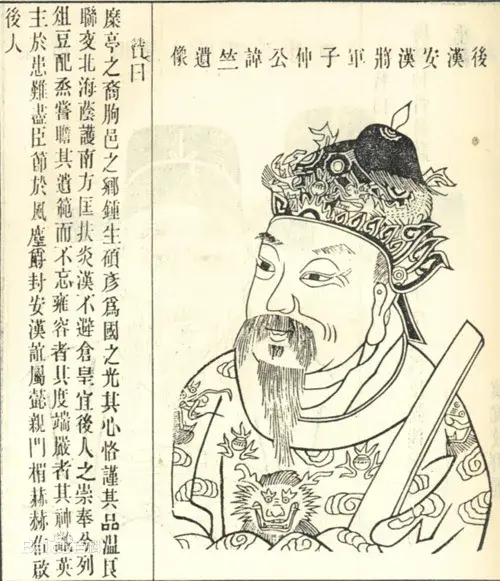
糜竺
Mi Zhu (died 220), courtesy name Zizhong, was a native of Qu County, Donghai Commandery (modern southwest of Lianyungang, Jiangsu Province). He was a paramount founding father, strategic benefactor, and the highest-ranking civil aristocrat of the Shu Han state during the late Eastern Han and Three Kingdoms periods. Hailing from an immensely wealthy merchant-gentry lineage possessing tens of thousands of retainers and enormous…
Mi Zhu (died 220), courtesy name Zizhong, was a native of Qu County, Donghai Commandery (modern southwest of Lianyungang, Jiangsu Province). He was a paramount founding father, strategic benefactor, and the highest-ranking civil aristocrat of the Shu Han state during the late Eastern Han and Three Kingdoms periods. Hailing from an immensely wealthy merchant-gentry lineage possessing tens of thousands of retainers and enormous mercantile fortunes, Mi Zhu originally served as Assistant Officer to Regional Governor Tao Qian of Xu Province. Following Tao Qian's death in 194, Mi Zhu executed his patron's dying wish by welcoming Liu Bei to assume leadership over Xu Province. In 196, when Lu Bu launched a treacherous surprise attack seizing Xiapi and capturing Liu Bei's dependents, leaving Liu Bei stranded in starvation at Haixi, Mi Zhu performed an extraordinary act of selfless devotion: he married his younger sister, Lady Mi, to Liu Bei and donated two thousand private retainers along with vast quantities of gold, silver, and provisions, single-handedly resurrecting Liu Bei's military enterprise from utter collapse. Repeatedly rejecting lucrative commanderships offered by Cao Cao, Mi Zhu remained unwaveringly loyal throughout decades of hardship. When Liu Bei took Yi Province in 214, Mi Zhu was appointed General Who Pacifies Han, taking precedence over Chancellor Zhuge Liang and receiving the highest emoluments of any minister in the realm. After his younger brother Mi Fang defected to Eastern Wu in 219 causing the tragic death of Guan Yu, Mi Zhu bound himself in grief to ask for punishment; though Liu Bei treated him with undiminished warmth and pardon, Mi Zhu succumbed to sorrow and illness shortly thereafter in 220.
Serving as Assistant Officer of Xu Province, Mi Zhu fulfilled Tao Qian's testamentary wish by inviting Liu Bei to take command of Xu Province.
Following Lu Bu's betrayal, Mi Zhu married his sister to Liu Bei and provided two thousand armed retainers and vast wealth to rearm the army.
Cao Cao memorialized the Han emperor to appoint Mi Zhu Administrator of Ying Commandery; Mi Zhu declined and followed Liu Bei into exile.
Sent as an envoy to Xiangyang, Mi Zhu successfully negotiated military sanctuary with Governor Liu Biao.
Appointed General Who Pacifies Han following the conquest of Chengdu, ranking above Zhuge Liang in protocol and court stipends.
Following Mi Fang's defection and Guan Yu's death, Mi Zhu bound himself to beg for execution; Liu Bei absolved him completely.
Overcome by remorse over his brother's treason, Mi Zhu fell gravely ill and passed away in Chengdu.
Mi Zhu was born into one of the wealthiest commercial gentry lineages in eastern China. For generations, the Mi clan traded in salt, iron, and textiles, amassing private holdings that included over ten thousand domestic retainers and vast landholdings across Donghai Commandery. Despite his immense fortune, Mi Zhu was celebrated for his gentle modesty, dignified presence, and refined scholarly demeanor, gaining widespread renown throughout Xu Province as an exemplary gentleman.
During the late Eastern Han dynasty, Tao Qian, Regional Governor of Xu Province, recruited Mi Zhu to serve as Assistant Officer (Biejia Congshi), relying heavily on his regional standing and administrative counsel. In 194, as Cao Cao's armies repeatedly assaulted Xu Province and Tao Qian fell terminally ill, Tao Qian summoned Mi Zhu to his deathbed, declaring that only Liu Bei possessed the virtue and martial capability to protect the populace of Xu Province. Following Tao Qian's demise, Mi Zhu personally led a delegation of civil officials and local gentry to Xiaopei, earnestly entreating Liu Bei to assume leadership. Mi Zhu's persuasive counsel overcame Liu Bei's initial reluctance, enabling Liu Bei to establish his first major territorial base in Xiapi.
In 196, while Liu Bei was campaigning against Yuan Shu along the Huai River, a mutiny broke out in Xiapi. Lu Bu capitalized on the instability to launch a sudden strike, capturing Xiapi along with Liu Bei's wives and children. Cut off from his supply lines, Liu Bei retreated south toward Haixi in Guangling Commandery. His troops exhausted their rations, disease spread rapidly, and the army began to disintegrate in desperation.
At this critical juncture, Mi Zhu demonstrated unmatched political foresight and personal commitment. He resolved to sacrifice his family's private fortune to sustain Liu Bei's cause. Mi Zhu arranged for his younger sister, Lady Mi, to marry Liu Bei as his official consort, cementing an indissoluble kinship alliance between the Mi lineage and Liu Bei. Furthermore, Mi Zhu mobilized two thousand robust retainers from his private estates to replenish the depleted military ranks and donated immense reserves of gold, silver, silks, and grain from his family warehouses. This massive infusion of manpower and material revived Liu Bei's military strength almost overnight, saving the fledgling warlord from total annihilation.
Recognizing Mi Zhu's immense influence and desiring to dismantle Liu Bei's inner circle, Cao Cao submitted a memorial to Emperor Xian offering Mi Zhu the prestigious appointment of Administrator of Ying Commandery, while appointing his brother Mi Fang Chancellor of Pengcheng. Both brothers adamantly rejected Cao Cao's imperial offices, choosing instead to share the perils of wandering exile with Liu Bei. When Liu Bei was driven out of Runan in 201, he dispatched Mi Zhu as his personal ambassador to Governor Liu Biao in Xiangyang. Through his diplomatic poise, Mi Zhu secured vital refuge for Liu Bei's faction in Xinye.
In 214, Liu Bei conquered Yi Province and entered Chengdu. During the distribution of imperial honors, Liu Bei remembered Mi Zhu's decades of loyal companionship and decisive aid at Haixi. By imperial commission, Liu Bei created the title of General Who Pacifies Han (Anhan Jiangjun) for Mi Zhu. In official state ceremonies and court seating arrangements, Mi Zhu took precedence even over Military Advisor General Zhuge Liang, and his salary and royal gifts exceeded those of all other ministers, marking him as the preeminent founding elder of the Shu state.
Tragedy struck in 219 when Guan Yu launched his northern campaign against Xiangfan. Mi Zhu's younger brother, Mi Fang, who had been entrusted with guarding the vital base of Jiangling as Administrator of Nan Commandery, harbored long-standing friction with Guan Yu. When Eastern Wu general Lu Meng crossed the Yangtze in disguise, Mi Fang surrendered Jiangling without a fight. This treachery caused Guan Yu's army to collapse, resulting in Guan Yu's death and the total loss of Jing Province.
Devastated by his brother's catastrophic betrayal, Mi Zhu bound his own hands and knelt in tears before Liu Bei, pleading for the death penalty according to laws governing treason. Liu Bei, profoundly aware of Mi Zhu's lifelong devotion and integrity, personally untied him and consoled him, insisting that one brother's crime could not tarnish the spotless honor of another. Liu Bei continued to treat Mi Zhu with undiminished reverence and favor. Nonetheless, tormented by shame over Guan Yu's demise and the destruction of the dynastic enterprise, Mi Zhu fell into profound melancholy and succumbed to severe illness within a year, passing away in 220.
Mi Zhu's decisive intervention at Haixi in 196 was among the most crucial turning points in the history of the Three Kingdoms. By offering his sister in marriage, supplying two thousand armed men, and financing the entire army with vast family treasures, Mi Zhu single-handedly kept Liu Bei's enterprise afloat when it was on the verge of extinction. Without Mi Zhu's extraordinary sacrifice, Liu Bei's faction would have dissolved in Guangling, altering the entire course of Chinese history.
When Cao Cao controlled the Han imperial court and sought to co-opt prominent regional elites, he offered Mi Zhu and Mi Fang powerful regional governorships. Mi Zhu's immediate refusal to abandon an impoverished and wandering leader in favor of central imperial office epitomized the highest Confucian ideals of fidelity and moral conviction, establishing him as a legendary archetype of loyalty.
As the first among equals, Mi Zhu's appointment as General Who Pacifies Han established an institutional precedent within Shu Han of honoring foundational moral and logistical benefactors above operational administrators. His exalted position over Zhuge Liang reflected Liu Bei's profound sense of gratitude and institutional respect for those who shared adversity during the genesis of his empire.
FIGURES ASSOCIATED WITH THIS DYNASTY