Birth and Youth in Ruzhou
Born into a distinguished family in Ruzhou; demonstrated early precocity in literary composition, phonology, and lute performance.
刘希夷
Liu Xiyi (dates of birth and death unrecorded, active mid-to-late 7th century), courtesy name Tingzhi, was a native of Ruzhou (present-day Ruzhou, Henan). He was an illustrious Early Tang poet and a pioneering master of the seven-character narrative song (Gexing). Endowed with handsome physical grace, witty conversational charm, and extraordinary musical talent on the pipa lute, he was known for consuming copious amounts of…
Liu Xiyi (dates of birth and death unrecorded, active mid-to-late 7th century), courtesy name Tingzhi, was a native of Ruzhou (present-day Ruzhou, Henan). He was an illustrious Early Tang poet and a pioneering master of the seven-character narrative song (Gexing). Endowed with handsome physical grace, witty conversational charm, and extraordinary musical talent on the pipa lute, he was known for consuming copious amounts of wine without inebriation and living an unconstrained, bohemian life free from rigid social conventions. In 675 CE (second year of the Shangyuan era of Emperor Gaozong), the twenty-five-year-old Liu Xiyi passed the imperial civil examinations on Zheng Yi's roster, attaining widespread literary renown across Luoyang and Chang'an through his brilliant policy dissertations. In his early writing, Liu Xiyi focused heavily on military frontier campaigns and boudoir laments. His poetic language was graceful and finely wrought; yet because his emotional themes were melancholic and profoundly rooted in Han-Wei ancient musical airs, they diverged sharply from the ornate, superficial court-poetry conventions favored by the contemporary throne, leaving him without official patronage during his lifetime. Nevertheless, he pursued poetic mastery with unrelenting dedication, particularly revolutionizing the seven-character narrative song by fusing the tonal elegance of Southern Dynasties verse with the crisp vitality of the emerging High Tang. His crowning masterpiece, On Behalf of the White-Headed Old Man (also titled Ballad of White Hair), transformed falling petals into a universal lament on youth and mortality, containing the eternal couplet: "Year after year the flowers resemble each other; Year after year the people are not the same." Tragically, Liu Xiyi's soaring genius provoked fatal professional jealousy. According to persistent historical lore, he was murdered before the age of thirty by aristocratic rivals seeking to usurp ownership of his masterpiece. His early demise was universally mourned. During the Kaiyuan reign, compiler Sun Yu published the authoritative anthology Collection of Correct Voices (Collection of Correct Voices), ranking Liu Xiyi's works as the supreme pinnacle of the collection. Alongside Zhang Ruoxu's Spring River Flowers and Moonlit Night, Liu Xiyi's narrative songs stand as twin landmarks of the Early-to-High Tang poetic transformation, exerting a profound thematic influence on subsequent Chinese literature, particularly the tragic transience depicted in masterworks like Dream of the Red Chamber.
Born into a distinguished family in Ruzhou; demonstrated early precocity in literary composition, phonology, and lute performance.
Passed the imperial civil examinations at age twenty-five on Zheng Yi's roster, earning wide literary acclaim through his policy dissertations.
Passed over for ministerial appointment; wandered between Luoyang and Chang'an, immersing himself in wine, landscape, and poetic innovations.
Composed the immortal narrative song On Behalf of the White-Headed Old Man, crystallizing his reflections on time and mortality in his famous couplet.
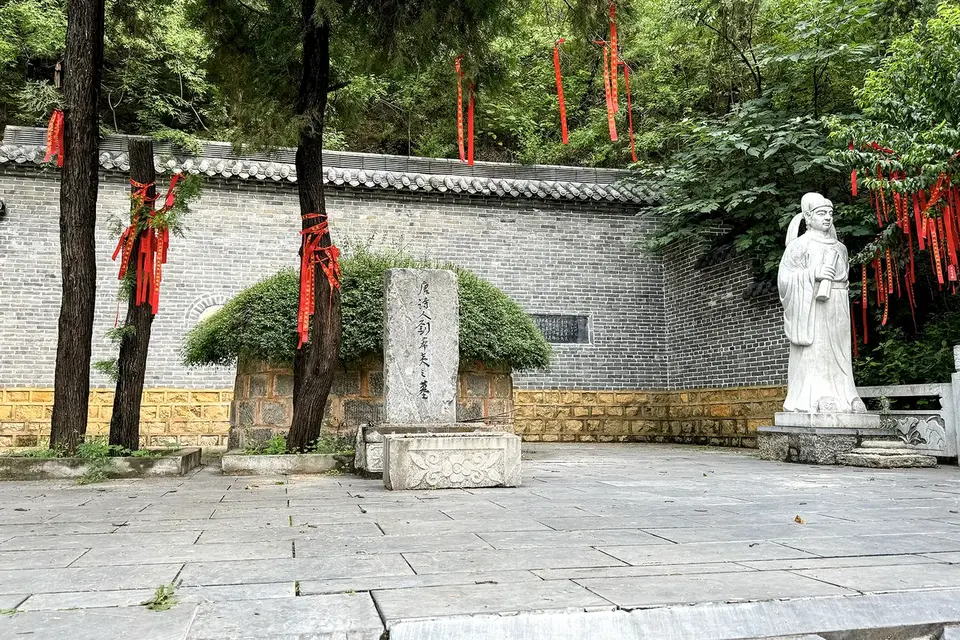
Tragically murdered in a detached residence before reaching thirty following disputes over poem ownership; interred beside Fengxue Temple in Ruzhou.
Anthology compiler Sun Yu ranked Liu Xiyi's works at the head of Collection of Correct Voices (Collection of Correct Voices), establishing his monumental standing in Tang poetic history.
Liu Xiyi was born during the reign of Emperor Gaozong in the cultural heartland of Ruzhou. Bordering Mount Song to the north and the Eastern Capital Luoyang to the west, Ruzhou possessed magnificent landscapes and a vibrant scholarly heritage. Immersed in classical education from infancy, Liu Xiyi displayed exceptional intellectual agility and artistic poise. Historical records describe him as "possessing handsome features, fond of witty conversation, and highly skilled in playing the pipa." He embodied the unrestrained bearing of Six Dynasties scholars, effortlessly comprehending tonal theory while playing the lute with expressive brilliance. Magnanimous and unconstrained by petty social decorum, he indulged in heavy drinking without succumbing to vulgarity, conducting his life with uninhibited authenticity.
In his scholarly pursuits, Liu Xiyi delved deeply into classical histories and ancient poetry. In 675 CE (second year of Shangyuan), at the age of twenty-five, Liu Xiyi journeyed westward to the imperial capital Chang'an to sit for the imperial civil examinations. Administered by examination director Zheng Yi, the examination drew thousands of brilliant scholars. Liu Xiyi distinguished himself with dazzling literary style and incisive philosophical reasoning, passing as an Advanced Scholar (Jinshi). His brilliant performance during the palace policy interrogations instantly established his reputation across the intellectual elite of both capitals.
However, the literary atmosphere of the Early Tang court remained firmly under the sway of Shangguan Wan'er's palace style and decadent Southern Dynasties court traditions. Court aristocrats primarily rewarded ornate, praise-laden odes tailored for imperial banquets. In stark contrast, Liu Xiyi's aesthetic vision was steeped in the austere vitality of the Han-Wei Music Bureau and the profound melancholy of Cao Zhi and Ruan Ji. His refusal to pander to contemporary court frivolity ultimately alienated him from lucrative career avenues.
Following his examination triumph, Liu Xiyi was denied a substantive official post in the central administration. Lacking influential aristocratic patrons in an era where noble pedigree still dictated bureaucratic advancement, he found himself marooned in poverty, "never obtaining a single inch of official salary and constantly enduring disappointment." Yet his professional frustration only deepened his contemplative insight into human existence, fueling an intense burst of creative energy.
During these wanderings, Liu Xiyi lived in modest hermitages nestled along the foothills of Mount Song and the pristine shores of Ruyang Pool south of Luoyang. Facing tranquil streams and ancient pines, he wandered alone in solitary contemplation, channeling his inner grief into evocative verse. He traveled widely across the Central Plains, exploring the ancient ruins of Luoyang. In Reflections on the Luo River, he meditated on the founding of the Later Han Dynasty by Emperor Guangwu, concluding mournfully: "Only tonight's moon remains, suspended forever as in ancient days." In Reflections on Mount Wu, he contemplated divine visions of the goddess, lamenting the relentless passage of human splendor. In frontier works like Joining the Army, he articulated the noble aspirations of heroic youths: "A real man seeks to cleanse ten thousand miles of earth; Who can content himself with sweeping a single room?"
Nevertheless, contemporary court arbiters failed to appreciate the depth of his art, misinterpreting his works as excessively mournful. Undaunted by societal neglect, Liu Xiyi recognized that authentic art required profound emotional truth and structural innovation. He committed himself to refining the seven-character narrative song (Gexing), striving day and night to synthesize ancient vigor with melodic fluidity.
Around the Yifeng era, while residing in Luoyang, Liu Xiyi observed the breathtaking spectacle of spring blossoms cascading along the banks of the Luo River. Contemplating the historical rise and fall of Luoyang's pleasure gardens, he was struck by the irreversible contrast between eternal nature and transient human life. In an inspired burst of genius, he drafted the celebrated narrative song On Behalf of the White-Headed Old Man (also titled Ballad of White Hair). In the original draft, he penned the lines: "This year the falling blossoms alter their color; Next year when flowers bloom, who will still be here?"
Chanting the verse repeatedly, Liu Xiyi felt a chilling sense of foreboding, sighing heavily: "This sentiment is far too tragic, sounding like an omen of death! Long ago, Western Jin grandee Shi Chong sighed at the Golden Valley Garden that white heads would share the same grave, only to meet swift execution. Why should I invite misfortune with such ill-omened verse?" He thereupon took up his brush and excised the couplet from the manuscript.
Shortly thereafter, however, fresh poetic inspiration seized him, and he penned the transcendent lines: "Year after year the flowers resemble each other; Year after year the people are not the same." The couplet achieved an immaculate synthesis of parallel symmetry and philosophical clarity, contrasting the cyclical rebirth of nature with the fragile mortality of humankind. Struck by its natural perfection, Liu Xiyi sighed philosophically: "Life, death, and human lifespan are determined by Heaven; how could empty poetic words possibly alter destiny?" He restored both couplets to the poem, establishing them as the emotional core of the entire composition.
Tragically, this immortal work provoked his doom. Early Tang historical anecdotes recorded in Da Tang Xinyu and Tang Caizi Zhuan recount a chilling crime: the prominent court poet Song Zhiwen (traditionally identified as Liu's maternal uncle or relative) became enraptured by the couplet upon reading the draft. Learning that the manuscript had not yet circulated widely among the public, Song Zhiwen desperately implored Liu Xiyi to relinquish authorship of the lines so that he could insert them into his own poetry to bolster his court standing.
Liu Xiyi initially acquiesced out of familial deference. However, upon returning to his study, he recognized that the couplet constituted the very lifeblood of his masterpiece. Driven by artistic integrity, he firmly retracted his consent. Enraged by the refusal and terrified that his attempted plagiarism might be exposed, Song Zhiwen dispatched servants in the dead of night to invade Liu's lodgings. The assailants smothered Liu Xiyi beneath heavy sacks filled with earth and sand, killing him before he reached thirty years of age. Literati across Luoyang and Chang'an were devastated by the monstrous murder of the young genius.
Following his murder, Liu Xiyi's remains were escorted back to his native Ruzhou by mourning friends and interred on the scenic hillside east of Fengxue Temple. Nestled against the southern slopes of Mount Song and flanked by winding streams, Fengxue Temple provided a serene sanctuary. Grieving companions planted evergreen cypresses around his burial mound as enduring symbols of his poetic spirit. Over centuries, these trees grew into massive trunks requiring four people to encircle, and the memorial grounds became known as the "Garden of Yi" (Yi Yuan), attracting generations of literati to pay homage.
Following his death, friends collected his writings into a ten-volume poetry collection. During the Kaiyuan reign of Emperor Xuanzong, Tang poetry entered its golden zenith. Eminent scholar Sun Yu compiled the authoritative anthology Collection of Correct Voices (Collection of Correct Voices) to preserve the finest verse of the era. Possessing penetrating critical foresight, Sun Yu broke through prevailing academic prejudices, placing Liu Xiyi's works at the head of the entire anthology and lauding him in the preface as "the supreme pinnacle of the collection."
Sun Yu's appraisal triggered an empire-wide reassessment of Liu Xiyi's legacy, establishing his enduring standing in Chinese literary history. Although his worldly career was tragically cut short, his immortal narrative songs illuminated the path toward the High Tang, surviving through the centuries as an unblemished jewel of Chinese poetic heritage.
Liu Xiyi's supreme contribution to Chinese poetry was the creation of On Behalf of the White-Headed Old Man, widely revered as the absolute pinnacle of early Tang narrative song (Gexing). Spanning forty-six lines, the poem employs fluid seven-character meter to narrate a profound human drama unfolding in Luoyang. Opening with a young Luoyang maiden lamenting fallen blossoms, the narrative shifts toward an impoverished, white-haired old man wandering the imperial boulevards. By juxtaposing his youthful opulence amidst painted towers against his present isolation, the poem mounts an unforgettable meditation on aging, mortality, and the transience of worldly ambition.
The central couplet—"Year after year the flowers resemble each other; Year after year the people are not the same"—transcended the rigid parallelism of Six Dynasties court verse by embedding a profound philosophical realization within effortless, natural diction. The contrast between nature's perennial renewal and human life's irreversible decay captured a universal human vulnerability, making the couplet one of the most frequently quoted epigrams in Chinese literature. Ming Dynasty critic Hu Yinglin lauded the poem in Shi Sou as "possessing supreme color, sound, and emotional truth, standing as the finest narrative song of the Early Tang."
The poignant aesthetic of this masterpiece deeply inspired later Chinese vernacular literature, most notably Cao Xueqin's eighteenth-century masterpiece Dream of the Red Chamber. In Zhen Shiyin's commentary on the Song of All Good Things, the description of deserted halls where grand banquets once resounded directly echoes Liu Xiyi's contrasting imagery of luxurious pavilions reduced to silent pine-covered tombs. Similarly, Lin Daiyu's celebrated Burying the Flowers directly inherits its emotional core, imagery, and rhythmic cadence from Liu Xiyi's lament on fallen petals and fleeting youth.
In the historical transformation of Tang poetry from decadent Southern Dynasties formalism to High Tang vitality, Liu Xiyi and Zhang Ruoxu served as the two indispensable catalysts. Liu Xiyi integrated the raw narrative vitality of ancient Han-Wei folk ballads with the tonal refinement and acoustic harmony of Southern Dynasties parallel prose. In doing so, he eliminated both the archaic stiffness of earlier verse and the superficial shallowness of palace poetry.
In works such as Spring Song, Plucking Mulberry Leaves, Ballad of the Spring Maiden, and Pounding Clothes, he deployed repetitive choruses, cyclical wordplay, and dynamic parallelism to craft a musical tempo resembling running water. This revolutionary formal structure dramatically broadened the narrative capacity and emotional depth of seven-character poetry, sweeping away the cloying artificiality of court verse and establishing the structural foundation that enabled the subsequent poetic explosions of Li Bai, Gao Shi, and Cen Shen.
Beyond his celebrated laments on youth and mortality, Liu Xiyi produced exceptional frontier and landscape poetry distinguished by heroic vigor and philosophical detachment. His five-character ancient verse Joining the Army provided an epic panorama of Tang forces departing for campaign: "The imperial gate presses upon the Yellow River; Military vigor surges against the white sun." Chronicling massive breakthroughs and severe skirmishes, he sounded the clarion call: "A real man seeks to cleanse ten thousand miles of earth; Who can content himself with sweeping a single room?"
During his seclusion near Ruyang Pool and Mount Song, he composed introspective landscape poems including Pine of the Southern Ravine and Autumn Waters. Praising the mountain pine that stands defiant against frozen winds while ignoring the flowing river, and channeling Zhuangzi's contemplation to transcend worldly gain and loss, Liu Xiyi infused his poetry with immense philosophical gravity and spiritual independence.
FIGURES ASSOCIATED WITH THIS DYNASTY