Tunneling at Yizhou
Directed subterranean sapping to capture Yizhou, earning the lifelong military nickname Liu the Burrower
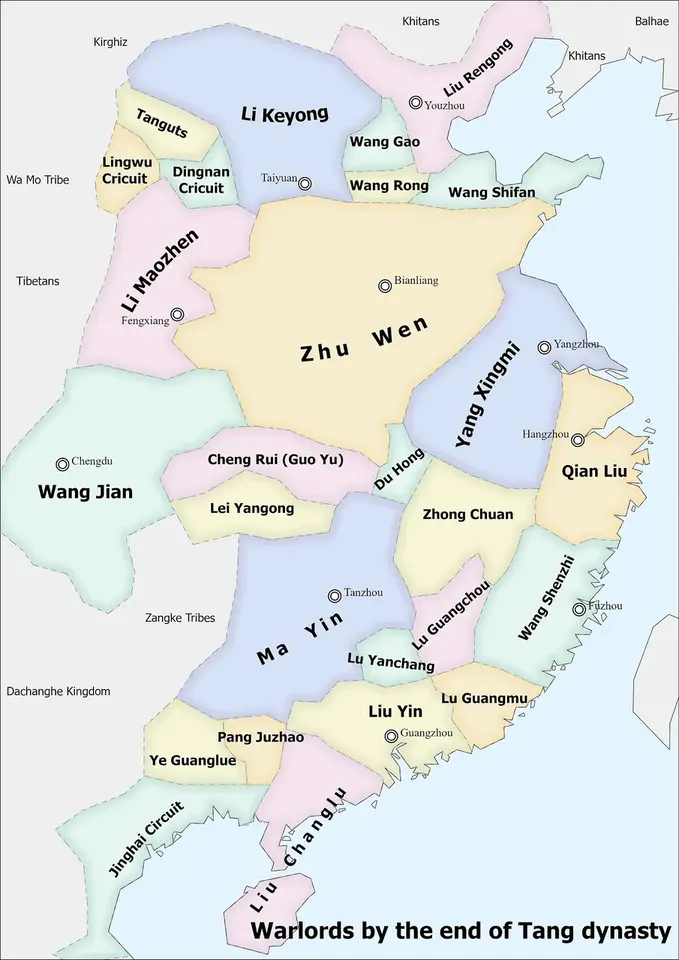
唐末五代初
刘仁恭
Liu Rengong (刘仁恭, ?–914) was a native of Shenzhou (modern Shenzhou City, Hebei Province). He was an infamous regional warlord of the late Tang Dynasty and early Five Dynasties period, ruling the Lulong Circuit (Youzhou) as Military Commissioner. Liu began his career as an officer under Lulong Military Commissioner Li Keju. In 885, while accompanying Li Quanzhong in besieging Yizhou, he directed sappers to tunnel beneath the…
Liu Rengong (刘仁恭, ?–914) was a native of Shenzhou (modern Shenzhou City, Hebei Province). He was an infamous regional warlord of the late Tang Dynasty and early Five Dynasties period, ruling the Lulong Circuit (Youzhou) as Military Commissioner. Liu began his career as an officer under Lulong Military Commissioner Li Keju. In 885, while accompanying Li Quanzhong in besieging Yizhou, he directed sappers to tunnel beneath the walls to storm the city, earning the military sobriquet "Liu the Burrower." Following an abortive mutiny at Weizhou in 893, he fled with his clan to Taiyuan to submit to Li Keyong, Prince of Jin, who appointed him Garrison Commander of Shouyang. In 894, Li Keyong conquered Youzhou, leaving Liu to hold the regional capital and subsequently recommending him as Military Commissioner of Lulong. Once entrenched in Youzhou, Liu broke away from Hedong control. In 897, when Li Keyong mounted a punitive expedition, Liu routed the Shatuo armies in an ambush at the Battle of Ansai, subsequently aligning with warlord Zhu Quanzhong and receiving the title of Chancellor. He then dispatched his eldest son, Liu Shouwen, to conquer Cangzhou, Dezhou, and Jingzhou, establishing regional hegemony across northern Hebei. In 899, he launched an offensive against Weibo and Chengde with a mobilized force, capturing Beizhou and slaughtering its entire population, tossing corpses into the Qingshui River until the waters were dammed. However, his southern expansion collapsed after his vanguard was ambushed at Neihuang by Zhu Quanzhong's general Ge Congzhou. In 906, facing repeated sieges by Zhu Quanzhong, Liu conscripted all males aged fifteen and older, forcibly tattooing their faces, while hoarding private copper currency within Mount Da'an, pursuing Daoist elixir rituals, and circulating clay and iron coins. In 907, his second son, Liu Shouguang, launched a coup and imprisoned him. In 913, Jin Prince Li Cunxu captured Youzhou, seizing both father and son. In 914, Li Cunxu had Liu Rengong transported to Daizhou, where his heart's blood was ritually extracted before Li Keyong's tomb before he was decapitated at Yanmen Mountain.
Directed subterranean sapping to capture Yizhou, earning the lifelong military nickname Liu the Burrower
Led mutinous frontier garrisons in a failed march on Youzhou; fled with his family to join Li Keyong in Taiyuan
Guided Li Keyong's conquest of Youzhou; appointed regional defender and later Military Commissioner of Lulong
Refused military levies from Hedong; routed Li Keyong's Shatuo army at Ansai and pledged fealty to Zhu Quanzhong
Dispatched Liu Shouwen to seize Yichang Circuit, bringing Cangzhou, Dezhou, and Jingzhou under his sway
Invaded Weibo, storming Beizhou and slaughtering its inhabitants before suffering defeat at Neihuang
Besieged by Ge Congzhou at Cangzhou; appealed to Li Keyong for relief and retreated to Waguan after Laoyadi
Faced renewed Liang encirclement; forcibly conscripted males with facial tattoos and hid copper coinage in Mount Da'an
Indulged in esoteric alchemy on Mount Da'an; overthrown and imprisoned in dark quarters by his son Liu Shouguang
Captured by Jin forces under Li Cunxu following the storming of Youzhou and transported in chains to Taiyuan
Sacrificed at Li Keyong's tomb in Daizhou and beheaded beneath Yanmen Mountain
Liu Rengong hailed from Shenzhou. His father, Liu Sheng, served the Lulong garrison as Garrison Commander of Xinxing under Military Commissioner Li Keju, and his mother belonged to a military family. Liu grew up in the frontier army, becoming adept at mounted archery and siege warfare.
In the sixth month of 885, Li Keju dispatched general Li Quanzhong to assault Yizhou. Facing thick stone ramparts, Liu selected a suicide squad of sappers to dig underground passages beneath the moat, emerging inside the fortifications to trigger the city's collapse.
His subterranean assault astonished the border garrisons, who dubbed him "Liu the Burrower," leading to his promotion as a company commander.
Liu was ambitious and calculating. He claimed to have dreamed of colossal banners sprouting from his fingertips toward heaven, asserting that he was destined to command a province before age fifty. Suspicious of his designs, Military Commissioner Li Kuangwei marginalized him as Magistrate of Jingcheng.
When garrison troops in Yingzhou murdered their magistrate, Liu mobilized a thousand local volunteers to suppress the mutiny. Recognizing his battlefield competence, Li Kuangwei dispatched him to garrison the northern outpost of Weizhou.
In 893, Liu's detachment had completed their scheduled tour at Weizhou but received no relief because of internal rivalries in Youzhou. Suffering from freezing conditions and supply shortages, the troops revolted. When Li Kuangchou ousted his brother Li Kuangwei to seize power, the garrison proclaimed Liu their leader and marched on Youzhou.
Li Kuangchou counterattacked outside the walls, routing Liu's forces. Left with no retreat, Liu led his clan westward across the passes to seek shelter under Li Keyong, Prince of Jin.
Li Keyong treated Liu with generosity, granting him an estate in Taiyuan and commissioning him as Garrison Commander of Shouyang. While in Taiyuan, Liu presented military plans to conquer the northeastern marches, offering to serve as guide if provided ten thousand infantry and cavalry.
In the winter of 894, Li Keyong launched an expedition against Youzhou, routing Li Kuangchou. Liu and Shatuo commander Fu Cunshen secured the capital, sealing regional treasuries and civil registers.
Delighted with his performance, Li Keyong placed Youzhou under Liu's custody. In 895, following Li Keyong's triumph over Wang Xingyu in Guanzhong, the throne appointed Liu Acting Minister of Works and Military Commissioner of Lulong.
Having secured Youzhou, Liu built up a loyal personal cohort of frontier horsemen and sought autonomy. In 896, when Li Keyong demanded Lulong troops to attack Weibo, Liu fabricated excuses regarding Khitan border incursions and refused to mobilize.
In 897, Li Keyong issued an urgent levy commanding Liu to relieve Zhu Xuan in Yanzhou. Liu ignored the orders, and when dozens of envoys arrived from Taiyuan to demand obedience, Liu insulted the messengers, imprisoned them, arrested all Taiyuan officers stationed in Youzhou, and enticed Hedong soldiers to defect.
Infuriated by this insubordination, Li Keyong led the main body of his Shatuo veteran cavalry through Yanmen Pass to chastise Youzhou. Anticipating the attack, Liu fortified mountain passes, cleared the countryside, and laid ambushes along the narrow defiles of Ansai.
When the armies clashed at Ansai, Liu lured the Shatuo vanguard into the gorge and sprang his trap. Shatuo cavalry formations were hemmed in along rocky paths, suffering catastrophic casualties. Senior commanders including Gai Yu fled in disorder, and Li Keyong escaped on a single mount.
Following the victory, Liu severed ties with Taiyuan. He boxed the heads of slain Shatuo soldiers and dispatched an embassy presenting them to Liang warlord Zhu Quanzhong. Zhu recommended that the throne appoint Liu Chancellor, establishing Liu as an autonomous regional power.
Securing his western flank, Liu expanded south into the central plains. In 898, he ordered his eldest son, Liu Shouwen, to attack Cangzhou, capital of Yichang Circuit. Warlord Lu Yanwei fled without offering resistance, allowing the father and son to annex Cangzhou, Dezhou, and Jingzhou.
Liu petitioned the throne to recognize Liu Shouwen as Military Commissioner. When Emperor Zhaozong rejected the demand, Liu rebuked an imperial eunuch envoy: "I can establish military banners whenever I please; petitioning the court is merely a gesture to show respect for the capital's name. Why does the throne withhold consent?"
In the spring of 899, Liu assembled a combined force of one hundred thousand troops from Youzhou and Cangzhou, claiming an army of three hundred thousand, to invade Weibo and Chengde. The army first besieged Beizhou.
Upon breaching the walls, Liu ordered the massacre of the entire urban population, casting over ten thousand corpses into the Qingshui River until the water flow was halted by human remains.
Liu then advanced against Weizhou. Weibo Commissioner Luo Shaowei appealed to Zhu Quanzhong, who dispatched generals Li Si'an and Ge Congzhou to Neihuang.
Overconfident in his numbers, Liu ordered his son Liu Shouwen and general Shan Keji to advance with fifty thousand shock troops along the Qingshui River. Li Si'an feigned retreat, luring the vanguard into an ambush at Neihuang. The Liang forces encircled and annihilated the advance column, slaying Shan Keji and forcing Liu Shouwen to flee alone.
That night, Ge Congzhou conducted a surprise counter-raid on Liu's main camp, overrunning eight defensive earthworks. The Lulong army panicked and broke, with casualties strewing the roads from Weizhou to Changhe. As Liu fled back to Youzhou, Chengde troops intercepted his retreat, halting his expansion.
In 900, Zhu Quanzhong dispatched Ge Congzhou with one hundred thousand troops to counterattack Cangzhou, besieging Liu Shouwen. Desperate for survival, Liu swallowed his pride and sent humble gifts to seek help from his former master, Li Keyong.
Li Keyong dispatched Zhou Dewei to strike Xingzhou and Mingzhou to draw off Liang forces. However, Ge Congzhou crushed Liu's relief army at Laoyadi, beheading thirty thousand soldiers. Liu retreated to Waguan, ending his dreams of southern conquest.
With peace restored along the southern front, Liu concluded that Youzhou's geographical remoteness shielded him from central plains campaigns, and he abandoned active military discipline.
He succumbed to the occult teachings of mystic Wang Rona, seeking Taoist immortality. On the peaks of Mount Da'an, he constructed palace pavilions, renaming the peak Mount Da'en. He abducted hundreds of women from commoner households to populate his seraglio and gathered monks and Taoist masters for alchemy rituals.
To accumulate personal wealth, Liu confiscated all authentic copper coins and metal vessels across Youzhou, transporting them to Mount Da'an to be sealed within deep subterranean caves.
Upon sealing the vaults, Liu executed all several hundred masons and laborers to keep the locations secret. The treasure remained undisturbed until 996, when Khitan soldiers of the Liao Dynasty excavated the mountain and carried the metal away.
Liu prohibited southern merchants from importing tea into Youzhou, ordering state officials to gather wild mountain weeds, dry them, and force residents to purchase the substitute at exorbitant prices.
Simultaneously, Liu dismantled regional currency. He issued coins fashioned from baked river clay and minted iron coins, including large denominations such as "Yong'an Worth Ten" up to "Yong'an Worth a Thousand." This debased money crippled market trade across northern Hebei.
In 906, Zhu Quanzhong mounted another siege of Cangzhou, digging dual moats and starving the defenders until cannibalism broke out within the walls.
To relieve his son, Liu instituted total civilian mobilization across Youzhou. He decreed that all males between fifteen and sixty years old be impressed into military service. To prevent desertion, he ordered that common peasants be branded with facial tattoos reading "Dingba Corps" (Pacifying Hegemon), while literate scholars were tattooed on their arms with "Devoted to the Sovereign."
Through these measures, Liu assembled two hundred thousand conscripts, stripping farms of labor. When Liu made desperate appeals to Li Keyong, the Jin prince attacked Luzhou, compelling Zhu Quanzhong to lift the siege of Cangzhou.
Following the relief of Cangzhou, Liu Shouwen governed Cangzhou while younger son Liu Shouguang held Youzhou, with Liu Rengong residing on Mount Da'an. Liu Shouguang conducted an illicit liaison with his father's concubine, Lady Luo. When Liu discovered the affair, he had his son flogged and expelled from court.
In the spring of 907, Liang general Li Si'an launched a cavalry raid against Youzhou, reaching the Shizi River. With Liu secluded in his mountain retreat, the city was unprepared. Liu Shouguang collected stray troops to repulse the raid.
Having secured the city, Liu Shouguang marched on Mount Da'an, captured his father, and brought him back to Youzhou to be locked within a secure chamber, assuming the title of Acting Military Commissioner.
Liu Shouwen subsequently marched from Cangzhou to punish his brother, initiating years of fratricidal war that ended when Liu Shouguang captured and murdered him. In 911, Liu Shouguang proclaimed himself Emperor of Yan.
In 913, Jin Prince Li Cunxu formed an alliance with Chengde and Yiwu to crush the Yan regime. Despised for cruelty, Liu Shouguang fled the falling city and was captured by a peasant; Jin troops discovered the aging Liu Rengong imprisoned in a cellar.
At a victory banquet in Youzhou, Li Cunxu summoned the captives before his commanders. Liu Rengong wept, prostrating himself before the Jin prince while berating Liu Shouguang for ruining the family. Li Cunxu cataloged Liu's record of treachery against Taiyuan.
In early 914, Li Cunxu displayed the prisoners in chains during a triumph at Taiyuan. Liu Shouguang was beheaded in the city market. Deputy Commissioner Lu Ruban escorted Liu Rengong to Daizhou.
Before Li Keyong's tomb, Lu Ruban read an imperial eulogy, excised Liu's heart's blood as a sacrificial offering to the late prince's spirit, and executed him by decapitation at the foot of Yanmen Mountain, terminating the twenty-year Liu regime in Youzhou.
For nearly two decades during the collapse of the Tang Dynasty, Liu Rengong ruled Youzhou as an autonomous military commissioner. He navigated rivalries among Li Keyong's Shatuo forces, Zhu Quanzhong's Liang army, and the rising Khitan empire.
Using Taiyuan's support to seize Youzhou, Liu renounced his patron, allied with Liang when attacked, and returned to Taiyuan when pressed by Zhu Quanzhong. This balance of power preserved his rule over the You-Ji frontier and the Bohai coast.
Liu fortified passes along the Taihang Mountains and the Great Wall, recruiting northern cavalry. Although his regime collapsed through cruelty, his prolonged rule shaped the northern frontier's geopolitical landscape during the Five Dynasties transition.
The Battle of Ansai in 897 was the tactical highlight of Liu's military career. Facing Li Keyong's Shatuo horsemen, Liu utilized his knowledge of mountain terrain to deploy ambush detachments along the defiles.
By drawing the Shatuo cavalry into narrow gorges, he disrupted their mobility and executed a coordinated counter-strike, killing more than half the invasion force and forcing Li Keyong to flee alone.
The victory terminated Hedong's military dominance over Youzhou, securing Lulong's independence and blunting Li Keyong's drive to contest the central plains against Zhu Quanzhong.
Liu's administration was marked by brutality. During his invasion of Weibo in 899, his forces sacked Beizhou, executing more than ten thousand civilians and damming the Qingshui River with human corpses.
During the siege of 906, he impressed two hundred thousand males aged fifteen and older, tattooing their faces with "Dingba Corps" and arms with "Devoted to the Sovereign."
This forced mobilization depleted the agricultural workforce, leaving villages abandoned and generating social dislocation across northern Hebei.
Liu's financial measures crippled the regional economy. While constructing palaces on Mount Da'an, he confiscated copper currency from private households, storing it in sealed caverns and executing the laborers involved.
He prohibited southern merchants from selling tea, compelling inhabitants to buy processed mountain weeds, and circulated inferior iron coins alongside baked clay tokens.
By circulating debased "Yong'an" currency while hoarding genuine metal, Liu destroyed commercial networks and exhausted the fiscal reserves of the northern marches.
FIGURES ASSOCIATED WITH THIS DYNASTY