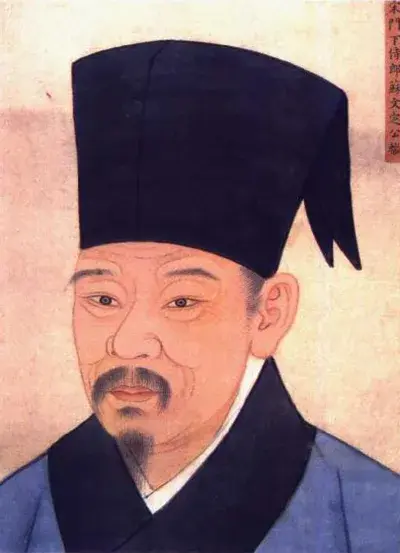
Life
Illustrious Heritage and Literary Precociousness
Liu Kezhuang was born into an illustrious bureaucratic lineage in Putian County, Xinghua Military Prefecture. His grandfather Liu Su had attained the rank of Grand Master of Court Audiences, while his father Liu Mizheng rose to Vice Minister of Personnel; both were celebrated scholars and upright ministers of the Southern Song.
Originally named Liu Zhuo, he was steeped in refined classical learning from childhood. Beyond mastering the Confucian Six Classics and pre-Qin philosophical schools, he developed a profound affinity for Han and Wei ancient music bureau ballads (yuefu) and High Tang poetry. Exceptionally gifted, he could memorize ten thousand words in a single day and composed elegant literary prose without drafting preliminary outlines. During his youth, he studied under local master Lin Shuzhi, developing academic perspectives that far outshone his peers.
In the first year of Kaixi (1205 CE), he placed first in the rhymed prose examinations at the National University in Lin'an, gaining entry as a student of the Directorate of Education. During his studies at the capital, he engaged in deep philosophical discussions on Neo-Confucian principles while leading the student body in classical literary composition.
While studying at the National University, he focused on statecraft and practical administration rather than frivolous ornate verse. While metropolitan scholars chased ephemeral poetic fads, Liu Kezhuang collected Han and Tang epigraphic rubbings, writing extensive critical notes and ancient verse. His fellow scholars admired his intellectual breadth, and high ministers competed to make his acquaintance.
In the second year of Jiading (1209 CE), relying on hereditary privilege granted to sons of high state ministers, he received appointment as Court Gentleman for Ceremonial Service. That same year, at the urging of his friend Hong Tianxi, he formally adopted the given name Kezhuang, inspired by the Confucian maxim of restraining the self and maintaining solemn dignity.
In the third year of Jiading (1210 CE), Liu Kezhuang assumed duties as Assistant Magistrate of Jing'an County in Jiangxi. Diligent and energetic, he investigated fiscal registers, suppressed rural tax evasion by wealthy landowners, and protected impoverished peasants, earning high praise from local commoners.
In the sixth year of Jiading (1213 CE), his father passed away in office in Lin'an. Liu Kezhuang resigned to observe the three-year filial mourning period in his native village. Afterward, he served as staff clerk in Zhenzhou and secretarial commissioner along the Yangtze defense lines. Confronting the devastated frontier towns and peasant misery amidst Song-Jin border warfare, he submitted memorials urging the central court to strengthen interior defensive networks, forging an enduring patriotic commitment.
Local Magistracy and the Jianghu Poetry Case
In the seventeenth year of Jiading (1224 CE), Liu Kezhuang was appointed Magistrate of Jianyang County in Jianning Prefecture. Located in northern Fujian, Jianyang suffered from rugged terrain and burdensome fiscal levies. Upon assuming office, Liu Kezhuang curbed his personal literary indulgences, focused on civil administration, reversed wrongful convictions, updated census registers, and dredged irrigation canals. During this tenure, he also established close ties with prominent Neo-Confucian statesman Zhen Dexiu, absorbing his doctrines on social ethics and popular welfare.
While administering Jianyang, he routinely visited remote villages to investigate the conditions of commoners. Observing the social abuses of abandoned corpses and rampant land usurpation by local magnates, he enforced statutory prohibitions, prosecuted corrupt pettifoggers, allocated treasury funds to repair the county academy, and invited eminent scholars to instruct youth. Grateful citizens erected a living shrine in his honor.
However, the political environment at the imperial court was exceptionally corrupt. Chancellor Shi Miyuan exercised tyrannical authority, having orchestrated the assassination of Prince Zhao Hong to enthrone Emperor Lizong and ruthlessly purging political rivals. Angered by the suppression of loyal ministers, Liu Kezhuang penned his famous poem Fallen Plum Blossoms: "The east wind mistakenly wields the blossom's authority, yet envies the lofty and refuses to support it." The verses utilized the destructive east wind as an allegory for tyrannical ministers destroying upright talent.
Around that time, Hangzhou bookseller Chen Qi published the Jianghu Collection (Jianghu Ji), compiling works by Liu Kezhuang, Dai Fugu, and dozens of non-establishment poets. Censor Li Zhixiao, a creature of Shi Miyuan, seized upon the poem to impeach Liu Kezhuang, alleging that the "east wind" mocked the Chancellor and that the "lofty" implied criticism of imperial personnel choices.
The imperial court issued decrees banning the Jianghu Collection and destroying its printing blocks. Chen Qi was exiled to remote borderlands, while Liu Kezhuang was stripped of office and ordered to return home under administrative restriction. This political purge ensnared dozens of poets, becoming known in historiography as the "Jianghu Poetry Case."
Faced with a decade of enforced political isolation, Liu Kezhuang remained composed. He retired to rural Putian, building a hermitage named Houcun, associating with local farmers and woodcutters while traveling across southeastern scenic mountains. This immersion in the grass roots transformed his verse from delicate Late Tang imitation into vigorous, mournful, and socially engaged masterpieces.
The Duanping Reform and Resolute Remonstrance
In the fifth year of Shaoding (1232 CE), Shi Miyuan died. In the first year of Duanping (1234 CE), Emperor Lizong assumed direct personal rule and launched administrative reforms, recalling upright officials who had suffered under the previous regency.
Zhen Dexiu was appointed Assistant Administrator of Military Affairs and strongly recommended Liu Kezhuang to the throne, remarking that his literary renown shook the empire and his unswerving loyalty was evident. Emperor Lizong rehabilitated Liu Kezhuang, appointing him Compiling Officer in the Bureau of Military Affairs and Assistant in the Inspection Office to handle strategic archives.
In the imperial capital, Liu Kezhuang openly opposed the hasty and ill-conceived "Duanping Expedition to Luoyang" launched by Emperor Lizong to reclaim the northern capitals without adequate preparation. Liu Kezhuang submitted memorials pointing out empty treasuries, neglected defense fortifications, and depleted logistical lines, arguing that the court should first consolidate the Huai-Shu perimeter and alleviate peasant taxes.
Although his warnings were prescient, hawkish censors like Pu Dounan attacked him for demoralizing the army. Liu Kezhuang was forced to resign and accept assignment as Prefect of Yuanzhou. The subsequent total rout of the Song expeditionary forces by Mongol cavalry proved his strategic foresight.
Governance Across Southern Provinces
Beginning in the early Chunyou era, Liu Kezhuang served successively as Prefect of Yuanzhou, Fuzhou, and Zhangzhou, and as Judicial Commissioner of Jiangxi and Fiscal Commissioner of Guangdong, demonstrating extraordinary administrative competence.
In Yuanzhou and Fuzhou, confronting severe droughts and skyrocketing rice prices, he disregarded bureaucratic red tape and released one hundred thousand bushels of state grain to relieve starving refugees, while punishing speculators who hoarded grain. Concurrently, he repaired city walls and pacified bandit gangs through strategic conciliation, swiftly stabilizing the region.
While serving as Judicial Commissioner of Jiangxi, facing successive years of drought and locust swarms that left human skeletons across the countryside, he risked impeachment for overstepping authority by immediately opening granaries to sell grain at reduced rates, forbidding subordinate prefectures from delaying relief. He inspected porridge stations personally, saving tens of thousands of lives.
In the sixth year of Chunyou (1246 CE), he was promoted to Fiscal Commissioner of Guangdong. The southern borderlands were mountainous, malarial, and afflicted by predatory local officials who colluded with gentry to extort extortionate salt duties.
Upon his arrival, Liu Kezhuang conducted solo inspection tours across the counties, abolishing dozens of illegal surtaxes including conversion charges and discretionary fees. He reduced official salt duties, encouraging private merchants to distribute salt freely, which curbed smugglers and replenished the state treasury. Furthermore, he pacified thousands of destitute mining bandits who had fled into the mountains, returning them to agriculture.
He also contributed his own personal wealth to purchase two hundred mu of fertile land to establish an ancestral charity estate, dedicated to funding the transport and burial of impoverished northern scholars who had perished in the southern tropics. Grateful Cantonese citizens erected a living shrine in Guangzhou to honor his benevolence.
In the ninth year of Chunyou (1249 CE), he was appointed Director in the Ministry of Works and concurrently Acting Prefect of Zhangzhou, where he suppressed landlord encroachments and pacified tribal communities, earning repeated imperial commendations.
Imperial Drafter and Court Remonstrant
During the late reign of Emperor Lizong, Mongol armies breached the Xiangyang and Huai River defense perimeters, placing the southern empire in mortal jeopardy. Needing experienced and venerable statesmen, the court recalled the nearly seventy-year-old Liu Kezhuang to the capital.
In the fourth year of Baoyou (1256 CE), Liu Kezhuang served as Director of Education and Auxiliary Academician of the Bureau of Academicians, drafting state proclamations and imperial edicts. His parallel prose was magnificent, learned, and rhythmically powerful; his diplomatic proclamations to border marshals and rival states were celebrated as the supreme literary creations of the Song realm.
In the third year of Jingding (1262 CE), at the age of seventy-five, he was named Vice Minister of War and Imperial Reader, lecturing daily to Emperor Lizong on the historical lessons of the Spring and Autumn Annals and the Comprehensive Mirror for Aid in Government.
As palace eunuchs like Dong Songchen and Lu Yunfeng interfered in administrative appointments, Liu Kezhuang repeatedly submitted frank memorials. Citing historical disasters caused by eunuchs during the Han and Tang dynasties, he warned: "In the founding days of our dynastic ancestors, appointments issued directly from the palace were extremely rare; today, ministerial posts are bestowed without consulting the Secretariat-Chancellery, and arbitrary palace decrees multiply. Where is dynastic discipline?" Although his bluntness provoked the favorites, Emperor Lizong revered his integrity, praising his counsel as noble.
Integrity in Old Age and Ministerial Eminence
In the fifth year of Jingding (1264 CE), Liu Kezhuang was appointed Minister of Works, Auxiliary Academician of the Bureau of Academicians, and Hanlin Academician, concurrently retaining his post as Imperial Reader. Suffering from severe eye disease that rendered him nearly blind, he still dictated memorials when the emperor consulted him on national crises, demonstrating total command over strategic affairs.
When Chancellor Jia Sidao enforced the coercive "Public Field Law" to forcibly purchase private estates in western Zhejiang for military grain, sparking nationwide outrage, Liu Kezhuang warned through letters and memorials that the policy caused severe extortion by venal clerks, urging the court to ease taxes and avoid exhausting popular resources. Although frail and blind, he exchanged frequent correspondence with his friend Lin Xiyi and student Fang Yue, evaluating contemporary literature, mentoring impoverished scholars, and welcoming all visitors with warm generosity as a revered spiritual leader.
In the first year of Xianchun (1265 CE), Emperor Duzong ascended the throne. Citing advanced age and blindness, Liu Kezhuang submitted repeated petitions to retire. The court conferred upon him the title Grand Academician of Longtu Pavilion and granted honorable retirement with full ministerial honors.
Returning to rural Putian, Liu Kezhuang lived quietly at Houcun. Despite total blindness, he remained consumed by concern for national survival. Whenever news arrived that Xiangyang was under heavy siege, he was sleepless with anxiety, patting his legs and sighing aloud, composing tragic patriotic verses such as "Viewing the imperial atlas with tears by the night window" and "This old man can still cross the vast northern desert."
On the twenty-ninth day of the first lunar month in the fifth year of Xianchun (1269 CE), Liu Kezhuang passed away peacefully in his ancestral home at the age of eighty-three. Emperor Duzong promulgated an edict of state mourning, posthumously bestowing the title Junior Protector and the canonical name Wending, with generous provisions for his household.
Major Accomplishments
Leading the Jianghu Poetry School into Grandeur
As the foremost leader and synthesizer of the Southern Song Jianghu Poetry School, Liu Kezhuang transformed the movement from its early parochialism into an expansive poetic force.
Early poets of the Four Literati and Jianghu circles slavishly copied Late Tang models, producing delicate but narrow five-character regulated verses centered on personal melancholy. Liu Kezhuang injected the moral gravity of Du Fu, the patriotic grief of Lu You, and the sweeping vitality of Su Shi into Jianghu poetry.
His works addressed frontier warfare, social injustice, dynastic decline, and vast mountain landscapes, freeing verse from rigid metrics. He established a poetic style marked by expansive vision, abundant vitality, and powerful diction, earning recognition as the undisputed literary master of the late Southern Song.
In poetic theory, Liu Kezhuang attacked pedantic trends with deep historical discernment. He sharply criticized Southern Song Neo-Confucian scholars who disparaged literary craft and reduced poetry to rhymed moralistic lecture notes, arguing that the essence of verse lies in expressing authentic human emotion and observing natural cosmos rather than serving as didactic homilies. Countering both the superficial simplicity of the Four Literati and the excessive pedantry of the Jiangxi School, he advocated assimilating classical reading into natural artistic grace, profoundly inspiring later literary criticism.
Pillar of the Heroic Patriotic Ci Tradition
In the history of Chinese lyric poetry, Liu Kezhuang was the paramount successor to the heroic and sorrowful ci tradition pioneered by Xin Qiji.
Historiographers rank him alongside Lu You and Xin Qiji as the tripartite pillars of Southern Song heroic ci, and alongside Xin Qiji and Liu Guo as the "Three Lius of the Xin School." Confronting national collapse, he composed impassioned patriotic masterpieces.
He utilized prose syntax and discursive arguments within the lyric medium, producing verses of thunderous martial power and deep historic sorrow. In an era dominated by delicate and effeminate verse, his heroic voice preserved the unyielding spirit of the Chinese nation, expanding the ideological and aesthetic horizons of the ci genre.
His extant ci poems exceed four hundred pieces, ranking first in quantity among Southern Song lyricists. Masterpieces like To the Tune of Hexinlang ("The national grievance remains unavenged while the warrior grows old; the sword in the scabbard cries out in the night") and To the Tune of Qinyuanchun ("Where shall we meet, ascending the heights in loud song, with the surviving subjects shedding bitter tears?") combined historical deliberation with personal anguish, realizing Xin Qiji's artistic innovation of utilizing prose within lyric verse and allowing the heroic tradition to shine with dazzling brilliance in the twilight of the Song.
Compiling the Houcun Canon and Founding the Thousand Masters
Liu Kezhuang produced a colossal literary output. His Collected Works of Master Houcun in one hundred and ninety-six chapters encompasses poetry, lyrics, memorials, imperial edicts, and prefaces, preserving invaluable historical records regarding the politics, military affairs, economy, and social systems of the late Southern Song.
Furthermore, his compilation Categorized Selection of Poems from a Thousand Worthies of Tang and Song served as the direct ancestor text for the universally celebrated educational classic Poems of a Thousand Masters (Qianjiashi), making an unparalleled contribution to classical poetic literacy across generations.
His four-chapter Houcun Poetry Talks (Houcun Shihua) utilized historical evidence to evaluate poetic styles and artistic transitions, becoming an authoritative monument in ancient Chinese literary criticism.
Literary Innovations in Prose and Parallel Style
Liu Kezhuang attained towering mastery in prose and four-six parallel prose, standing as a master drafter of state proclamations.
While late Southern Song parallel prose degenerated into shallow sonic ornamentation, Liu Kezhuang infused the genre with deep historical erudition and classical vigor. His four-six state papers were grand, erudite, and rhythmically powerful, fusing the strength of Han Yu with the flowing grace of Ouyang Xiu.
Whether crafting imperial edicts, frontline proclamations, or funerary inscriptions, his prose was acclaimed for profound substance and solemn beauty. Contemporaries celebrated him alongside Li Hanlao and Zhen Dexiu as one of the Three Great Parallel Prose Masters of the Southern Song, elevating the literary stature of late Song official documents and funerary biographies.
Upright Character and Practical Governance
Liu Kezhuang was not only a towering literary scholar but a dedicated Confucian administrator devoted to practical governance.
From his fearless poetic resistance against Chancellor Shi Miyuan in Jianyang to his relief administration in Jiangxi and Guangdong, and his principled remonstrance before Emperor Lizong in his twilight years, Liu Kezhuang embodied the moral duty of the traditional scholar-official who prioritized the welfare of the people above personal preservation.
Undeterred by multiple political demotions under authoritarian ministers, he dedicated his writing and administrative career to public service, exemplifying the unyielding moral dignity of the Song intellectual tradition.