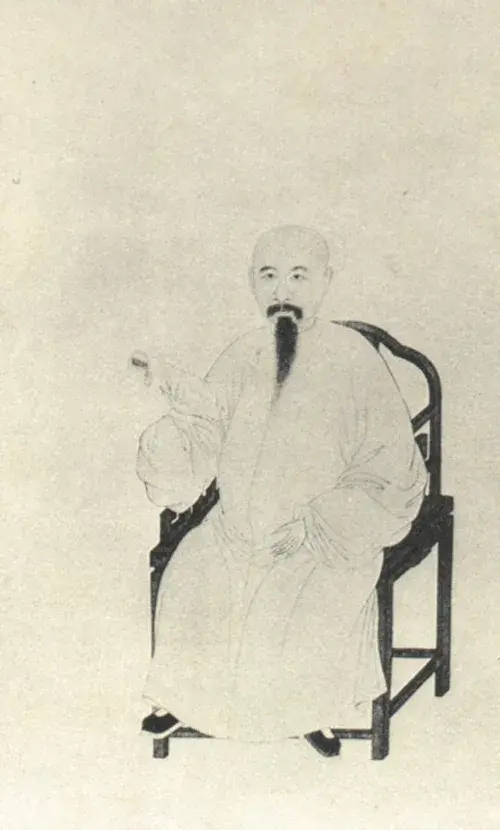
PROFILE
Ling Tingkan (凌廷堪, 1757–1809), courtesy name Cizhong and pseudonym Zhongzi, traced his ancestral origin to She County in Huizhou Prefecture, Anhui Province, and was born in Banpu Town, Haizhou, Huai'an Prefecture, Jiangsu Province (modern Lianyungang, Jiangsu). He was an eminent mid-Qing dynasty classicist, ritual scholar, musicologist, and a leading exponent of the Qianjia School of evidential scholarship. In 1790, he earned the Jinshi degree, eventually serving as Director of Studies (Xuezheng) in Hezhou, Anhui.
Born into an impoverished merchant household, Ling endured severe hardships during an early commercial apprenticeship before committing himself entirely to classical studies. Intellectually aligned with Dai Zhen's empirical methodology, he investigated the ancient ritual canons (Sanli) and traditional pitch systems, rejecting the speculative metaphysical doctrines of the Song-Ming Neo-Confucians regarding human nature and heavenly principle. He championed the practical philosophy of "replacing principle with ritual" (yi li dai li), maintaining that ethical order must be anchored in the objective, verified institutional rites established by the ancient sages. Over decades of research, he compiled the monumental thirteen-fascicle ritual treatise Lijing Shili, creating an empirical classification of the Yili that revolutionized Qing ritual studies.
In musicology, Ling made historic breakthroughs. By examining ancient musical treatises from the Han through the Tang and Song dynasties, he authored the landmark six-fascicle Yanyue Kaoyuan, successfully deciphering the Sui-Tang twenty-eight banquet music (yanyue) modal system that had baffled scholars for centuries, providing a rigorous mathematical and philological foundation for the study of medieval suites (daqu) and song lyrics (cipu). His collected writings were published as Jiaolitang Wenji in thirty-six fascicles. Ling passed away at his official residence in Hezhou in 1809 at the age of fifty-three.
- Courtesy Name
- Cizhong (次仲)
- Pseudonym
- Zhongzi (仲子)
- Dynasty
- Qing
- Ancestral Home
- She County, Huizhou Prefecture, Anhui (born in Haizhou, Jiangsu)
- Birth Date
- 1757 (22nd year of the Qianlong reign, Qing)
- Death Date
- 1809 (14th year of the Jiaqing reign, Qing)
- Age at Death
- 53
- Highest Office
- Director of Studies of Hezhou, Anhui
- Historical Identity
- Classicist, ritual scholar, musicologist, evidential scholar
BIOGRAPHY
Chronology
- 1757 (22nd year of the Qianlong reign) | Birth in Haizhou | Born in Banpu Town, Haizhou, into an impoverished merchant family tracing roots to She County, Anhui.
- 1770 (35th year of the Qianlong reign) | Commercial Apprenticeship | Forced by poverty to apprentice in a grocery shop at age thirteen, studying classical texts at night.
- 1775 (40th year of the Qianlong reign) | Patronage from Scholars | Gained the recognition of scholars Ling Chaohan, Wang Zhong, and Cheng Jinfang, accessing rare private libraries.
- 1779 (44th year of the Qianlong reign) | Senior Licentiate | Selected as an imperial tribute student, studying mathematics, phonology, and the Classics at Anding Academy in Yangzhou.
- 1789 (54th year of the Qianlong reign) | Juren Degree | Passed the Shuntian provincial examination as a Juren in Beijing, earning high esteem among evidential scholars.
- 1790 (55th year of the Qianlong reign) | Jinshi Degree | Passed the palace examination in the second class, appointed Director of Studies of Hezhou, Anhui.
- 1797 (2nd year of the Jiaqing reign) | Completing Lijing Shili | Completed the thirteen-fascicle ritual masterwork Lijing Shili, articulating his philosophy of ritual supremacy.
- 1807 (12th year of the Jiaqing reign) | Yanyue Kaoyuan | Finished Yanyue Kaoyuan in six fascicles, deciphering the Tang and Song twenty-eight modal music systems.
- 1809 (14th year of the Jiaqing reign) | Demise in Hezhou | Passed away at his post in Hezhou at age fifty-three; disciples conferred the private posthumous title Wenlie.
Life and Career
Commercial Apprenticeship and Returning to Classical Studies
Ling Tingkan was born in 1757 in Banpu Town, Haizhou, Jiangsu. His ancestral lineage belonged to She County in Anhui, with his father and grandfather having relocated to Jiangsu to engage in small-scale salt and grain trade. Ling lost his father in early childhood, leaving the household in deep poverty. When he was seven, his mother, Lady Wang, pawned her few remaining silver ornaments to pay for his initial schooling. However, facing worsening destitution, thirteen-year-old Ling was compelled in 1770 to leave school and enter a general merchandise shop near Yangzhou as an apprentice clerk.
Surrounded by commercial ledgers and market bustle, Ling retained a passion for canonical texts. While working at the shop counter, he kept copies of the Book of Songs and the Book of Rites hidden in his sleeves, studying by dim candlelight in the storeroom late into the night. His employer reprimanded him repeatedly for neglecting commercial pursuits. Recognizing that mercantile enterprise conflicted with his intellectual aspirations, Ling resigned his apprenticeship, returning home to support his mother and pursue classical scholarship.
Intellectual Mentors and Success in the Examinations
In 1775, at eighteen, Ling made the acquaintance of his kinsman Ling Chaohan in Haizhou, gaining access to regional private libraries. During this period, prominent Qianjia scholar Cheng Jinfang inspected regional education in northern Jiangsu, while Yangzhou philologist Wang Zhong resided temporarily in Haizhou. Reading Ling's handwritten classical notes, both scholars recognized his philological acumen and took him under their guidance, sharing rare volumes and introducing him to Ruan Yuan.
Under their mentorship, Ling advanced rapidly. In 1779, he was selected as an imperial tribute student, studying at academies in Yangzhou and Zhili. He mastered Han canonical commentaries while studying ancient mathematics, acoustics, astronomy, and institutional antiquities. In 1789, at thirty-three, he traveled to Beijing and passed the Shuntian provincial examination as a Juren. The following spring of 1790, he passed the palace examination as a Jinshi, receiving an appointment as Director of Studies (Xuezheng) of Hezhou, Anhui.
Directing Education in Hezhou and Philological Mastery
Hezhou was a historic administrative seat along the northern bank of the Yangtze River. Although the directorship of studies was an eighth-rank local educational post, Ling dedicated himself fully to the office, serving for sixteen years until his death. He reformed regional school curricula, delivering monthly lectures on the Yili and the Book of Han, training candidates in evidential methodology and supporting impoverished students.
Within his modest official residence, Ling dedicated his private hours to scholarship. Strongly influenced by Dai Zhen's Mengzi Ziyi Shuzheng, he advanced the Anhui School's empirical rigor. Over sixteen years in Hezhou, he produced two landmark works: Lijing Shili and Yanyue Kaoyuan. In 1809, exhausted by uninterrupted study, Ling passed away at his official quarters at the age of fifty-three. Mourned deeply by regional scholars, his disciples conferred upon him the private posthumous name Master Wenlie.
Major Achievements
Formulating the Philosophy of Replacing Principle with Ritual
Ling Tingkan's most significant philosophical contribution was proposing the doctrine of "replacing principle with ritual" (yi li dai li), which challenged the idealist metaphysics of Song and Ming Neo-Confucianism. Beginning with the Cheng brothers and Zhu Xi, Neo-Confucianism had elevated "Heavenly Principle" (tianli) into an abstract metaphysical entity, enabling officials and scholars to impose subjective moral judgments that Dai Zhen characterized as "killing people in the name of principle."
Expanding upon Dai Zhen's critique, Ling argued in his treatises Fuli Shang, Fuli Zhong, and Fuli Xia that "the Way of the sages can be summarized in a single word: ritual." He demonstrated that pre-Qin classical texts never treated "principle" as an abstract, disembodied cosmic entity. Confucius's concept of "restraining oneself and returning to ritual" referred directly to concrete, observable institutions, ceremonies, and behavioral norms (including capping, marriage, mourning, sacrifice, archery, and diplomatic audiences). Ling asserted that discussing moral principles detached from concrete ritual institutions inevitably led to speculative Buddhist subjectivism. He advocated utilizing objective, verified ritual codes to regulate human desires, constructing an empirical ethical framework that represented a high point of Qing practical philosophy.
Authoring Lijing Shili: The Masterpiece of Ritual Exegesis
To provide an empirical textual foundation for his ritual philosophy, Ling dedicated over a decade to compiling the thirteen-fascicle Lijing Shili. The Yili (Book of Etiquette and Ceremonial), due to its archaic language and complex institutional regulations, had long intimidated traditional scholars, who regarded it as unreadable.
Ling pioneered a structural methodology, replacing traditional word-by-word commentaries with comparative thematic categorization. Surveying all seventeen chapters of the Yili, he established three overarching analytical categories: general rules (tongli), shared rules (gongli), and particular exceptions (teli). Under subheadings such as capping, marriage, mourning, and sacrifice, he tabulated the exact utensils, measurements, spatial orientations, postures, and verbal formulas prescribed for lords, ministers, and common scholars. This systematic taxonomy transformed obscure ancient rituals into an accessible institutional blueprint, recognized by scholars as the supreme achievement of Qing evidential ritual studies alongside Gu Yanwu's Rizhilu and Dai Zhen's Mengzi Ziyi Shuzheng.
Deciphering Tang and Song Musical Systems in Yanyue Kaoyuan
In Chinese musicology and historical acoustics, Ling achieved a breakthrough by authoring Yanyue Kaoyuan in six fascicles. Since the Song and Yuan periods, the twenty-eight banquet music (yanyue) modal systems of the Sui and Tang dynasties had been lost due to textual fragmentation and changes in musical notation, perplexing scholars from Shen Kuo to Zhu Xi.
Drawing upon classical mathematics and phonetic exegesis, Ling analyzed musical treatises preserved in the Song Shi, New Tang Book, and transmitted Song lyric collections. Tracing the system back to the twelve pre-Qin pitch-pipes (lülü) and Han folk songs, he cracked the "seven tones and four modes" structure of the twenty-eight modal system, which coordinated seven diatonic pitches with four tonal keys. By drafting precise mathematical pitch diagrams, he corrected centuries of musical errors, establishing a theoretical foundation for the study of Tang-Song song suites, ci melodies, and Yuan-Ming opera.
Personal Relationships
- Intellectual Inspiration: Dai Zhen, master of the Anhui School of Qianjia evidential scholarship; Ling adopted and expanded his classical and ritual theories.
- Mentor and Benefactor: Cheng Jinfang, Hanlin Compiler and evidential scholar; discovered Ling in northern Jiangsu, supporting his studies with rare books.
- Teacher and Senior Friend: Wang Zhong, prominent Yangzhou scholar; befriended Ling in Haizhou, engaging in extensive dialogue on pre-Qin texts.
- Scholarly Patron: Ruan Yuan, leading classicist of the Qianjia School; praised Ling's ritual and musical treatises, describing Lijing Shili as an extraordinary work.
- Intellectual Peer: Jiao Xun, prominent Qing classicist and mathematician; corresponded regularly with Ling on acoustics, rituals, and mathematics.
Historical Evaluations
- Ruan Yuan, Preface to Lijing Shili: "Master Ling Cizhong of She County comprehended the relationship between heaven and man and investigated the three ritual canons. His Lijing Shili illuminated the subtleties of ancient sages, standing as an unprecedented masterpiece since the Han and Tang dynasties."
- Jiao Xun, Diaogu Ji: "Cizhong investigated acoustics with immense depth, authoring Yanyue Kaoyuan to resolve thousand-year mysteries. The precision of his evidential research and mathematical calculations could only be achieved by a consummate scholar of the Classics."
- Zhao Erxun et al., Draft History of Qing (Qing Shi Gao): "Ling Tingkan was broadly learned in history and the Classics, excelling particularly in ritual... In scholarship he championed replacing principle with ritual, and his Lijing Shili rendered immense service to moral philosophy."
Related Entries
- Dai Zhen
- Wang Zhong
- Ruan Yuan
- Lijing Shili
- Yanyue Kaoyuan
- Qianjia School