Birth in Dongping
Born into a gentry lineage in Dongping, Shandong, relocating south to Qiantang following dynastic dislocation.
梁楷
Liang Kai (梁楷, fl. late 12th–early 13th century), courtesy name Bomei, art name Liang Fengzi (Madman Liang), was a celebrated court painter and foundational pioneer of abbreviated-brush (jianbi) and splashed-ink (pomo) figure painting during the Southern Song dynasty. Originally hailing from Dongping, his family relocated south to Qiantang, Lin'an. He served as Painter-in-Attendance in the Hanlin Academy of Painting during…
Liang Kai (梁楷, fl. late 12th–early 13th century), courtesy name Bomei, art name Liang Fengzi (Madman Liang), was a celebrated court painter and foundational pioneer of abbreviated-brush (jianbi) and splashed-ink (pomo) figure painting during the Southern Song dynasty. Originally hailing from Dongping, his family relocated south to Qiantang, Lin'an. He served as Painter-in-Attendance in the Hanlin Academy of Painting during the reign of Emperor Ningzong. Liang possessed transcendent painterly genius, initially studying under court master Jia Shixian and mastering meticulous, fine-line figure and Buddhist painting. Disdaining the rigid, decorative conventions of the imperial painting academy, Liang broke decisively with formal traditions to pioneer the abbreviated brush and splashed-ink methods. Characterized by explosive spontaneous brushwork, sparse calligraphic strokes, and deep psychological capture, his paintings captured the vital spiritual essence of his subjects with minimal strokes, imbued with Zen insight. When Emperor Ningzong awarded him the imperial Golden Belt—the highest professional honor for an academy artist—Liang refused to be constrained by imperial patronage, hanging the Golden Belt on the academy beam and walking away to live among taverns and monasteries. Celebrated by contemporaries as Madman Liang, his surviving masterpieces, such as Immortal in Splashed Ink, Li Bai Chanting a Poem, Shakyamuni Emerging from the Mountain, and The Sixth Patriarch Chopping Bamboo, represent supreme treasures of world art, exerting an immense and enduring influence on Song-Yuan literati painting, Japanese Zen ink monochrome, and modern expressionist art.
Born into a gentry lineage in Dongping, Shandong, relocating south to Qiantang following dynastic dislocation.
Studied meticulous figure and Daoist-Buddhist painting under court master Jia Shixian in Lin'an.
Appointed to the Hanlin Academy of Painting under Emperor Ningzong, earning imperial favor for his figure painting.
Awarded the imperial Golden Belt by Emperor Ningzong, Liang hung the belt on the academy rafters and departed for a free life.
Wandered among West Lake monasteries and taverns, painting Immortal in Splashed Ink and Li Bai Chanting a Poem.
Passed away in a monastery retreat in Qiantang, celebrated as a supreme master of Chinese monochrome ink art.
Liang Kai traced his ancestral roots to Dongping in Shandong Province. Following the Jingkang Incident and the collapse of northern dynastic control, the Liang clan joined the refugee migration south, establishing their residence in Qiantang, the metropolitan district of the Southern Song capital Lin'an. Surrounded by the mist-shrouded peaks and waters of West Lake, Lin'an stood as the artistic and cultural heart of the empire. From childhood, Liang exhibited extraordinary artistic precocity, possessing acute visual observation and bold draughtsmanship.
As a young man, Liang entered the formal imperial painting academy system, studying under the renowned Southern Song master Jia Shixian. Jia was acclaimed for his fine-line Daoist and Buddhist figures, demanding rigorous brush discipline and layered color washes. Under Jia's tutelage, Liang copied classical Tang and Northern Song masterpieces, mastering the techniques of the iron-wire outline and delicate architectural rendering. His early figure compositions displayed flawless academic structure and noble coloring, earning him rapid professional advancement within the court.
During the reign of Emperor Ningzong, the court expanded the Hanlin Academy of Painting. Recognized for his supreme technique, Liang was appointed Painter-in-Attendance, the pinnacle of professional achievement for imperial artists. Within the palace, he completed numerous imperial screens, portrait scrolls, and narrative frescoes, receiving frequent commendations from Emperor Ningzong and Empress Yang.
However, Liang possessed an uninhibited, free-spirited disposition and a passion for wine. He found the rigid palace protocol and sycophantic court aesthetic deeply stifling. During the Jiatai era, Emperor Ningzong bestowed upon him the prestigious imperial Golden Belt, a rare badge of imperial distinction coveted by all court artists. Yet Liang refused to surrender his creative independence. In full view of the court, he calmly unbuckled the Golden Belt, hung it upon the high rafters of the painting academy hall, and walked away laughing, severing all institutional ties.
Following his dramatic departure, Liang shed all courtly pretension, wandering through the monasteries and wine taverns around West Lake in hemp robes and straw sandals. Known to drink heavily and paint spontaneously amidst bouts of wild laughter, capital residents and monks affectionately dubbed him Liang Fengzi (Madman Liang).
Freed from imperial constraints, Liang entered his most prolific artistic phase. Associating closely with Chan Buddhist masters at Lingyin Temple and Jingci Temple, he absorbed the Zen doctrine of direct intuition and sudden enlightenment. He initiated a revolution in Chinese figure painting, discarding delicate outlines in favor of bold, sweeping calligraphic strokes and saturated ink washes. Executing works with lightning speed using dry and wet brushwork, Liang stripped away non-essential detail, allowing raw spiritual presence to emerge through minimalist lines.
In his declining years, Liang resided primarily in Zen temples around Qiantang. He painted only when inspired by kindred monks and wine companions, refusing all commercial commissions. He passed away peacefully in Qiantang during the Jiading reign. Although dismissed by conventional bureaucrats as an eccentric outcast, his abbreviated brush and splashed-ink innovations redirected the course of Asian art. His masterpieces were treasured across Japan and East Asia, becoming the ultimate icon of Zen painting.
Liang Kai's most celebrated contribution to world art history was his invention of the abbreviated brush (jianbi) method in Chinese monochrome painting.
Prior to Liang, Chinese figure painting was dominated by the continuous fine outlines of Gu Kaizhi or the rhythmic drapery lines of Wu Daozi. Liang pioneered an entirely new aesthetic by drastically reducing the number of brushstrokes while maximizing expressive vitality. In his iconic masterwork Li Bai Chanting a Poem, Liang used scarcely a dozen swift, calligraphic strokes to define the poet's billowing robe, yet Li Bai's transcendent genius, proud posture, and windblown dignity were rendered with unforgettable psychological truth, establishing the classical aesthetic principle of achieving maximum resonance through minimal form.
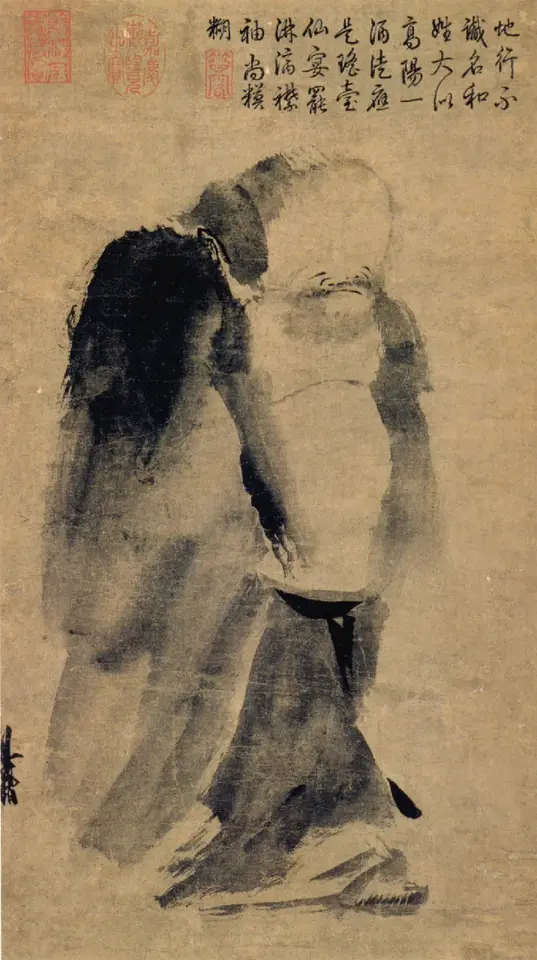
Liang Kai's supreme masterpiece is Immortal in Splashed Ink, a paper monochrome album leaf preserved in the National Palace Museum in Taipei.
Depicting a barefoot, grinning immortal strolling unsteadily through cosmic emptiness, Liang applied broad, watery ink washes that naturally diffused across the paper to form the torso and billowing robe. The facial features, squinting eyes, and snub nose were executed with succinct, expressive calligraphic lines. The painting harmonized wild spontaneous ink splashes with exquisite psychological characterization, celebrated as an unrepeatable miracle of ink monochrome painting.
Liang Kai's act of hanging the imperial Golden Belt on the academy rafters stands as one of the most heroic declarations of artistic autonomy in world cultural history.
In an autocratic society where court painters were expected to serve as imperial decorators, Liang boldly asserted that genuine creative genius requires absolute spiritual freedom. Choosing poverty and freedom over palace prestige, his unyielding independence infused his brushwork with profound moral authenticity and structural power.
Liang Kai's works were transported to Japan by visiting Zen monks during the late Song and Kamakura periods, fundamentally transforming the development of Japanese ink painting.
Japanese masters such as Sesshu Toyo and the Kano school revered Liang Kai's splashed ink as their primary model. In the modern era, Western art historians have marveled at Liang Kai's ability to achieve the emotional intensity of expressionism and impressionism eight centuries before their emergence in Europe, securing his stature as an immortal pioneer of global art.
Liang Kai's artistic exploration underwent a profound evolution from meticulous precision to spontaneous abbreviated ink. During his early service in the imperial Academy of Painting, he adhered closely to the models established by his teacher Jia Shixian, producing Daoist and Buddhist figures as well as palace banquet scenes marked by intricate linear brushwork, rich and elegant coloring, and rigorous form that captured the spirit of Song academic painting.
As his artistic philosophy matured and he absorbed the sudden enlightenment of Chan Buddhism, Liang recognized that overly rigid craftsmanship constrained spiritual authenticity. Consequently, he initiated one of the most radical stylistic revolutions in Chinese art: reducing intricate brush lines to the barest essentials while deploying saturated splashes of wet ink directly onto silk, creating the "splashed-ink technique" (pomo fa). Sweeping swift, decisive brushstrokes that sheared like steel blades through bamboo created the "broken-reed outline" (zhelu miao) and "abbreviated brush" (jianbi) methods. This leap marked a fundamental transition from the objective representation of external forms to the pure expression of subjective internal spirit.
Beyond his spontaneous caricatures, Liang demonstrated extraordinary range in narrative religious painting. In Shakyamuni Emerging from the Mountain, preserved in the Tokyo National Museum, Liang depicted the Buddha stepping out from snowy cliffs after years of ascetic mortification, combining delicate facial portraiture with jagged drapery lines that express immense spiritual fortitude.
Conversely, in The Sixth Patriarch Chopping Bamboo, Liang used dynamic, slashing brushwork to depict Chan master Huineng slicing bamboo, embodying the Zen philosophy that spiritual enlightenment resides in everyday physical labor. Both works are registered as National Treasures of Japan.
Beyond figure painting, Liang Kai exhibited extraordinary mastery in landscape compositions. His hanging scroll Wintry Landscape (Xuejing Shanshui Tu), preserved in Japan, depicts a lone traveler on a donkey braving biting snowstorms through towering mountain ravines. Liang employed sharp, crystalline axe-cut texture strokes (fupi cun) combined with dragged-mud washes (tuoni daishui cun), rendering precipitous cliffs, twisted barren trees, and a piercing atmosphere of desolation that demonstrated his profound sensitivity to nature's austere majesty.
In his celebrated work The Monk Budai (Budai Heshang Tu), Liang employed succinct and humorous caricature brushwork to vividly capture the plump, carefree appearance of the monk Budai, revered as an incarnation of Maitreya. Carrying his cloth sack with boundless joviality, the figure is defined purely through calligraphic bone lines, epitomizing the aesthetic transformation of religious portraiture toward secular life and popular accessibility.
FIGURES ASSOCIATED WITH THIS DYNASTY
Bibliographic information is not yet available for this entry.