Aristocratic Heritage
Born into the prominent Guzang branch of the Longxi Li clan, excelling in verse and classics from early youth.
李益
Li Yi (李益), styled Junyu (君虞), was a towering frontier poet and high court minister of the Mid-Tang dynasty, tracing ancestral roots to the prestigious Guzang branch of the Longxi Li clan in Liangzhou (modern Wuwei, Gansu Province). Demonstrating poetic eloquence in youth, Li passed the imperial jinshi examination in 769 during the reign of Emperor Daizong. He subsequently spent decades in the strategic military headquarters…
Li Yi (李益), styled Junyu (君虞), was a towering frontier poet and high court minister of the Mid-Tang dynasty, tracing ancestral roots to the prestigious Guzang branch of the Longxi Li clan in Liangzhou (modern Wuwei, Gansu Province). Demonstrating poetic eloquence in youth, Li passed the imperial jinshi examination in 769 during the reign of Emperor Daizong. He subsequently spent decades in the strategic military headquarters of Youzhou, Binning, and Shuofang across the northern frontiers, experiencing the rigors of garrison life before rising through metropolitan posts including Secretariat Drafter, Academician of the Jixian Academy, and Minister of Rites, receiving the posthumous title Vice Director of the Department of State Affairs. In classical poetry, Li was the preeminent leader of Mid-Tang frontier verse, celebrated alongside Gao Shi and Cen Shen. He was particularly celebrated for his majestic, plaintive seven-character quatrains (qiyan jueju), which were set to music by imperial court musicians and sung across the empire. His masterwork, Written on Listening to a Flute at Shouxiang City at Night, famously opens: "Before the Huile Peak the sand resembles snow; outside Shouxiang City the moon is like frost. Knowing not from where a reed pipe sounds, throughout the night all soldiers gaze toward home." Combining martial valor with tragic nostalgia, his verse stands as an immortal monument of East Asian literature.
Born into the prominent Guzang branch of the Longxi Li clan, excelling in verse and classics from early youth.
Passed the imperial jinshi examination at age twenty-four, embarking on bureaucratic service as Defender of Zhengxian.
Resigned county office to journey to the northern frontiers, serving on the military staffs of Liu Ji and Qu Huan.
Composed Written on Listening to a Flute at Shouxiang City at Night; musicians set his verses to court melodies across the realm.
Recalled to the capital by Emperor Xianzong, serving as Prefect of Mizhou, Remonstrance Censor, and Academician.
Promoted to Secretariat Drafter and Minister of Rites, directing national educational and ceremonial administration.
Retired from office in advanced old age, passing away peacefully at age eighty-four; awarded posthumous Vice Director of the Right.
Li Yi was born into the Guzang lineage of the Longxi Li clan, tracing his descent to King Li Gao of the Western Liang during the Sixteen Kingdoms. Nurtured within an environment of classical literary refinement, Li exhibited sparkling wit and lyrical grace from boyhood. In 769 (the fourth year of Dali), the twenty-four-year-old Li traveled to Chang'an, passing the prestigious jinshi examination alongside contemporary luminaries.
Yet Li's early bureaucratic prospects were underwhelming. He was assigned merely as County Defender of Zhengxian within Huazhou, responsible for mundane tax collection and minor criminal adjudication. Proud, uninhibited, and passionately ambitious, Li found himself deeply stifled by county drudgery. Turning to wine and poetry, he eventually abandoned his magistracy to seek adventure on the northern military frontier.
From the late Dali era through the middle of the Zhenyuan era, Li spent nearly two decades roaming the northern borderlands. Following the An Lushan Rebellion, the northern frontier remained destabilized by autonomous regional warlords and recurring raids by the Tibetan Empire and Uyghur Khaganate. Leveraging his rhetorical power and strategic insight, Li was recruited by regional military commanders including Liu Ji of Youzhou and Qu Huan of Binning, serving as Judicial Investigator and Headquarters Judge.
Accompanying military columns across the Sanggan River, the Shouxiang fortress, the Helan Mountains, and the Gobi Desert, Li endured freezing blizzards, howling desert storms, and the constant threat of ambush. He observed firsthand the bloody sacrifices of frontline soldiers contrasted against their aching homesickness. This extensive military experience purged his poetry of delicate metropolitan superficiality, infusing his brushwork with the skeletal vigor, raw desolation, and tragic grandeur of the northern frontiers.
Composed amidst military camps, Li's seven-character quatrains possessed impeccable melodic cadences that broke out of literati salons into universal performance. Imperial musicians of the palace Pear Garden and civilian courtesans across metropolitan taverns vied desperately for his latest manuscripts, setting them immediately to flute and string arrangements.
Contemporary anecdotes record that artists across Chang'an competed to paint scrolls illustrating Li's frontier verses, while high ministers hosting banquets along the Qujiang Stream hired performers to sing his poems. In particular, Written on Listening to a Flute at Shouxiang City at Night and Song of the Frontier were recited not only in the twin capitals, but resonated among non-Han nomadic tribes across the steppes.
Following his accession, Emperor Xianzong launched campaigns to reassert central imperial authority over regional warlords, seeking officials thoroughly versed in border defense. Recalled to Chang'an in 806, Li was appointed Prefect of Mizhou, Remonstrance Censor, and Secretariat Drafter concurrent with Academician of the Jixian Academy, drafting crucial imperial military directives.
Under Emperor Muzong in 821, Li ascended to Minister of Rites (Libu Shangshu), supervising state ritual liturgies and civil service examinations. Throughout his high ministerial career, Li maintained an unyielding, aloof integrity. In his final years, he retired due to physical infirmity, passing away in Chang'an in 829 at the age of eighty-four. Emperor Wenzong mourned his death, awarding him the posthumous title Vice Director of the Department of State Affairs.
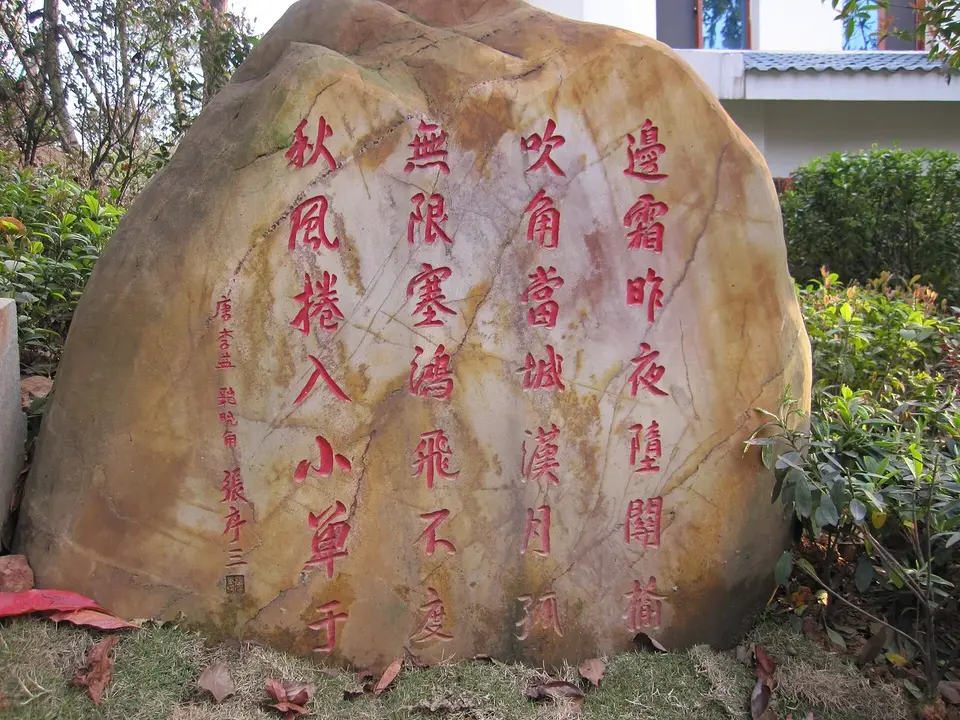
Li Yi's preeminent achievement in Chinese literature was his seven-character quatrain Written on Listening to a Flute at Shouxiang City at Night: "Before the Huile Peak the sand resembles snow; outside Shouxiang City the moon is like frost. Knowing not from where a reed pipe sounds, throughout the night all soldiers gaze toward home." The verse weaves the freezing sand dunes and crystalline moonlight of the Gobi into an evocative panorama of desolate beauty.
The opening couplet deploys vivid visual metaphors of snow and frost to establish an atmosphere of biting, desolate cold. The third line pivots dramatically from sight to sound as the haunting melody of a nomad's reed pipe drifts unexpectedly across the night air. The final line resolves the tension: hardened veteran soldiers, moved by the mournful tune, spend the long night looking south toward their distant homelands. Celebrated for emotional restraint and profound empathy, it is universally anthologized as a crowning masterpiece of the Tang dynasty.
In poetic history, Li fulfilled a crucial transitional role, revitalizing the declining verse of the Mid-Tang. While contemporaries retreated into the delicate, insular naturalism of the Ten Talents of Dali or the eccentric obscurities of the bitter-crafting school, Li championed the heroic grandeur of High Tang masters Gao Shi and Cen Shen.
In his Song of the Frontier, he declared: "General Fubo sought only to return wrapped in horsehide; why should Ban Chao have insisted on re-entering the Jade Gate alive? Let not a single rebel wheel return to their ocean lairs, retaining one arrow to pacify the Heavenly Mountains." This uncompromising martial patriotism and masculine vitality swept away the pervasive melancholy of the late eighth century, providing direct aesthetic inspiration to subsequent masters including Li He and Du Mu.
Li was a supreme exponent of harmonizing classical verse with vocal performance. His poetry strictly observed tonal cadences, making his lyrics effortlessly singable. Court musicians regarded acquiring Li's verses as a mark of highest professional prestige.
This musical dissemination endowed Li's poetry with unprecedented social penetration. Sung alike by imperial concubines within the inner palace, armored sentries on freezing bastions, and merchants navigating southern waterways, his quatrains bridged social strata and cultural geographies, standing as an extraordinary triumph in classical Chinese literary communication.
FIGURES ASSOCIATED WITH THIS DYNASTY