Age one | Born in Lueyang Commandery as the third son of Li Te; his mother was Lady Luo
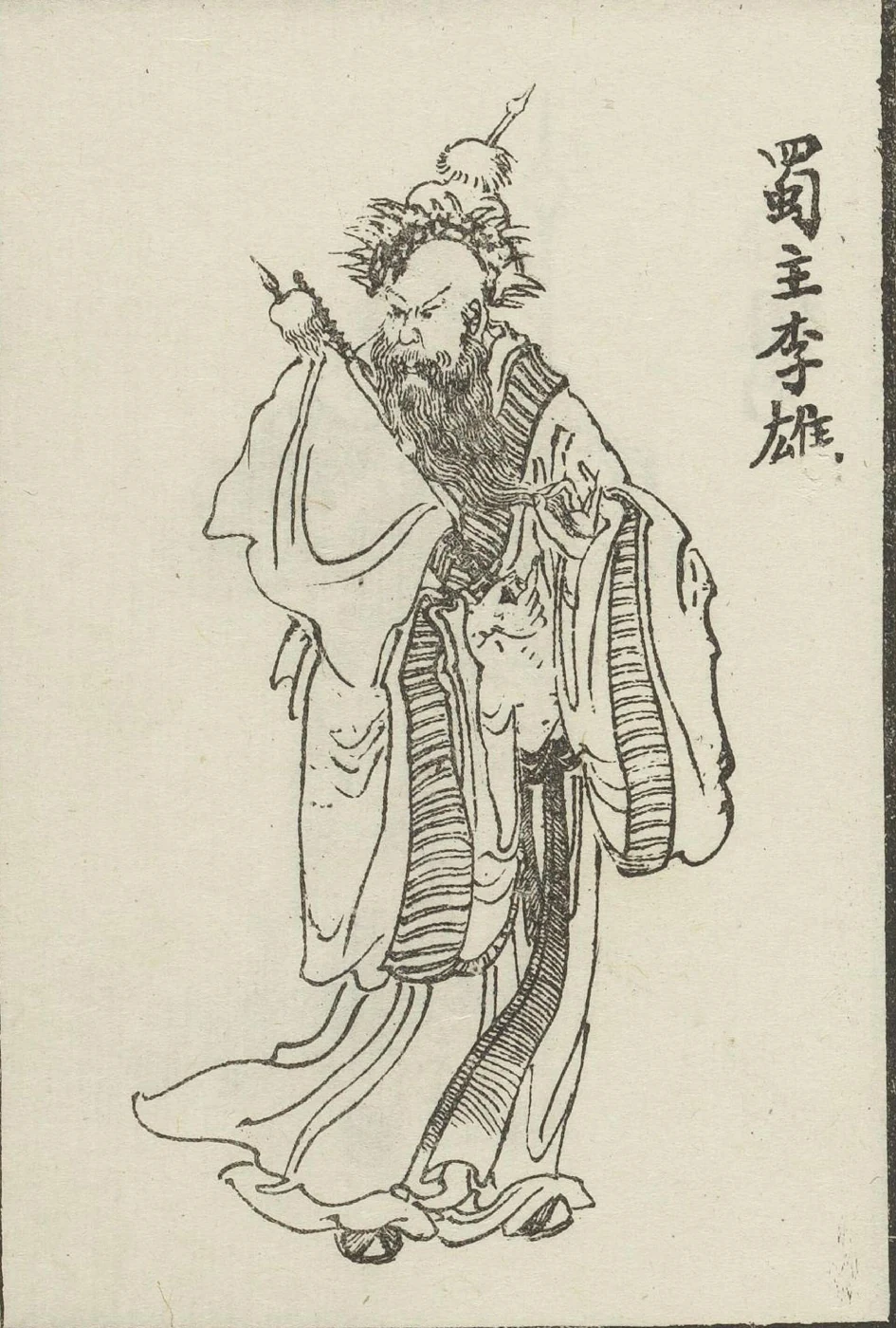
304 CE–334 CE
Emperor
Li Xiong
李雄
Li Xiong (274–334), courtesy name Zhongjun, was a member of the Di people, ancestrally from Dangqu (present-day Qu County, Sichuan) and born in Lueyang Commandery (present-day Qin'an County, Tianshui, Gansu). He was the founding emperor of Cheng Han during the Sixteen Kingdoms period and reigned from 304 to 334, successively using the era names Jianxing, Yanping, and Yuheng. After his death he received the posthumous name…
304 CE–334 CECheng Han
PROFILE
Li Xiong (274–334), courtesy name Zhongjun, was a member of the Di people, ancestrally from Dangqu (present-day Qu County, Sichuan) and born in Lueyang Commandery (present-day Qin'an County, Tianshui, Gansu). He was the founding emperor of Cheng Han during the Sixteen Kingdoms period and reigned from 304 to 334, successively using the era names Jianxing, Yanping, and Yuheng. After his death he received the posthumous name Emperor Wu and the temple name Taizong and was buried at Andu Mausoleum. Li Xiong was the third son of Li Te. At the end of the Western Jin he joined his father in leading refugees from six commanderies in revolt. After his father and elder brother were killed, he took control of their followers, proclaimed himself Prince of Chengdu in 304, and formally assumed the imperial title in 306, naming his state Great Cheng and establishing its capital at Chengdu. During his reign he gradually secured Bashu, Hanzhong, and all of Nanzhong, brought an end to years of warfare in Yizhou, promoted the recovery of production, and valued education and culture. He became one of the relatively few rulers of the Sixteen Kingdoms able to maintain a stable regional regime in Bashu.
- Other names
- Li Zhongjun
- Courtesy name
- Zhongjun
- Period
- Cheng Han
- Dynasty / regime
- Cheng Han
- Identity
- Emperor
- Ethnicity / ethnic affiliation
- Di people
- Native place
- Not recorded in historical sources
- Date of birth
- 274
- Place of birth
- Lueyang Commandery
- Date of death
- 334
- Reign
- 304–334
- Predecessor
- Not applicable (founding emperor)
- Successor
- Li Ban
- Era name
- Jianxing
- Temple name
- Taizong
- Posthumous name
- Emperor Wu
- Major achievements
- Son of Li Te; established Cheng Han after proclaiming himself emperor, creating one of the earliest southern regimes of the Sixteen Kingdoms to assume an imperial title.
LIFE TIMELINE
Age twenty-eight | Joined his father Li Te's uprising, was appointed General of the Vanguard, and guarded Zitong
Age thirty | His father Li Te and elder brother Li Dang were killed in succession; after his uncle Li Liu died, the commanders acclaimed him as leader, and he styled himself Grand Commander, General-in-chief, and Inspector of Yizhou
Age thirty-one | Captured Chengdu, proclaimed himself Prince of Chengdu, adopted the era name Jianxing, abolished Jin laws, and issued a seven-article legal code
Age thirty-three | Formally proclaimed himself emperor, named his state Great Cheng, adopted the era name Yanping, and posthumously honored his father Li Te as Emperor Jing
Age thirty-six | Lost Zitong and Baxi after subordinate rebellions, then sent Zhang Bao to feign defection and retake Zitong
Age thirty-eight | Adopted the era name Yuheng; his uncle Li Xiang captured Fucheng and the Zitong administrator Qiao Deng and killed the rebel Wen Shuo
Age forty-two | Made Lady Ren empress
Age fifty-one | Overcame opposition and made Li Ban, son of his elder brother Li Dang, crown prince
Age fifty-seven | Sent Li Shou to capture Badong and advance toward Jianping
Age sixty | Sent Li Shou to take Zhuti; Yin Feng, Inspector of Ningzhou, surrendered, bringing all of Nanzhong under Cheng Han control
Age sixty-one | Developed a malignant sore on his head and died on the twenty-fifth day of the sixth lunar month; Crown Prince Li Ban succeeded him
BIOGRAPHY
Biography
Family Background and Early Years
Li Xiong came from a powerful Di family whose ancestral home was Dangqu before the clan moved to Lueyang Commandery. His family had long been leaders among the Di and wielded considerable influence in the Guanlong region. Li Xiong was said to stand eight chi and three cun tall, with an imposing appearance. From youth he was known locally for a fierce and resolute spirit, and people regarded as discerning placed high hopes in him. During the Taikang era (280–289), a Daoist diviner named Liu Hua reportedly told people of the region that the men of Guanlong would migrate south and that among the Li sons only Zhongjun, Li Xiong's courtesy name, possessed exceptional endowments and the bearing of a future ruler. Many local people accepted the prediction. Li Xiong and his uncle Li Xiang were both renowned for their bold spirit and attracted followers. Xin Ran, administrator of Guanghan, was struck by Li Xiong on meeting him and said that his physiognomy foretold great rank. Another diviner described four signs of extraordinary nobility in his eyes, nose, mouth, and ears and predicted that his position would surpass the Three Excellencies.
Joining His Father's Revolt and the Deaths of His Father and Brother
At the end of the Western Jin, years of warfare and famine in Guanzhong drove more than one hundred thousand refugees from the six commanderies around Lueyang and Tianshui into Shu in search of food. In 301, the first year of the Yongning era, the court tried to force them back to their home regions. Luo Shang, Inspector of Yizhou, used the occasion to extort them, provoking resistance. Li Te raised troops in Shu, styled himself Inspector of Yizhou, Grand Commander, and General-in-chief Who Guards the North, and assumed authority to confer offices in the emperor's name following the precedent of Dou Rong in Hexi. Li Xiong was appointed General of the Vanguard and stationed at Zitong. His uncle Li Liu had long valued his mature character, often saying, "The one who will revive our house must be this man," and instructed his own sons to respect and serve Li Xiong.
Li Te made three rules with the people of Shu, distributed wealth, aided the poor, honored talented men, and promoted those who had been overlooked, maintaining disciplined administration and military order. In the spring of 303, the first year of Li Te's Jianchu era, he entered the Lesser City of Chengdu and accepted the surrender of Xu Jian, administrator of Shu Commandery. Luo Shang withdrew into the Greater City and sent envoys seeking peace. Short of grain, Li Te dispersed the refugees from the six commanderies among villages and fortified settlements for food. Li Xiong and the military officer Shangguan Dun advised him to take the sons of leading provincial families as hostages and tighten his defenses. Li Te angrily refused, saying that the great task was already settled and that they should now soothe the people rather than act against popular sentiment. On the fifteenth day of the second lunar month, Luo Shang launched a surprise attack while Li Te was unprepared. Li Te, Li Fu, and Li Yuan were killed at Xinfan (present-day Xinfan, Chengdu, Sichuan).
After Li Te's death many people in Shu turned against his followers. Li Liu and Li Te's sons Li Dang and Li Xiong gathered the remnants and withdrew to Chizu. Li Liu styled himself Grand Commander, General-in-chief, and Inspector of Yizhou and held the eastern camp, while Li Dang and Li Xiong defended the northern camp. In the third lunar month Luo Shang sent Chang Shen, Zuo Si, Huang Yin, and He Chong in three columns. Li Liu and his younger brother Li Xiang resisted Chang Shen while Li Dang and Li Xiong fought Yao Shen. He Chong attacked the northern camp while it was exposed, and the Di men Fu Cheng, Wei Bo, and Shi Ding rebelled inside to support him. Li Dang's mother, Lady Luo, put on armor and fought. Wei Bo slashed her face with a sword, but the wound only increased her determination. The fighting lasted from morning until noon and the northern camp was close to falling when Li Xiang broke Chang Shen's camp and Li Dang and Li Xiong defeated Yao Shen. They returned and together routed He Chong's force. Li Dang pursued the defeated army but was struck by a spear and killed.
Taking Command and Capturing Chengdu
With Li Te and Li Dang dead and Jingzhou troops occupying Deyang, the situation became critical. Li Liu feared the expected arrival of Song Dai and Sun Fu. Administrator Li Han advised surrender, and Li Liu intended to accept. Li Xiang and Li Xiong repeatedly remonstrated without success. In the fifth lunar month Li Liu sent his son Li Shi and Li Han's son Li Hu to Sun Fu as hostages, but Sun Fu refused them. Li Li, elder brother of Li Hu and administrator of Zitong, heard that his father and uncle intended to surrender and rode back from Zitong to remonstrate, but arrived too late. He returned and plotted with Li Xiong to attack Sun Fu's army, saying that if they succeeded Li Xiong should become ruler, with a change of ruler every three years. Li Xiong asked what they should do if his uncle refused. Li Li replied that they must restrain him and, if necessary, take extraordinary measures because circumstances left no alternative. Li Xiong was delighted. Together they persuaded the refugees from the six commanderies that after the violence already inflicted on the people of Shu, surrender would leave them helpless victims and that only a united attack on Sun Fu offered the prospect of survival and prosperity. The men agreed. Li Xiong and Li Li attacked and defeated Sun Fu's army with heavy losses. Song Dai then died at Dianjiang (present-day Hechuan, Chongqing), causing the Jingzhou army to withdraw. Li Liu turned to attack Luo Shang and, ashamed of his own weakness and impressed by Li Xiong's ability, handed all military affairs to him.
In the sixth lunar month Li Xiong crossed the river at Boyangtuai, killed Chen Tu, administrator of Wenshan, and captured Pi City (present-day Pidu District, Chengdu). In the ninth lunar month Li Liu became seriously ill and told the commanders that Li Xiang was wise, humane, and capable of great affairs, but that General of the Vanguard Li Xiong was heroic and formidable and seemed favored by Heaven; they should therefore obey Li Xiong and make him Prince of Chengdu. Li Liu soon died, and the commanders jointly acclaimed Li Xiong as their leader. He styled himself Grand Commander, General-in-chief, and Inspector of Yizhou and established himself at Pi City.
Luo Shang sent a commander against him. Li Xiong recruited a man from Wudu named Pu Tai, had him flogged until he bled, and sent him to deceive Luo Shang by claiming that Li Xiang and Li Xiong were starving, isolated, and quarreling daily, and that Li Xiang intended to move the population west of the river for food. If troops secretly entered Pi City, Pu said, he would open the way from within. Luo Shang believed him and rewarded him generously. Pu Tai arranged a signal by fire while Li Xiang set an ambush on the route. Pu placed a long ladder against the wall and raised a torch. When Wei Bo's men saw the signal they rushed up the ladder. Pu hauled more than one hundred of them over the wall with ropes and had them all killed. Li Xiang then struck from outside while the defenders attacked from within, routing Wei Bo's army. During the night they falsely shouted "Ten thousand years!" and entered the Lesser City. Luo Shang realized the deception and retreated to the Greater City. Li Xiang then attacked Qianwei, cut Luo Shang's supply route, and captured the commandery administrator Gong Hui. In the twelfth lunar month Li Xiong intensified the siege. With supplies exhausted, Luo Shang abandoned the city and fled by night along the Niubei River. Li Xiong finally captured Chengdu and occupied the entire area. His own army was extremely short of food and had to move to Qishan, digging wild taro for sustenance.
Assuming the Imperial Title and Expanding the Realm
In 304, the first year of the Yongxing era, his commanders insisted that Li Xiong assume a sovereign title. He proclaimed himself Prince of Chengdu, issued an amnesty, adopted the era name Jianxing, abolished Jin law, and promulgated seven articles of law. He appointed his uncle Li Xiang Grand Preceptor, his elder brother Li Shi Grand Protector, General Li Li Defender-in-chief, General Li Yun Minister over the Masses, General Li Huang Minister of Works, and Li Guo Grand Steward. He posthumously honored his great-grandfather Li Hu as Duke Huan of Ba Commandery, his grandfather Li Mu as Prince Xiang of Longxi, his father Li Te as Prince Jing of Chengdu, and his mother Lady Luo as queen dowager. Fan Changsheng came from the Western Mountains to Chengdu in a plain carriage. Li Xiong met him at the gate, held a tablet before him, invited him to sit, appointed him chief councillor, and honored him as "Worthy Fan."
In 306, the third year of the Jianxing era, Fan Changsheng urged Li Xiong to proclaim himself emperor. Li Xiong did so, issued an amnesty, changed the era name to Yanping, and named the state Great Cheng, later known as Cheng Han. He posthumously honored his father Li Te as Emperor Jing with the temple name Shizu, and his mother Lady Luo as empress dowager. Fan Changsheng received the title Grand Master of Heaven and Earth and was enfeoffed as Marquis of the Western Mountains; his followers were exempted from military service and their tax revenues were assigned to his household. Because the new regime initially lacked established ritual and law, generals relied on personal favor and disputed rank. Yan Shi, Director of the Department of State Affairs, submitted a memorial urging adoption of Han and Jin institutions, and Li Xiong accepted the proposal.
In 307, Li Xiong sent Li Li, Li Guo, Li Yun, and others with twenty thousand men into Hanzhong. Zhang Yin, Inspector of Liangzhou, fled to Chang'an. Li Guo and the others captured Nanzheng and moved the inhabitants of Hanzhong into Shu. In 309, Li Li, who held Zitong, was killed by his subordinates Hong Qi, Luo Yang, Zhang Jingou, and others, who surrendered Zitong to Luo Shang. Li Guo, who held Baxi, was likewise killed by his subordinate Wen Shuo, who surrendered Baxi. Li Xiong sent Zhang Bao into Zitong pretending to be a murderer in flight. After winning the rebels' confidence, Zhang shut the gates while they went out to receive Luo Shang's envoy and successfully retook the city. Luo Shang then died and disorder spread through Ba Commandery. Li Xiang attacked Fucheng. In the first lunar month of 311, the first year of the Yuheng era, Li Xiang captured Fucheng and the Zitong administrator Qiao Deng, then advanced and killed Wen Shuo. Li Xiong was delighted, issued an amnesty, and changed the era name to Yuheng.
In 314, the fourth year of the Yuheng era, Cheng Han gained Hanji and Fuling, and people from more distant regions increasingly submitted. Li Xiong issued a broad order exempting those who surrendered or attached themselves to his regime from labor and taxes. He valued talent and made appointments according to ability, and Yizhou became stable. In 315 he made Lady Ren empress. At this time the Di ruler Yang Nandi and his brothers, defeated by Liu Yao of Former Zhao, fled to Jiameng and sent a son as hostage to Cheng Han. The rebel commander Chen An of Longxi also attached himself to Li Xiong.
In 319, Li Xiong sent Li Xiang against Yuexi Commandery, and the following year Administrator Li Zhao was compelled to surrender. Li Xiang then advanced from Xiaohui against Wang Xun, Inspector of Ningzhou. Wang sent Yao Yue with all his troops to meet him. Li Xiang was defeated and, after days of heavy rain, withdrew. In the rush to cross the Lu River many soldiers died. When Li Zhao reached Chengdu, Li Xiong treated him exceptionally well and entrusted court ceremonial and mourning rites to him.
When Yang Nandi and his brothers had fled to Jiameng from Former Zhao, Li Xiong's nephew Li Zhi, General Who Pacifies the North, treated them generously and did not send them on to Chengdu. After the Former Zhao army withdrew, he allowed them to return to Wudu. Yang Nandi then relied on the region's natural defenses and repeatedly violated Cheng Han authority. Li Zhi requested permission to punish him. Ignoring his ministers' remonstrance, Li Xiong sent Li Zhi's elder brother Li Han, Commander of the Central Army, together with Generals Le Ci, Fei Ta, Li Qian, and others from the Baishui Bridge against Xiabian, while General Li Shou directed Li Wu against Yinping. Yang Nandi sent forces to resist. Li Shou was unable to advance, but Li Han and Li Zhi pressed forward as far as Wujie. Yang cut their route of retreat, surrounded them, captured both, and killed several thousand men. Li Han and Li Zhi were sons of Li Xiong's elder brother Li Dang. Li Xiong grieved deeply, went without food for several days, wept whenever he spoke of them, and severely blamed himself.
The Succession Dispute and Later Years
Li Xiong intended to make one of his elder brother Li Dang's sons crown prince. He first considered Li Han, but Li Han had been killed. In 324, the fourteenth year of the Yuheng era, he decided on Li Ban, another son of Li Dang. Li Xiong had more than ten sons of his own, and his ministers all wanted one of them to be chosen. Li Xiong replied that the original rising had been like an ordinary person raising a hand to protect his own head, not an attempt to found an imperial house. The collapse of the Jin and the suffering of the people had led the followers to raise him to princely rank, but the foundation of the regime, he said, truly belonged to the former ruler. His elder brother had held the legitimate family line and should have inherited the great succession, and Li Ban was humane, filial, studious, and destined for great things. Li Xiang and Minister over the Masses Wang Da remonstrated that the purpose of establishing a crown prince was to prevent future usurpation and that history showed the dangers of passing over one's own sons. Li Xiong refused to change his decision and made Li Ban crown prince. Li Xiang withdrew in tears, saying, "Disorder begins from this point."
Zhang Jun, Prince Wen of Former Liang, sent Li Xiong a letter urging him to relinquish the imperial title and acknowledge the Jin as a vassal ruler. Li Xiong replied that he had originally been elevated by the scholar-officials without desiring kingship, that at best he wished to become a meritorious minister who restored the Jin and at worst a frontier commander like Zhang Jun, but that the Jin house had declined and he had long looked eastward in vain. Zhang Jun respected the reply and maintained exchanges of envoys.
Because the Central Plains remained in chaos, Li Xiong repeatedly exchanged envoys with Tuoba Yilu, Prince of Dai, and even agreed with him on a division of the realm. Zhang Jun once sent Fu Ying through Cheng Han territory to submit a memorial to the Jin court at Jiankang, but Li Xiong refused passage. Zhang then sent Zhang Chun, an official on his staff, to declare Former Liang's subordinate status to Cheng Han in order to secure transit. Li Xiong was pleased and asked why such a renowned ruler with defensible territory and strong forces did not proclaim himself emperor. Zhang Chun replied that his ruler's ancestors had long been loyal ministers and that he sought to restore the Jin from Jiangdong in the manner of Duke Huan of Qi and Duke Wen of Jin, not to seize the realm for himself. Li Xiong looked ashamed and said that his own ancestors and father had also been Jin subjects, and that if the Jin prince at Jiankang could restore the dynasty in the Central Plains he too would lead his followers to assist. Zhang Chun eventually delivered the memorial and received praise from the Jin emperor.
Conquest of Nanzhong and Death
After Li Xiang died, Li Xiong appointed Li Xiang's son Li Shou General-in-chief and Colonel of the Western Yi. In the tenth lunar month of 330, the twentieth year of the Yuheng era, Li Shou directed General Fei Hei and General Ren Hui in capturing Badong, forcing Administrator Yang Qian to retreat to Jianping. Li Shou then sent Fei Hei to harass Jianping, and Guanqiu Ao, the Eastern Jin military supervisor of Badong, withdrew to Yidu. In the seventh lunar month of 331, Li Shou attacked Yinping and Wudu, and the Di ruler Yang Nandi surrendered. In 333 Li Xiong again sent Li Shou against Zhuti, with Fei Hei and Yang Pan as vanguard commanders, while General Ren Hui campaigned against Mulu to disperse Ningzhou's relief forces. Yin Feng, Inspector of Ningzhou, surrendered, bringing Nanzhong under Cheng Han. Li Xiong issued an amnesty, sent Li Ban to suppress and pacify the non-Han peoples of Ningzhou, and appointed Li Ban General Who Pacifies the Army.
In 334, the twenty-fourth year of the Yuheng era, Li Xiong developed a malignant sore on his head. He died on the twenty-fifth day of the sixth lunar month at the age of sixty-one after thirty-one years on the throne. He received the posthumous name Emperor Wu and the temple name Taizong and was buried at Andu Mausoleum. Crown Prince Li Ban succeeded him.
Li Te's Assumption of Titles and His Government by Simple Law
In the first year of Yongning Li Te styled himself commissioner with the staff of authority, grand commander-in-chief and general of the north, "appointing and enfeoffing by imperial authority exactly after the precedent of Dou Rong in Hexi". His brother Li Fu was made swift cavalry general, his brother Li Xiang chief of the swift cavalry, his brother Li Liu general of the east with the title of eastern protector, his eldest son Li Shi general of Wuwei, his second son Li Dang general of the garrison, and his youngest son Li Xiong general of the front, with Li Han as colonel of the western barbarians, and Li Han's sons Li Guo and Li Li together with Ren Hui, Li Gong, Shangguan Jing, Li Pan and Fei Tuo as commanders, Ren Zang, Shangguan Dun, Yang Bao, Yang Gui, Wang Da and Qu Xin as claws and teeth, Li Yuan, Li Bo, Xi Bin, Yan Cheng, Shangguan Qi, Li Tao and Wang Huai as staff, Yan Yu as chief adviser and He Ju and Zhao Su as intimates. At that time "Luo Shang grew daily more greedy and cruel and was a scourge to the people, while Li Te made a three-point covenant with the people of Shu, giving alms and relief, honouring the worthy and raising the obscure, so that army and government were orderly". On the first day of the first month of the first year of Jianchu Li Te "crossed the river secretly and broke Luo Shang's flotilla", crossing at Angdi with his partisans at Chishui into Pi, and "as he went southwest the river guards all scattered", so that he raided Chengdu; the governor of Shu, Xu Jian, surrendered Shaocheng, and Li Te occupied it, "taking only horses for the army and plundering nothing else", granting an amnesty in the region and changing the reign-title to Jianchu, with Li Huang as governor of Shu to comfort the people, while Luo Shang held Taicheng and Li Liu camped at Jianshang west of the river, so that Luo Shang, in fear, sent to sue for peace. The people of Shu, alarmed, "walled their villages and sent in their submission" to Li Te, who sent envoys to soothe them; and because grain was short he "sent the refugees of the six commanderies into the city by households to feed themselves from the villages, with the strong and bold in charge of the villages". Li Liu told Li Te that "your highness is divinely martial and has taken Shaocheng, but the villages are newly submitted and men's hearts are not yet firm, and in the hills and marshes grain and weapons are scarce; you should take the sons of the great families of the commanderies as hostages and send them bound to Guanghan, and gather the bold and keen in the two camps and guard strictly", adding to the marshal Shangguan Dun that "to receive a surrender is like facing an enemy; it must not be lightly done", and the general of the front Li Xiong said the same; but Li Te was angry and said that "the great matter is settled; we should only pacify the people — why act contrary to men's hearts and add suspicion, so that they rebel?" Afterwards Luo Shang attacked unprepared and Li Te, Li Fu and Li Yuan were killed at Xinfan.
The Danger at the Northern Camp and the Death of Li Dang
After Li Te's death Li Liu with Li Dang and Li Xiong gathered the remnant and fell back on the eastern and northern camps. In the third month Luo Shang sent the protector Chang Shen to camp at Piqiao, and the gate-commanders Zuo Si, Huang Yin and He Chong to attack in three columns at Fancheng; the commander of Mianzhu surrendered, and the people of Fuling, Yao Shen and Du A, rose in aid of Luo Shang. Li Liu with his brother Li Xiang met Chang Shen, and sent Li Dang and Li Xiong against Yao Shen; He Chong, taking advantage of the emptiness, attacked the northern camp, where the Di Fu Cheng, Wei Bo and Shi Ding rebelled and joined him against Li Dang and Li Xiong. Li Dang's mother, the Lady Luo, "put on armour and fought", and Wei Bo "cut at her with his own hand and wounded her face", yet "her heroic spirit burned the fiercer"; with Fu Cheng and Wei Bo fighting within and He Chong attacking without, "from morning to midday the camp was on the point of being broken", until Li Xiang broke Chang Shen's palisade and his men scattered, and Li Dang and Li Xiong, having also broken Yao Shen, brought their troops back and fought He Chong, breaking him utterly, while Fu Cheng and Wei Bo led their party out to Luo Shang. Li Liu and the rest, pressing their victory, reached Chengdu, and Luo Shang again shut the city and held it; and Li Dang, galloping in pursuit of the fugitives, "was killed by a long spear of the Sou". The court then sent the palace attendant Liu Chen with the staff of authority to command the armies of the governor of Yizhou, Luo Shang, and the governor of Liangzhou, Xu Xiong, against Li Liu; but at Chang'an the prince of Hejian, Sima Yong, asked that Liu Chen be kept as his army adviser, and sent Xi Wei in his place. Li Liu, with Li Te and Li Dang both dead and Song Dai and Sun Fu about to come, "was much afraid", and when the governor Li Han urged surrender he would have yielded, but Li Xiang and Li Xiong "remonstrated again and again without his heeding".
The Surprise against Sun Fu and Li Liu's Last Charge
In the fifth month Li Liu sent his son Li Shi and Li Han's son Li Hu as hostages to Sun Fu, who refused them; and Li Hu's elder brother Li Li, governor of Zitong, "hearing that his father and uncle meant to surrender, galloped back from Zitong to remonstrate, but came too late", and returning plotted with Li Xiong to surprise Sun Fu's army, saying that "if the thing succeeds and the work is done, you should be the ruler", and agreeing to alternate with Li Xiong every three years. Li Xiong asked what was to be done if their uncle would not agree, and Li Li answered that "we must now control him, and if we cannot control him, then do a great deed; though he is your uncle, circumstance leaves no choice", at which Li Xiong was greatly pleased, and together they persuaded the refugees of the six commanderies that "we have already done violence to the people of Shu, and if we now fold our hands we shall be flesh for the knife; nothing but joining forces to surprise Sun Fu will win us wealth and honour", and all followed them; and so they surprised and broke Sun Fu's army, "the slain being very many". It happening that Song Dai died at Dianjiang and the Jingzhou army withdrew, they turned against Luo Shang; and Li Liu, "ashamed of his own shortcomings and marvelling at Li Xiong's talent, entrusted him with all military affairs". In the sixth month Li Xiong crossed the river from Boyangtui, killed the governor of Wenshan, Chen Tu, and took Pi. In the ninth month Li Liu, gravely ill, said to his officers that "the chief of the swift cavalry, Li Xiang, is lofty and benevolent and of uncommon judgement and could accomplish the great matter; but the general of the front, Li Xiong, is brave and martial and is, I think, aided by Heaven; all should obey the general of the front and let him be prince of Chengdu". Soon Li Liu died and the officers together made Li Xiong their lord, who styled himself grand commander-in-chief, grand general and governor of Yizhou, living at Pi; and Li Liu was afterwards posthumously named prince Wen of Qin.
The Fraud of Pu Tai and the Taking of Chengdu
When Luo Shang sent his officers against Li Xiong, the latter hired a man of Wudu, Pu Tai, "flogged him till he bled" and sent him to deceive Luo Shang with the tale that "Li Xiang and Li Xiong are starving and isolated, quarrelling and blaming each other daily; Li Xiang means to take the people east of the river to eat grain, and if you send troops secretly into Pi, I will be your man within and the city may be had". Luo Shang believed him and "gave him much gold and treasure", but Pu Tai said that "as the matter has not yet shown any result, it will be time enough to take them later", and asked to have men sent with him to spy, so that Luo Shang trusted him the more and "sent out all his best troops under Wei Bo and others to attack Pi with Pu Tai". Pu Tai agreed to raise fire as the signal, and the chief of the swift cavalry, Li Xiang, laid an ambush on the road; Pu Tai "leaned a long ladder against the wall and raised the fire", and Wei Bo's men, seeing it, "strove to climb the ladder", while Pu Tai hauled up more than a hundred of Wei Bo's men with a rope and "beheaded them all", whereupon Li Xiang loosed his troops and struck from within and without, breaking them utterly and pursuing them to the city wall, where by night he raised a false shout that "Pi is taken", and entering Shaocheng before Luo Shang perceived it, so that Luo Shang fell back on Taicheng. Wei Bo, gravely wounded, was taken alive by Li Xiong, who spared him because his daughter was the wife of Liang Shuang and Liang Shuang was then in Li Xiong's service, but he rebelled again afterwards. Li Xiang went separately against Jianwei to cut Luo Shang's supply road and took its governor Gong Hui; and Gong Hui, who had once been magistrate of Tianshui West when Ren Hui was his clerk, was asked by Ren Hui whether he recognized his old subordinate, and answered that "I know you, that is all", and when the officers of the commandery scattered "only the merit clerk Yang Huan stood by him", and Ren Hui told Yang Huan that "you are a righteous man; my strength cannot save Lord Gong nor spare you, so you had best go early", but Yang Huan answered that "to betray one's lord for life — how is that better than to keep faith and die?", and the two were killed together. In the twelfth month Li Xiong pressed Luo Shang hard; his grain failed and his soldiers had nothing to eat, so that leaving the gate-commander Zhang Luo to hold the city he fled by night down the Niubi river, and Li Xiong, finding it out too late to catch him, saw him lose in his haste the tally and the axe of office, which Zhang Luo picked up with stores besides, "and so he opened the gate and let Li Xiong in", who thus took Chengdu and held the whole region; his army being then in great hunger, he led them to Mount Ji to seek food and dig wild taro.
Taking the Princely and Imperial Titles and Founding the State
Yang Xiang, Yang Gui and the other officers pressed Li Xiong to take the highest place, and in the tenth month of the first year of Yongxing he "falsely styled himself prince of Chengdu, took his seat in the southern suburb, granted an amnesty within his borders for all but capital crimes, and changed the reign-title to Jianxing", abolishing the Jin law and "making a covenant of seven articles". He made his uncle Li Xiang grand tutor, his elder half-brother Li Shi grand guardian, the charging general Li Li grand commandant, the awing-general Li Yun minister of education, the general Li Huang minister of works, the general Li Guo chief minister, Yan Yu president of the secretariat, Yang Bao president of the left and Yang Xiang president of the right; and he posthumously honoured his great-grandfather Li Hu as prince Huan of Ba, his grandfather Li Mu as prince Xiang of Longxi, his father Li Te as prince Jing of Chengdu and his mother the Lady Luo as queen dowager, with his uncle Li Fu as prince Lie of Qi, Li Xiang as prince Wu of Liang, Li Liu as prince Wen of Qin and his brother Li Dang as duke Zhuangwen of Guanghan. Afterwards Fan Changsheng came to Chengdu from the western hills in a plain carriage, and Li Xiong "welcomed him at the gate, took his tablet and gave him a seat, made him chancellor and called him Fan the Worthy"; and when Fan urged him to take the imperial style he did so, granting an amnesty and changing the reign-title to Taiwu, posthumously honouring his father Li Te as emperor Jing with the temple name Shizu and his mother as empress dowager, making Fan Changsheng master of heaven and earth, marquis of the western hills, "exempting his retainers from military service and reserving their rents and taxes to his own house". At the founding "there were no rules, and the officers, relying on favour, quarrelled over precedence", whereupon the president of the secretariat Yan Shi memorialised that "in making law for a state one follows the old precedents; by the usage of Han and Jin only the grand commandant and the chief minister held troops, the grand tutor and grand guardian were offices of father and elder brother, of discoursing on the Way, and the minister of education and minister of works had charge of the five teachings and the nine regions; Qin set up a chancellor to lead all business, and at the end of Han Wu the grand general was exceptionally given the government. Now that the state is newly founded and everything is unprepared, the princes and generals have different ranks and come pressing for appointments not answering to the precedents; rules should be made to serve as a model", which Li Xiong followed.
Hanzhong, Zitong and the Taking of Fu
In the second month of the second year of Yanping, when the refugees of the passes, Deng Ding and Xun Di, with more than two thousand households, came starving into Hanzhong and held Chenggu "gradually becoming robbers", the governor of Liangzhou, Zhang Yin, sent the governor of Baxi, Zhang Yan, with the gate-commander Wu Zhao and the assistant of the state of Han, Xuan Ding, against them; and Deng Ding, hard pressed, "feigned surrender to Zhang Yan and sent him gold and silver", so that Zhang Yan rejoiced and delayed his advance, while Deng Ding secretly sent the Di to league with Li Xiong. In the fifth month Li Xiong sent Li Li, Li Guo, Li Yun and Li Huang with twenty thousand to his aid; they first attacked Zhang Yin's camp and broke it, then attacked Deng Ding and broke him, and Zhang Yan, "fearing battle, fled with a hundred or so horsemen", while Li Li and the rest broke the provincial army utterly and advanced on Hanzhong. The governor of Hanzhong, Du Mengzhi, sent the gate-commander Cai Song to look at Li Li's position, and Cai Song, returning, said that "the provincial army has broken the rebels and cannot be waited for", at which Du Mengzhi was afraid; the protector wished to hold the city, saying that "the rebels come in numbers, which is the common way of an invader... they have come only to rescue Deng Ding and the Di", but Du Mengzhi said that "it is not so; Li Xiong, calling himself emperor and ranging across the world, has sent this great host and will surely take Hanzhong; though our city be strong we cannot fight him, and this is to wait for the bandit", and so opened the gate and withdrew, the protector going north. Du Mengzhi entered the Dasang valley with "several thousand families and several thousand carts, travelling only a few dozen li in a night", and Jing Zi of Zitong, whose father had quarrelled with Du Mengzhi, "gathered the sons of his clan and pursued him, coming up with him at the mouth of the valley", so that Du Mengzhi abandoned his son and fled and Jing Zi took his son and a thousand families of officials and people; only the merit clerk of the state of Han, Tian Qiu, "carrying his load on a staff" and saying that "though I am unworthy, I am an officer of a state; the state being lost I cannot preserve it, but I will not belong to the rebels", starved to death in the valley. Li Xiong also told his officer Zhang Bao that "if you can take Zitong I will give you the office Li Li once held", and Zhang Bao, having first killed a man, fled to Zitong, where Xun Qi and the rest trusted him as their intimate; and when Luo Shang sent an envoy to Zitong and Xun Qi and the others went out to see him off, Zhang Bao "shut the gate behind them", so that Xun Qi fled, and Zitong was recovered.
The taking of Fu was bound up with Qiao Deng. A son of Qiao Zhou lived in Baxi and was killed by its governor Ma Tuo, and his son Qiao Deng went to the general of the south, Liu Hong, asking troops for vengeance; Liu Hong, having none to give, memorialised making Qiao Deng awing-general and inner secretary of Zitong, "to raise refugees of Ba and Shu himself", and he raised two thousand; going west to Ba commandery he asked Luo Shang for more troops and was refused, and so attacked Dangqu, killed Ma Tuo and "cut out his liver and ate it", whereupon Zitong surrendered to him and he occupied Fu. Li Xiong came in person against him and was beaten, and Zhang Luo occupied Heshi in Jianwei, so that Ba and Shu had a saying that "Qiao Deng governs Fu, Wen Shuo holds Baxi, Zhang Luo guards Heshi — how shall the Ba Di come on?" In the tenth month Luo Shang died, and the grand tutor Li Xiang attacked Qiao Deng at Fu, while the governor of Yizhou, Pi Su, camped at Badong and ordered the general of the west, Zhang Shun, and Yang Xian to relieve Qiao Deng; but Luo Shang's son Luo Yu and his staff, hating Qiao Deng, refused him grain, and Pi Su, coming to Fu in anger to punish them, was murdered at Ba in the twelfth month by Luo Yu's men, the surrendered generals Zhao Pan and Yan Lan, while the commandant of Jianping, Bao Zhong, killed Luo Yu and Zhao Pan, "and Ba was thrown into disorder and Qiao Deng was never relieved". Li Xiang, knowing that Qiao Deng's food was gone and his help cut off, pressed the siege the harder, but Qiao Deng held firm, "his soldiers eating smoked rats, and many starving to death, yet not one deserted"; and Li Xiang's son Li Shou, who had been with Qiao Deng, was sent home by him. Afterwards the officers of the three offices imprisoned Bao Zhong and his family at Yidu and killed them, and jointly memorialised making Zhang Luo of Ba commander of the three offices; Zhang Luo governed at Zhi and went himself against Wei Wen at Gongqi, breaking and receiving his surrender, but "within a month he rebelled again", seizing the governor of Ba, Huang Kan, and making him their figurehead; Huang Kan, at his wits' end, would have killed himself, and his secretary Yang Yu advised him that "Wen's old villainy is known to all the rivers and hills; that he has seized your honour — who will not fear, and who will believe a false name?", and when Huang Kan said that "the rebels have cut the roads, so how can Lord Jingzhi be made to know?", Yang Yu wrote a letter in Huang Kan's name and sent his brother to Zhang Luo; Wei Wen, hearing of it, was angry, imprisoned Huang Kan and seized Yang Yu, demanding to know how the message had been sent, and Huang Kan said that it had not been, whereupon Wei Wen tortured Yang Yu for a day and a night and Yang Yu said nothing; and when Wei Wen would have killed Huang Kan, Yang Yu "died under the rod" and Wei Wen, thinking him righteous, spared Huang Kan. Zhang Luo sent troops against him, was beaten and withdrew; going himself, he was defeated and killed; and Wei Wen at last "drove the officials and people west and surrendered to Li Xiong", so that in Ba there was no remnant left, and Li Xiong's officer Ren Hui took the governor of Jianwei, Wei Ji.
The Spirit of Those Who Would Not Submit, and the Measure of His Use of Men
Among those who kept their honour under Li Xiong was Hou Fu. In the spring of the tenth year of Yuheng Hou Fu, governor of Jiangyang under the Jin, "won over the Yi and Liao and repaired his ships, meaning to advance", and would have gone out from Fuling with the governor of Ningzhou, Wang Xun, and the governor of Zangke, Xie Shu, but could not advance alone; the general of the east, Li Gong, attacked him with a host, and "being outnumbered he was broken and taken", and Hou Fu was brought captive to Li Xiong, who questioned him through the commandant of justice, and Hou Fu said that "to serve a lord one dies without a second thought, and next to that one destroys one's house for the state; now though I do not die, I am of no use to the state; to be ground to dust is my portion, and I keep my heart only, with no other hope". Li Xiong, determined to make him submit, sent Zhang Ying of his own commandery to persuade him, and Hou Fu cursed Zhang Ying, saying: "We, whose state is lost and cannot be preserved, who in great calamity cannot die — how shall we face men, bowing our heads under heaven? And Wang of Ningzhou is a man to govern disorder; because I bore the shame of my native place he sent to the court far away and sent me to punish the rebels. On the day I received the charge I truly forgot food and sleep, but the ships were not ready and the troops I asked for had not come, and caught unprepared I was forestalled; I should break my body to dust in expiation. I would not fail the sun and moon above nor shame the princes below — how should I live on as you and your like, you womanish creatures?" Zhang Ying reported it, and Li Xiong "thought him righteous and pardoned him". Of losses in war, the affair of Yang Nandi stands out: when the Di king Yang Nandi fled to Jiameng and the Zhao ruler Liu Yao sent the general of the west, Liu Hou, in pursuit, Yang Nandi sent hostages and asked to submit to Li Xiong, but Li Xiong's nephew, the general of the north Li Zhi, then holding Jiameng, "took his bribes and did not send him to Chengdu", and when the Zhao troops withdrew at once sent him back to Wudu, so that Yang Nandi, relying on the passes, would not submit. Li Zhi, repenting his error, memorialised again and again asking to attack him, and though his ministers mostly remonstrated Li Xiong would not hear, sending Li Zhi's brother, the palace attendant and chief of the guards Li Han, with Li Zhi by the Baishui road, and the general of the east Li Shou with Li Zhi's younger brother Li Wu by Yinping, in two columns against Yang Nandi; Yang Nandi first met Li Shou and Li Wu and held them, while Li Han and Li Zhi pressed on to Xiabian and "were utterly broken by Yang Nandi", Li Han and Li Zhi both dying "with several thousand killed", so that Li Xiong "deeply repented and blamed himself, to excuse himself before the people". Afterwards, in the first month of the thirteenth year of Yuheng, Li Xiong sent the grand tutor Li Xiang and the general of the south Ren Hui against Taideng, where the general Sima Min died, and detached troops against Zhuti and Yuexi, where the governor of Yuexi and colonel of the western barbarians, Li Zhao, and the governor of Hanjia, Wang Zai, both rebelled and surrendered to Li Xiang; in the fifth month Li Xiang advanced from Xiaohui against the colonel of the southern barbarians and governor of Ningzhou, Wang Xun, who sent the generals Yao Yue and Cuan Chen with all their troops, and they fought at Tanglang, where Li Xiang's army fared ill and, with continuous rain, withdrew, Yao Yue pursuing to the Lu river where "the troops strove to cross and more than a thousand were drowned"; and Wang Xun, angry that Yao Yue had not pursued to the end, "imprisoned his generals, seized Yao Yue and flogged him, his fury growing until his hair stood up and split his cap, and he died in the night".
The Dispute over the Succession, the Envoy Zhang Chun, and His Last Years
Li Xiong's empress Ren bore no son, and Li Xiong wished to make Li Dang's son Li Ban heir, though of his own sons by concubines there were more than ten, and his ministers all wished to set up one of his own. Li Xiong said: "When we rose, we raised our hands to shield our heads and did not hope for the empire of a king; it happened that the world fell into disorder and the Jin house was tossed about, and the multitude rose in righteous wrath with the will to save men from the mire, and you pressed me forward and set me above princes and dukes. The root of this estate was my father's work. My brother was the legitimate heir and the throne was his due; noble and wise, he was all but Heaven's appointment, and when the great work was nearly done he died in the field, and I have always mourned him. And Li Ban is benevolent and filial by nature, fond of learning and early ripened, and he can surely bear the great charge. Sun Zhongmou held Jiangdong on the foundation laid by Bofu, yet Bofu's son was no more than a marquis, which the history of that state has thought a shame; and when the duke of Lu set aside his son for his brother the gentlemen thought him a judge of men. I wish to mend the shame recorded of that state and follow the duke of Lu." Li Xiang and the minister of education Wang Da remonstrated that "the setting up of an heir is to prevent the sprouting of usurpation and must not be lightly done", citing the case of the Wu prince who set aside his son for his brother and so brought on the dagger of Zhuan Zhu, and of the duke of Song who did not set up Yuyi but Duke Mu, and so brought on the affair of Song Du, warning that "in the matter of sons, what can compare with one's own son?", but Li Xiong would not hear and set up Li Ban, and Li Xiang, withdrawing, wept and said that "trouble begins from this".
In his dealings abroad, the former Liang prince Zhang Jun sent envoys with a letter urging him to drop the imperial style and become a vassal of Jin, and Li Xiong answered that "I was undeservedly pressed forward by the gentry, though I had no mind for empire; advancing I would be a servant of great merit to the Jin house, and withdrawing I would be as you, a general guarding the frontier, to sweep away the dust of disorder and bring peace to the emperor's domain; but the Jin house has declined and its virtue and fame are not raised, and I have stretched my neck and looked east for many a month", adding that "I know you would follow the old affair of Chu and Han and honour the righteous emperor of Chu, in which the sense of the Spring and Autumn is greatest". Afterwards, when Zhang Jun sent the assistant of the administration Zhang Chun to declare himself a vassal in Shu and ask passage, Li Xiong was greatly pleased and asked him how, "your lord's fame covering the age and his land perilous and his troops strong", he did not call himself emperor in his own quarter, and Zhang Chun answered that "my lord, since his forebears were loyal and good for generations and could not wipe away the shame of the world nor lift men from the pit, forgets food when the sun declines and sleeps on his spear till dawn; because the prince of Langya has restored the Jin in Jiangdong he holds him up from ten thousand li away, meaning to accomplish the work of a Huan or a Wen — how should he speak of taking it himself?", at which Li Xiong "looked ashamed" and said that "my forebears too were servants of the Jin, and when we took refuge here from the six commanderies we were pressed forward by our allies and so came to this; if the prince of Langya can restore the great Jin in the central land I too will lead my people to help him", and Zhang Chun returning sent the memorial to the capital and "the emperor commended it". By another account Li Xiong, in anger, "feigned to agree" and meant to send robbers to kill Zhang Chun in the eastern gorge, but Qiao Zan of Shu secretly warned him, and Zhang Chun argued that "if you would kill me you should put me to death publicly in the market and show me to the crowd... but to have robbers kill me on the river, so that the punishment cannot be openly displayed, how can that spread a fair fame?", at which Li Xiong was astonished and said that "how could such a thing be? I shall send you back to Hexi", while his colonel of the capital, Xuan Qian, advised keeping him, saying that "Zhang Chun is a brave man and should be kept in service", and Li Xiong answered that "a brave man cannot be kept", so that Xuan Qian pleaded the heat to delay him, and Zhang Chun answered that "my lord, because the imperial carriage has suffered disgrace and the late emperor's coffin has not returned... though it were seas of fire and mountains of boiling water I should go, and should I fear heat or cold?" In his own house, when his mother the Lady Luo died Li Xiong "trusted the words of the shamans and had many taboos, to the point of wishing not to bury her", and desisted only at the remonstrance of his minister of works Zhao Su; and when he wished to observe the full three years of mourning his ministers remonstrated without avail, until Li Xiang with Shangguan Dun and Ren Hui pleaded together, Li Xiang "taking off his cap and weeping" and demanding that he put off mourning for the state's sake, and Li Xiong wept aloud and refused, and Ren Hui kneeling said that "now the royal work is newly founded and all is in the rough; a single day without a lord and the world is in fear. Of old the king of Wu reviewed his troops in white armour and the duke of Jin followed the army in black mourning cloth — was that their wish? It was to bend themselves for the world's sake", and so they "raised Li Xiong up by force and he put off his mourning and took up the government".
The Proposal on Land and the Worth of His Officers
In Li Xiong's day land was already being engrossed, and Li Ban proposed to him that "of old the fields were divided equally and rich and poor each had their place; now the noble occupy waste land on a great scale and the poor have no ground to plant, and the rich sell what they have over, which is surely not the great equality of a king", a proposal Li Xiong accepted. Of the worth of his officers the magistrate of Pi, Zhang Xin, was most praised: Zhang Xin was "shrewd and capable and repeatedly beat Li Xiong", but his helpers could not act in concert and he was at last killed by Li Xiong, who often said that "if all Luo Shang's generals had been men like Zhang Xin, our house would long ago have had no descendants". At the same time the gate-commander Zuo Si had merit in war, yet Luo Shang gave him no more men or grain, so that Zuo Si bore a deep grudge, went home for his mother's death, and refused repeated summons, at which Luo Shang in anger said that "without Zuo Si, could we not destroy the rebels?", and killed him, and Li Xiong, hearing of it, "rejoiced with all his host".
Major Activities
Establishment of the Cheng Han Regime
Li Xiong founded one of the earliest southern regimes of the Sixteen Kingdoms to assume a sovereign title. He proclaimed himself Prince of Chengdu in 304 and formally became emperor in 306, naming his state Great Cheng and establishing the capital at Chengdu. After founding the regime, he abolished Jin law and issued a seven-article legal code, providing a comparatively stable political order in Bashu. Cheng Han endured for more than forty years and was one of the longer-lived regional regimes of the Sixteen Kingdoms.
Consolidation of Bashu
During Li Xiong's reign Cheng Han gradually controlled Bashu, Hanzhong, and all of Nanzhong, bringing an end to years of warfare in Yizhou during the collapse of the Western Jin. He valued talent, made appointments according to ability, promoted economic recovery, and attracted refugees from other regions. In 314 he issued broad exemptions from corvée and taxation for those who submitted, helping stabilize Yizhou.
Territorial Expansion
Li Xiong repeatedly expanded the regime's territory: in 307 he entered Hanzhong and moved its population into Shu; in 319 he campaigned in Yuexi Commandery and compelled Administrator Li Zhao to surrender; in 330 he captured Badong; and in 333 he took Zhuti and received the surrender of Yin Feng, Inspector of Ningzhou, gaining all of Nanzhong. At its height Cheng Han extended east to Badong, west to Hanji, south across Nanzhong, and north to Hanzhong.
Support for Education and Culture
Li Xiong valued learning, established schools, and appointed historiographers, contributing to cultural development in Bashu. He employed the former Jin administrator of Yuexi, Li Zhao, and entrusted him with court ritual and mourning practices, helping construct a fuller ceremonial system for Cheng Han. When Yan Shi, Director of the Department of State Affairs, urged the adoption of Han and Jin institutions, Li Xiong accepted his proposal.
Relations with Contemporaries
Li Xiong exchanged letters with Zhang Jun of Former Liang, who urged him to abandon the imperial title and become a Jin vassal. Li Xiong declined in a courteous reply. He also exchanged envoys with Tuoba Yilu, Prince of Dai, and agreed on a division of the realm. He treated the Western Mountains recluse Fan Changsheng with exceptional respect, appointing him chief councillor and Grand Master of Heaven and Earth, enfeoffing him as Marquis of the Western Mountains, and exempting his followers from military service.
Mild Government, Letters, and the Handling of the Peoples
The History of the Jin says that Li Xiong "was generous by nature and simplified punishments and laws, and had a great name"; when the Di Fu Cheng and Wei Bo, having surrendered and rebelled again and "wounded his mother with their own hands", came once more to submit, Li Xiong "pardoned them all and received them richly", so that "Yi and Chinese alike were at peace and his might shook the four quarters"; and "while the world was in great disorder Shu alone was free of trouble, so that those who came to him followed one another". He therefore "established schools and set up historians, and in the intervals of hearing cases never let a book out of his hand", while his taxes were "three piculs of grain a year for a grown man, half for a woman, and a household levy of no more than a few lengths of silk and a few ounces of floss silk", so that "business was little and labour rare, the people were rich, the gates were not shut at night and there was no robbery". His clemency to the rebels had its reasons: though Fu Cheng and Wei Bo and the other Di chiefs led their partisans away, there remained many Di and Qiang in the refugee host of the six commanderies, and Ba, Shu and Nanzhong had long held numbers of Di and Qiang, so that Li Xiong needed them to soothe the Di and to keep his state firm — the history recording just after his generous treatment of Fu Cheng and the rest that "Yi and Chinese were at peace". As for Nanzhong, long held by Yi chieftains and great families, Li Xiong in order to take Ningzhou had first lured the Yi of Jianning to attack the colonel of the southern barbarians, Li Yi; and when the state was flourishing there came "the Yi king of Hanjia, Chong Gui, sending his son as a hostage... and Cuan Liang of Jianning risking the passes to pledge allegiance", which so troubled the Eastern Jin that its governor of Ningzhou could not hold out and was replaced by the governor of Lingling, Yin Feng, who adopted the policy of using Yi against Yi and with rich bribes hired Yi from beyond the frontier to assassinate Cuan Liang, and Ningzhou was stilled. Yet Cheng-Han's rule in Nanzhong was not firm: the history records that "when Nanzhong was first pacified the prohibitions were very severe; afterwards they turned to plunder the people; in autumn the people of Jianning, Mao Yan and Luo Tun and others, rebelled and killed the governor Shao Pan, and the governor of Zangke, Xie Shu, declared his commandery for Jin", and Li Shou broke them; after which Ningzhou was divided and Jiaozhou set up, with Huo Biao as governor of Ningzhou and Cuan Shen of Jiaozhou, and later still divided into Hanzhou and Anzhou. It may be inferred that Cheng-Han at first stationed its own troops and officials in Nanzhong, whose harsh exactions caused the risings, and that the state then changed its policy, both dividing the province to make it easier to govern and giving the local great families and Yi chiefs charge of it to soothe the people. On the whole the national relations of Cheng-Han were better than those of other states of the Sixteen Kingdoms: no oppressive policy towards the peoples and no "rule of Hu and Han apart" is recorded, and for a long time national friction was not marked, chiefly because the distribution and structure of the peoples in Ba, Shu and Nanzhong had changed little since Wei and Jin, and the Li house merely carried on the regional government of those dynasties without need of special measures.
The Extension of His Territory and the Faults of His Institutions
At its founding Cheng-Han controlled only the three Shu commanderies, Zitong and Baxi, with the Western Jin army around it, and Li Xiong, to keep his rule, had to break the encirclement, extend his land and develop production to strengthen himself; at his accession three states stood in China, the Cheng-Han of the Cong people, the Han of the Xiongnu Liu Yuan, and the tottering Western Jin. In such circumstances Li Xiong "actively made war on his neighbours, driving out the Jin forces" and by degrees gained Hanzhong and Nanzhong. The southern campaign best shows the judgement of his commanders: when Li Shou and Fei Hei reached Zhuti, its governor Dong Bing held the city and the governor of Ningzhou, Yin Feng, sent the governor of Jianning, Huo Biao, and the great clansman Cuan Chen with troops to help him, and Li Shou, having already invested the city, wished to meet Huo Biao in the field, but Fei Hei said that "by my reckoning the city has little food, and though Biao and the rest come they bring few provisions; better to let Biao into the city to consume its grain, of which we would wish there were less — why prevent him?", which Li Shou approved and withdrew his troops, so that Huo Biao and the others entered and the siege went on without success; and when Li Shou would storm the city, Fei Hei said again that "Nanzhong is perilous and its rebellions hard to subdue; one must wear them down with time, waiting until their wisdom and courage are both exhausted, and then take the city; what is penned in a sty is not worth hurrying after", and Li Shou, disregarding him and attacking, indeed failed to take it, "and so gave all military affairs to Fei Hei and withdrew". In the first month of the twenty-third year of Yuheng Li Xiong sent the grand general Li Shou again against Zhuti, and Dong Bing and Huo Biao both came to the gate of the camp to surrender, "his might shaking Nanzhong and three commanderies being formed"; in the third month the governor of Ningzhou, Yin Feng, surrendered the province, and Yin Feng was moved to Shu, "and so he held the land of Nanzhong", granting an amnesty for all but capital crimes, making Li Shou governor of Ningzhou, restoring Nanguang commandery with Li Tong of Xinggu as its governor; and in the seventh month Jianning and Zangke plotted rebellion, which Li Shou again took and subdued, while Li Ban was sent to pacify the Yi of Ningzhou and made general of the pacification. Of the faults of his government the histories say that Li Xiong, "meaning to draw men from afar while the state's revenues were insufficient, allowed his generals to present gold and silver and treasures, many obtaining office thereby", and his chancellor Yang Bao remonstrated that "Your Majesty is lord of the world and should gather the four seas about him; how can office be bought with gold?", and Li Xiong apologised. When later he pushed his secretary of the secretariat in his cups and flogged the master of the table, Yang Bao said that "the Son of Heaven is grave and the princes august; how should the Son of Heaven be drunken?", and Li Xiong gave it up. And when Li Xiong walked abroad at leisure and Yang Bao galloped past him with a spear, Li Xiong asked him in wonder, and Yang Bao answered that "the weight of ruling the world is like my riding a bad horse with a spear: if I press it I fear I shall hurt myself, and if I let it go I fear to lose it, and so the horse runs without control", at which Li Xiong understood and turned back. Of his failures the historians say that "in his state there was no dignity, in his offices no ranks or salaries, no distinction of precedence, and no difference between the dress of gentlemen and of common men; on the march there were no orders, in battle no formations; in victory they gave no ground to one another and in defeat they did not rescue one another, and in attacking cities they always went first for plunder".
The Situation of His State in Ba-Shu and a Note of Place
The Cheng-Han state was founded with its capital at Chengdu; at first it could control only the three Shu commanderies, Zitong and Baxi, with the Western Jin army about it, and Li Xiong, to keep his rule, had to break the encirclement, extend his land, develop production and strengthen himself, or he could not have survived. At his accession three states stood in China: the Cheng-Han of the Cong people, the Han of the Xiongnu Liu Yuan, and the tottering Western Jin, and in such circumstances Li Xiong "actively made war on his neighbours, driving out the Jin forces" and laid the foundation of his state. Of Dangqu in particular the History of the Jin records that the commandery was set up in the Yanxi period with Wang Shi of Guanghan as its governor and abolished nine years later, and was restored by Li Xiong in the first year of Yongxing; and that "the elders say Dangqu was the old state of the Cong, and there are now Cong city and Lu city", adding that in the time of the First Emperor of Qin "a giant twenty-five zhang tall appeared at Dangqu" and the Qin historian Hu Mu Jing said that "after this, in more than five hundred years, there must appear a man of strange greatness", which, when the ancestry of Li Xiong's house came from Dangqu, "those who knew took for its fulfilment".
Personal Relations
- Father: Li Te, posthumously Emperor Jing of Cheng Han and a refugee-revolt leader at the end of the Western Jin
- Mother: Lady Luo, empress dowager of Cheng Han, who once put on armor to resist enemy troops
- Elder brother: Li Dang, General Who Pacifies the Army, killed while pursuing Jin troops
- Uncle: Li Liu, led the followers after Li Te and later died of illness
- Uncle: Li Xiang, Grand Preceptor and important Cheng Han general
- Wife: Lady Ren, made empress in 315
- Crown prince: Li Ban, son of Li Dang, chosen by Li Xiong over the objections of his ministers
- Sons: Li Xiong had more than ten sons, none of whom was made crown prince
- Fan Changsheng: recluse of the Western Mountains, appointed chief councillor and Grand Master of Heaven and Earth and enfeoffed as Marquis of the Western Mountains
- Yan Shi: Director of the Department of State Affairs, proposed the establishment of Cheng Han law and ritual institutions
- Li Li: cousin and administrator of Zitong, helped Li Xiong defeat Sun Fu's army
- Luo Shang: Western Jin Inspector of Yizhou and Li Xiong's principal opponent, eventually driven out of Chengdu
- Li Shou: son of Li Xiang, General-in-chief and Colonel of the Western Yi, who expanded Cheng Han into Nanzhong
- Zhang Jun: Prince Wen of Former Liang, who urged Li Xiong to abandon the imperial title and acknowledge the Jin
- Tuoba Yilu: Prince of Dai, with whom Li Xiong agreed on a division of the realm
Historical Assessment
Contemporary
The Book of Jin says of Li Xiong: "Xiong stood eight chi and three cun tall and was handsome in appearance. In youth he was known for his fierce spirit, and discerning men whom he encountered in his home region all regarded him highly." His uncle Li Liu said, "The one who will revive our house must be this man." After the dispute over the crown prince, Li Xiang withdrew in tears and said, "Disorder begins from this point." Contemporary opinion therefore combined admiration for his abilities with concern over some of his decisions.
Northern and Southern Dynasties through Sui–Tang
Cui Hong of Northern Wei recorded Li Xiong's career in detail in the Spring and Autumn Annals of the Sixteen Kingdoms and recognized his achievement in founding Cheng Han. The Tang compilers of the Book of Jin included him in the Hereditary Records and described him as possessing "heroic martial ability and outstanding strategy." Tang historians considered the ability to maintain a stable regime in Bashu for decades amid the turmoil of the Sixteen Kingdoms a substantial achievement.
Song–Yuan Period
Sima Guang's Zizhi Tongjian records Li Xiong's activities in detail and characterizes his administration as generous and his attitude toward talent as open-minded. Song scholars associated the comparative stability of Cheng Han with Li Xiong's personal ability. Hu Sanxing's Yuan-period annotations to the Zizhi Tongjian also acknowledged aspects of his military skill and political methods.
Ming–Qing Period
Ming and Qing historians often assessed Li Xiong through the lens of dynastic legitimacy. Wang Fuzhi's Commentaries on the Comprehensive Mirror regarded his separatist rule in Bashu as usurpatory but considered his ability to protect the territory and settle the people preferable to many northern regimes. Qing scholar Zhao Yi noted in Notes on the Twenty-Two Histories that Cheng Han was among the earliest southern regimes of the Sixteen Kingdoms and that Li Xiong's thirty-one-year reign was comparatively stable.
Modern Period
Modern historians have generally offered a more contextual assessment. Lü Simian, in History of the Two Jin and Northern and Southern Dynasties, argued that Li Xiong's Cheng Han protected Bashu from some of the destruction of the late Western Jin and aided economic recovery. Wang Zhongluo's History of the Wei, Jin, and Northern and Southern Dynasties notes the relative stability of Cheng Han and credits Li Xiong's rule. Tian Yuqing's Politics of the Great Clans of the Eastern Jin analyzes the historical position of Li Xiong's regime through its relations with the Eastern Jin.
FIGURES ASSOCIATED WITH THIS DYNASTY
Bibliography
- Book of Jin*, vol. 121, Hereditary Records 21
- Spring and Autumn Annals of the Sixteen Kingdoms*, vols. 76–77, Records of Shu
- Lü Simian, History of the Two Jin and Northern and Southern Dynasties
- Wang Zhongluo, History of the Wei, Jin, and Northern and Southern Dynasties