Leading Refugees South
Following famine and Qi Wannian's revolt, Li Te led displaced families across the mountains into Sichuan.
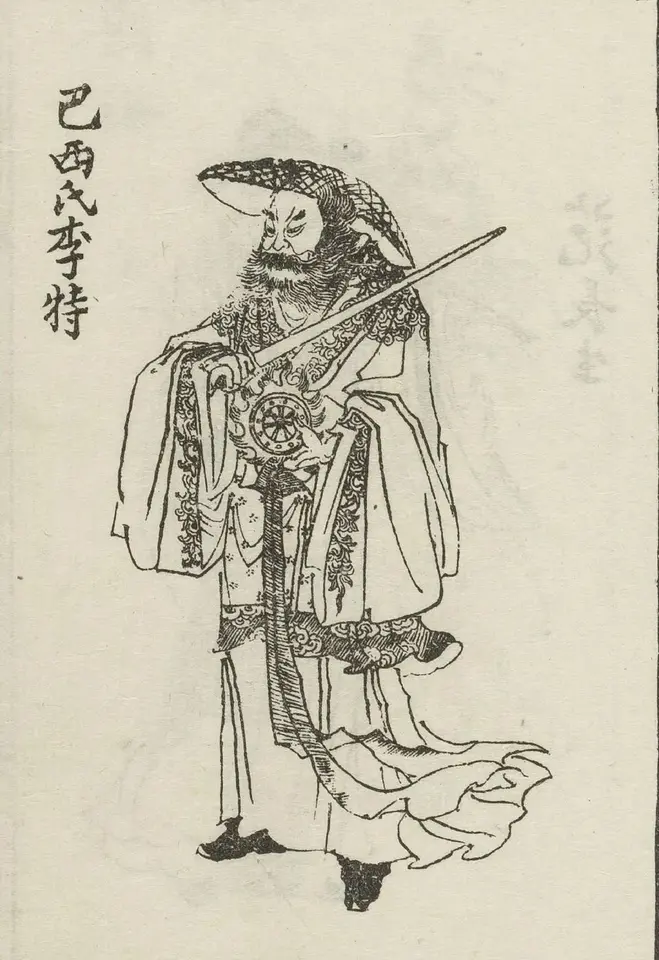
约–303 CE
李特
Li Te (李特, 3rd century–303), courtesy name Xuanxiu (玄休), of Ba-Di heritage, was a native of Dangqu of Baxi (modern Qu County, Sichuan) whose family had relocated to Linwei of Lueyang (modern Qin'an County, Gansu). He was the paramount leader of the Ba-Di refugee uprisings during the late Western Jin dynasty and the founding patriarch of the Cheng Han state. Tall, imposing, and skilled in archery and horsemanship, Li Te was…
Li Te (李特, 3rd century–303), courtesy name Xuanxiu (玄休), of Ba-Di heritage, was a native of Dangqu of Baxi (modern Qu County, Sichuan) whose family had relocated to Linwei of Lueyang (modern Qin'an County, Gansu). He was the paramount leader of the Ba-Di refugee uprisings during the late Western Jin dynasty and the founding patriarch of the Cheng Han state. Tall, imposing, and skilled in archery and horsemanship, Li Te was renowned for his resolute character, martial acumen, and chivalrous generosity among both Han and non-Han refugees across northwestern and southwestern China. During the Yuankang era of the Western Jin dynasty, massive droughts and the rebellion of Qi Wannian devastated Guanzhong, driving tens of thousands of displaced households from six commanderies south across the mountains into Hanzhong and Sichuan. In 300, when Yizhou Regional Inspector Zhao Xin rebelled against the Jin court, Li Te and his brothers initially allied with him. Following Zhao Xin's treacherous murder of Li Te's younger brother Li Xiang, Li Te launched a surprise counterattack, capturing Chengdu and destroying Zhao Xin. When the Western Jin authorities subsequently ordered the forced repatriation of refugees and subjected them to extortion, Li Te rallied over twenty thousand fighters at Mianzhu, broke the imperial armies at Chizu, and established an autonomous regime as Acting General Pacifying the North. Li Te maintained strict discipline, enacted three simple articles of law, remitted labor services, and distributed grain to relieve local distress, repeatedly routing the forces of Western Jin Regional Inspector Luo Shang and imperial punitive expeditions. He occupied Guanghan and the Minor City of Chengdu, establishing the era title Jianchu. In 303, Luo Shang colluded with local fortress barons to launch a coordinated surprise assault; Li Te was defeated and fell in battle at Xinfan. Following his death, his brother Li Liu and his son Li Xiong inherited his cause, culminating in the establishment of the Cheng Han empire and the posthumous elevation of Li Te as Emperor Jing with the temple name Shizu.
Following famine and Qi Wannian's revolt, Li Te led displaced families across the mountains into Sichuan.
Initially assisted Yizhou Regional Inspector Zhao Xin, but broke with him after the murder of his brother.
Orchestrated a night assault on Mianzhu, routed rebel forces, and captured Chengdu, causing Zhao Xin's downfall.
Resisted forced repatriation, established a fortified camp at Mianzhu, and wiped out Zeng Yuan's army at Chizu.
Repelled triple imperial assaults, assumed the title of Governor of Yizhou, and proclaimed the era Jianchu.
Captured the Minor City of Chengdu, but was ambushed by Luo Shang and fortress barons, dying in battle at Xinfan.
Li Te, courtesy name Xuanxiu, traced his ancestral roots to Dangqu of Baxi (modern Qu County, Sichuan) and belonged to the Ba-Di ethnic group. In early Western Han times, the tribute cloth exacted by the state from the Di people was known as Zong cloth, leading contemporaries to refer to them as Ba-Zong. During the late Eastern Han dynasty when Zhang Lu controlled Hanzhong, Li Te's ancestor Li Hu led more than five hundred households of Ba-Zong clansmen to surrender to Cao Cao, receiving military commissions and relocating to Linwei of Lueyang. Li Te's father, Li Mu, served as an Eastern Qiang Hunting General under the Western Jin, winning high esteem among border communities.
Li Te was the second of five brothers, the eldest being Li Fu, followed by Li Xiang, Li Liu, and Li Xiang. In his youth, Li Te held minor appointments in local commanderies, earning widespread respect for his extraordinary judgment. Standing eight feet tall, robust, skilled in mounted archery, and possessing a courageous and magnanimous disposition, he was celebrated for his chivalry and readiness to assist those in distress, drawing many local stalwarts to his banner.
In 296, the Di chieftain Qi Wannian launched a massive rebellion that ravaged the Guanzhong region. The conflict, coupled with consecutive years of severe drought and famine, forced tens of thousands of Han and Di households across six commanderies—including Lueyang, Tianshui, and Anding—to flee their homes and seek subsistence in the Han River basin. Li Te and his brothers joined this immense refugee migration.
Throughout the arduous trek across precipitous mountain passes, where thousands suffered from sickness and hunger, the Li brothers spent their own wealth to distribute rations, protect the infirm, and shelter orphans, earning the heartfelt gratitude of the refugee populace.
Upon arriving in Hanzhong, the displaced populace petitioned the Western Jin imperial court for permission to enter Sichuan. The court initially refused and dispatched Attendant Censor Li Mi with credentials to halt them at the Sword Gate pass. However, Li Mi accepted bribes from refugee representatives and submitted a memorial arguing that Hanzhong could not feed over a hundred thousand starving people, whereas Sichuan possessed abundant granaries. The imperial court granted permission, allowing the refugees to disperse throughout Liangzhou and Yizhou.
When Li Te reached the formidable precipices of Sword Gate, he rested his hand upon his sword, surveyed the peaks, and sighed: "Liu Shan held such impregnable terrain, yet surrendered meekly with bound hands; was he not truly an incompetent simpleton!" Companions such as Yan Shi, Zhao Su, Li Yuan, and Ren Hui marveled at his bold words, realizing that Li Te possessed extraordinary political ambitions.
In the eleventh month of 300, the Western Jin court summoned Yizhou Regional Inspector Zhao Xin to the capital to serve as Director of the Empress's Domestic Affairs, naming Chengdu Administrator Geng Teng as his successor. At the time, Prince of Zhao Sima Lun had orchestrated a coup in Luoyang, executing Empress Jia. Because Zhao Xin was related by marriage to the fallen empress, he feared execution; observing the internal collapse of the Jin dynasty, he conceived ambitions to establish an independent kingdom in Sichuan.
Zhao Xin opened state granaries to relieve the refugees and showered the Li brothers with favors, treating their battle-hardened retainers as his personal shock troops. Relying on Zhao Xin's patronage, Li Te's followers grew in strength, though their rowdy conduct drew resentment from local gentry. Geng Teng repeatedly warned the imperial throne that the fierce northern refugees would inevitably overthrow the native populace if left unchecked, urging their immediate repatriation. Zhao Xin despised Geng Teng for these memorials.
When Geng Teng arrived outside the western gate of Chengdu with his retinue, Zhao Xin launched an ambush that killed him on the spot. Zhao Xin then proclaimed himself Grand Commander, Grand General, and Governor of Yizhou, reorganizing local magistracies. He appointed Li Te's younger brother Li Xiang as General Subduing Bandits and Marquis of Yangquan Pavilion, commanding four thousand elite cavalry to block northern avenues and expanding his recruitment to ten thousand men.
Li Xiang was a brilliant commander known across the frontier as the foremost general of the Eastern Qiang. Zhao Xin's chief associates, Du Shu and Zhang Can, grew intensely jealous of his rising fame and urged Zhao Xin to eliminate him. In the second month of 301, when Li Xiang innocently advised Zhao Xin to declare himself emperor, Du Shu seized the occasion to accuse Li Xiang of treason. Zhao Xin murdered Li Xiang and more than ten of his sons and nephews in Chengdu. Li Te and Li Liu were stationed outside the city; Zhao Xin dispatched envoys to appease them with military titles.
Overcome with grief and rage over their brother's murder, Li Te and Li Liu withdrew their forces northward to Mianzhu. Fearing retaliation, Zhao Xin sent Chief Clerk Fei Yuan and Qianwei Administrator Li Bi with over ten thousand men to block the road at Shiting near Mianzhu. Li Te assembled seven thousand veteran warriors and launched a surprise night attack under cover of heavy rain and wind, setting the enemy encampment ablaze and routing Fei Yuan's army.
Li Te advanced directly upon Chengdu, causing the defending forces to melt away. Zhao Xin attempted to escape by boat toward Guangdu with his family, but was killed en route by his attendant Zhu Zhu. Li Te's soldiers occupied Chengdu, plundered the official warehouses, and dispatched officers Wang Jiao and Li Ji to Luoyang to present Zhao Xin's crimes and justify their punitive march.
Following Zhao Xin's defeat, the Western Jin court appointed General Pacifying the West Luo Shang as Colonel Who Protects the Western Barbarians and Regional Inspector of Yizhou, sending him into Sichuan with seven thousand elite troops. Acknowledging imperial authority, Li Te sent his fifth brother Li Xiang to welcome Luo Shang along the route with tributes of ancient treasures. Luo Shang was pleased and appointed Li Xiang as Cavalry Supervisor; Li Te and Li Liu also hosted a lavish feast for Luo Shang at Mianzhu.
However, officers Wang Dun and Guanghan Administrator Xin Ran urged Luo Shang to execute the Li brothers immediately to avert future danger, but Luo Shang hesitated. Xin Ran, who had known Li Te previously, privately warned him: "When old acquaintances meet unexpectedly, it portends either great fortune or grave disaster!" Li Te was deeply unsettled and heightened his vigilance.
Shortly thereafter, the court issued decrees commanding all refugees from Qin and Yong provinces to return to their native lands by autumn, dispatching censors Feng Gai and Zhang Chang to enforce the evacuation. At this juncture, Li Te's elder brother Li Fu arrived from Lueyang, warning that northern China was engulfed in civil war and unlivable. Li Te resolved to remain in Sichuan. He sent Yan Shi to petition Luo Shang repeatedly for postponement until after the autumn harvest, backing his appeals with substantial bribes to Luo Shang and Feng Gai, thereby securing a temporary reprieve.
The imperial throne rewarded the suppression of Zhao Xin by appointing Li Te General of Declared Might and Marquis of Changle Village, while Li Liu was created General of Manifest Might and Marquis of Wuyang. The court instructed the provincial government to submit a roster of refugee warriors eligible for honors. However, Xin Ran, greedy and arrogant, suppressed the roster to claim sole credit for the victory, stoking bitter resentment among the refugees.
By the seventh month, under pressure from Xin Ran and Li Bi, Luo Shang dispatched ultimatums demanding that all refugees depart immediately, setting up checkpoints along mountain roads in Zitong to confiscate their belongings. Displaced families had been working as hired hands; hit by unseasonal rainstorms before the harvest, they lacked travel provisions. Desperate and weeping, they flocked to Mianzhu to seek Li Te's protection.
Li Te erected a vast encampment at Mianzhu to shelter the refugees and wrote to Xin Ran begging for an extension until winter. Furious, Xin Ran posted bounties across strategic crossroads offering huge rewards for the severed heads of the Li brothers. Li Te retrieved the posters and, together with Li Xiang, forged new notices declaring that the government offered hundred bolts of cloth for the head of any refugee clan chieftain or tribal leader. Terrified that the authorities planned total extermination, over twenty thousand armed warriors joined Li Te's camp within a month, transforming the refuge into an armed rebellion.
In the tenth month of 301, Li Te moved his army to Chizu and established two separate encampments: Li Te occupied the North Camp, while Li Liu held the East Camp. Li Te sent Yan Shi to Chengdu once more to negotiate. Along the way, Yan Shi observed palisades and fortifications being constructed across strategic bottlenecks, confirming that the authorities intended military suppression.
Yan Shi confronted Luo Shang, warning: "The people are in extreme distress. To push them beyond endurance will provoke uncontrollable disaster!" Luo Shang gave evasive assurances, but Xin Ran and Li Bi secretly dispatched Guanghan Commandant Zeng Yuan, along with captains Zhang Xian and Liu Bing, to lead thirty thousand infantry and cavalry in a surprise night raid against Li Te's North Camp. Luo Shang sent defense supervisor Tian Zuo to support the operation.
Forewarned of the enemy movement, Li Te ordered his men to repair their armor, sharpen their weapons, and conceal archers in ambush along both flanks of the encampment. When Zeng Yuan's army marched into the camp under cover of darkness, assuming the refugees were unprepared, Li Te sounded the battle drums. Torches illuminated the valley, and concealed archers unleashed volleys from all directions, followed by coordinated charges of cavalry and infantry.
Zeng Yuan, Zhang Xian, and Tian Zuo were slain in the melee, and the thirty-thousand-strong government force disintegrated into total rout. Li Te ordered the severed heads of the three commanders sent to Luo Shang and Xin Ran, plunging the provincial authorities into panic.
Following the victory at Chizu, the refugee populace unanimously acclaimed Li Te as their supreme leader. Retainer commanders Li Han, Ren Zang, Yan Shi, Li Pan, and Li Yuan submitted a joint petition invoking the historical precedent of Liang Tong elevating Dou Rong in Hexi, officially requesting Li Te to act as General Pacifying the North. Li Te appointed Li Liu as General Pacifying the East, Li Fu as General of Agile Cavalry, and Li Xiang as Brave Cavalry General.
Li Te then laid siege to Guanghan. Xin Ran sorties were repeatedly beaten back, while reinforcements sent by Luo Shang refused to advance out of fear. Utterly isolated and out of supplies, Xin Ran broke through the siege and fled to Jingzhou. Li Te occupied Guanghan, appointed Li Chao as Administrator, and marched upon Chengdu.
Luo Shang wrote to Yan Shi accusing the refugees of rebellion, but Yan Shi delivered a scathing reply exposing the corruption of provincial officials, Xin Ran's embezzlement of merit, and the regime's unprovoked treachery. Unable to refute these charges, Luo Shang fortified Chengdu behind a seven-hundred-li defensive line along the Pi River and appealed desperately to Liangzhou and Ningzhou for military aid. Within his newly won territories, Li Te enacted three simple articles of law, opened granaries to feed the starving, abolished corvee taxes, and treated scholar-gentry with respect, winning profound admiration across Sichuan.
In 302, Prince of Hejian Sima Yong dispatched Ya Bo and Zhang Zheng to lead imperial punitive armies against Li Te from Zitong; Ningzhou Regional Inspector Li Yi sent five thousand troops to reinforce Luo Shang, who stationed Zhang Gui at Fancheng to launch a three-pronged offensive.
Undaunted, Li Te deployed his forces skillfully: he sent his second son Li Dang and third son Li Xiong north to intercept Ya Bo, while he led the main body to confront Zhang Gui. Li Te crushed Zhang Gui at Fancheng, while Li Dang engaged Ya Bo in relentless combat along the Yangmian river valley, annihilating the bulk of the imperial forces and chasing Ya Bo to Jiameng. Mao Zhi, assistant administrator of Baxi, and Xiang Zhen surrendered the entire commandery to Li Dang, who conciliated the local population and accepted the surrender of Jiameng.
Capitalizing on these triumphs, Li Te formally assumed the titles of Commissioner Bearing Credentials, Grand Commander, Grand General, and Governor of Yizhou at Guanghan, proclaimed the era title Jianchu, declared a general amnesty, and established a civil bureaucracy modeled after Dou Rong's administration in Hexi. He appointed Li Shi as General of Martial Might, Li Dang as General Guarding the Army, Li Xiong as General of the Front, and Li Han as Colonel Who Protects the Western Barbarians.
In the eighth month, Li Te launched an offensive against Zhang Zheng, who held fortified heights across mountainous terrain. Li Te and Li Dang pitched separate camps. Detecting that Li Te's camp was lightly defended, Zhang Zheng sent mountain troops along steep ridges to launch a surprise attack. Hard-pressed and hemmed in by narrow tracks, Li Te refused calls to retreat, trusting that Li Dang would come to his rescue.
Informed of his father's peril, Li Dang wept with emotion, declared to his staff that this was his day to die for his father, donned two layers of heavy iron armor, and charged into the fray with a long spear. Slaying more than a dozen enemy warriors single-handedly, Li Dang shattered Zhang Zheng's line. Li Te and Li Dang pursued the fleeing enemy, killed Zhang Zheng, captured his son Zhang Cun, and chivalrously released him to conduct his father's burial.
Li Te further detached Qian Shuo to conquer Deyang, extending his territory to Dianjiang in Ba Commandery. He stationed Li Xiang and Li Pan at Pi Bridge to check Luo Shang. When Luo Shang dispatched ten thousand troops in a midnight assault, Li Pan fell fighting bravely, but Li Xiang joined forces with Li Liu to mount a ferocious counterattack in the dark, routing Luo Shang's force with eighty percent casualties.
When Western Jin Liangzhou Regional Inspector Xu Xiong attacked, Li Te defeated him on the battlefield, crushed Luo Shang's river fleet, and occupied the Minor City of Chengdu. Administrator Xu Jian surrendered the gates, and Li Te placed Li Huang in charge of the city. Luo Shang retreated inside the Major City, unable to venture forth. The surrounding rural population organized fortified stockades and offered submission; Li Te welcomed them and permitted his soldiers to obtain grain from these stockades.
In the first month of 303, the Western Jin court sent Jingzhou Regional Inspector Zong Dai and Jianping Administrator Sun Fu with thirty thousand naval troops westward to relieve Chengdu, threatening Deyang. Li Te detached Li Dang, Li Huang, and Ren Zang to march east and block the Jin advance.
Overawed by the massive naval fleet of Zong Dai, the rural fortress barons around Chengdu secretly wavered. Ren Rui, a military officer inside Chengdu, suggested to Luo Shang that Li Te's forces were widely scattered across rural stockades and lacked vigilance. Luo Shang lowered Ren Rui from the city walls by rope at night to coordinate a joint assault with the fortress barons on the tenth day of the second month.
Ren Rui then approached Li Te under the pretense of surrender, claiming that Chengdu had exhausted its grain and possessed only money and cloth. Believing him, Li Te permitted him to visit his family outside the camp, allowing Ren Rui to finalize arrangements with the fortress chieftains.
On the night of the tenth day of the second month, Luo Shang launched his entire garrison from Chengdu while surrounding stockades rose in rebellion, converging tens of thousands of troops upon Li Te's encampment. Overwhelmed in the surprise attack, Li Te fought his way out and retreated to Xinfan. When Luo Shang's vanguard fell back, Li Te pursued them over thirty li without anticipating an ambush, leading his exhausted troops into a concealed trap.
Surrounded on all sides by imperial forces, Li Te, his elder brother Li Fu, and general Li Yuan fought courageously until they were killed in battle. Luo Shang severed Li Te's head, sent it to Luoyang, and incinerated his body. Following the disaster, the surviving refugee forces retreated to Chizu under the leadership of Li Liu and Li Xiong. When Li Xiong established the Cheng Han dynasty, he posthumously honored Li Te as Emperor Jing with the temple name Shizu.
Li Te demonstrated exceptional charisma, strategic insight, and battlefield bravery as the paramount leader of the refugee uprisings.
Confronted with the Western Jin court's brutal decree of forced repatriation, Li Te accurately harnessed the refugees' collective determination to survive, transforming scattered migrants into a disciplined and formidable military confederation. At the Battle of Chizu, he utilized deception and tactical ambushes to wipe out thirty thousand imperial troops, breaking the military dominance of the Western Jin in Yizhou.
Throughout his campaigns across Sichuan, Li Te excelled in both maneuver warfare and siege operations. His victories at Fancheng, Yangmian, and Pi Bridge demonstrated mastery of mountain warfare and shock cavalry tactics. However, his overconfidence following the capture of the Minor City of Chengdu, combined with his failure to anticipate the betrayal of native fortress barons, ultimately precipitated his tragic downfall at Xinfan.
In state-building, Li Te laid the institutional and political foundations for the future Cheng Han empire amidst extreme adversity.
Politically, Li Te displayed sophisticated legitimacy management. Beginning with accepted court appointments such as General of Declared Might, he subsequently invoked the Western Han precedent of Dou Rong in Hexi, securing nomination as Acting General Pacifying the North before formally assuming the governorship of Yizhou and establishing the era Jianchu.
In civil administration, Li Te practiced enlightened governance to win over the native Sichuan population. In stark contrast to Luo Shang's rapacious tyranny, Li Te enacted three simple articles of law upon entering Guanghan and Chengdu, opened granaries to distribute grain to the destitute, abolished burdensome corvee exactions, and employed esteemed local scholars such as Yan Shi and Zhao Su. These policies earned broad support from both immigrant and native communities, creating the popular mandate that sustained the Li clan for decades.
In tactical doctrine, Li Te capitalized on the rugged terrain of northern and central Sichuan to maximize the mobility and archery prowess of his Ba-Di troops.
Recognizing that his forces could rarely match the heavy armor and logistical reserves of imperial legions in prolonged open-field clashes, Li Te perfected ambush and envelopment tactics along narrow mountain defiles. At Chizu, he lured Zeng Yuan deep into a mock camp before closing the trap; at Yangmian, his columns used valley corridors to isolate Ya Bo's rear echelons; and against Zhang Zheng, his shock troops scaled mountain crags to shatter enemy formations from behind. This synthesis of guerrilla mobility, rapid skirmishing, and decisive shock combat neutralized the imperial army's material superiority, providing a model for subsequent regional operations.
In community organization, Li Te demonstrated remarkable social leadership by forging a durable coalition out of disparate refugee groups.
Late Western Jin Sichuan was fraught with complex fractures between arriving northern migrants and entrenched native landowners, compounded by imperial oppression. Li Te mobilized his immediate family as a core command cadre while integrating influential gentry and tribal chieftains from Lueyang, Tianshui, and Anding into his council.
Rather than allowing his movement to degenerate into aimless plunder, Li Te mediated inter-ethnic disputes, conciliated indigenous non-Han tribes, and directed his followers toward long-term settlement. This far-sighted social cohesion preserved the refugee movement even after Li Te's death, providing the resilient social foundation for the four-decade survival of the Cheng Han state.
FIGURES ASSOCIATED WITH THIS DYNASTY