Birth in Fengxiang
Born into a learned Daoist and medical lineage; educated by his father Li Bo in astronomical mathematics.
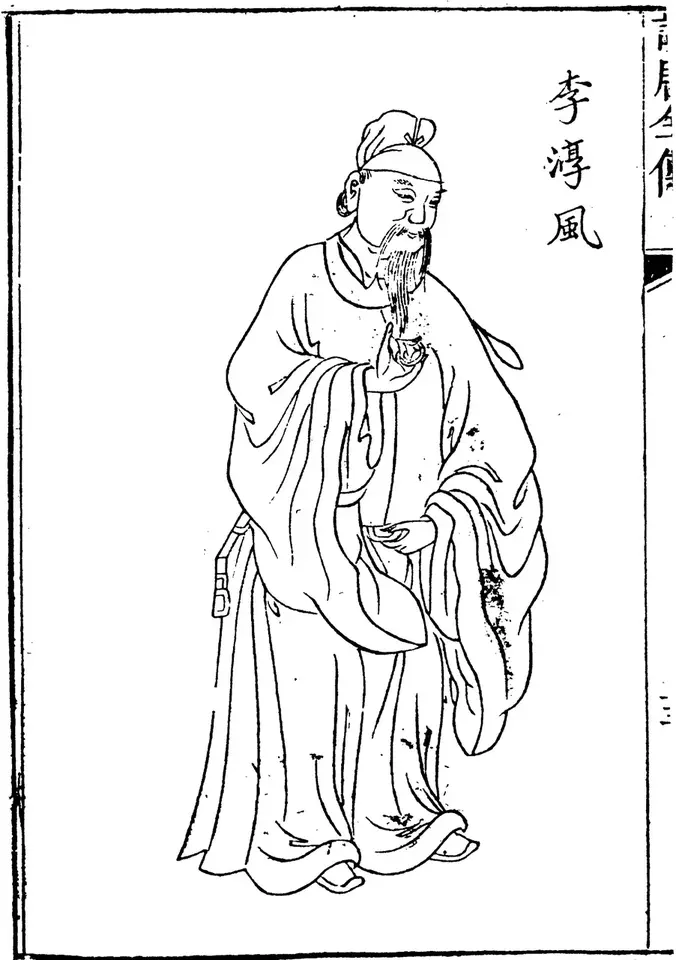
李淳风
Li Chunfeng (李淳风) was the foremost astronomer, mathematician, calendar reformer, and Daoist polymath of the Tang dynasty from Yongxian in Qizhou (modern Fengxiang, Shaanxi Province), and the son of Sui Daoist scholar Li Bo. Demonstrating astronomical precocity from childhood, Li mastered celestial mechanics, classical mathematics, yinyang cosmography, and ancient calendar systems, joining the staff of Prince Li Shimin in…
Li Chunfeng (李淳风) was the foremost astronomer, mathematician, calendar reformer, and Daoist polymath of the Tang dynasty from Yongxian in Qizhou (modern Fengxiang, Shaanxi Province), and the son of Sui Daoist scholar Li Bo. Demonstrating astronomical precocity from childhood, Li mastered celestial mechanics, classical mathematics, yinyang cosmography, and ancient calendar systems, joining the staff of Prince Li Shimin in youth. He served with distinction across the reigns of Emperor Gaozu, Emperor Taizong, and Emperor Gaozong, rising from Gentleman for Ceremonial Service to Director of the Imperial Astrological Bureau (Taishi Ling) with the noble dignity of Baron of Changle. Li established immortal monuments in the history of science and technology. In observational astronomy, he designed and cast the bronze "Triple-Concentric Armillary Sphere" in 633, revolutionizing observational precision. In calendrical science, he compiled the groundbreaking Linde Calendar (665), permanently abolishing the archaic nineteen-year intercalary cycle. In mathematics, he supervised the authoritative annotation of the Ten Computational Canons (Suanjing Shishu), imperial decreed as the standard state textbooks for imperial civil service examinations. In atmospheric physics, his treatise Yisi Zhan established an eight-tier empirical wind-force scale over a millennium before the Beaufort scale. He also authored the astrological treatises of the Book of Jin and Book of Sui, occupying a towering position in global history of science.
Born into a learned Daoist and medical lineage; educated by his father Li Bo in astronomical mathematics.
Recruited into Prince Li Shimin's elite retinue as an academician due to his astronomical and mathematical genius.
Submitted memorials identifying eighteen calculation errors in Fu Renjun's Wuyin Calendar, validated by eclipse observations.
Designed and cast the landmark bronze Triple-Concentric Armillary Sphere, inspected and praised by Emperor Taizong.
Promoted to Vice Director of the Astrological Bureau, directing observational astronomy and court acoustic tuning.
Appointed Director of the Imperial Astrological Bureau, commissioned to collate and comment upon the Ten Computational Canons.
Completed the annotated editions of the Ten Computational Canons, promulgated as official textbooks for state examinations.
Completed the Linde Calendar, officially promulgated by Emperor Gaozong to replace earlier flawed systems throughout the empire.
Passed away in his official residence in Chang'an at age sixty-nine; Emperor Gaozong issued an imperial lament and mourning gifts.
Li Chunfeng was born in Yongxian, Qizhou, into a distinguished Daoist and scholarly family. His father, Li Bo, had served as Magistrate of Gaotang under the Sui before resigning to pursue Daoist reclusion under the moniker "Huangguanzi," authoring celebrated treatises on astronomical portents. Raised under strict maternal and paternal discipline, Li Chunfeng mastered the Confucian classics while demonstrating an insatiable fascination for mathematical calculations, star charts, and astronomical cycles. Often spending nights on open terraces observing planetary movements, he attained early fame across Guanzhong for his extraordinary mathematical genius.
During the collapse of the Sui dynasty, Li Yuan and Li Shimin seized the Central Plains to establish the Tang. Prince Li Shimin created the Palace of Literary Studies, actively enlisting visionary talents. Recognizing Li Chunfeng's mastery of celestial mechanics and logistical calculation, the prince inducted him into his staff. Serving with meticulous fidelity, Li proved his empirical abilities during the consolidation of the empire. Following the accession of Emperor Taizong, Li entered the Imperial Astrological Bureau, embarking on an administrative and scientific career spanning more than four decades.
At the inception of the Tang, the state employed the Wuyin Calendar crafted by Fu Renjun. In 627 (the first year of Zhenguan), the twenty-six-year-old Li submitted a memorial exposing eighteen serious errors in Fu's calculations regarding solar eclipses and planetary alignments, proposing exact algorithmic corrections. Skeptical court ministers under Feng Deyi arranged public disputations and empirical observations. Over several subsequent solar and lunar eclipses, Li's calculations proved scrupulously accurate while the official calendar failed. Deeply impressed, Emperor Taizong promoted Li to Court Gentleman for Ceremonial Service, assigning him to the central bureau.
In practical observation, Li found earlier instruments structurally deficient, incapable of simultaneously coordinating equatorial, ecliptic, and lunar orbital planes. In 633, after years of mathematical modeling, Li designed and cast the bronze "Triple-Concentric Armillary Sphere." The instrument comprised three nested concentric ring systems—the Six Harmonies Component, the Three Luminaries Component, and the Four Travels Component—allowing astronomers for the first time to observe equatorial and ecliptic coordinates on a single apparatus. Emperor Taizong ordered the instrument permanently housed within the Nenghui Pavilion of the Astrological Bureau, presenting Li with imperial honors.
In 641, Li advanced to Vice Director, subsequently rising to Director of the Astrological Bureau under Emperor Gaozong. In this premier post, Li oversaw imperial calendar production, celestial tracking, and state omens. He resisted superstitious sycophancy, offering rational, measured interpretations of celestial phenomena. When the planetary alignment known as "Venus Seen by Day" sparked dynastic paranoia regarding the prophecy of a female sovereign replacing the house of Li, Li advised Emperor Taizong against executing innocent figures, saving numerous loyal ministers from imperial purges.
In 656, recognizing that mathematics education suffered from textual fragmentation, Emperor Gaozong commanded Li to supervise the definitive collation and annotation of ancient mathematical texts. Leading a team of scholars including Liang Xiang and Wang Zhenru, Li labored for years to assemble and edit ten fundamental texts, including Zhoubi Suanjing, Jiuzhang Suanshu, Haidao Suanjing, and Sunzi Suanjing, collectively designated the Ten Computational Canons. Li corrected centuries of copyist errors, formulating clear commentaries on Liu Hui's exhaustion method and Zu Chongzhi's circular algorithms. Gaozong officially promulgated these editions as the mandatory curriculum for the Ming Suan examinations in the National University.
In 664, synthesizing decades of astronomical records, Li finalized the Linde Calendar. The system dismantled the archaic nineteen-year intercalary cycle inherited from the Spring and Autumn period, introducing unequal solar motion and second-order interpolation methods to achieve unprecedented precision in predicting lunar phases and eclipses. Promulgated in 665, the calendar governed the empire for decades.
Li also completed Yisi Zhan in ten volumes, synthesizing meteorology, planetary astrology, and wind classification, and authored the authoritative treatises on astronomy, music/acoustics, and natural disasters for the official Book of Jin and Book of Sui. Passing away in 670 at age sixty-nine, he was mourned by Emperor Gaozong, leaving an unmatched scientific legacy across Eurasia.
Li Chunfeng's paramount mechanical achievement was inventing the world's first triple-concentric bronze armillary sphere. Prior instruments dating from Zhang Heng to Liu Zhuo were rigid structures capable of tracking celestial bodies along only a single coordinate axis.
Li resolved this dilemma by inventing a nested three-ring architecture: the outer "Six Harmonies Component" remained fixed, providing equatorial, meridian, and horizon coordinate baselines; the middle "Three Luminaries Component" revolved in synchrony with diurnal celestial motion, charting the sun, moon, and planetary movements; the innermost "Four Travels Component" held an unobstructed sighting tube rotating freely across all quadrants. This nested concentric design served as the direct mechanical ancestor of modern equatorial telescopes and astronomical theodolites, establishing a millennium of observational preeminence for Chinese astronomy.
In the history of timekeeping, Li's Linde Calendar was a watershed event transforming empirical reckoning into exact mathematical physics. For over a millennium, Chinese astronomers had adhered to the Metonic cycle of inserting seven intercalary months every nineteen solar years. However, accumulated discrepancies inevitably caused calendar drift, creating anomalies where new moons fell on the wrong day.
Li courageously abandoned the rigid nineteen-year cycle, instituting an empirical system where intercalations were determined dynamically by exact solar-lunar orbital intersections. Furthermore, he incorporated the non-uniform velocities of the sun and moon, deploying advanced quadratic interpolation algorithms. The system was so exceptionally accurate that Japanese envoys transmitted it to Nara, where the Japanese imperial court adopted it as the national calendar (Gihō-reki) for forty-two years.
Li's preeminent contribution to global mathematics was compiling and annotating the Ten Computational Canons (Suanjing Shishu). Prior to the Tang, ancient mathematical masterworks circulated primarily in fragmented manuscript copies filled with scribal corruptions and obscure archaic terminology.
Li directed a systematic editorial project, editing and providing mathematical proofs for fundamental works including The Nine Chapters on the Mathematical Art. Rather than merely parsing textual semantics, Li provided rigorous demonstrations for algorithmic operations, square and cube root extractions, Pythagorean calculations, and early algebraic systems. Promulgated as mandatory textbooks for the National University's Ming Suan degree, this monumental compilation preserved China's classical mathematical corpus from historical extinction, establishing the mathematical foundations of East Asian civil engineering, astronomy, and state finance.
In atmospheric physics and empirical geography, Li's treatise Yisi Zhan stands as an astonishing monument of early science. Although structured within the traditional paradigm of astrological prognostication, the text preserves rigorous observations of natural phenomena.
Most brilliantly, Li formulated the world's earliest empirical wind-force scale. Analyzing the physical effects of moving air upon vegetation and structures, he classified wind into eight distinct stages: moving leaves, whistling through branches, swaying boughs, dropping foliage, breaking limbs, carrying dust and stones, uprooting trees, and flattening buildings. Including calm and light air, this formed a ten-point empirical scale identical in scientific methodology to the Beaufort scale, preceding Sir Francis Beaufort's 1805 system by one thousand one hundred and forty years.
In annotating the Ten Computational Canons, Li Chunfeng executed an unprecedented mathematical synthesis of ancient algorithmic traditions centered on the Nine Chapters on the Mathematical Art. Across its nine canonical fields—Field Measurement, Millet and Grain, Distribution by Proportion, Short Width, Construction Consultations, Fair Levies, Excess and Deficit, Rectangular Arrays, and Right-Angled Triangles—Li methodically reconstructed algorithmic proofs that earlier texts had expressed only in cryptic shorthand. In the Field Measurement section, he rigorously formulated fraction reduction, common denominators, and four-operation arithmetic while standardizing geometric formulas for irregular polygons. In Short Width, he provided parallel geometric and arithmetic proofs for extracting square and cube roots.
In Rectangular Arrays (systems of linear equations) and Right-Angled Triangles, Li derived systematic algorithmic rules for negative and positive number additions and subtractions, transforming Han methods into standardized examination curricula. For the Pythagorean theorem in Zhoubi Suanjing and astronomical shadow estimations via solar elevation diagrams, Li deployed rigorous geometric projections, clarifying obscure archaic texts into a coherent mathematical pedagogy for East Asian scholars.
The exceptional multi-decade operational accuracy of the Linde Calendar derived fundamentally from Li Chunfeng's pioneering application of dynamic parallax models and mathematical interpolation functions. Observing solar orbital velocities, Li discerned that solar motion along the ecliptic was non-uniform, accelerating toward perigee around the winter solstice and decelerating toward apogee around the summer solstice. To calculate the sun's true celestial longitude at any given moment, Li invented an unequal second-order difference interpolation method, replacing archaic linear models with dynamic celestial reckoning.
In lunar orbital mechanics and eclipse prediction, Li established sophisticated models coordinating the intersection angles of the ecliptic and lunar orbits. Distinguishing between the moon's sidereal orbit and its equatorial projection, he created complete mathematical algorithms calculating eclipse limits, eclipse magnitudes, first contact, totality, and final clearance. Crucially, his equations adjusted for observer latitude, rectifying longitudinal and latitudinal parallaxes to eliminate the persistent historical discrepancies where eclipses were predicted but failed to occur.
In his encyclopedic masterwork Yisi Zhan, Li Chunfeng assembled over a millennium of empirical observations of celestial and atmospheric anomalies from the pre-Qin period through the Early Tang. In solar and stellar astronomy, he recorded solar prominences, sunspots, and atmospheric optical phenomena including multi-ring solar and lunar halos, classifying them by color and morphological intersection. Regarding transient night sky objects, Li distinguished between comets, guest stars, and meteors, categorizing comets into more than ten morphological types based on tail structures, creating an early monument of observational astrophysics.
In meteorological technology, Li complemented his eight-tier wind scale by inventing specialized physical instruments to measure wind direction and velocity: the "Wind-Observing Bronze Bird" (Houfeng Tongwu) and the "Feather Anemometer" (Xiangfengyu). Mounted upon pivots atop open observatory towers, these copper birds and balanced feathers rotated freely to point into oncoming currents; observers quantified wind speed by measuring oscillation frequencies. Stationed at the Astrological Bureau in Chang'an and courier posts nationwide, these instruments established an empirical meteorological monitoring network unrivaled in the medieval world.
Directing state calendrical and musical institutions, Li Chunfeng achieved monumental reforms in standardizing weights, measures, and imperial court pitch pipes. Ancient Chinese science operated on the principle that metrology originated from acoustics—specifically that the physical volume, length, and mass of the Huangzhong pitch pipe constituted the ultimate standard for all measures under heaven. Yet continuous warfare from the Han through the Six Dynasties had fractured metrological baselines into chaotic regional variations.
Commanded by Emperor Taizong, Li gathered twelve hundred medium grains of black millet from Shangdang, measuring their combined cubic volume and weight to cast the canonical bronze Huangzhong pipe. Using the exact displacement of water and grain capacity of this pipe, Li recalibrated the Small and Large metrological systems of the Sui and Tang, publishing the Treatise on Metrology and Pitch Pipes. This breakthrough in physical acoustics, geometric capacity, and metrological history unified imperial tax assessment, land surveying, and court ritual music.
As the foremost court polymath of the Early Tang, Li Chunfeng fulfilled an irreplaceable historiographical mission in safeguarding classical scientific literature. When Emperor Taizong and Emperor Gaozong commissioned the official Book of Jin and Book of Sui, centuries of geopolitical fragmentation had scattered state archives and corrupted astronomical charts. The imperial court assigned the composition of the Treatises on Astronomy, Pitch Pipes and Calendars, and Five Phases across both dynastic histories exclusively to Li Chunfeng.
Leveraging his exhaustive mastery of classics and mathematical sciences, Li sifted imperial archives and private collections, gathering scattered observational data. In his treatises, he recorded centuries of planetary alignments, eclipses, and seismic disruptions, while evaluating the technical merits of ancestral calendars, notably Zu Chongzhi's Daming Calendar and Liu Zhuo's Huangji Calendar. Li's three historiographical treatises remain the indispensable cornerstone for researching medieval Chinese astronomy, geophysics, and historical meteorology.
FIGURES ASSOCIATED WITH THIS DYNASTY