Birth in Jinling
Born in Jiangning County, Yingtian Prefecture, South Zhili, into an impoverished gentry-military family originating from Rizhao, Shandong.
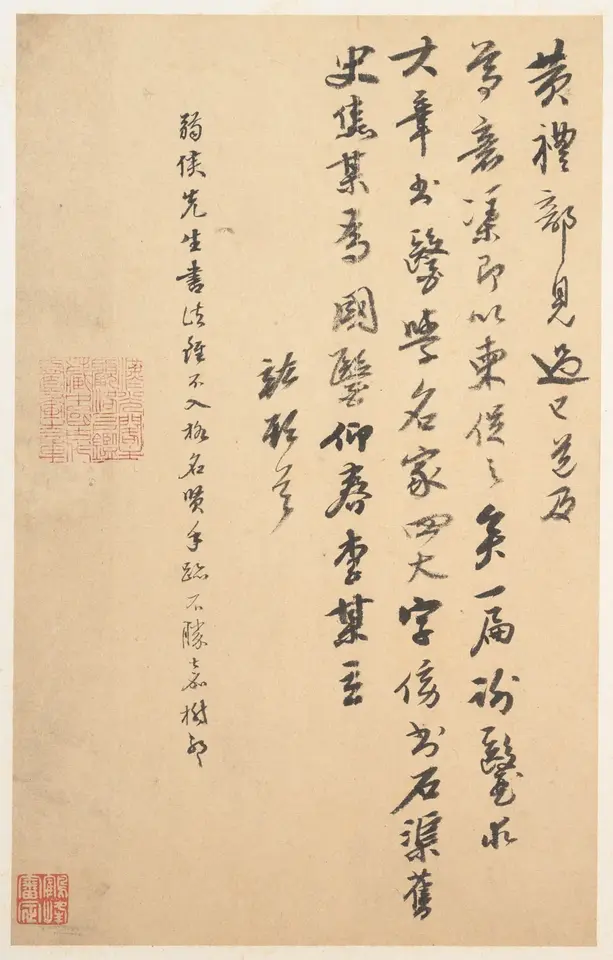
焦竑
Jiao Hong (焦竑, 1540–1620), courtesy name Ruohou, art names Danyuan and Yiyuan, was a native of Jiangning, Yingtian Prefecture, with ancestral roots in Rizhao, Shandong. He was an eminent thinker, historian, philologist, and bibliophile of the late Ming Dynasty. In 1589 (the seventeenth year of the Wanli reign), at the mature age of fifty, Jiao Hong clinched first place in both the metropolitan and palace examinations,…
Jiao Hong (焦竑, 1540–1620), courtesy name Ruohou, art names Danyuan and Yiyuan, was a native of Jiangning, Yingtian Prefecture, with ancestral roots in Rizhao, Shandong. He was an eminent thinker, historian, philologist, and bibliophile of the late Ming Dynasty. In 1589 (the seventeenth year of the Wanli reign), at the mature age of fifty, Jiao Hong clinched first place in both the metropolitan and palace examinations, emerging as the Zhuangyuan (first-rank first-place jinshi). He was subsequently appointed Senior Compiler in the Hanlin Academy, serving as imperial lecturer to the Crown Prince Zhu Changluo, Reader-in-Waiting, and Director of Studies in the Nanjing Directorate of Education. Jiao Hong's scholarship was extraordinarily vast and comprehensive. Grounded in the Taishan school of Neo-Confucianism and open to Buddhist and Daoist insights, he fiercely opposed the dogmatic scholasticism of the Cheng-Zhu orthodox tradition, advocating intellectual emancipation and declaring that true scholars must transcend rigid dogmas to open genuine perspectives from their own minds. His historical and bibliographical contributions were monumental: he compiled the five-volume Guoshi Jingji Zhi (Treatise on Classics and Literature of National History), which established the standard catalogue system for Ming literature, and independently assembled the hundred-and-twenty-volume Guochao Xianzhenglu (Record of Eminent Worthies of the Ming Dynasty), successfully salvaging thousands of primary epigraphic and biographical records from early Ming to the Wanli era. His philological masterpiece Jiao Shi Bicheng pioneered historical phonology and evidentiary research, leading later Qing scholars such as Qian Daxin and Gu Yanwu to revere him as a founding pioneer of Qing evidential scholarship (Hanxue). In 1597, while serving as associate examiner for the Shuntian provincial examination, Jiao Hong demonstrated extraordinary discernment by discovering Xu Guangqi's discarded examination paper and promoting him to first place (Jieyuan). Later, ensnared in factional feuds and the contentious imperial succession debate, Jiao Hong was impeached by conservative censors and demoted to Vice Prefect of Funing Subprefecture in Fujian. He subsequently retired from bureaucratic life to his Danyuan residence in Nanjing, where he erected the Wuche Tower to house tens of thousands of rare volumes, engaged in critical printing, and instructed generations of scholars. His profound learning and virtue earned immense respect from domestic literati as well as the Italian Jesuit missionary Matteo Ricci. He was posthumously honored with the title "Wenjian" by the Southern Ming court.
Born in Jiangning County, Yingtian Prefecture, South Zhili, into an impoverished gentry-military family originating from Rizhao, Shandong.
Studied under Geng Dingli, an influential Taizhou School thinker, absorbing the philosophy of practical moral cultivation.
Studied under Luo Rufang, internalizing the core philosophy of innate benevolence and the unity of the Three Teachings.
Met radical philosopher Li Zhi in Huang'an, Huguang; the two established a lifelong intimate intellectual alliance.
Travelled to Beijing to take the jichou palace examination and was selected first-rank first-place by the Wanli Emperor, entering the Hanlin Academy.
Strongly declined funds for building commemorative Zhuangyuan arches in Jinling and Rizhao, diverting them to famine relief, and penned the preface for Rizhao's first gazetteer.
Appointed imperial lecturer to Crown Prince Zhu Changluo, elucidating the Confucian Classics through concrete historical lessons.
Recommended by Grand Secretary Chen Yubi to lead the compilation of the national bibliography Guoshi Jingji Zhi.
Served as associate examiner in Shuntian; rescued Xu Guangqi's rejected exam paper and ranked him first overall (Jieyuan).
Targeted by conservative censors over examination disputes and his association with Li Zhi; demoted to Vice Prefect of Funing, Fujian.
Interacted extensively in Nanjing with Jesuit missionary Matteo Ricci, discussing Western geography, astronomy, and calendar science.
Briefly transferred to Director of Studies in Nanjing, after which he retired permanently to his estate in Jinling to dedicate himself to writing.
Died peacefully at Danyuan in Jinling at eighty; subsequently granted the posthumous title Wenjian during the Southern Ming.
Jiao Hong's ancestral seat was Dahuaya Village, Xihu Town, Rizhao County, Qingzhou Prefecture, Shandong Province. According to his late-life genealogical treatise, his early ancestor had been dispatched to Nanjing during the Hongwu reign on imperial military appointment, serving in the elite Banner Guard of the imperial garrison. The family settled permanently in Jiangning County, Yingtian Prefecture, living in Jinling for more than two centuries.
During the Zhengde and Jiajing eras, recurrent famines and epidemics took a devastating toll on the family lineage, leaving only his father Jiao Wenjie to sustain the household. Born in 1540 into severe poverty, Jiao Hong exhibited extraordinary intellect and academic dedication from an early age. His father enforced rigorous Confucian education, while Jiao Hong himself possessed an insatiable hunger for reading and textual preservation.
Lacking sufficient funds to purchase books, the young Jiao Hong borrowed rare editions from local scholars and painstakingly copied them by hand, working tirelessly through freezing winters and scorching summers. As he reached adulthood, his reading extended across canonical classics, dynastic histories, philosophical treatises, Buddhist sutras, Daoist canons, and diverse masterworks. His encyclopedic mastery of ancient philology, phonology, and bureaucratic institutions laid the bedrock for his future preeminence in late Ming scholarship.
In formulating his philosophical worldview, Jiao Hong was profoundly influenced by the vibrant Taizhou School of the Wang Yangming tradition. During the Longqing and early Wanli eras, he studied under eminent thinkers Geng Dingli and Luo Rufang. From Geng, he learned practical moral action rooted in daily human affairs; from Luo, he absorbed the core teaching of innate benevolence and intuitive knowledge. These teachings led him to reject the sterile rote-memorization and rigid formalism of Cheng-Zhu orthodoxy.
In 1582, Jiao Hong encountered the iconoclastic thinker Li Zhi in Huang'an. The two shared an immediate intellectual affinity, engaging in spirited debates on history, philosophy, and governance. Jiao Hong championed Li Zhi's revolutionary writings, facilitating the publication of works such as Fenshu and Cangshu. In return, Li Zhi revered Jiao Hong as his foremost confidant, praising his peerless erudition and magnanimity.
Concurrently, Jiao Hong embraced an inclusive perspective toward the Three Teachings and Western learning. When Italian Jesuit missionary Matteo Ricci stayed in Nanjing, Jiao Hong visited him repeatedly, engaging in rigorous dialogues on Western geometry, astronomy, and cartography. In his memoirs, Ricci portrayed Jiao Hong as an illustrious civic leader and supreme scholar, whose patronage legitimized Western learning among the Chinese intellectual elite.
Because Jiao Hong pursued independent, substantive inquiry rather than fashionable examination clichés, his early path through the civil service examinations was fraught with repeated setbacks. It was not until 1589, when he was fifty years old, that he sat for the jichou metropolitan examination in Beijing and achieved top honors.
During the decisive palace examination, Jiao Hong presented a comprehensive policy memorial addressing frontier defense, fiscal deficits, bureaucratic indolence, and hollow scholasticism. Impressed by his strategic depth and resonant prose, the Wanli Emperor personally ranked him first-class first-place (Zhuangyuan) and appointed him Senior Compiler in the Hanlin Academy. His examination cohort included such distinguished luminaries as Dong Qichang, Yuan Keli, and Tao Wangling.
When officials in both Rizhao and Jinling prepared to erect grand celebratory arches in his honor, Jiao Hong firmly declined. Knowing that severe droughts and floods had afflicted both regions, he urgently wrote to local magistrates requesting that public funds be redirected toward purchasing grain for starving peasants. Furthermore, he tirelessly petitioned the Ministry of Revenue, successfully securing five thousand taels of emergency relief silver for Rizhao.
In 1591, the Wanli Emperor established the Crown Prince's Lecture Bureau, and Jiao Hong was selected to instruct Crown Prince Zhu Changluo. In lecturing on the Confucian classics, Jiao Hong consistently linked ancient moral maxims to historical statecraft and administrative prudence. To facilitate the young prince's comprehension, he collected historical episodes of virtuous monarchs in their youth and commissioned illustrative woodblock illustrations, compiling the celebrated primer Yangzheng Tujie.
In 1594, Grand Secretary Chen Yubi initiated a major imperial project to revise the dynastic history of the Ming and specifically petitioned for Jiao Hong to oversee the compilation institute. Recognizing that reliable history depended upon systematically organizing public and private records, Jiao Hong devoted years to examining imperial holdings in the Wenyuan Chamber, the Directorate of Education, and private libraries, culminating in his landmark five-volume Guoshi Jingji Zhi.
At the same time, Jiao Hong utilized his official standing and wide connections to rescue neglected biographical records, epitaphs, and historical accounts from across the realm. Over twenty years, he compiled the monumental hundred-and-twenty-volume Guochao Xianzhenglu, preserving priceless first-hand documentation of Ming political and social life.
In 1597, Jiao Hong served as associate examiner for the Shuntian provincial examination. Refusing to rely merely on formulaic eight-legged essays, he reviewed all candidate papers that had been discarded in the preliminary rounds. Among the discarded piles, he unearthed the essay of thirty-six-year-old Xu Guangqi. Astonished by Xu's profound strategic vision and pragmatic command of agriculture and warfare, Jiao Hong exclaimed that he had found a generational master and elevated Xu to first place overall (Jieyuan).
Subsequently, Jiao Hong and Dong Qichang introduced Xu Guangqi to their examination brother Yuan Keli, then serving on the maritime frontier, allowing Xu to cultivate his expertise in Western weaponry and coastal defense. Xu Guangqi honored Jiao Hong as his foundational mentor throughout his life, ensuring that the seeds of modern Chinese science blossomed under Jiao's patronage.
Jiao Hong's upright demeanor, association with iconoclasts like Li Zhi, and synthetic approach to the Three Teachings provoked intense hostility from conservative Donglin partisans and orthodox officials. Concurrently, court politics were inflamed by the volatile "Root of the State" succession controversy.
In 1598, conservative censors exploited examination grievances to launch a fierce political assault against Jiao Hong. Censor Cao Xuecheng and others submitted memorials accusing him of factional bias, promoting heterodox ideas, and subverting public morals through his patronage of Li Zhi. Yielding to bureaucratic pressure, the Wanli Emperor demoted Jiao Hong to Vice Prefect of Funing Subprefecture in remote Fujian.
Accepting his exile with equanimity, Jiao Hong governed Funing with benevolence, reforming local academies, resolving legal disputes, and winning widespread popular affection. In 1599, he was transferred to Director of Studies in the Nanjing Directorate of Education. Recognizing the incurable venality of factional politics, he promptly resigned and retired permanently to his private estate in Jinling.
In his peaceful retirement at Danyuan, Jiao Hong built the Wuche Tower and named his study Xingshangzhai. There he assembled tens of thousands of rare volumes, spending his days collating ancient texts, composing commentaries, and tutoring scholars.
Scholars from across the empire traveled to Jinling seeking his guidance. As memorialized by late Ming calligrapher Huang Ruheng, literati deemed an audience with Jiao Hong equivalent to ascending the Dragon Gate, while Nanjing ministers regularly sought his counsel on pressing institutional debates. Jiao Hong also fostered scholarly development in his ancestral home of Rizhao, mentoring local scholars Li Fan and An Zhong, both of whom subsequently achieved the jinshi degree.
In 1620, Jiao Hong died peacefully at the age of eighty in his Danyuan study. During the reign of the Chongzhen Emperor, numerous memorials sought his exoneration, and under the Southern Ming Hongwu regime, he was officially awarded the posthumous title "Wenjian."
Jiao Hong's foremost bibliographic contribution was the compilation of the five-volume Guoshi Jingji Zhi (Treatise on Classics and Literature of National History).
Following the Yongle reign, imperial libraries suffered recurrent fires and neglect, leaving the Ming court without a comprehensive catalogue of dynastic publications. In 1594, upon assuming his role in the Historiography Institute, Jiao Hong methodically collated the original records of the Wenyuan Chamber, records of both the northern and southern Directorates of Education, the Palace Eunuch Directorate, and major private libraries across Jiangnan.
Modeling his framework after the classic bibliographic treatises in the Book of Han and Book of Sui, Jiao Hong structured the work across the standard four divisions of Classics, History, Philosophers, and Belles-lettres, subdivided into thirty-eight specialized categories encompassing over thirty thousand volumes. For each entry, he recorded the author's name, native place, official posts, volume counts, and survival status, prefacing each category with analytical essays exploring the historical development of each discipline.
Guoshi Jingji Zhi represented the most comprehensive and methodologically sound national bibliography created during the Ming Dynasty. When the Qianlong court compiled the official bibliography for the History of Ming, over eighty percent of its foundational records were derived directly from Jiao Hong's work. The treatise also exerted an enduring impact across East Asia, being widely studied and reprinted by Japanese scholars during the Edo period.
Jiao Hong achieved another epochal historiographical milestone through his independent compilation of the hundred-and-twenty-volume biographical compendium Guochao Xianzhenglu.
Because the official Historiography Institute operated intermittently due to bureaucratic paralysis, primary records commemorating early Ming founding meritocrats, stalwart frontier commanders, moral exemplars, and distinguished scholars were rapidly disappearing. Inscriptions, tomb steles, family genealogies, and private anthologies scattered across provincial estates faced irreversible destruction. Recognizing that reliable history required preserving original documentation, Jiao Hong spent over twenty years gathering materials throughout the realm.
His compilation encompassed imperial edicts, official sacrifice texts, funerary inscriptions, and private memoirs written by contemporary eyewitnesses from the Hongwu through the Longqing eras. Rather than rewriting or moralizing the narratives, Jiao Hong organized the documents chronologically and by administrative hierarchy, transcribing thousands of unabridged biographical texts.
Because the materials in Guochao Xianzhenglu avoided the partisan omissions and stylistic distortions common in official dynastic compilations, the compendium became an indispensable primary archive for later Ming-Qing historians. Eminent scholars including Gu Yanwu, Huang Zongxi, Zhu Yizun, and the chief editors of the Siku Quanshu consistently treated it as the premier authority for verifying late Ming institutions and personages.
Within the realm of late Ming philosophy, Jiao Hong stood as an audacious trailblazer of intellectual liberation. Extending the Taizhou School's premise that everyday human life embodies the ultimate Dao, he fiercely challenged the scholastic dogmatism of the Cheng-Zhu school.
Jiao Hong famously asserted: "Those who seek the Dao must sweep away the straw dogs of the ancients and open a new world from within their own hearts." By equating ancient canonical texts to sacrificial "straw dogs"—revered during ancient rites but discarded once their temporal purpose had passed—he championed dynamic philosophical evolution over subservience to ancient authority. He advocated the synthesis of Confucianism, Buddhism, and Daoism, arguing that Confucian moral rectification, Buddhist mental illumination, and Daoist natural simplicity converged upon a single metaphysical reality.
To substantiate this synthesis, Jiao Hong authored profound commentaries including Laozi Yi, Zhuangzi Yi, Laozi Yuanyi, and annotations to the Surangama Sutra. Stripping away esoteric alchemical superstitions, he interpreted early Daoist and Buddhist texts through rigorous metaphysical epistemology, injecting invigorating vitality into late Ming intellectual discourse and paving the way for early modern Chinese pragmatism.
Jiao Hong was also an outstanding master of textual criticism and philology, widely recognized as a foundational progenitor of the Qing evidential scholarship (Qianjia Hanxue). His representative work, Jiao Shi Bicheng (consisting of a six-volume primary compilation and an eight-volume supplement), demonstrated an extraordinary standard of empirical scrutiny.
Throughout Jiao Shi Bicheng, Jiao Hong examined disputed passages in classical canons, ancient histories, administrative institutions, historical phonology, and historical geography. Rejecting the subjective speculation typical of Song and Yuan commentators, he insisted on rigorous empirical verification. In phonology, he reconstructed archaic rhyme schemes through rigorous cross-textual comparisons; in material culture, he cross-referenced ancient texts against stone and bronze inscriptions, correcting hundreds of longstanding errors perpetuated by earlier commentators.
He also compiled Sushu Kanwu (Correction of Common Scribal Errors), establishing a rigorous paradigm for Chinese textual collation. Qing philological master Gu Yanwu extensively cited Jiao Hong's findings in his Rizhilu, while Qian Daxin of the Qianjia school explicitly credited Jiao Hong with initiating the rigorous evidentiary methods that defined Qing dynasty classical scholarship.
Throughout his life, Jiao Hong was celebrated as one of China's greatest private bibliophiles and publishers. Contemporaries coined the phrase "Li of the North and Jiao of the South" to honor Li Kaixian of Shandong and Jiao Hong of Jinling as the two foremost book collectors under heaven.
At his Danyuan residence, Jiao Hong erected the Wuche Tower, acquiring exceptional Song and Yuan imprints as well as rare manuscripts from across China. Rather than hoarding his treasures, he methodically collated every acquisition, appending scholarly colophons and applying his seals, including "Danyuan Jiao Shi Zhenzang" and "Ruohou Dushuji." He also compiled the Xingshangzhai Shumu and Jiao Shi Cangshumu, meticulously documenting book provenances and transmission histories.
Believing that books should serve practical public utility, Jiao Hong financed the woodblock engraving and distribution of dozens of essential historical collections. He published monumental multi-volume works such as the collected writings of Yang Shen, the works of Su Shi and Su Xun, and various pre-Qin philosophical compilations, pioneering high-quality woodblock illustration and fine printing that preserved invaluable textual heritage for future generations.
Jiao Hong's extraordinary capacity for recognizing and nurturing talent had a transformative impact on Chinese intellectual and technological history. In 1597, his bold decision to retrieve Xu Guangqi's discarded examination paper from the rejected submissions and declare him the provincial Jieyuan rescued one of China's greatest scientific minds from obscurity.
Recognizing that Xu Guangqi possessed an exceptional mind geared toward hydraulics, mathematical astronomy, agriculture, and military technology, Jiao Hong hosted him in Beijing for in-depth deliberations on governance and Western science. He subsequently introduced Xu to influential contemporaries such as Dong Qichang and Yuan Keli. Yuan, an authority on coastal defense and artillery, provided Xu with practical administrative experience in frontier armaments, laying the foundation for Xu's seminal translations of Euclid's Elements and compilation of the Nongzheng Quanshu.
Throughout his illustrious career, Xu Guangqi revered Jiao Hong as his supreme intellectual mentor, consistently acknowledging that his accomplishments were made possible by Jiao Hong's courage and insight. Jiao Hong's discovery of Xu Guangqi remains celebrated in Chinese historiography as one of the most consequential acts of mentorship in the late imperial era.
FIGURES ASSOCIATED WITH THIS DYNASTY