Birth in Silla
Born on the Korean Peninsula in Silla; ordained as a Buddhist monk in youth, deeply inspired by Tang civilization.
慧超
Huichao (慧超), alternatively written as Hyecho, was an illustrious Buddhist monk, globetrotter, and translator of the Tang dynasty, originally hailing from the kingdom of Silla on the Korean Peninsula. Traveling to Chang'an in his youth, he studied Esoteric Buddhism under Vajrabodhi, one of the Three Great Masters of the Kaiyuan era. In global geography and Central Asian historiography, Huichao ranks alongside Faxian,…
Huichao (慧超), alternatively written as Hyecho, was an illustrious Buddhist monk, globetrotter, and translator of the Tang dynasty, originally hailing from the kingdom of Silla on the Korean Peninsula. Traveling to Chang'an in his youth, he studied Esoteric Buddhism under Vajrabodhi, one of the Three Great Masters of the Kaiyuan era. In global geography and Central Asian historiography, Huichao ranks alongside Faxian, Xuanzang, and Yijing as one of the preeminent explorers of world history who journeyed to India via the Maritime Silk Road and returned overland across the Pamir Mountains. In 723 (the eleventh year of Kaiyuan), Huichao departed Guangzhou aboard a Persian merchant vessel, traversing the South China Sea and the Bay of Bengal to reach the Indian subcontinent. For several years, he made pilgrimages across the Five Indic Kingdoms, visiting sacred sites associated with the Buddha's birth, enlightenment, first sermon, and parinirvana. He then embarked upon a perilous overland trek across Kashmir, Gandhara, Little and Great Balur, Tokharistan, the frontiers of Persia and Transoxiana, scaling the freezing heights of the Pamirs to reach the Tang garrison towns of Kashgar, Kucha, and Khotan, arriving in Chang'an in 727 after covering tens of thousands of leagues. Huichao distilled his eyewitness observations into his three-volume masterpiece, Memoir of the Pilgrimage to the Five Indic Kingdoms (Wang Wu Tianzhuguo Zhuan). In 1908, French Sinologist Paul Pelliot discovered a substantial manuscript fragment in Cave 17 of the Mogao Caves at Dunhuang. Recording the geopolitical rivalry between the Tang Empire and the Tibetan Empire in the Western Regions, the eastward advance of the Umayyad Arab Caliphate, and Turkic governance across Central Asia, the work remains an irreplaceable primary source for world history. In his later years, Huichao resided at Qianyuan Bodhi Monastery on Mount Wutai, translating esoteric scriptures until his peaceful passing.
Born on the Korean Peninsula in Silla; ordained as a Buddhist monk in youth, deeply inspired by Tang civilization.
Traveled across the Yellow Sea to Chang'an, becoming a direct disciple of Esoteric master Vajrabodhi.
Boarded an ocean vessel in Guangzhou, sailing through the South China Sea and the Indian Ocean to reach eastern India.
Visited Nalanda Monastery, Bodh Gaya, and Rajgir in Magadha, proceeding across southern and western India.
Journeyed through Kashmir, Gandhara, and Little Balur, observing Tokharistan and Umayyad frontiers before climbing the Pamirs.
Arrived at Kucha, seat of the Tang Anxi Protectorate, where he completed his three-volume travel memoir in the eleventh month.
Resided at the Great Jianfu Monastery in Chang'an, assisting Vajrabodhi in translating Sanskrit esoteric scriptures.
Relocated to Qianyuan Bodhi Monastery on Mount Wutai, collaborating with disciples of Amoghavajra to translate the Thousand-Arm Manjusri Sutra.
Huichao was born into a cultured family in the kingdom of Silla, entering the Buddhist sangha at an early age. Inspired by the glorious cultural and religious flourishing of the High Tang Empire, Huichao braved the maritime crossing to China during the early Kaiyuan reign of Emperor Xuanzong. In Chang'an, he was accepted as a close disciple by the South Indian Tantric master Vajrabodhi. Not content with studying translated texts in the Tang capital, Huichao resolved to emulate the heroic examples of Faxian and Xuanzang by undertaking a direct pilgrimage to the birthplace of Buddhism in India.
In 723 (the eleventh year of Kaiyuan), Huichao journeyed south to Guangzhou, boarding an ocean-going merchant vessel bound for the southern seas. Navigating monsoon storms through the South China Sea, the Strait of Malacca, and across the Bay of Bengal, he disembarked on the eastern coast of the Indian subcontinent. Traveling on foot into Magadha in central India, Huichao visited the Four Great Sacred Sites: the deer park at Sarnath, the Bodhi tree at Bodh Gaya, the site of the Buddha's parinirvana at Kushinagar, and the Vulture Peak at Rajgir. He worshipped at the historic Nalanda Monastery where Xuanzang had studied decades earlier. Continuing his expedition, he traversed the Deccan Plateau of southern India and the coastal realms of western India, compiling meticulous records on monastic discipline, caste customs, and the geographical distribution of Mahayana and Hinayana traditions.
In the spring of 726, Huichao concluded his survey of northern India and initiated his return trek toward China. Rather than returning by sea, he chose the hazardous overland Silk Road. Advancing north from Jalandhara, he traversed Kashmir into Gandhara and the mountainous regions of Great and Little Balur. At that time, this rugged mountainous corridor constituted the front line of intense geopolitical struggle between the Tang Empire and the Tibetan Empire. Huichao recorded that the King of Little Balur, bolstered by Tang military garrisons from Anxi, actively resisted Tibetan encroachment, chronicling the intermingling of local Sogdians, Indic peoples, and Turkic tribes.
Advancing further northwest across the upper Oxus River into Tokharistan, Huichao reached the easternmost frontiers of the expanding Umayyad Arab Caliphate. Witnessing profound cultural upheaval, Huichao observed Arab Muslim governors imposing heavy tributary levies upon Central Asian oasis city-states while noting that local Turkic rulers continued to patronize Buddhist monasteries. Facing harsh mountain climates and political volatility, Huichao crossed the formidable snowbound passes of the Congling, overcoming severe altitude sickness and exhaustion to reach Kashgar, the westernmost military outpost of the Tang Empire.
In the late autumn of 727, Huichao followed the northern Silk Road along the southern foothills of the Tianshan Mountains, arriving at Kucha, the administrative headquarters of the Tang Anxi Protectorate-General. Welcomed by Tang military commanders and protectorate officials, Huichao spent several weeks organizing his travel notes, completing his landmark three-volume manuscript Wang Wu Tianzhuguo Zhuan (Memoir of the Pilgrimage to the Five Indic Kingdoms) in the eleventh month of that year.
Arriving in Chang'an that winter, Huichao was hailed as a hero by both Buddhist monastics and court scholars. Master Vajrabodhi welcomed his disciple, inducting him into the imperial translation bureau at the Great Jianfu Monastery. In his later years, Huichao relocated to Mount Wutai in Shanxi, residing at Qianyuan Bodhi Monastery. There, he collaborated with Amoghavajra's disciples to translate the esoteric Thousand-Arm Manjusri Sutra, teaching Tantric meditation until his peaceful passing during the early Jianzhong era of Emperor Dezong.
Huichao's Wang Wu Tianzhuguo Zhuan stands alongside Xuanzang's Great Tang Records on the Western Regions and Marco Polo's Travels as a supreme classic of medieval Eurasian geography. While Xuanzang documented the early seventh century, Huichao captured the critical geopolitical and religious landscape of the 720s, a transformative decade in Eurasian history.
In lucid, unvarnished prose, Huichao documented urban layouts, military forces, agricultural produce, and religious practices across northern, central, southern, western, and northern India, into Central Asia and the Western Regions. In particular, his accounts of the retreat of Buddhism in northwestern India and the resurgence of Brahmanism provide an irreplaceable empirical benchmark for modern South Asian historiography and archaeology, representing the sole surviving contemporary Oriental source for this transitional era.
Huichao's records possess monumental military and geopolitical significance. In the early eighth century, Central Asia was the focal arena of complex rivalries among four major powers: the Tang Empire with its Four Garrisons of Anxi, the Tibetan Empire pushing north from the plateau, the Umayyad Arab Caliphate expanding eastward after conquering the Sasanian Empire, and various Turkic nomadic confederations.
As a firsthand observer, Huichao documented the division of the Balur kingdoms: Great Balur had fallen under Tibetan suzerainty, forcing its royal family to retreat into Little Balur, which remained loyal to the Tang Empire to prevent the severance of communications between Chang'an and the Western Regions. He also recorded the multiethnic composition of Khuttal and Tokharistan, where Turkic elites ruled Sogdian populations while paying tribute to Arab invaders. These eyewitness accounts corroborate the official dynastic histories of the Book of Tang, providing the crucial background to General Gao Xianzhi's famous expedition against Little Balur.
During his crossing of the Pamirs, Huichao conducted an empirical survey of the ethnic composition, linguistic patterns, military structures, and religious affiliations of the polities along the Oxus River. In Gandhara, he noted the dual social structure where the military and ruling elites were Turkic while the indigenous populace was Sogdian, observing that these Turkic conquerors embraced local Buddhist culture with fervent devotion, patronizing monasteries and upholding Mahayana teachings.
In Khuttal, north of the Panj River, Huichao recorded that the king was Turkic, the populace was mixed between Sogdians and Turks, and their speech fused Tokharian, Turkic, and local dialects. Even under Umayyad tributary oversight, the local court and commoners remained devoted to the Buddhist Three Jewels, sustaining Hinayana monastic communities. Traversal through these oasis kingdoms enabled Huichao to preserve a priceless ethnographical portrait of Central Asian cultural syncretism on the eve of widespread Islamic conversion.
Beyond his geographic and ethnographic achievements, Huichao expressed deep lyricism through poetry scattered across his travelogue. Confronting biting blizzards, logistical exhaustion, and the profound solitude of an alien landscape thousands of leagues from home, Huichao composed regulated five-character verses that captured the stoic courage and emotional longing of the medieval explorer.
Encountering imperial Tang envoys returning to Chang'an in the northern Indic wilderness, Huichao composed a moving poem expressing shared wanderlust and longing for the Tang capital: "You lament the remoteness of the Western regions, while I sorrow over the boundless road to the east. Mist coalesces across the desolate trail, and foaming rivers roar beneath azure snowy peaks." Later, while crossing the icy precipices of the Pamir plateau, he recorded evocative verses portraying frozen glaciers and towering crags splitting under the howling winter winds. These verses represent rare literary artifacts of trans-Eurasian travel during the High Tang.
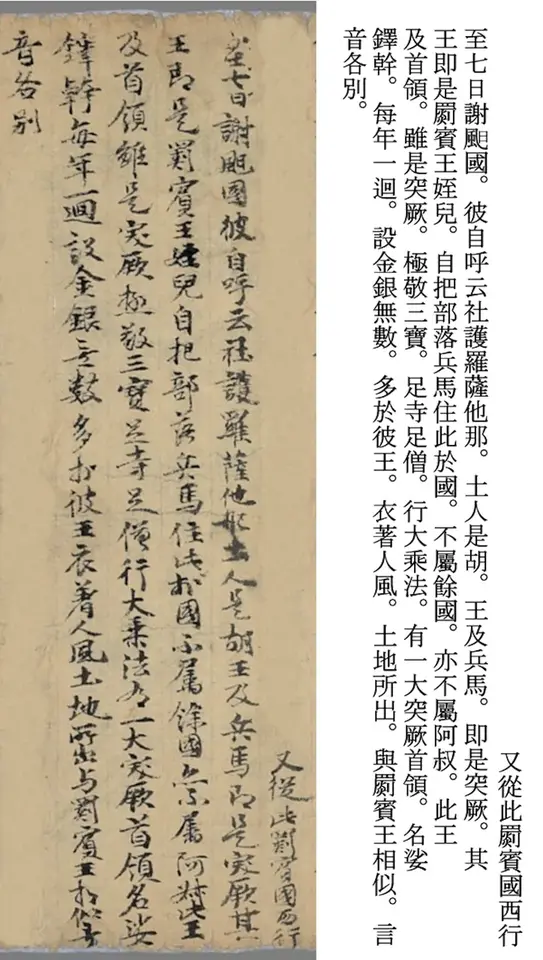
Although the original three-volume text was lost in China after the Song dynasty, surviving only as phonetic glosses in Huilin's Pronunciation and Meaning of All Scriptures, a dramatic rediscovery occurred in 1908. French Sinologist Paul Pelliot identified a manuscript roll containing the core sections of Huichao's memoir in Cave 17 of the Mogao Caves at Dunhuang.
The manuscript, spanning more than three hundred columns and over six thousand characters, preserved the continuous narrative from Kashmir through Tokharistan, Little Balur, and the Four Garrisons of Anxi. Its publication ignited global scholarly excitement, prompting critical studies by Luo Zhenyu, Wang Guowei, Naito Torajiro, and Western orientalists, cementing Huichao's international stature as a pioneer of global exploration.
FIGURES ASSOCIATED WITH THIS DYNASTY