Preserved by Imperial Grace
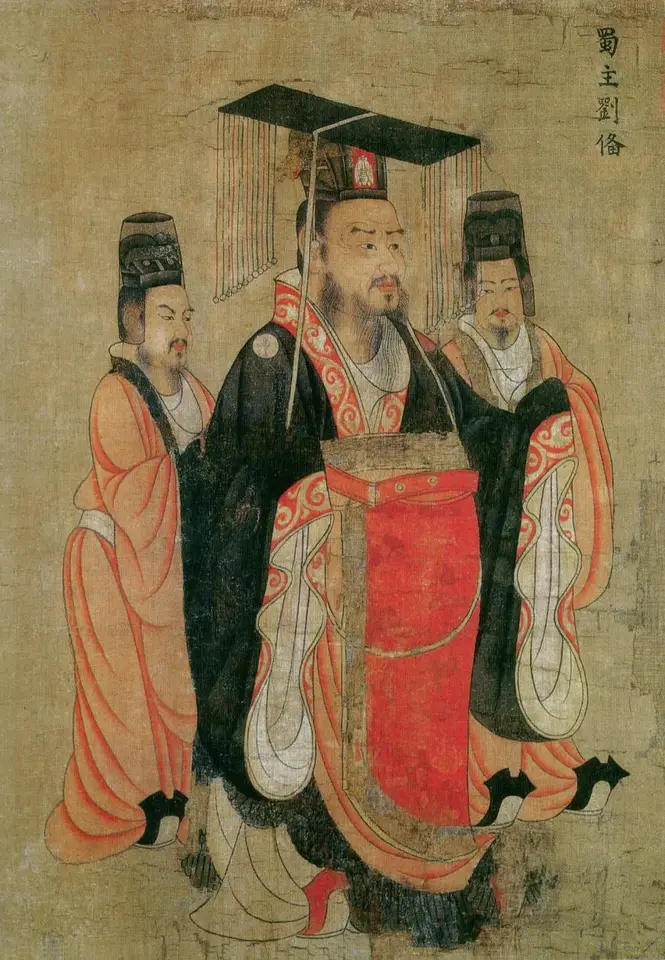
Following Huang Quan's surrender to Wei, Liu Bei pardoned Huang Quan's dependents; Huang Chong was protected and raised in Chengdu.
黄崇
Huang Chong (died 263) was a native of Langzhong County, Baxi Commandery (modern Langzhong, Sichuan Province). He was an upright official and heroic martyr of the Shu Han state during the Three Kingdoms period. He was the son of Huang Quan, an eminent minister of Shu Han who had been forced to surrender to Cao Wei following Liu Bei's catastrophic defeat at the Battle of Yiling in 222. When legal officials urged the execution…
Huang Chong (died 263) was a native of Langzhong County, Baxi Commandery (modern Langzhong, Sichuan Province). He was an upright official and heroic martyr of the Shu Han state during the Three Kingdoms period. He was the son of Huang Quan, an eminent minister of Shu Han who had been forced to surrender to Cao Wei following Liu Bei's catastrophic defeat at the Battle of Yiling in 222. When legal officials urged the execution of Huang Quan's remaining kin in Chengdu, Emperor Zhaolie (Liu Bei) magnanimously pardoned the family, declaring that the fault lay with the sovereign rather than the minister, thereby preserving and nurturing Huang Chong within the imperial commonwealth. Huang Chong grew into a disciplined scholar-officer skilled in statecraft and military strategy, serving as Secretarial Court Gentleman (Shangshu Lang). In the autumn of 263, when Cao Wei general Deng Ai executed an audacious crossing of the Yinping mountain trails to capture Jiangyou, Emperor Liu Shan ordered General of the Guards Zhuge Zhan to command the central field armies. Serving on Zhuge Zhan's staff, Huang Chong displayed profound strategic vision: upon reaching Fu County, he tearfully implored Zhuge Zhan to advance with all speed to seize the mountain gorges and deny the invading Wei army access to the Chengdu plain. When Zhuge Zhan hesitated and squandered the critical tactical window, Deng Ai broke through into the lowlands, forcing a retreat to Mianzhu. At Mianzhu Pass, Huang Chong rallied his soldiers with unyielding resolve to fight to the death, charging into the melee and sacrificing his life alongside fellow commanders to repay the benevolence of the Han house.
Following Huang Quan's surrender to Wei, Liu Bei pardoned Huang Quan's dependents; Huang Chong was protected and raised in Chengdu.
Appointed Secretarial Court Gentleman in the Department of State Affairs, assisting with administrative and military paperwork.
Accompanied Zhuge Zhan to oppose Deng Ai's invasion; repeatedly wept while urging an immediate advance to hold the mountain passes, but his advice was ignored.
Following the retreat to Mianzhu, Huang Chong rallied his soldiers to fight to the last breath, falling heroically in combat against Deng Ai's army.
Huang Chong belonged to the prestigious Huang clan of Langzhong in Baxi Commandery. His father, Huang Quan, was a brilliant regional strategist trusted implicitly by Liu Bei. During Liu Bei's eastern campaign against Sun Quan in 221, Huang Quan was commissioned General Who Guards the North to defend the northern bank of the Yangtze against potential Cao Wei interference. In 222, when Eastern Wu commander Lu Xun set fire to the Shu camps at Yiling, Liu Bei's armies collapsed and the southern river passages were completely severed. Cut off from retreat and refusing to surrender to Eastern Wu, Huang Quan led his forces northward to submit to Cao Wei, where he was ultimately created General of Chariots and Cavalry.
According to the laws of the Han dynasty, the family of a defector was subject to execution. In Chengdu, legal officers petitioned Liu Bei to arrest and execute Huang Quan's wife and children. Liu Bei, demonstrating unmatched magnanimity, placed his hand on his heart and sighed: "I failed Huang Quan; Huang Quan did not fail me!" Liu Bei ordered the judiciary to leave the family untouched and continued to provide them with imperial stipends as before. Protected by this extraordinary display of sovereign grace, young Huang Chong grew up in Chengdu under the care of the Shu Han state.
Conscious of the profound debt of gratitude his family owed to the founding emperor, Huang Chong cultivated moral rectitude and studied military strategy, vowing to dedicate his life to the defense of the state. Entering official service, he was praised for his diligence, administrative clarity, and strategic insight, rising to become Secretarial Court Gentleman (Shangshu Lang) in the imperial secretariat.
In the autumn of 263, the Cao Wei state launched its massive multi-pronged invasion of Shu Han. While the main armies under Zhong Hui were held at bay by Grand General Jiang Wei at Jiange Pass, General Who Conquers the West Deng Ai executed a desperate military maneuver: leading ten thousand elite infantry through seven hundred li of precipitous wilderness across the Yinping trails, sliding down cliffs wrapped in felt blankets, and launching a surprise assault on Jiangyou. Taken completely unaware, the garrison commander Ma Miao surrendered without a fight, opening the southern gateway into the heart of Sichuan.
Confronted with imminent danger, Emperor Liu Shan ordered General of the Guards Zhuge Zhan (son of Chancellor Zhuge Liang) to take supreme command over the imperial guards and regional levies, accompanied by Master of Documents Zhang Zun (grandson of Zhang Fei), Feathered Forest Guard Controller Li Qiu (nephew of Li Hui), and Secretarial Court Gentleman Huang Chong.
When the imperial army arrived at Fu County (modern Mianyang, Sichuan), Zhuge Zhan, unaccustomed to field command, was paralyzed by indecision. Fearful of Deng Ai's reputation, he halted the army and hesitated to advance.
Huang Chong recognized the acute tactical danger with remarkable strategic clarity. He understood that Deng Ai's army had traversed hundreds of li of rugged mountain gorges; their soldiers were physically exhausted, their supply trains were completely nonexistent, and their sole advantage lay in shock value and momentum. If the Shu forces advanced swiftly to occupy the narrow defiles and mountain passes between Fu County and Jiangyou, Deng Ai's isolated vanguard would starve in the mountains.
Huang Chong rushed into Zhuge Zhan's command tent, passionately urging an immediate advance: "Deng Ai has penetrated deeply into our territory with an isolated force, with treacherous terrain behind him and no supply lines. We must advance day and night with all our forces to occupy the strategic defiles! We must never allow the enemy's cavalry to reach the open plains. Once they descend into the flatlands, our infantry will lose all geographic advantages, and Chengdu will be doomed!"
However, Zhuge Zhan was indecisive and listened to timid advisors who favored cautious defensive postures. Seeing the golden tactical opportunity slipping away, Huang Chong fell to his knees, weeping bitter tears and pleading with his commander to march forward. Yet Zhuge Zhan stubbornly refused. Unopposed, Deng Ai's forces swept out of the mountains, routed the Shu forward detachments, and drove Zhuge Zhan's army into headlong retreat toward Mianzhu.
Zhuge Zhan retreated to Mianzhu Pass (modern Huangxu Town, Deyang), where he rejected Deng Ai's letter offering him princely honors if he surrendered, executing the enemy envoy. As the final battle lines were drawn outside the city, Huang Chong realized that the survival of the state was hanging by a thread.
Rather than considering surrender to join his half-brother Huang Yong in northern Wei, Huang Chong prepared for death. Donning heavy armor, he walked through the ranks of his troops, delivering an impassioned address that moved the men to tears: "We have received the boundless benevolence of the Late Sovereign and the Han house. Today the enemy stands at our gates and the state faces extinction; this is the moment for true men to give their lives for their country!" Inspired by Huang Chong's courage, the soldiers shouted in unison that they would fight to the death.
When Deng Ai launched a coordinated double-envelopment assault led by Deng Zhong and Shi Zuan, Zhuge Zhan and his son Zhuge Shang were killed in the melee. Huang Chong, Zhang Zun, and Li Qiu each led their remaining detachments in desperate counter-charges against the encircling Wei troops. Huang Chong personally cut down several enemy soldiers, sustaining dozens of spear wounds before finally collapsing on the battlefield. Through his heroic death, Huang Chong repaid Liu Bei's clemency with his lifeblood, standing as an enduring symbol of filial and patriotic martyrdom.
Huang Chong's tearful counsel at Fu County is recognized by military historians as the definitive operational solution to Deng Ai's raid. By correctly diagnosing that Deng Ai's forces were exhausted and devoid of logistical depth, Huang Chong formulated the exact tactical plan required to trap and destroy the invaders in the mountain defiles. His passionate, tearful appeals reflected exceptional strategic brilliance and profound personal devotion to the state.
When his father Huang Quan defected to Wei in 222, Liu Bei's extraordinary mercy spared the household from execution. Forty-one years later, when the dynasty faced its twilight at Mianzhu, Huang Chong repaid that royal favor with absolute fidelity. Rejecting the possibility of survival and aristocratic honors in Wei, he chose martyrdom, providing an immortal paradigm of Confucian reciprocal loyalty.
FIGURES ASSOCIATED WITH THIS DYNASTY