Birth in Lingling
Born into an impoverished scholarly family in Lingling; exhibited an instinctive fascination with brush calligraphy from early childhood.
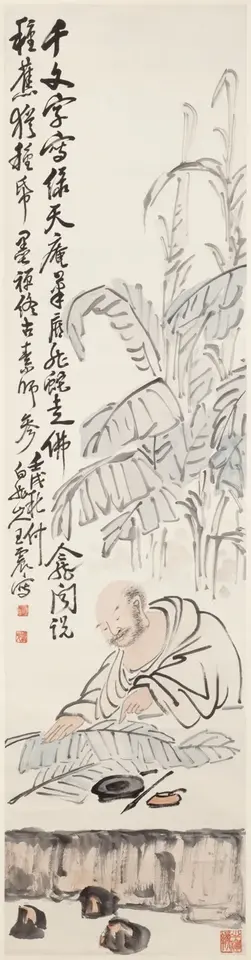
怀素
Huai Su (737–799 CE), secular surname Qian and courtesy name Zangzhen, was a native of Lingling (present-day Yongzhou, Hunan). He was an eminent Buddhist monk and monumental master of calligraphy of the Tang Dynasty, universally celebrated as a supreme titan of wild cursive script (Kuangcao). Showing an early affinity for Buddhism from childhood, he took monastic vows at the age of ten at Shutang Temple in Lingling,…
Huai Su (737–799 CE), secular surname Qian and courtesy name Zangzhen, was a native of Lingling (present-day Yongzhou, Hunan). He was an eminent Buddhist monk and monumental master of calligraphy of the Tang Dynasty, universally celebrated as a supreme titan of wild cursive script (Kuangcao). Showing an early affinity for Buddhism from childhood, he took monastic vows at the age of ten at Shutang Temple in Lingling, recorded in historical annals as the "Lingling Monk" or "Monk of Changsha." Impoverished in his youth with no means to purchase paper, he planted over ten thousand plantain trees around his hermitage, harvesting broad leaves to practice calligraphy, and wore through multiple lacquered wooden trays, burying worn brush tips in a famous "Tomb of Worn Brushes." Endowed with a magnanimous and bohemian temperament, Huai Su possessed an unquenchable fondness for wine. In moments of drunken inspiration, his brush swept across walls, garments, and daily utensils like sudden wind and torrential rain, creating swirling calligraphic movements of sublime vitality. Driven to master the authentic orthodox brush techniques of the Jin masters, he set out with staff and knapsack to explore Chang'an and Luoyang. In Chang'an, his uncle Wu Tong imparted Zhang Xu's wild cursive methods and the Jin heritage of the Two Wangs; in Luoyang, he consulted monumental master Yan Zhenqing, mastering the "Twelve Brushstroke Methods" and the profound aesthetic of "Leaking Rain Stains" (Wu Lou Hen). Alongside the High Tang master Zhang Xu, Huai Su formed the twin peaks of wild cursive calligraphy, immortalized in cultural history under the collective epithet "Mad Zhang and Drunken Su" (Dian Zhang Zui Su), celebrated as a true "Sage of Cursive Script." His surviving masterpiece Autobiography (Zixu Tie) is hailed as the supreme monument of wild cursive, while his paper manuscript Thousand Character Classic in Small Cursive Script is revered as the finest small cursive work in Chinese history. His artistic daring, disciplined technique, and sublime expressive freedom exerted an enduring impact on subsequent generations of Chinese calligraphers.
Born into an impoverished scholarly family in Lingling; exhibited an instinctive fascination with brush calligraphy from early childhood.
Renounced secular life at age ten to enter Shutang Temple in Lingling, receiving the dharma name Huai Su and courtesy name Zangzhen.
Relocated to Lütian Hermitage, planting plantains to practice writing; praised at age seventeen by demoted official Wei Zhi as a future cultural giant.
Encountered immortal poet Li Bai along the Xiang River; Li Bai composed the celebrated Ballad of Cursive Script in praise of his genius.
Traveled to Chang'an and Luoyang; received Zhang Xu's cursive lineage from Wu Tong and studied brush mechanics under Yan Zhenqing.
Authored the immortal wild cursive masterwork Autobiography (Zixu Tie) at forty-one in Chang'an, stunning imperial ministers and scholars.
Retired to native Lingling; penned the sublime Thousand Character Classic in Small Cursive Script before passing away serenely at sixty-three.
Huai Su was born in 737 CE during the Kaiyuan reign in the southern prefecture of Lingling. His family had resided along the picturesque banks of the Xiao and Xiang rivers for generations, maintaining scholarly traditions despite severe financial hardship. Huai Su exhibited precocious intellectual sharpness and an obsessive passion for brushwork from infancy. In 747 CE (sixth year of Tianbao), at the tender age of ten, he experienced a sudden and unshakeable desire to enter the Buddhist sangha. Despite affectionate parental dissuasion, he stood resolute in his spiritual calling, entering Shutang Temple situated two li west of Lingling to take formal monastic vows.
Within the monastic community, Huai Su channeled all his waking hours outside monastic devotions into the study of calligraphy. Because the impoverished temple lacked funds to purchase fine paper, Huai Su practiced wherever surface permitted, covering whitewashed walls, wooden doors, temple vessels, and even his own coarse monastic cassocks with flowing cursive characters. Seeking a sustainable supply of writing surfaces, he moved to Lütian Hermitage outside the eastern gate of Lingling and cleared surrounding wilderness to plant more than ten thousand broad-leafed plantain trees.
As the plantain grove flourished, Huai Su harvested large green leaves each morning, spreading them flat across stone slabs to trace ancient copybooks. When winter arrived and leaves withered, he commissioned a local artisan to construct a large wooden tray and smooth boards coated in black lacquer. Dipping his brush in thick ink, he wrote furiously upon the lacquered surfaces, wiping them clean with water day after day until the friction wore holes through the hardwood boards. The discarded brushes accumulated into massive piles, which he eventually interred within a deep pit behind the hermitage, mounding earth above it to create his famous "Tomb of Worn Brushes."
During these early years, Huai Su's cursive style was animated by natural vitality and boundless imagination, though he had not yet fully absorbed the orthodox transmission of the Jin masters. Aware that his self-taught art lacked the structural rigor of ancient models, he intensified his daily discipline, examining stone rubbings with monastic devotion to build an unshakeable technical foundation.
In 752 CE, the sixteen-year-old Huai Su composed the spirited cursive piece Eight Autumn Poems. Although his personal style remained in development, his kinetic momentum and structural balance far surpassed ordinary copyists. Local scholar Zhu Kui recognized his extraordinary genius, composing the famous poem Song of Master Huai Su's Cursive Script to introduce the young monk to literati circles. The following year, former Minister of Personnel Wei Zhi, who had been demoted to a remote frontier posting, stopped in Lingling during his southern journey. Upon examining Huai Su's cursive calligraphy, Wei Zhi was astonished, declaring: "This Buddhist monk's brushwork will shake the universe with grand renown!"
In 759 CE (second year of Qianyuan), the twenty-two-year-old Huai Su learned that legendary poet Li Bai, having received imperial pardon following exile, was traveling through the Xiangtan region. Huai Su traveled eagerly to meet the immortal poet. Sharing an unconstrained love of wine and artistic freedom, the two creators bonded instantly. Li Bai was mesmerized by Huai Su's lightning-fast brush movements, writing the celebrated Ballad of Cursive Script in which he proclaimed: "Master Huai Su's cursive script is unexcelled throughout the empire; with the soaring ambition of youth he reaches to grasp the clouds."
In 766 CE (first year of Dali), esteemed man of letters Zhang Wei assumed office as Prefect of Tanzhou (Changsha). Hearing of the remarkable monk, Zhang Wei visited Lütian Hermitage and became a lifelong patron. Zhang Wei lavishly praised Huai Su's dynamic lines as resembling "slithering vipers entering the hall and sudden downpours shaking the room," urging the young master to venture north to the imperial capitals of Chang'an and Luoyang to seek out the foremost calligraphic masters of the realm.
In the spring of 768 CE, at the age of thirty-two, Huai Su composed the Shenji Tie transcription of the Thousand Character Classic, demonstrating that his brushwork had entered the classical Jin heritage. Heeding Zhang Wei's advice, Huai Su packed his bags, took up his monk's staff, and embarked upon a journey to Chang'an. Traveling northward by boat alongside scholar Wang Yong, he won immediate literary admiration along his route.
Arriving in Chang'an, Huai Su sought out his maternal uncle, the celebrated calligrapher Wu Tong. Wu Tong had studied directly under the great cursive master Zhang Xu, inheriting the esoteric brush mechanics of Wang Xizhi and Wang Xianzhi. Wu Tong generously instructed his nephew, imparting Zhang Xu's expansive kinetic rhythms alongside the rigorous discipline of Wang Xizhi's Seventeen Model Letters. Under Wu Tong's tutelage, Huai Su learned to balance reckless dynamic momentum with precise structural order.
In the autumn of 772 CE, returning south to visit family, Huai Su detoured through the Eastern Capital Luoyang to pay homage to the preeminent master of Chinese calligraphy, Yan Zhenqing. Yan Zhenqing, who had likewise inherited Zhang Xu's teachings, was deeply impressed by Huai Su's artistic intuition. Yan Zhenqing generously imparted the "Twelve Brushstroke Methods" and shared how Zhang Xu had achieved divine revelation after watching Lady Gongsun's sword dance.
During their dialogue, Huai Su described his own spiritual communion with nature: "I observe summer clouds forming shifting peaks and take them as my teachers; at moments of exhilaration, my brush moves like birds bursting from a forest, startled snakes darting through grass, or ancient cracks spreading across crumbling walls." Yan Zhenqing listened with admiration, then challenged him: "How does it compare to the trace of leaking rain on an earthen wall?" Huai Su experienced an immediate epiphany, realizing that brushwork must achieve deep frictional resistance, rounded centered firmness, and concealed force. This breakthrough permanently united his wild inspiration with classical substance, prompting Yan Zhenqing to compose the famous Preface to Master Huai Su's Cursive Script.
Having synthesized the teachings of masters with classical tradition, Huai Su's art attained its ultimate zenith. In 777 CE (twelfth year of Dali), at the age of forty-one in his Chang'an residence, Huai Su took up his brush to record his life's pilgrimage. Saturated with deep ink upon a seven-meter scroll of fine hemp paper, he executed the immortal masterpiece Autobiography (Zixu Tie) in a single sustained burst of creative energy.
The scroll comprises one hundred and twenty-six lines totaling six hundred and ninety-eight characters. Composed in lucid, elegant prose, the text recounts his monastic renunciation, plantain practice, travels to the capitals, and guidance from Wu Tong and Yan Zhenqing, incorporating poems composed in his honor by contemporary luminaries. Visually, the scroll unfolds like a thunderstorm: thin, tensile lines twist and pivot with round centered momentum, combining unbridled dynamic passion with strict adherence to classical cursive orthography.
Following the appearance of Autobiography, ministers, aristocrats, and scholars competed to entertain the master. Huai Su loved alcohol passionately; historical chronicles in Jinhu Ji recorded that he was "drunk nine times a day." Whenever wine ignited his inspiration, he seized any brush at hand, covering palace walls, painted folding screens, and linen robes with swirling cursive strokes in seconds. Contemporaries linked him directly with Zhang Xu, establishing the enduring cultural legend of "Mad Zhang and Drunken Su."
After 778 CE, weary of court socializing and aristocratic banquets, Huai Su traveled south to Mount Yandang in eastern Zhejiang, carrying fine paper to commune with natural waterfalls and cliffs. As advancing age and chronic rheumatism took their toll, he yearned for monastic seclusion and returned permanently to his hometown of Lingling.
In his native hermitage, Huai Su's spiritual state returned to tranquil Buddhist meditation. His art evolved from explosive passion into serene, ancient simplicity. In 799 CE (fifteenth year of Zhenyuan), while bedridden in Shutang Temple at sixty-three, he summoned his remaining strength to transcribe Zhou Xingsi's Thousand Character Classic in exquisite small cursive script on paper, creating the legendary Thousand Character Classic in Small Cursive Script (also known as the Thousand Gold Model).
Spanning forty-two lines and five hundred and thirty surviving characters, each character stands independently with rounded, tranquil bone and effortless clarity. Shortly after finishing this final testament, Huai Su passed away peacefully in his meditation chamber in the winter of 799 CE. Mourning disciples buried him west of Lingling, where his inkstone-washing well and funerary stele remain sacred monuments of Chinese calligraphic pilgrimage.
Huai Su's supreme contribution to Chinese art was establishing the definitive aesthetic paradigm for wild cursive script (Kuangcao). Before him, Zhang Xu had pioneered the style, but surviving exemplars of Zhang's writing were exceedingly scarce. Huai Su synthesized centered seal-script roundness, Two Wangs fluid modulation, and his own dynamic genius to formulate a distinct style characterized by slender, tensile iron-wire strokes and continuous rhythmic momentum.
His masterpiece Autobiography (Zixu Tie) represents the undisputed summit of Chinese wild cursive. It stands simultaneously as a magnificent work of visual art and a vital historical record of Tang intellectual life. The scroll moves from measured, deliberate phrasing into an overwhelming tempest of sweeping strokes, maintaining structural coherence despite dizzying speeds. Northern Song master Huang Tingjian remarked: "Huai Su's cursive script in his late years was fully equal to Zhang Xu; his brushwork was round and vigorous, arising from nature." Ming grand secretary Li Dongyang added a seal-script title to the scroll, praising it as "resembling a valiant warrior unsheathing a sword, soaring beyond human reach." Preserved today in the Palace Museum, it is universally venerated as the finest wild cursive work in existence.
While Autobiography represents the fiery passion of Huai Su's middle years, his paper manuscript Thousand Character Classic in Small Cursive Script, executed in his sixty-third year, embodies the tranquil summit of his mature art. Measuring 26.8 centimeters in height across nine pages, the manuscript was hailed throughout imperial history as "worth a thousand gold pieces per character" (Qianjin Tie).
Departing completely from the sprawling connections of wild cursive, each character in this text stands in pristine, detached composure. The brushstrokes are lean, firm, and thoroughly saturated with centered force, exuding a classical serenity reminiscent of Tao Yuanming's poetry. Late Ming scholar Wang Shizhen praised it in Yanzhou Shanren Gao: "Every character seems poised for immortal flight; while Master Huai Su's other works are lean and bold, this work alone is balanced, limpid, and exquisitely mature." Modern scholars universally revere it as the supreme paradigm of small cursive script.
Huai Su made seminal contributions to aesthetic theory by articulating the philosophy that calligraphy must directly model the spontaneous forces of nature. In his celebrated dialogues with Yan Zhenqing, he demonstrated how shifting summer clouds inspired his spatial architecture, how darting snakes and startled birds informed his brush turns, and how cracks running through ancient masonry guided his organic textures.
Critically, under Yan Zhenqing's guidance, Huai Su incorporated the aesthetic of "Leaking Rain Stains" (Wu Lou Hen) into rapid cursive execution. Leaking rain stains represent water seeping down an uneven mud wall, encountering friction, gathering weight, and descending with stubborn, deliberate gravity. By executing rapid wild cursive with this centered, frictional restraint, Huai Su eradicated the superficial slickness and theatrical instability that plagued lesser imitators, establishing the enduring principle that true wildness must remain anchored within classical discipline.
Beyond Autobiography and the small cursive Thousand Character Classic, Huai Su's surviving corpus includes celebrated works such as Bitter Bamboo Shoots (Kusun Tie), Eating Fish (Shiyu Tie), On Calligraphy (Lunshu Tie), Holy Mother (Shengmu Tie), and Zangzhen Tie. Bitter Bamboo Shoots, preserved in the Shanghai Museum, comprises only fourteen characters across two lines, yet represents an unexcelled national treasure of calligraphic vigor. On Calligraphy incorporates archaic Han-Jin draft cursive conventions, showcasing the breadth of his historical erudition.
Moreover, historical records confirm that Huai Su was an accomplished poet, painter, and Sanskrit translator. His surviving poems, including Painting Pines and Inscribed on Zhang Sengyou's Painting of Drunken Monks, reveal deep painterly sensitivity and poetic refinement. Northern Song scholar Ouyang Xiu observed in Jigu Lu that "Huai Su was celebrated for cursive script in his own age, and is treasured even more deeply today," ensuring his legacy as an immortal luminary of world calligraphy.
FIGURES ASSOCIATED WITH THIS DYNASTY