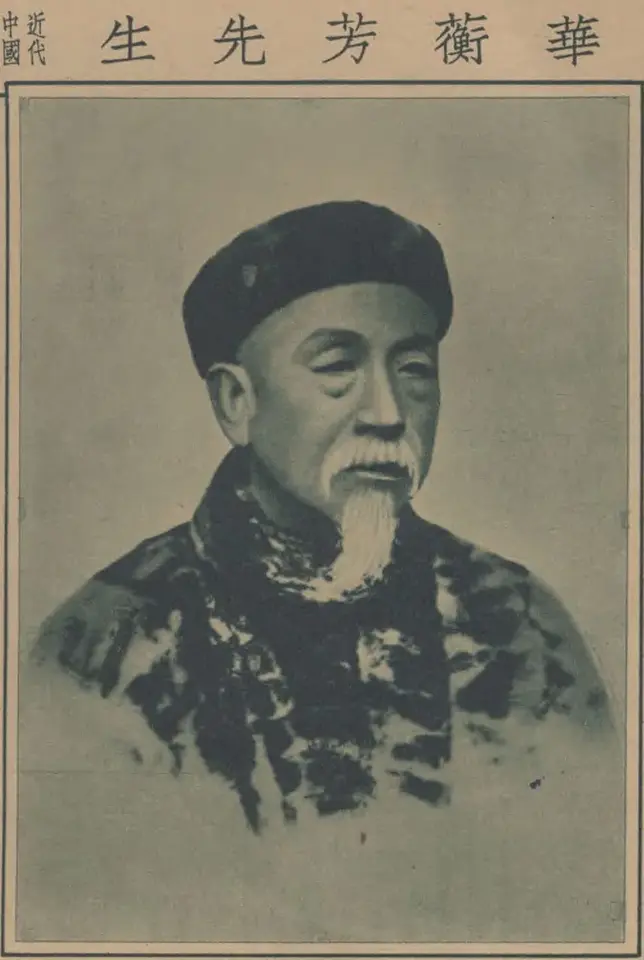
PROFILE
Hua Shifang (华世芳, 1854–1905), courtesy name Ruoxi and pseudonym Huozhai, was a native of Dangkou Town in Jingui County, Changzhou Prefecture, Jiangsu Province (modern Dangkou Town, Xishan District, Wuxi). He was an eminent late Qing mathematician, translator of scientific and technical literature, and an early pioneer of modern higher engineering mathematics education in China. Born into the prominent Dangkou Hua scientific lineage of Wuxi, he was the younger brother of Hua Hengfang, a foundational figure of modern Chinese science and mathematics; the two brothers were celebrated collectively in Chinese intellectual history as the "Two Huas of Dangkou."
Guided and instructed from childhood by his elder brother, Hua Shifang mastered both traditional Chinese and Western mathematics, specializing in Euclidean geometry, algebra, differential and integral calculus, and infinite series. During the Guangxu reign, he was recruited into the Translation Department of the Jiangnan Arsenal in Shanghai, China's foremost translation bureau for modern science, collaborating closely with British scholar John Fryer to translate advanced Western treatises on higher mathematics and engineering. His major translations, including Daishu Nanti Jiefa (Solutions to Algebraic Problems), Weiji Suyuan (Tracing the Origins of Calculus), and Jueyi Shuxue (Treatise on Probability)—the first systematic Chinese introduction to modern probability theory and mathematical statistics—filled critical gaps in China's mathematical literature.
In education, Hua actively promoted modern mathematics in early higher educational institutions. He served as senior mathematics instructor at the Wuchang Ziqiang School (predecessor of Wuhan University) founded by Huguang Viceroy Zhang Zhidong, and later as Chief Mathematics Instructor at Nanyang Public School (predecessor of Shanghai Jiao Tong University and Xi'an Jiaotong University) founded by Sheng Xuanhuai. He established China's earliest university curriculum in calculus and engineering mathematics, training a generation of modern engineers and scientists. In 1905, Hua passed away while serving on the faculty of Nanyang Public School at the age of fifty-two.
- Courtesy Name
- Ruoxi (若溪)
- Pseudonym
- Huozhai (蒦斋)
- Dynasty
- Qing
- Ancestral Home
- Dangkou Town, Jingui County, Changzhou Prefecture, Jiangsu (modern Dangkou, Xishan, Wuxi, Jiangsu)
- Birth Date
- 1854 (4th year of the Xianfeng reign, Qing)
- Death Date
- 1905 (31st year of the Guangxu reign, Qing)
- Age at Death
- 52
- Highest Office
- Chief Translator at the Translation Department of Jiangnan Arsenal, Chief Mathematics Instructor of Nanyang Public School
- Historical Identity
- Mathematician, scientific translator, modern educator
BIOGRAPHY
Chronology
- 1854 (4th year of the Xianfeng reign) | Birth in Dangkou | Born into a prominent scholarly family in Dangkou Town, Jingui County, Jiangsu.
- 1866 (5th year of the Tongzhi reign) | Mathematical Training | Began systematic study of traditional arithmetic and Western algebra under his elder brother Hua Hengfang at age twelve.
- 1880 (6th year of the Guangxu reign) | Translating at Jiangnan Arsenal | Entered the Translation Department of the Jiangnan Arsenal, collaborating with John Fryer on higher mathematics.
- 1882 (8th year of the Guangxu reign) | Publishing Jueyi Shuxue | Published Jueyi Shuxue, China's first translated treatise on modern probability theory and statistics.
- 1893 (19th year of the Guangxu reign) | Instructing in Wuchang | Recruited by Viceroy Zhang Zhidong to serve as mathematics instructor at the newly established Wuchang Ziqiang School.
- 1898 (24th year of the Guangxu reign) | Chief Instructor at Nanyang | Transferred to Shanghai Nanyang Public School as Chief Mathematics Instructor, directing university-level mathematics.
- 1905 (31st year of the Guangxu reign) | Demise at Post | Passed away from sudden illness while actively teaching at Nanyang Public School at the age of fifty-two.
Life and Career
Family Heritage and Mathematical Enlightenment
Hua Shifang was born in 1854 in Dangkou Town, Jingui County, Jiangsu, into an elite lineage known for its emphasis on practical science and statecraft. His elder brother Hua Hengfang was twenty-one years his senior and had already achieved national renown by co-designing China's first domestic steam-powered vessel, the Huanghu, with Xu Shou.
From early childhood, Hua Shifang exhibited intellectual curiosity regarding natural phenomena and mathematical computation. The family library housed thousands of volumes of Chinese and Western astronomical and mathematical works. In 1866, at twelve, Hua Shifang committed himself to mathematical studies. Recognizing his talent, Hua Hengfang designed a structured curriculum, providing problem sets and reviewing his work daily. Alongside his examination studies, Hua Shifang read Mei Wending's astronomical compilations and Li Shanlan's translations of Euclid's Elements (Books VII–XV) and Augustus De Morgan's Elements of Algebra, mastering traditional counting-rod methods while acquiring command of Western algebraic notation and early calculus.
Translating Western Science at Jiangnan Arsenal
Following the suppression of mid-century rebellions, the Self-Strengthening Movement prioritized advanced mathematics to support naval construction, artillery casting, and railway engineering. The Translation Department of the Jiangnan Arsenal in Shanghai served as the empire's center for scientific dissemination. In 1880, recommended by Hua Hengfang, Hua Shifang was appointed official mathematics translator at the Arsenal.
At the Translation Department, Hua established an effective translation partnership with British Sinologist John Fryer. Their collaborative method paired Fryer's oral interpretation of Western texts with Hua's precise rendering into classical Chinese prose and mathematical formulas. Drawing upon his classical Chinese literary background and mathematical insight, Hua formulated standardized Chinese nomenclature for numerous advanced mathematical concepts. Together they translated William Wallace's Solutions to Algebraic Problems in sixteen fascicles, Tracing the Origins of Calculus in eight fascicles, and Thomas Galloway's landmark probability manual Jueyi Shuxue in ten fascicles. These works, characterized by rigorous proofs and step-by-step solutions, became standard textbooks for late Qing academies.
Teaching at Ziqiang and Nanyang Public Schools
Following the Sino-Japanese War of 1894–1895, the Qing government recognized the urgent need to establish modern polytechnic universities. In 1893, Huguang Viceroy Zhang Zhidong established the Wuchang Ziqiang School in Wuhan, incorporating divisions in foreign languages, mathematics, natural science, and commerce. Zhang invited Hua Shifang to head the mathematics department. In Wuchang, Hua authored original lecture notes introducing analytical geometry, spherical trigonometry, and differential calculus into university instruction.
In 1898, railway commissioner Sheng Xuanhuai founded Nanyang Public School in Shanghai, envisioning it as China's premier engineering university. Sheng recruited Hua Shifang as Senior Mathematics Instructor, subsequently elevating him to Chief Mathematics Instructor. Over eight years at Nanyang, Hua oversaw the university's mathematical curriculum. Aligning advanced mathematics with mechanical engineering, railway surveying, and structural mechanics, he trained students in rigorous analytical methods, establishing Nanyang Public School's national reputation in engineering education.
In 1905, worn down by decades of teaching and translation, Hua fell suddenly ill and passed away at Nanyang Public School at the age of fifty-two.
Major Achievements
Translating China's First Probability Treatise Jueyi Shuxue
Hua Shifang's foremost contribution to Chinese scientific history was the publication of Jueyi Shuxue in ten fascicles at the Jiangnan Arsenal in 1882. The translation was based on British mathematician Thomas Galloway's Treatise on Probability.
Prior to this publication, traditional Chinese mathematics possessed no systematic literature on stochastic mathematics or statistical probability. Drawing the title Jueyi from the I Ching ("resolving doubts and deciding uncertainties"), Hua utilized classical vocabulary to introduce the mathematical analysis of chance events. He established standard Chinese translations for fundamental statistical terms such as "opportunity" (jihui), "average" (pingjunshu), and "expected value" (qiwangzhi), while deriving the Law of Large Numbers, binomial distribution, and observational error theory. The work expanded Chinese mathematics beyond deterministic calculation into modern statistical science.
Translating Advanced Algebra and Calculus Textbooks
Hua made essential contributions to disseminating higher algebra and calculus across late imperial China. His translation of Wallace's Daishu Nanti Jiefa in sixteen fascicles presented hundreds of complex equations and geometric-algebraic problems, providing worked derivations that helped Chinese mathematicians transcend the limitations of traditional polynomial algebra (tianyuanshu and siyuanshu).
His translation of Weiji Suyuan in eight fascicles introduced the foundational axioms of limits and infinitesimals, methodically proving differentiation and integration rules while demonstrating applications in mechanics, astronomy, and architectural engineering. These translations were adopted as standard textbooks across the Tongwen Guan, regional naval academies, and military colleges throughout China.
Founding Higher Engineering Mathematics Education
During his twelve years on university faculties, Hua translated modern Western mathematical curricula into Chinese educational practice. At the Wuchang Ziqiang School and Shanghai Nanyang Public School, he replaced traditional elementary arithmetic with an integrated higher engineering curriculum comprising algebra, Euclidean and analytical geometry, trigonometry, and calculus.
Hua combined theoretical proofs with real-world engineering applications, illustrating calculus principles through bridge construction, railway curves, and ship stability. Under his instruction, early graduates of Nanyang Public School achieved distinction when continuing their studies in North American and European universities. Through his pedagogy, Hua guided Chinese mathematics education from informal tutoring into an institutionalized university discipline.
Personal Relationships
- Elder Brother and Mentor: Hua Hengfang, courtesy name Yifang, prominent mathematician and scientist of the Self-Strengthening Movement; directly guided Hua Shifang's early mathematical training.
- Translation Collaborator: John Fryer, British Sinologist and chief editor at the Jiangnan Arsenal Translation Department; collaborated with Hua over two decades.
- Academic Founder and Viceroy: Zhang Zhidong, Huguang Viceroy and prominent statesman; founded the Wuchang Ziqiang School and appointed Hua to lead its mathematics department.
- University Founder: Sheng Xuanhuai, industrialist and educational reformer; founded Shanghai Nanyang Public School, appointing Hua as Chief Mathematics Instructor.
- Distinguished Students: Early engineering graduates of Nanyang Public School, who later directed early twentieth-century Chinese railway and mechanical engineering projects.
Historical Evaluations
- Sheng Xuanhuai, Memoir of Mr. Hua, Mathematics Instructor at Nanyang Public School: "Master Ruoxi was thoroughly versed in Western algebra and calculus. Teaching at Nanyang, he guided young talents with patience and clarity; he was truly the cornerstone of our school's engineering mathematics."
- John Fryer, Preface to the Catalog of Translations of the Jiangnan Arsenal: "Master Hua Ruoxi was peerless in arithmetic and meticulous in prose. Translating Jueyi Shuxue with me, he analyzed the subtlest mathematical concepts with deep precision, standing as a rare scholar in this eastern realm."
- Li Yan, History of Chinese Mathematics: "The brothers Hua Hengfang and Hua Shifang mastered both Chinese and Western mathematics, translating a vast library of works and teaching across northern and southern institutions. The revival of mathematics in the late Qing owed largely to the efforts of the Hua family."
Related Entries
- Hua Hengfang
- John Fryer
- Jiangnan Arsenal
- Nanyang Public School
- Jueyi Shuxue
- Weiji Suyuan