Pledging Allegiance in Chuyang
Joined Zhu Yuanzhang's camp in Chuyang, appointed vanguard commander, and broke enemy lines with distinguished bravery.
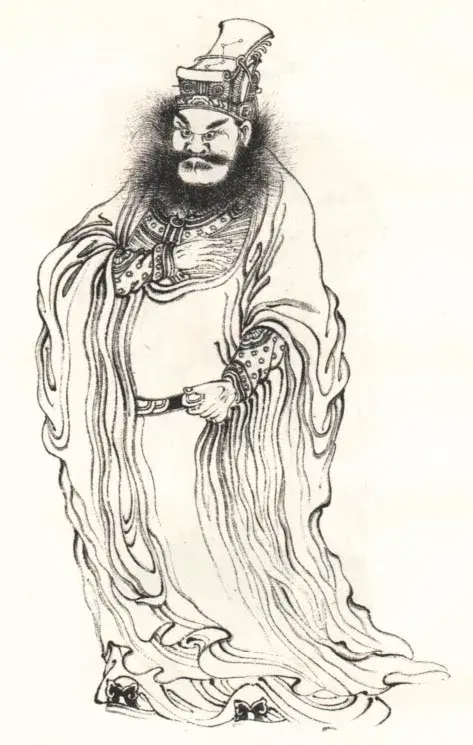
胡大海
Hu Dahai (?–1362), courtesy name Tongfu, was a native of Hong County, Sizhou (present-day Si County, Anhui Province). He was a founding merit minister, renowned military commander of the Ming dynasty, and one of the Twenty-Four Generals of Huaixi. Standing over eight feet tall with a dark, stern countenance, Hu Dahai possessed unmatched valor, strength, and strategic intellect. When Zhu Yuanzhang first established his camp in…
Hu Dahai (?–1362), courtesy name Tongfu, was a native of Hong County, Sizhou (present-day Si County, Anhui Province). He was a founding merit minister, renowned military commander of the Ming dynasty, and one of the Twenty-Four Generals of Huaixi. Standing over eight feet tall with a dark, stern countenance, Hu Dahai possessed unmatched valor, strength, and strategic intellect. When Zhu Yuanzhang first established his camp in Chuyang, Hu Dahai arrived to pledge allegiance and was immediately appointed vanguard commander. He accompanied the main force across the Yangtze River, winning widespread renown and rising to Marshal of the Right Wing Army, Signator Official of the Bureau of Military Affairs, and Assistant Administrator of the Branch Secretariat of Jiangnan. During the campaigns to secure Eastern Zhejiang and eliminate Yuan garrison forces, Hu Dahai held independent theater command. He assisted in capturing Ningguo and Huizhou, crushing the hundred-thousand-strong host of Yuan general Yang Wanzhe outside Huizhou against overwhelming odds. Later, alongside Deng Yu and Li Wenzhong, he stormed across the rugged Yuling Pass, captured Jiande and Chun'an, and accepted the surrender of thirty thousand mountain troops. Driving forward, he seized Lanxi, Wuzhou (present-day Jinhua, Zhejiang), and Zhuji, firmly anchoring Zhu Yuanzhang's strategic rear in Eastern Zhejiang. Hu Dahai maintained iron military discipline and forbade his troops from harming civilians, earning profound public respect. Furthermore, he revered scholars, vigorously recommending the "Four Sages of Eastern Zhejiang"—Liu Ji, Song Lian, Ye Chen, and Zhang Yi—to Zhu Yuanzhang, thereby assembling the core intellectual and administrative foundation of the Ming dynasty. In the second month of 1362, surrendered officers Jiang Ying and Liu Zhen plotted treason in Jinhua. As Hu Dahai dismounted in front of the Bayong Tower to inspect the troops, the mutineers struck with concealed arrows and spears, assassinating Hu Dahai and his son Hu Guanzhu. Zhu Yuanzhang wept bitterly upon learning of the tragedy, eventually crushing the rebels, executing Jiang Ying, and presenting his severed head in Jinhua as a sacrificial offering to Hu Dahai's spirit. In the first year of Wu, he was posthumously granted Grand Master of Glorious Happiness, Manager of Governmental Affairs of the Branch Secretariat of Eastern Zhejiang, and Duke of Yue. In 1370, he was enshrined in the Imperial Ancestral Temple, ranked seventh in the Meritorious Officials Temple, and granted the posthumous title "Wuzhuang".
Joined Zhu Yuanzhang's camp in Chuyang, appointed vanguard commander, and broke enemy lines with distinguished bravery.
Advanced across the Yangtze to conquer Hezhou and Taiping; appointed Marshal of the Right Wing Army and guarded the commander's tent.
Coordinated with Deng Yu to defend Huizhou, executing a surprise dawn assault that shattered Yang Wanzhe's hundred-thousand-strong army.
Scaled precipitous cliffs to capture Yuling Pass, took Jiande and Chun'an, pacified thirty thousand mountain troops, and rose to Signator Official of the Bureau of Military Affairs.
Seized Lanxi and stormed Wuzhou, rigorously forbidding plundering, and was promoted to Assistant Administrator of the Jiangnan Branch Secretariat.
Governed Eastern Zhejiang military affairs and enthusiastically recommended Liu Ji, Song Lian, Ye Chen, and Zhang Yi to join the secretariat.
Marched to seize fortified points across Zhuji and Chuzhou, repelling multiple offensives launched by warlord Zhang Shicheng.
When Zhu Yuanzhang enacted a strict prohibition on alcohol, Hu's son was executed for violation; Hu remained steadfastly loyal without grievance.
Treacherously assassinated alongside his son by surrendered commander Jiang Ying in front of Bayong Tower in Jinhua; posthumously granted Right Grand Councilor of the Central Secretariat, Duke of Yue, and ranked seventh in the Meritorious Officials Temple in 1370.
Hu Dahai's birth year is unrecorded in historical records. His ancestral home was Hong County, Sizhou (present-day Si County, Suzhou City, Anhui Province). Hu Dahai stood over eight feet tall, with a coal-black complexion, piercing eyes, immense physical strength, and sharp tactical foresight. During the tumultuous Red Turban Rebellions of the late Yuan dynasty, Hu Dahai initially organized local militias to defend against bandits. Observing that most regional rebel leaders were violent pillagers devoid of visionary leadership, he refused to join them. Upon hearing that Zhu Yuanzhang was gathering honorable men and enforcing strict discipline at Chuyang (present-day Chuzhou, Anhui), Hu Dahai led his followers and rode directly to pledge his services.
Zhu Yuanzhang recognized Hu Dahai's extraordinary caliber and composure, immediately appointing him vanguard commander. In 1355, Hu Dahai accompanied Zhu Yuanzhang across the turbulent Yangtze River, participating in key engagements that captured Hezhou, breached the Caishi Shoals, and secured Taiping Prefecture. On the battlefield, Hu Dahai fought in the forefront wielding an iron lance, striking dread into adversary ranks. Following the conquest of Jiqing Circuit (present-day Nanjing, Jiangsu), Zhu Yuanzhang appointed Hu Dahai Marshal of the Right Wing Army and assigned him to guard the Commander-in-Chief's headquarters tent, making him one of Zhu's most trusted protective commanders.
In 1357, Zhu Yuanzhang dispatched forces to secure the strategic southern Anhui towns of Ningguo and Huizhou. Hu Dahai led elite strike units alongside Signator Official Deng Yu, capturing Ningguo before traversing mountain ridges to storm Huizhou Prefecture, quickly subduing the surrounding territory. Huizhou was a wealthy and vital corridor linking Anhui and Zhejiang. Alarmed by its loss, Yuan general Yang Wanzhe amassed Jiangzhe provincial forces and thirty thousand mountain auxiliary fighters, totaling a reputed hundred thousand troops, establishing interconnected encampments spanning dozens of miles to push the Ming forces back across the river.
The Yuan forces laid siege to Huizhou, their banners blotting out the sky. Outnumbered and isolated, many Ming garrison troops grew fearful. Unfazed, Hu Dahai mounted the ramparts to survey the siege works, calmly observing to his officers that Yang Wanzhe's army was vast but poorly coordinated and bloated with arrogance, making it vulnerable to a decisive sudden blow.
At dawn, under dense river fog, Hu Dahai led several thousand elite cavalry quietly through the gates, splitting into two wings to strike deep into Yang Wanzhe's central command post. Setting fires with the prevailing wind and sounding horns, the Ming assault threw the sleeping Yuan host into blind panic and mutual trampling. Yang Wanzhe's guard collapsed completely. Hu Dahai pursued the retreating enemy for dozens of miles, killing over ten thousand soldiers, capturing countless packhorses and provisions, and sending Yang Wanzhe fleeing into the wilderness. The siege of Huizhou was broken, securing southern Anhui.
Having broken Yang Wanzhe's counteroffensive, Zhu Yuanzhang ordered a push from southern Anhui into Eastern Zhejiang. In 1358, Hu Dahai, alongside Deng Yu and Li Wenzhong, marched from Huizhou toward Yuling Pass, the key choke point between Anhui and Zhejiang. Yuling Pass sat atop sheer cliffs, heavily reinforced by Yuan forces who had felled trees and stacked boulders to fortify the gorge. Hu Dahai ordered his soldiers to dismount and climb the rocky precipices using hanging vines, launching an unexpected assault from the rear cliff. Panicked by the attack from behind, the Yuan defenders broke and fled, allowing the Ming forces to seize the pass.
Following this breakthrough, Hu Dahai drove across the western Zhejiang plain, pressing toward Jiande and Chun'an. Surviving Yuan units rallied thirty thousand mountain fighters across Yanzhou to make a stand along the riverbanks. Hu Dahai commanded the fleet, deploying artillery to shatter the defensive timber booms, then surrounded the enemy while declaring clemency for any who yielded. Intimidated by Hu Dahai's military renown and moved by his fair reputation, all thirty thousand mountain troops laid down their weapons and surrendered. Elated by the victory, Zhu Yuanzhang promoted Hu Dahai to Signator Official of the Branch Bureau of Military Affairs.
Subsequently, Hu Dahai directed his forces toward strategic centers of Eastern Zhejiang. He swiftly captured Lanxi and joined the siege of Wuzhou (present-day Jinhua, Zhejiang). The garrison resisted for months until supplies failed; Hu Dahai breached the outer fortifications and seized the city. Zhu Yuanzhang arrived in person to console the army and promoted Hu Dahai to Assistant Administrator of the Branch Secretariat of Jiangnan, placing him in overall charge of military defense across Wuzhou as theater commander of the Eastern Zhejiang frontier.
Though raised in military camps, Hu Dahai possessed profound civic benevolence and visionary political insight. Amid the widespread atrocities of late Yuan warlords, who frequently plundered, torched towns, and assaulted women upon taking a city, Hu Dahai enforced uncompromising military rules. He proclaimed three capital prohibitions across his command: any soldier who executed noncombatants would be beheaded; any who plundered civilian property would be beheaded; and any who molested women would be beheaded.
After capturing Wuzhou, Lanxi, and Zhuji, Hu Dahai stationed mounted inspectors along every street night and day. Markets operated without interruption, farmers worked their fields in safety, and civil life resumed smoothly. Contemporaries praised Hu Dahai as a warrior who combined an iron face with the benevolent heart of a true gentleman.
While managing Eastern Zhejiang, Hu Dahai actively sought out and honored scholars. He frequently lamented to his aides that although he had grown up as a man of arms and lacked classical education, true scholars living in seclusion must not be left neglected in the mountains during the founding of an empire. At that time, renowned Jiangnan intellectuals Liu Ji (Liu Bowen), Song Lian, Ye Chen, and Zhang Yi lived in seclusion in Qingtian and Pujiang, refusing office under regional warlords. Recognizing their profound statesmanship, Hu Dahai sent emissaries bearing sincere letters and repeatedly pleaded with Zhu Yuanzhang to enlist these four sages. Zhu Yuanzhang subsequently sent lavish gifts to recruit them to Yingtian Prefecture. Liu Ji and Song Lian became the foremost strategic advisors and institutional architects of the early Ming dynasty, a development largely attributable to Hu Dahai's keen discernment.
In 1361, to preserve food grain and enforce army sobriety, Zhu Yuanzhang decreed a total prohibition on alcoholic brewing, with violation punishable by death. While Hu Dahai was away directing front-line operations, his elder son privately brewed wine within the camp for profit and was arrested by provost marshals. Senior officers pleaded on his behalf before Zhu Yuanzhang, pointing out that Hu Dahai was risking his life expanding frontiers and that executing his son might spark unrest among the troops. Zhu Yuanzhang retorted angrily that he would rather face Hu Dahai's rebellion than allow the laws of the realm to be undermined, ordering the son executed publicly. When news reached Hu Dahai at the front, he understood that the laws of the state superseded personal paternal affection. Displaying neither rancor nor disloyalty, he instead tightened field discipline even further, winning Zhu Yuanzhang's deepest admiration.
Between late 1361 and early 1362, Hu Dahai captured Zhuji and defeated several massive amphibious assaults launched by warlord Zhang Shicheng, slaying prominent rival generals and seizing hundreds of warships. Around this time, surrendered Yuan commanders Jiang Ying, Liu Zhen, and Li Fu led their troops to surrender. Hu Dahai treated them with characteristic generosity, incorporating their units into the garrison forces at Jinhua.
Jiang Ying and his confederates harbored treacherous designs. Observing that Zhu Yuanzhang was committing his primary armies to fierce confrontations against Chen Youliang in Jiangxi, they conspired to assassinate Hu Dahai and defect to Zhang Shicheng in Pingjiang. On the morning of February 7, 1362, Jiang Ying and Liu Zhen feigned an auspicious parade at the foot of the Bayong Tower in Jinhua, inviting Hu Dahai to review the troops and venerate the army standards.
Suspecting nothing, Hu Dahai rode to the Bayong Tower accompanied by only a few aides. Just as he dismounted and prepared to receive ceremonial salutes, Jiang Ying drew a concealed sleeve-arrow and shot him at point-blank range, while hidden conspirators surged forward with spears. Unarmed and caught off guard, Hu Dahai fell mortally wounded. His son Hu Guanzhu and director Wang Kai rushed forward to protect him, only to be slain in the melee. Jiang Ying and his accomplices plundered the treasury and fled eastward.
When news of Hu Dahai's death reached Yingtian, Zhu Yuanzhang broke down in inconsolable tears, lamenting that he had lost an irreplaceable pillar of the realm. In 1365, Zhu Yuanzhang personally conquered the region, captured Jiang Ying alive, and ordered him executed and disembowelled before the Bayong Tower as a sacrifice to the spirits of Hu Dahai and his son. In 1367 (first year of Wu), Zhu posthumously elevated Hu Dahai to Grand Master of Glorious Happiness, Manager of Governmental Affairs of Eastern Zhejiang, and Duke of Yue. In 1370, during the grand ennoblement of founding merit ministers, Emperor Taizu issued an imperial decree elevating Hu Dahai to Grand Master for Glorious Happiness, Pillar of State, and Right Grand Councilor of the Central Secretariat, granting him enshrinement in the Imperial Ancestral Temple, ranking his portrait seventh in the Meritorious Officials Temple, and conferring the posthumous name "Wuzhuang".
The defense of Huizhou in 1357 was Hu Dahai's signature masterpiece. Facing Yang Wanzhe's reputedly hundred-thousand-strong army, Hu Dahai overcame heavy numerical inferiority through audacity and tactical precision.
Utilizing dawn river fog to conceal a multi-pronged assault on the enemy's main camp, he threw the opposing army into panic and routed them with wind-spread fire, slaying over ten thousand enemy soldiers. This triumph eliminated the southern threat against Yingtian and cleared the pathway across Yuling Pass into the Eastern Zhejiang heartland.
Amid the chaos and brutality of the late Yuan rebellions, Hu Dahai distinguished himself through uncompromising moral standards in warfare. Wherever he marched, he enforced his three capital prohibitions against killing civilians, looting wealth, and molesting women.
Upon taking Wuzhou and Lanxi, his strict administration preserved civil commerce and spared the population from warfare's ravages. His deference to imperial statute and selflessness were demonstrated when his eldest son was executed for violating the alcohol prohibition, proving his unswerving loyalty to national law above personal grief.
Hu Dahai played an indispensable role in the institutional and intellectual founding of the Ming dynasty. Though a battlefield general, he understood that empires cannot be governed from horseback alone and actively sought out rustic scholars.
Through his earnest appeals, the "Four Sages of Eastern Zhejiang"—Liu Ji, Song Lian, Ye Chen, and Zhang Yi—were brought into Zhu Yuanzhang's inner circle. Liu Ji's grand strategic designs and Song Lian's ceremonial and legal codifications provided the core governance architecture of the Ming empire, rendering Hu Dahai's discernment an enduring historical contribution.
FIGURES ASSOCIATED WITH THIS DYNASTY