Birth in Leping
Born into a prominent scholarly lineage in Leping; studied under his mother while his father was detained in Jin.
洪迈
Hong Mai (洪迈, 1123–1202), courtesy name Jinglu, art name Yechu and Rongzhai, posthumous name Wenmin, was an illustrious literary master, historian, foundational textual philologist, and senior statesman of the Southern Song dynasty from Leping, Raozhou. He was the third son of patriotic diplomat Hong Hao, celebrated alongside his elder brothers Hong Gua and Hong Zun as the Three Hong Brothers of Poyang. He lived from 1123 to…
Hong Mai (洪迈, 1123–1202), courtesy name Jinglu, art name Yechu and Rongzhai, posthumous name Wenmin, was an illustrious literary master, historian, foundational textual philologist, and senior statesman of the Southern Song dynasty from Leping, Raozhou. He was the third son of patriotic diplomat Hong Hao, celebrated alongside his elder brothers Hong Gua and Hong Zun as the Three Hong Brothers of Poyang. He lived from 1123 to 1202, passing away at the advanced age of eighty, granted the posthumous title Wenmin. Hong earned his jinshi degree in 1145 and subsequently passed the prestigious Boxue Hongci examination. Dispatched as an envoy to the Jurchen Jin court in 1162, Hong resisted severe diplomatic humiliation and food blockades, preserving the imperial honor of the Song dynasty. He served across four successive reigns, holding high offices including Hanlin Academician, Secretariat Drafter, and Prefect of Ji'zhou, Ganzhou, Wuzhou, and Shaoxing, before rising to Academician of the Duanming Hall. In scholarship, Hong was a towering giant. Over four decades of research, he composed the monumental seventy-four-volume Rongzhai Suibi, widely revered as the absolute pinnacle of classical Chinese historical and textual philology. Furthermore, he compiled the massive 420-volume Yijian Zhi, the largest collection of supernatural tales and social anecdotes in Chinese history, and preserved thousands of Tang poems in Wanshou Tangren Jueju, securing an eternal place in Chinese cultural history.
Born into a prominent scholarly lineage in Leping; studied under his mother while his father was detained in Jin.
Passed both the jinshi and Boxue Hongci examinations in the same year, entering civil service.
Dispatched to the Jin court, enduring confinement and food blockades while preserving national dignity.
Served as prefect in Ji'zhou, Ganzhou, and Wuzhou, clearing false legal charges and developing water conservancy.
Conducted exhaustive philological research in his library, beginning his monumental Rongzhai Suibi.
Elevated to Hanlin Academician and Imperial Lecturer, drafting confidential state decrees and compiling dynastic history.
Appointed Prefect of Shaoxing, providing famine relief, restoring Lake Jian, and advancing to Academician of Duanming Hall.
Passed away peacefully at his native estate at age eighty, posthumously granted the title Wenmin.
Hong Mai was born in Leping County, Raozhou Prefecture. His father Hong Hao was dispatched as an imperial envoy to the Jin dynasty in 1129 and was detained in northern frozen wastelands for fifteen years, displaying unbending loyalty that contemporaries likened to Han diplomat Su Wu. Reared by their mother Lady Shen in Jiangnan, Hong Mai and his brothers Hong Gua and Hong Zun studied day and night under strict maternal guidance.
In 1145, at twenty-three years of age, Hong Mai achieved his jinshi degree alongside his elder brother Hong Gua. In the same year, he passed the formidable Boxue Hongci examination, which tested comprehensive command of ancient history and classical parallel prose. The brothers' sequential examination triumphs became a national legend, celebrated across the empire as the Three Hong Brothers of Poyang.
In 1162, following the accession of Jin Emperor Shizong, Emperor Xiaozong appointed Hong Mai as envoy to congratulate the Jin court. Appeasement officials had drafted submissive diplomatic protocols, expecting Hong to submit to foreign demands.
Upon arriving in the Jin capital of Yanjing, Jurchen protocols demanded that Hong kneel in submission to present the imperial letters. Drawing upon his father's uncompromising heritage, Hong adamantly refused. Infuriated, the Jurchen authorities confined Hong in a remote temple hostel, cutting off water, food, and heating for several days. Facing freezing starvation, Hong sat upright chanting the Spring and Autumn Annals without wavering. Awed by his unyielding spirit, Jin Emperor Shizong rescinded the degrading demands and received him as an honored foreign envoy. Upon his return, Emperor Xiaozong praised him for upholding the glory of his father's name.
During the Qiandao reign, Hong requested regional assignments to escape factional bickering at court. He served successively as Prefect of Ji'zhou, Ganzhou, Wuzhou, and Shaoxing, displaying exceptional administrative capability.
In Ji'zhou and Ganzhou, he audited population rolls, eliminated unauthorized levies, and exonerated hundreds of innocent prisoners. While governing Shaoxing during severe droughts, Hong opened imperial granaries to distribute grain at subsidized prices and repaired the reservoirs of Lake Jian, protecting regional agriculture. When he completed his term, thousands of local residents lined the highways weeping in gratitude.
During the Chunxi era, Hong was recalled to Lin'an to serve as Hanlin Academician, Imperial Lecturer, and Dynastic Historiographer. The post required exceptional classical erudition to draft confidential imperial edicts. Hong fulfilled his duties with profound stylistic grace, drafting hundreds of foundational state decrees.
In his declining years, Hong retired with the rank of Academician of the Duanming Hall and Grand Master of Glorious Happiness. At his native estate in Leping, he constructed the Yechu Hall, devoting his remaining days to research and writing. In 1202, Hong passed away peacefully at age eighty, honored with the posthumous title Wenmin.
Hong Mai's foremost contribution to world scholarship was his lifelong composition of the seventy-four-volume Rongzhai Suibi.
Structured across five series, the work represents the highest peak of classical Chinese historical criticism. Hong rigorously verified dynastic histories, ancient administrative systems, and literary metrics, correcting errors in standard historical texts through exhaustive textual comparison. The work anticipated the rigorous philological methods of the Qing dynasty Qianjia school by centuries. In modern times, Mao Zedong read Rongzhai Suibi repeatedly throughout his life, praising its profound factual clarity.
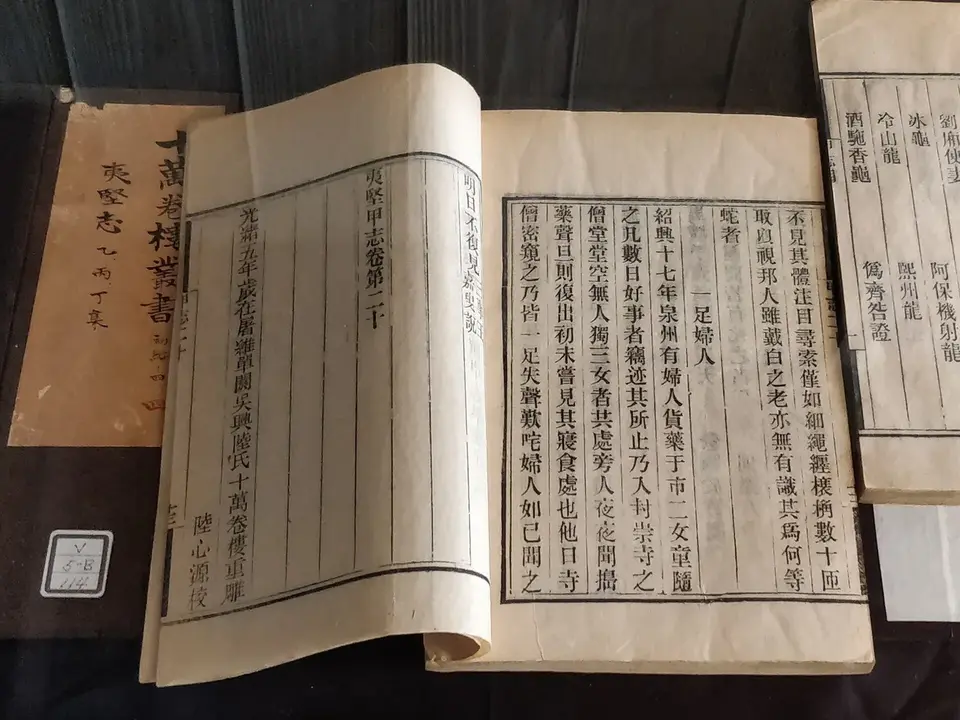
Hong's other monumental contribution was Yijian Zhi, the largest collection of supernatural anecdotes, folklore, and social vignettes in Chinese history.
Originally spanning 420 volumes and millions of characters, the anthology recorded folklore, religious beliefs, legal cases, and commercial life across all social strata of the Southern Song. It serves as an irreplaceable historical encyclopedia for the study of medieval Chinese popular culture, social history, and religious practices.
Hong performed an invaluable service to Chinese literary heritage by compiling Wanshou Tangren Jueju in one hundred volumes.
Following the destruction of imperial libraries during the northern wars, countless Tang poetic manuscripts were lost. Hong spent decades gathering fragmented manuscripts to preserve ten thousand five-character and seven-character quatrains by known and anonymous Tang poets. His anthology provided the primary foundational source for the later compilation of the Complete Tang Poems (Quan Tang Shi).
Hong's diplomatic resistance in the Jurchen capital exemplified the highest ideals of Confucian statecraft.
Facing death by starvation, his refusal to compromise national dignity defeated Jurchen attempts to subjugate the Southern Song diplomatically, inspiring widespread patriotic resolve across the empire.
During his diplomatic mission to the Jin dynasty in 1162, Hong Mai endured acute political and personal peril. Jin Emperor Shizong had recently ascended the throne and sought to exploit the arrival of the Southern Song mission to impose humiliating subordinate tributary protocols, demanding that the Song embassy declare vassalage and present diplomatic credentials on bended knee.
Upon reaching Yanjing, Hong faced insolent Jin protocol officials and brandished weapons, resolutely arguing that both states possessed sovereign dignity and established diplomatic etiquette could not be abandoned. Infuriated, the Jin court dispatched heavily armed soldiers to place Hong under house arrest in a secluded temple hostel outside Yanjing, enforcing strict surveillance and cutting off fuel, food, and water for days. Facing bitter cold and starvation, Hong maintained steadfast dignity, sitting erect day and night chanting the Spring and Autumn Annals without yielding. Awed by his unbending loyalty and moral resemblance to ancient diplomat Su Wu, Emperor Shizong rescinded the unreasonable demands and granted him an audience according to reciprocal state protocol before escorting him home. Upon his return, Emperor Xiaozong praised Hong before the court for upholding his father's illustrious integrity.
What elevated Rongzhai Suibi to the pinnacle of classical Chinese scholarly notebooks was its vast interdisciplinary breadth and uncompromising empirical methodology.
Hong Mai conducted meticulous comparative textual analyses of the deeds of rulers and military campaigns recorded in the Shiji, Hanshu, and Zizhi Tongjian, rectifying numerous chronological confusions and erroneous official titles in transmitted histories. He analyzed the evolution of Han and Tang bureaucratic institutions, agrarian land tax systems, and equitable grain transport policies, while rigorously examining poetic meters, rhyming conventions, and Tang literary anecdotes. Mao Zedong was an avid lifelong reader of Rongzhai Suibi, frequently annotating copies and commending its rigorous empirical evidence and persuasive clarity, demonstrating the enduring academic brilliance of Hong Mai's scholarship across centuries.
FIGURES ASSOCIATED WITH THIS DYNASTY
Bibliographic information is not yet available for this entry.