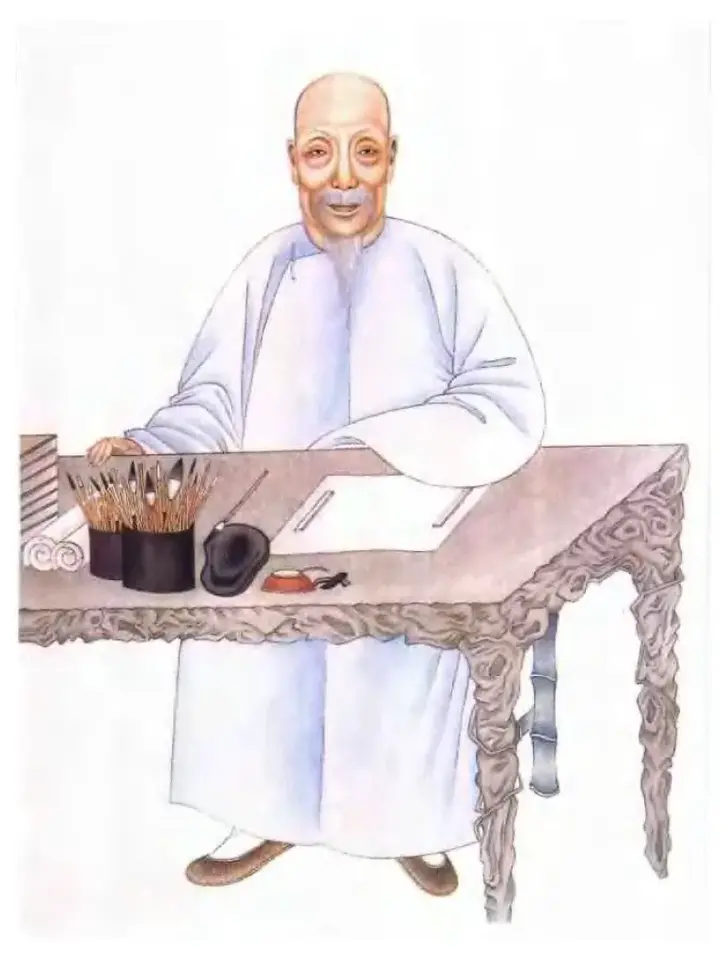
Life and Career
Lineage Mentorship and Early Intellectual Inquiries
He Shaoji was born on December 30, 1799, alongside his twin brother He Shaoye, in Dongzhou outside Daozhou, Hunan. His father, He Linghan, achieved third place (Tanhua) in the palace examination of 1805, rising to Grand Academician and Minister of Works and Revenue. He Shaoji spent his early childhood in his maternal uncle's village, receiving strict instruction in classical literature from his mother, Lady Liao.
In 1806, seven-year-old He Shaoji accompanied his mother to Beijing, where his father oversaw his formal education. Displaying intellectual gifts, he studied poetry and classical prose under Qianxian scholar Sun Pengqing in 1811. By 1812, his talent had attracted the praise of senior scholars Ruan Yuan and Cheng Enze, who formed a close friendship with the young prodigy, introducing him to the leading intellectual circles of the capital.
During his youth, He read widely in philology and classical texts. In 1817, he studied under Shanhua scholar Zhang Xinghuan, and in 1818 began a daily regimen of copying Pre-Qin seal scripts while studying Xu Shen's Shuowen Jiezi. In 1819, he married Lady Tao in Shanxi before returning to Beijing. During this period, he met regularly with Bao Shichen, Gong Zizhen, Wei Yuan, and Huang Xun to discuss statecraft, classical scholarship, and practical administrative reform.
Epigraphical Discoveries in Shandong and Examination Setbacks
In 1821, He failed the Hunan provincial examination and returned home to Daozhou. In autumn 1822, his father was appointed Education Intendant of Shandong, and He accompanied the family to Jinan. Shandong was rich in pre-Qin, Han, and Wei-Jin stone inscriptions. Over several years traveling across Qufu, Mount Tai, Yidu, and Pingdu, He surveyed ancient stele rubbings, touching cliff inscriptions and copying Northern Dynasties tablets.
He collaborated with collectors such as Chong'en, copying Zheng Daozhao's cliff carvings and Han steles on Mount Tai and Mount Yunfeng. This fieldwork challenged his early preference for Dong Qichang and Zhao Mengfu's graceful model-book styles, convincing him that enduring calligraphy required the archaic power of Han clerical and Northern Dynasties stele scripts.
Despite his scholarly reputation, He experienced repeated failures in the provincial examinations between 1818 and 1834. In 1835, at thirty-seven, he passed the Shuntian provincial examination as a Juren, and in 1836 earned his Jinshi degree, entering the Hanlin Academy as a Bachelor. In 1840, he was formally appointed Compiler, subsequently working in the State Historiography Institute and the Wuying Palace on the Veritable Records of the Daoguang Emperor.
Directing Sichuan Education and Demotion for Outspoken Memorials
In 1839, He served as Associate Examiner for the Fujian provincial examinations. Following the deaths of both parents, he observed the traditional mourning period in Hunan. In 1852, the newly enthroned Xianfeng Emperor appointed him Provincial Education Intendant of Sichuan. Sichuan's educational institutions had long been corrupted by extortionate fees and widespread cheating.
Arriving in Sichuan, He traveled light to inspect Chengdu, Chongqing, Baoning, and Kuizhou. He personally supervised examination attendance, prevented proxy test-taking, refused customary gifts from local magistrates, and abolished mandatory travel fees previously imposed on poor candidates. He selected examination topics based on classical sources and statecraft, advancing qualified scholars from impoverished backgrounds.
During his tenure, the Taiping Rebellion expanded along the Yangtze River, destabilizing the southwest. Observing widespread military incompetence and corruption within the Green Standard Army, He submitted an impassioned memorial in 1855 detailing regional military failures and proposing militia reorganization, troop reductions, and refugee relief. However, this frank memorial threatened the interests of provincial governors and court grandees. Imperial counselors accused him of exceeding his educational jurisdiction to interfere in military affairs. The Xianfeng Emperor demoted him several ranks. Undaunted, He immediately transferred his administrative seals and resigned, resolving never to return to bureaucratic office.
Directing Academies in Shandong and Hunan
In the winter of 1855, He traveled east through Hubei and Jiangxi. In 1856, his friend Chong'en, then Governor of Shandong, invited him to direct the Luoyuan Academy in Jinan, the premier educational institution in the province. He accepted and led the academy for four years.
At Luoyuan, He emphasized practical Confucian statecraft, lecturing on the Classics in the morning and dynastic histories in the afternoon. In his leisure hours, he joined local scholars in exploring ancient monuments around Daming Lake and the Thousand Buddha Mountain, collecting Shang and Zhou bronzes and Han steles, and composing extensive epigraphical commentaries.
In 1860, as military conflict escalated in northern China, He returned to Hunan. Invited by provincial authorities and local gentry, he assumed the directorship of the Chengnan Academy in Changsha, leading it for a decade. He advocated practical learning over empty metaphysical speculation, encouraging students to study Gu Yanwu and Dai Zhen. Leaders of the Xiang Army, including Zeng Guofan, Zuo Zongtang, and Guo Songtao, maintained close correspondence with him, while emerging scholars such as Wang Kaiyun and Li Yuandu studied under his guidance, establishing Chengnan as a center of the late Qing Hunan statecraft movement.
Late Years in Suzhou and Collating the Thirteen Classics
In 1870, Jiangsu Governor Ding Richang established the Jiangsu Book Bureau in Suzhou to publish a critical edition of Ruan Yuan's Nanchang print of Shisanjing Zhushu (Commentaries and Subcommentaries on the Thirteen Classics). Recognizing that textual collation required rare philological expertise, Ding invited the seventy-two-year-old He Shaoji to supervise the project.
He accepted and moved to Suzhou, residing near the Caoqiao Book Bureau. Between 1870 and 1873, despite declining health and failing eyesight, he collated transmitted Song, Yuan, and Ming woodblock editions character by character, writing over ten thousand critical notes to rectify centuries of accumulated textual corruptions.
During his stay in Suzhou, He spent several hours daily practicing calligraphy with a suspended arm. Gentry, merchants, and foreign scholars frequently requested his works, which he provided freely, particularly to those in modest circumstances. In his final years, his brushwork achieved a serene and monumental synthesis of power and restraint. On September 11, 1873, He passed away quietly in Suzhou at the age of seventy-five. His son, He Qinghan, escorted his coffin back to Hunan for burial in Gaoping, Shanhua County.
Major Achievements
Synthesizing Four Scripts and Championing Stele-Model Fusion
He Shaoji occupies an essential place in the history of Chinese calligraphy, widely acknowledged as the definitive synthesizer of the stele and model-book traditions during the late Qing. While Ruan Yuan and Bao Shichen had championed northern steles over southern model-books, many contemporary stele practitioners produced rigid, unrefined lines. He Shaoji bridged this divide, fusing the structural strength of Northern Dynasties steles with the fluid rhythm of classical model-books.
In regular script, he began with Tang master Yan Zhenqing, particularly studying the Zheng Zuowei Tie, before integrating the angular structures of Northern Wei monuments like the Zhang Menglong Stele and Jing Shijun Stele. In running-cursive script, he applied the structural weight of clerical and regular scripts, creating dynamic characters with minimal superficial ligatures.
In seal and clerical scripts, his dedication was extraordinary; he transcribed the Zhang Qian Stele over one hundred times, alongside dozens of copies of the Cao Quan, Li Qi, and Fenglongshan steles. His clerical brushwork featured archaic, weighted strokes resembling falling boulders, combining the rounded vigor of seal script with cursive dynamism. His art inspired modern masters including Kang Youwei, Wu Changshuo, Qi Baishi, and Huang Binhong.
Inventing the Suspended Arm and Inward-Curving Wrist Technique
A defining technical innovation of He's calligraphy was his "suspended arm and inward-curving wrist" (huiwan gaoxuan) method. To overcome the weakness and superficial smoothness caused by resting the wrist on the desk, He developed a demanding physiological technique.
Regardless of character size, he fully suspended his entire arm in the air, gripping the brush near the top of the shaft with five fingers gathered, curving his wrist inward toward his chest while pushing his elbow outward. This posture directed physical force from the lower back and shoulders through the suspended arm directly into the brush tip.
He maintained the brush perpendicular to the paper, advancing with deliberate friction like a cone carving sand. Although this technique required intense physical exertion, causing him to perspire heavily after writing a few sheets, it imparted an extraordinarily dense, metallic resonance to his lines, solving the technical dilemma of translating archaic epigraphical power into fluid cursive strokes.
Standardizing Couplet Calligraphy and Aesthetic Innovation
He was a preeminent figure in the art of the calligraphic couplet. During the mid-nineteenth century, as literati gatherings and classical gardens flourished, the couplet evolved into an independent artistic format. He composed and wrote thousands of calligraphic couplets throughout his career.
He rejected the rigid symmetry of standard examination hall scripts, varying character sizes, ink density, and spatial spacing based on structural balance. His dynamic compositions combined literary wit with visual impact. His inscribed couplets remain preserved in historical landmarks across China, including the Yuelu Academy and Tianxin Pavilion in Changsha, the Master of the Nets Garden and Surging Wave Pavilion in Suzhou, and Daming Lake in Jinan, earning him traditional acclaim as a master of the couplet form.
Championing Song-Style Poetry and Leading Modern Poetic Renewal
In literature, He was a leading figure of the Song Poetry School in the late Qing. Reacting against the conventional imitation of High Tang verse popularized by Wang Shizhen and Shen Deqian, He advocated a return to the intellectual vigor of Northern Song poets Su Shi and Huang Tingjian alongside Cheng Enze, Wei Yuan, and Zeng Guofan.
He maintained that poetry must reflect authentic emotion and broad learning, utilizing rigorous argumentation to expand poetic boundaries. He did not avoid complex rhymes, creating dense, intellectually resonant verses. His four thousand extant poems, gathered in the thirty-fascicle Dongzhou Caotang Shichao, documented the historical traumas of the Opium Wars, social distress during the mid-nineteenth century, and his travels across China, laying the groundwork for the modern Tongguang poetic movement.
Advancing Paleography and Classical Textual Collation
In classical philology, He made significant contributions to phonology and lexicography. Building upon Ruan Yuan's teachings, he mastered ancient bronze inscriptions and Han lexicography. In Shuowen Duanzhu Bofzheng, he critically evaluated Duan Yucai's celebrated commentary on Shuowen Jiezi, citing pre-Qin canons and Han-Tang stone inscriptions to correct hundreds of errors in Duan's radical classifications and phonological divisions.
His other scholarly works, including Xidaoweizhai Jingshuo and Dongzhou Caotang Wenchao, offered insights into ritual institutions in the Liji and administrative geography in the Hanshu. His rigorous work overseeing the Jiangsu Book Bureau's edition of the Thirteen Classics with Commentaries and Subcommentaries set an enduring standard for late imperial classical collation.