Imperial Recruitment
Recruited into the imperial Pear Garden Academy for her peerless folk sword dance skills, becoming a core dancer in the Tang imperial court.
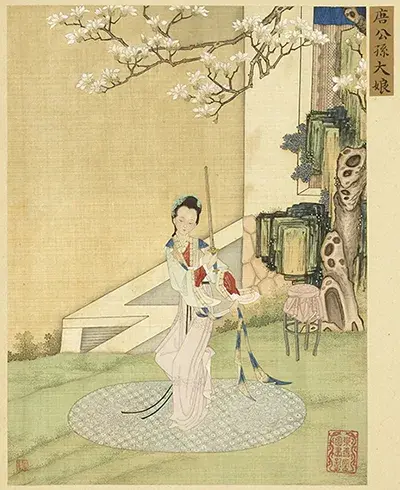
公孙大娘
Lady Gongsun (公孙大娘), originally named Gongsun Xi and native to Yancheng, was an illustrious dance artist of the High Tang era during the Kaiyuan reign. Renowned throughout the empire for her extraordinary mastery of the vigorous sword dance known as the Sword-Device Dance, she initially performed in folk communities before being recruited into the imperial Pear Garden Academy (Liyuan). Her dynamic performances combined folk…
Lady Gongsun (公孙大娘), originally named Gongsun Xi and native to Yancheng, was an illustrious dance artist of the High Tang era during the Kaiyuan reign. Renowned throughout the empire for her extraordinary mastery of the vigorous sword dance known as the Sword-Device Dance, she initially performed in folk communities before being recruited into the imperial Pear Garden Academy (Liyuan). Her dynamic performances combined folk vitality with imperial elegance, profoundly inspiring contemporary masters of calligraphy, painting, and poetry, including the cursive calligraphers Zhang Xu and Huaisu, the master painter Wu Daozi, and the great poet Du Fu. During the An Lushan Rebellion, she left the imperial court and passed her consummate performing arts to pupils such as Lady Li the Twelfth.
Recruited into the imperial Pear Garden Academy for her peerless folk sword dance skills, becoming a core dancer in the Tang imperial court.
Zhang Xu witnessed her performance of the Xihe sword dance in Ye County, gaining sudden inspiration for cursive script calligraphy; Du Fu also witnessed her performance in childhood.
The outbreak of the An Lushan Rebellion scattered the imperial performing troupes; Lady Gongsun took refuge in folk society and taught students.
Du Fu witnessed a performance by her disciple Lady Li the Twelfth in Kuizhou and composed the renowned poem Ballad of Watching the Sword Dance of Lady Gongsun's Disciple.
Lady Gongsun, originally named Gongsun Xi, was born in the northern street of Yancheng. In Tang dynasty naming conventions, \"Daniang\" (Eldest Daughter) was an affectionate and respectful title within a household. She trained rigorously in dynamic sword dancing from an early age. During the early Kaiyuan period, she performed extensively across the Yellow River and Central Plains regions. Her dazzling footwork, lightning agility, and sweeping blades captured the admiration of both common audiences and the scholar-gentry.
In 715 (Kaiyuan 3), Emperor Xuanzong gathered top musical and dancing talents nationwide to expand the imperial music academies. Lady Gongsun was enlisted into the Pear Garden Academy, joining the premier rank of court performers. Within the grand spectacles of the Kaiyuan and Tianbao eras alongside court musicians such as Li Guinian, she regularly performed during court banquets and major state rituals, gaining wide acclaim from the emperor and imperial dignitaries.
Lady Gongsun's sword dance achieved rare aesthetic harmony, combining high refined grace with the robust vigor of popular performance. Her art inspired multiple cultural disciplines of the High Tang. The \"Sage of Cursive Script\" Zhang Xu attested that watching her sword dance awakened him to the true momentum of brushwork, transforming his wild cursive calligraphy into an epochal style. The monk calligrapher Huaisu similarly drew creative power from her movements. The celebrated painter Wu Daozi, having watched her whirling blade dances in Luoyang, translated the kinetic velocity and swirling drapery into his murals, giving birth to the legendary painterly aesthetic known as \"Wu's Flying Drapery.\"
Following the catastrophic outbreak of the An Lushan Rebellion in 755, the imperial musical institutions dispersed. Lady Gongsun lived among ordinary folk and devoted her remaining years to educating pupils. Her foremost disciple, Lady Li the Twelfth of Linyin, preserved the authentic sword dance repertoire. In 767, the poet Du Fu watched Lady Li perform in Kuizhou, evoking nostalgic memories of the golden Kaiyuan era and culminating in his celebrated masterpiece Ballad of Watching the Sword Dance of Lady Gongsun's Disciple.
Tang palace dances were broadly categorized into gentle dances (Ruanwu) and vigorous dances (Jianwu). Lady Gongsun elevated the sword dance to the summit of vigorous choreography. Brandishing twin blades with dramatic leaps and sudden pauses, her choreography embodied exquisite dramatic tension. Du Fu's classic verse captured this sublime transition: \"Fierce as Hou Yi shooting down the nine suns, graceful as celestial sovereigns riding winged dragons; approaching like thunderclaps gathering wrath, pausing like vast waters freezing into tranquil light.\"
Lady Gongsun served as a pivotal aesthetic catalyst linking dance, calligraphy, painting, and poetry in High Tang culture. Primary records in Tang Guoshi Bu and the biographies of Zhang Xu record that Zhang Xu achieved his breakthrough in wild cursive script by assimilating the cadence of her sword dance. Wu Daozi likewise absorbed the rhythmic dynamism of her performance into his brushwork. This cross-pollination demonstrated the vibrant synthesis and boundless creativity of High Tang artistic civilization.
FIGURES ASSOCIATED WITH THIS DYNASTY