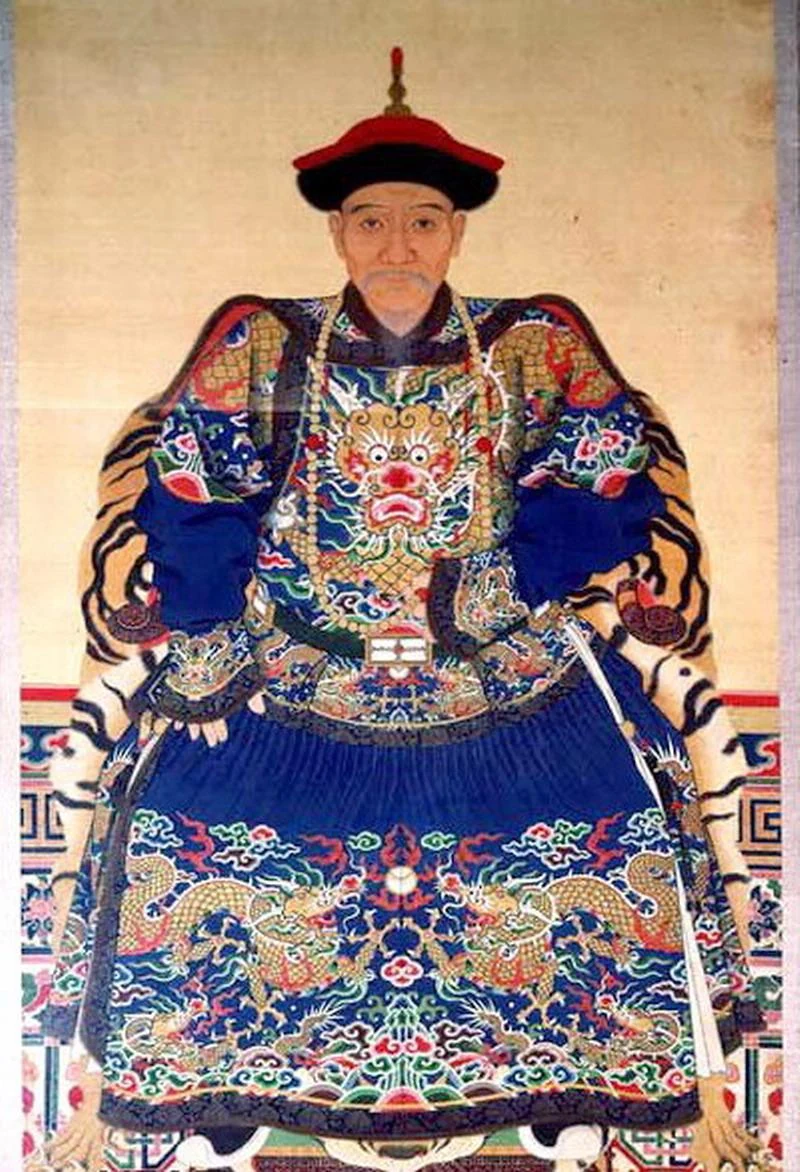
Biography
Family Background and Early Years
Geng Jingzhong came from a military family of Liaodong. His ancestors were originally from Shandong and later moved to Gaizhou Guard in Liaodong. His grandfather Geng Zhongming had served as a subordinate general under the Ming commander Mao Wenlong. After Mao was executed by Yuan Chonghuan, Geng Zhongming joined Sun Yuanhua; after Sun was executed by the Ming court, Geng surrendered to Nurhaci during the Tiancong era of Later Jin and was enrolled in the Han Bordered Yellow Banner. In the early Shunzhi period, Geng Zhongming entered China proper with Dorgon and was made Prince of Jingnan in 1649, the sixth year of Shunzhi. Not long afterward, fearing punishment in a case involving subordinates who concealed runaway people, he killed himself. His son Geng Jimao inherited the title and in 1660, the seventeenth year of Shunzhi, was transferred to garrison Fujian.
Geng Jingzhong was Geng Jimao's eldest son. His birth year is unknown, though the source places it around 1644, the first year of Shunzhi. In 1655 his father sent him to Beijing to serve at court. The Shunzhi Emperor granted him a first-class jingkini hafan (viscount) rank, and he married a daughter of Prince Su Hooge, receiving the rank hošoi efu (consort of a princess). This marriage created a direct tie between the Geng family and the Qing imperial house. In 1671 Geng Jimao died and Geng Jingzhong inherited the title Prince of Jingnan, becoming the feudatory prince stationed in Fujian.
After inheriting the title, Geng Jingzhong came to believe a prophetic saying that he interpreted as indicating Heaven's Mandate for the Geng family and secretly encouraged his officers and troops to prepare for political change. His mother, Lady Zhou, discovered this and strongly tried to stop him. Geng refused to listen, and she died in anger and distress.
Rebellion Against the Qing
In 1673, Prince Pingnan Shang Kexi memorialized requesting permission to retire to Liaodong. The Kangxi Emperor used the opportunity to order abolition of the feudatory domains. Geng Jingzhong and Wu Sangui, seeking to test the court's intentions, also memorialized requesting abolition, and the emperor approved all of the requests. In the eleventh month Wu Sangui rebelled in Yunnan, beginning the Revolt of the Three Feudatories. The Qing court, fearing that Geng might also rebel, ordered him to remain stationed in Fujian and recalled the official Chen Yibing, who had already gone to Fujian to handle the abolition of the domain.
Wu Sangui wrote to Geng inviting him to join the uprising. Geng and subordinate officers including Ma Jiuyu, Zeng Yangxing, Jiang Yuanxun, Bai Xianzhong, Xu Wenyao, Wang Shiyu, Wang Zhenbang, and Jiang Dehong discussed responding. Ma Jiuyu opposed rebellion, while Zeng Yangxing and the others favored it. In the third month of 1674, Geng rose in Fuzhou against the Qing. He detained Fan Chengmo, Governor-general of Fujian, together with more than fifty members of Fan's household and entourage. Fan refused to submit, went without food for eight days, and was imprisoned. Governor Liu Bingzheng surrendered.
Geng styled himself Commander-in-Chief and General-in-Chief of the Army, grew out his hair, changed his dress, and adopted Ming-style clothing and headgear. He minted coins inscribed Yumin Tongbao. He appointed Zeng Yangxing, Bai Xianzhong, and Jiang Yuanxun as generals and sent forces that captured the prefectures of Yanping, Shaowu, Funing, Jianning, and Tingzhou. He agreed with Wu Sangui to combine forces in Jiangxi, encouraged Chaozhou commander Liu Jinzhong to disturb Guangdong, and invited Zheng Jing of Taiwan to take coastal prefectures as support. At the height of his power his army was said to number more than one hundred thousand.
Defeat and Surrender
Geng divided his forces into three main advances. Zeng Yangxing led the eastern force through Xianxia Pass into Zhejiang, capturing Jiangshan, Pingyang, Yueqing, Tiantai, Xianju, and Sheng County and at one point advancing deep into eastern Zhejiang with a force said to number one hundred thousand. The western force attacked Guangxin, Jianchang, and Raozhou in Jiangxi and pressed toward Ningdu and Ganzhou. The central force attacked Jinhua and Quzhou in Zhejiang, while detachments entered Huizhou, Wuyuan, and Qimen in Anhui. Li Zhifang, Governor-general of Zhejiang, moved to Quzhou and sent Wang Tingmei and other officers to resist. The Kangxi Emperor ordered the general Laita into Zhejiang and the Manchu general 希尔根 into Jiangxi, stripped Geng of his title, detained his brothers in Beijing, and sent Zhou Xiangxu and Geng's guard Chen Jiayou with an edict offering pacification. Geng kept the envoys in his camp.
In 1674 the Kangxi Emperor appointed Prince Kang Giyesu as General-in-Chief by Imperial Commission and Beizi Fulata as General Who Pacifies the Sea, ordering them to lead troops into Zhejiang. Qing forces recovered Sheng County, Shouchang, Sui'an, Changshan, Kaihua, Chun'an, and other places. In 1675 Fulata led troops by a side route and defeated Zeng Yangxing at Maoping Ridge, recovering Huangyan and Yueqing. Mahada defeated Xu Shangchao, Feng Gongfu, Sha Youxiang, and others and recovered Chuzhou. Geng's offensive was comprehensively checked.
At the same time, Geng and Zheng Jing fell out over territorial disputes. Zheng claimed that Geng had failed to honor their agreement, directly took Zhangzhou and Quanzhou, and accepted Geng's defecting commanders. The two sides then fought one another, leaving Geng's forces caught between fronts. Shortage of military funds, abuses by troops, and loss of popular support further weakened his position.
In the eighth month of 1676 Qing forces defeated Ma Jiuyu at Daxitan, captured Jiangshan, induced Jin Yinghu, defender of Xianxia Pass, to surrender, and entered Fujian. They took Pucheng and Jianning and captured Yanping. Geng's position became desperate. Before surrendering he had the imprisoned Fan Chengmo and Fan's guest Ji Yongren and others killed in an attempt to eliminate witnesses. In the tenth month, when Giyesu's army reached Yanping, an envoy presented the imperial terms. Geng sent his son Geng Xianzuo together with Zhou Xiangxu and Chen Jiayou to meet the Qing army, then came out of the city stripped to the waist with civil and military officials to surrender. Giyesu reported the submission. The emperor ordered Geng's title restored, appointed his younger brother Geng Zhaozhong as General Who Pacifies the Region to remain in Fuzhou, and ordered Geng Jingzhong to campaign against Zheng Jing.
After Surrender and Execution
After surrendering, Geng led troops against Zheng Jing, defeating Zheng's forces and forcing him back to Taiwan. The Qing then ordered Geng to move to Chaozhou, where Liu Jinzhong surrendered, and Geng remained stationed there. He nevertheless continued to harbor rebellious intentions. In 1677 subordinate officer Xu Hongbi and others went to the Ministry of War to accuse him, and Geng Zhaozhong also submitted accusations. The Kangxi Emperor kept the reports without immediate action. In 1678 he ordered Geng back to Fuzhou to bury his grandfather and father. That autumn Wu Sangui died. Giyesu memorialized asking that Geng be executed, but the Kangxi Emperor refused on the grounds that Guangxi, Hunan, and Sichuan had only recently been pacified and many rebels were still hoping to return to allegiance; suddenly killing Geng might discourage them. Geng was instead ordered to request permission to come to Beijing himself.
In 1680 Geng requested an imperial audience. The Kangxi Emperor placed Ma Jiuyu in command of the feudatory troops. Geng Zhaozhong and Geng Juzhong again memorialized accusations, after which the emperor released the reports from Xu Hongbi and others and ordered judicial officials to investigate. Geng's princely title was removed and he was imprisoned on charges of betraying imperial favor and plotting rebellion, while Geng Juzhong was sent to Fuzhou to pacify the troops. In the winter of 1681 Qing forces captured Kunming; Wu Shifan killed himself and the Revolt of the Three Feudatories ended. In the first month of 1682 the judicial authorities submitted the completed case. The Kangxi Emperor initially wished to show leniency, but Grand Secretary Mingju argued that Geng's betrayal and rebellion were even more serious than those of Shang Zhixin. The emperor then ordered Geng executed by dismemberment. His principal associates, including Zeng Yangxing, Bai Xianzhong, Jiang Yuanxun, Liu Jinzhong, Xu Wenyao, Wang Shiyu, Wang Zhenbang, and Jiang Dehong, were likewise executed publicly. Fan Chengmo's son Fan Shichong divided Geng's flesh and offered it at his father's grave.
After Geng's execution, his family members were organized into five companies and assigned to the Han Bordered Yellow Banner, serving under the same military obligations as other Han bannermen. His younger brother Geng Zhaozhong died in 1686 and received the posthumous name Qinxi; Geng Juzhong died in 1687 and received the posthumous name Quemin.