Born in Jizhou
Born into a prominent local gentry family in Wuyi, Jizhou, training in equestrian archery and tactics from childhood.
苏定方
Su Dingfang (苏定方, 592–667), born Su Lie, known to history by his courtesy name Dingfang, was a native of Wuyi, Jizhou (modern Wuyi County, Hebei Province), who later settled in Shiping, Yongzhou (modern Xingping, Shaanxi Province). He was one of the preeminent military strategists, commanders-in-chief, and territorial expansionists of the early Tang dynasty, rising to General of the Left Guard, General of the Left Valiant…
Su Dingfang (苏定方, 592–667), born Su Lie, known to history by his courtesy name Dingfang, was a native of Wuyi, Jizhou (modern Wuyi County, Hebei Province), who later settled in Shiping, Yongzhou (modern Xingping, Shaanxi Province). He was one of the preeminent military strategists, commanders-in-chief, and territorial expansionists of the early Tang dynasty, rising to General of the Left Guard, General of the Left Valiant Guard, and Area Commander of Youzhou, ennobled as Duke of Xing, and posthumously conferred the name Zhuang. Revered in Chinese military annals for the unprecedented feat of "destroying three foreign kingdoms and capturing all three of their monarchs alive," Su Dingfang played a paramount role in expanding the borders of the Tang Empire to their greatest historical extent. Possessing exceptional physical strength and tactical daring from his youth, Su Dingfang accompanied his father in battle at age fifteen during the late Sui rebellions, repeatedly serving as vanguard. Following his father's death, he commanded his local militia to kill the bandit chieftain Zhang Jincheng and rout Yang Gongqing, safeguarding his native county. He subsequently served under the rebel regimes of Dou Jiande and Liu Heita. After Liu Heita's defeat, Su declined all appointments to live in retirement. Entering imperial Tang service under Emperor Taizong, he served as Li Jing's vanguard in 630 during the northern expedition against the Eastern Turkic Khaganate, leading two hundred elite cavalry through dense fog to launch a surprise attack on the imperial yurt of Illig Qaghan, precipitating the total collapse of the nomad empire. During the reign of Emperor Gaozong, Su Dingfang achieved his most monumental victories across Central and East Asia. In 657, commissioned as Commander-in-Chief of the Yili March, he led imperial forces at the Battle of the Irtysh River, employing infantry defensive squares to crush a force of 100,000 Western Turkic cavalry before launching a winter pursuit through heavy snow to capture Ashina Helu, annexing the Western Turkic Khaganate and projecting Tang authority to the Aral Sea and Persia. In 660, appointed Commander-in-Chief of the Xiongjin March, he commanded an amphibious invasion force of 100,000 troops across the Yellow Sea to conquer Baekje, seizing the capital of Sabi and capturing King Uija and Crown Prince Yung. In 661, he commanded the siege of Pyongyang against Goguryeo, inflicting crushing casualties along the Taedong River. In his final years, despite being over seventy, he was assigned as Pacification Ambassador of Liangzhou, securing the Hexi Corridor against the rising Tibetan Empire. Dying in military camp in 667 at age seventy-six, he was awarded posthumous honors, enshrined in the imperial ancestral temple, and painted in the Lingyan Pavilion.
Born into a prominent local gentry family in Wuyi, Jizhou, training in equestrian archery and tactics from childhood.
Accompanied his father Su Yong into battle at age fifteen to suppress local banditry, leading assaults as vanguard.
Commanded the militia after his father's death, personally slaying rebel chief Zhang Jincheng and routing Yang Gongqing.
Joined Dou Jiande's rebel army, adopted by veteran general Gao Yaxian and distinguishing himself in combat.
Fought under Liu Heita against Tang armies; following Gao Yaxian's death and Liu's fall, Su retired to his native village.
Recruited into imperial service by Emperor Taizong, appointed Garrison Commandant of the Kuangdao Garrison.
Led two hundred cavalry through thick fog to assault Illig Qaghan's camp, destroying the Eastern Turkic Khaganate.
Served as deputy to Cheng Mingzhen against Goguryeo, crossing the Guiduan River and earning the title Grand Master for Court Conversation.
Served as vanguard under Cheng Zhijie, leading five hundred horsemen over ridges to rout twenty thousand Western Turkic cavalry.
Appointed Commander-in-Chief of Yili March, defeated Ashina Helu at the Irtysh River and captured him, ennobled as Duke of Xing.
Marched three hundred li in twenty-four hours to capture rebel chief Duman at Matouchuan, securing Tang authority across Central Asia.
Commanded an armada of 100,000 troops across the Yellow Sea, storming Sabi and capturing King Uija to extinguish Baekje.
Advanced across the Taedong River to besiege Pyongyang, defeating Goguryeo field forces before withdrawing in winter.
Commissioned as Pacification Ambassador of Liangzhou to fortify the northwestern border against Tibetan expansions.
Died of illness on the northwestern frontier at age seventy-six; posthumously honored as General of the Left Valiant Guard and Area Commander of Youzhou.
Su Dingfang was born in 592 during the twelfth year of the Kaihuang reign under Emperor Wen of Sui in Wuyi County, Jizhou (modern Wuyi County, Hebei Province), later relocating with his family to Shiping in Yongzhou (modern Xingping, Shaanxi Province). His family was influential in regional gentry society. During the chaotic final years of the Daye reign under Emperor Yang of Sui, Su's father, Su Yong, organized thousands of local villagers into a defensive militia on imperial orders to protect the commandery against surging bandit insurgencies. Endowed with remarkable physical strength and natural daring, Su Dingfang joined his father's force at the age of fifteen, invariably volunteering to lead forward charges.
As the Sui dynasty collapsed into widespread civil war, powerful bandit leaders such as Zhang Jincheng and Yang Gongqing ravaged the provinces of Shandong and Hebei with tens of thousands of plunderers. During an intense defensive battle, Su Yong was killed in an ambush. Recognizing the young Su Dingfang's martial brilliance, the commandery magistrate immediately commissioned him to take command of his father's troops. Assuming leadership, Su enforced strict military discipline and revitalized the militia.
In a decisive engagement south of Xindu commandery seat, Zhang Jincheng surged forward with over ten thousand bandits. Leading several hundred elite cavalry, Su Dingfang tore through the rebel formations, slaying Zhang Jincheng with his own blade and displaying his severed head to the battlefield, which shattered the enemy's morale. Turning west without delay, Su intercepted Yang Gongqing's insurgent host, laying an ambush that routed them and pursuing the survivors for over twenty li. Following these victories, regional outlaws avoided Wuyi, and local agrarian communities enjoyed security under his shield.
As warlords partitioned the northern plains, Su Dingfang brought his men into Dou Jiande's Xia regime. Dou's premier general, Gao Yaxian, admired Su's strategic insight and adopted him as his son, placing him in charge of frontline cavalry. Su served with distinction, consistently spearheading assaults. After Dou Jiande was defeated at the Battle of Hulao in 621, Su accompanied Gao Yaxian to join Liu Heita's anti-Tang uprising.
In fierce fighting at the Battle of Minshui and Zijin Pass, Su repeatedly broke enemy lines. In 622, Gao Yaxian fell in battle at Minshui, and in 623, Liu Heita was eliminated by Tang princes Li Jiancheng and Li Shimin. Disillusioned by ceaseless warlord bloodletting, Su firmly declined recruitment offers from various factions, disbanding his followers and returning to his ancestral farm in Wuyi. Over the next several years, he studied classical military treatises, remaining in quiet seclusion while awaiting a righteous monarch.
Following Emperor Taizong's ascension and the declaration of the Zhenguan era, the imperial court sought talent across the realm. Recommended by local officials, Su Dingfang answered the imperial call and was appointed Garrison Commandant of the Kuangdao Garrison, entering the ranks of professional officers in the Tang standing army.
In 630, the Eastern Turkic Khaganate under Illig Qaghan raided imperial frontiers, threatening the heartland of Guanzhong. Determined to eliminate northern steppe threats, Emperor Taizong appointed Li Jing as Commander-in-Chief of the Dingxiang March, deploying six armies in a coordinated northern counter-offensive. Su Dingfang was assigned directly to Li Jing's vanguard. Li Jing secured a rapid victory by capturing Dingxiang, forcing Illig Qaghan to withdraw to Iron Mountain (Tie Shan) along the Yin Mountain range. Desperate to buy time until spring pasturage could replenish his cavalry herds, Illig dispatched Zhishi Sili to Chang'an with deceptive peace overtures.
Perceiving Illig's ruse, Li Jing and his deputy Zhang Gongjin realized the Turkic camp would be off-guard. On the night of the eighth day of the second lunar month in 630, Li Jing selected two hundred mounted archers under Su Dingfang's command to act as an advance shock unit. Operating under cover of thick fog, Su's riders advanced stealthily with gags in their mouths and muffled hooves, traversing frozen mountain passes to approach the imperial yurt at Iron Mountain. At dawn, as the fog parted, Su found his squad only one li away from the sleeping enemy camp.
Su Dingfang drew his sabre and shouted the charge, leading two hundred cavalry into the heart of the khagan's headquarters. Caught entirely unprepared, tens of thousands of nomads descended into blind panic, stampeding over their own tents. Illig Qaghan fled with only a dozen retainers, while the remaining tribesmen surrendered en masse. Su's two hundred troopers held the camp in disarray until Li Jing's main host arrived to execute a complete encirclement. Tang forces killed over ten thousand enemy warriors, took more than one hundred thousand prisoners, and captured vast herds. Illig Qaghan was subsequently captured by Zhang Baoxiang, marking the total annihilation of the Eastern Turkic Khaganate. For this feat, Su was promoted to Vice Commander of the Left Martial Guard. Over the next two decades, Su served in various military commands, refining his strategic leadership.
In May 655, Goguryeo and Baekje allied to launch aggressive assaults against Silla, which petitioned the Tang court for military intervention. Emperor Gaozong dispatched Area Commander Cheng Mingzhen on a punitive expedition against Goguryeo, elevating Su to Vice Commander of the Right Militant Guard as Cheng's chief lieutenant.
Crossing the Liao River into Goguryeo territory, Tang troops were intercepted by a ten-thousand-man defensive army across the Guiduan River. Recognizing that the enemy's defensive lines were disordered, Su spearheaded a cavalry river assault, smashing the enemy's flanks. The Goguryeo host disintegrated; Su killed over one thousand enemy soldiers, torched outer fortifications, and captured immense grain supplies, earning imperial promotion to Grand Master for Court Conversation.
In 656, Ashina Helu of the Western Turkic Khaganate revolted, raiding border settlements along the Silk Road. Emperor Gaozong appointed Cheng Zhijie as Commander-in-Chief of the Congshan March, with Su serving as Commander of the Vanguard. In December, at Ying Suo Chuan in the Yulduz Valley, twenty thousand Western Turkic horsemen attacked Tang forward elements, while twenty thousand elite warriors of the Shunishi tribe arrived to encircle Tang general Su Haizheng.
Stationed on a plateau ten li away, Su observed rising dust clouds and deduced that the forward lines were failing. Leading five hundred elite horsemen, he dashed over the ridge and slammed directly into the Turkic lines. Disrupted by this sudden assault, the nomadic army fractured in panic. Su pursued them for twenty li, killing fifteen hundred enemy fighters and seizing vast amounts of weapons and horses. However, Deputy Commander Wang Wendu, envious of Su's success, forged an imperial decree ordering the army into an immobile square formation, which caused cavalry horses to starve, while plotting to slaughter surrendered tribesmen to seize their gold. Su openly confronted him, declaring: "Acting in this manner makes us no different from bandits; how can we call ourselves an imperial punitive force!" Upon return, Wang was stripped of rank for forging decrees, Cheng Zhijie was retired, and Su was commended by Gaozong for his moral steadfastness.
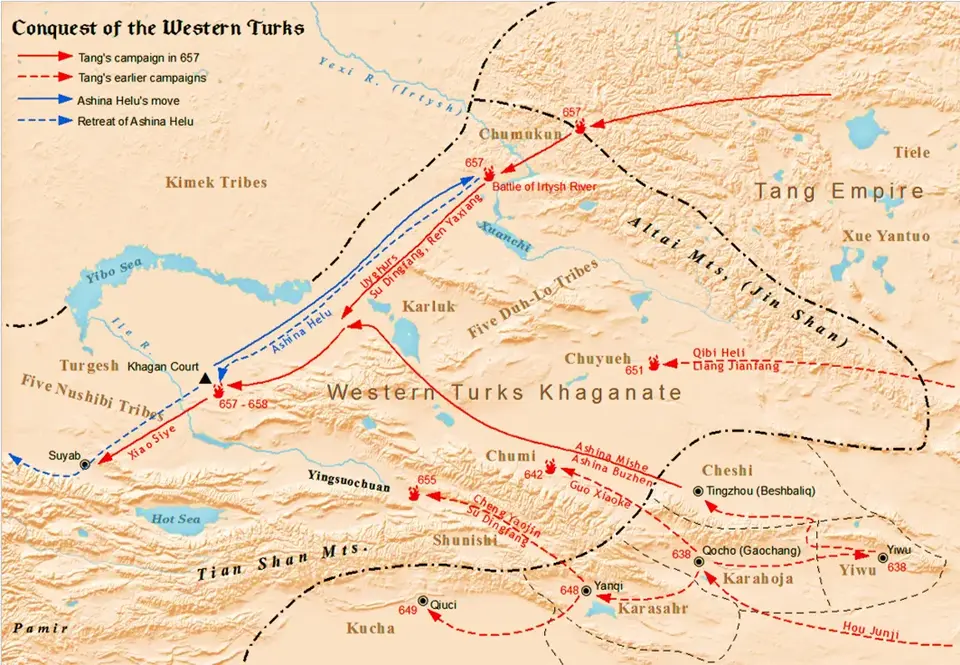
In the spring of 657, Emperor Gaozong appointed Su Dingfang as Commander-in-Chief of the Yili March, granting him supreme command to eliminate Ashina Helu. Maintaining impeccable discipline, Su won over local tribes; the Chumukun chieftain Landulu surrendered with ten thousand tents, and Su recruited one thousand allied cavalry as scouts.
In November 657, Su arrived near the Irtysh River amidst winter blizzards. Ashina Helu had assembled a massive coalition army of 100,000 steppe cavalry. Su commanded barely ten thousand Tang and Uyghur soldiers, outnumbered ten to one. Seeing Su's small force, Helu formed a crescent encirclement to envelop them.
Facing overwhelming odds, Su deployed his infantry on elevated ground, ordering them to form an interlocking square with outward-pointing spears and crossbows, while holding his elite cavalry in reserve on the northern plains. The Turkic cavalry charged three times with immense fury, but were broken by volley fire and dense spears. As the enemy charges lost momentum, Su unleashed his reserve cavalry into the enemy's flank. Coordinated with an infantry counter-charge, Tang troops routed the nomadic host across thirty li, killing tens of thousands and slaying two hundred chieftains.
The following day, five major confederations surrendered. Helu fled westward with several hundred horsemen into a blizzard that covered the plains with two feet of snow. When subordinates advised waiting until spring, Su roared: "The enemy believes the snow stops us! We must strike now while they think themselves safe!" Leading his cavalry through deep snowdrifts, Su marched hundreds of miles to attack Helu's final base at Jinye Mountain. Helu fled to Tashkent, where the local ruler surrendered him to Tang pursuers. Su brought Ashina Helu to Luoyang as a captive, extinguishing the Western Turkic Khaganate and establishing the Mengchi and Kunling Protectorates, expanding Tang borders to the Aral Sea and Persia. Emperor Gaozong celebrated a triumph at the ancestral temple, promoting Su to General of the Left Valiant Guard and Duke of Xing.
In 659, Duman, leader of the Sijie tribe, rebelled in the Pamir region alongside Shule and neighboring principalities, raiding Khotan with Tibetan support. Appointed Pacification Ambassador, Su selected 10,000 elite infantry and 3,000 cavalry, marching three hundred li in twenty-four hours to surprise the enemy at Matouchuan. Shocked by his arrival, Duman fled to Mabao fortress. Su encircled the city; devoid of relief, Duman surrendered.
When officials demanded Duman's execution in Luoyang, Su kowtowed before Emperor Gaozong, pleading: "I promised him imperial clemency on Your Majesty's behalf; pray spare his life to manifest the empire's good faith." Gaozong praised him, saying: "I shall preserve good faith for your sake," and pardoned Duman. The sixteen kingdoms west of the Pamirs submitted, and Tang established eighty prefectures across the region.
In March 660, responding to Baekje's incursions against Silla, Gaozong appointed Su Commander-in-Chief of the Xiongjin March, commanding an army and armada of 100,000 troops alongside King Muyeol of Silla. In August, over one thousand warships sailed from Chengshan Cape, landing at Baekgang (the Geum River estuary). Baekje forces lined the riverbanks, but Su directed marines onto the beaches, killing thousands and securing the beachhead. The armada sailed upriver in a dense formation covering leagues of water.
Advancing toward the Baekje capital of Sabi (modern Buyeo), Su met Baekje's mobilization twenty li outside the walls. Tang forces routed the defenders, killing over ten thousand and seizing the outer city. King Uija and Crown Prince Yung fled to Ungjin fortress, while Prince Buyeo Tae seized power in Sabi. Seeing defeat, royal grandson Buyeo Munsa escaped over the walls on ropes to surrender, causing the defense to collapse. Su raised Tang standards over Sabi and surrounded Ungjin, forcing King Uija and Crown Prince Yung to surrender. Su annexed thirty-seven commanderies and two hundred and fifty counties, creating five protectorates (Ungjin, Mahan, Dongmyeong, Geumryeon, Deokan). In November 660, Su presented King Uija and fifty-eight captives to Emperor Gaozong in Luoyang, prompting three days of empire-wide banqueting.
In January 661, Emperor Gaozong mobilized imperial divisions against Goguryeo, appointing Su Commander-in-Chief of the Pyongyang March. In August, Su forced a crossing of the Taedong River, routing Goguryeo forces at Mayeopsan and encamping outside the capital of Pyongyang. While Su maintained a close siege for months, northern columns under Qibi Heli crossed the frozen Yalu River on ice, killing 30,000 enemy troops. However, the sudden rebellion of the Nine Tiele Tribes forced the court to recall northern armies. With severe winter snows cutting supply lines and preventing Silla relief, Su executed a disciplined withdrawal, his military reputation deterring enemy pursuit.
In 663, the Tibetan Empire conquered Tuyuhun, directly threatening the Hexi Corridor. At age seventy-two, Su was appointed Pacification Ambassador of Liangzhou and Commander-in-Chief of the Anji Pingqiu March, commanding garrisons at Liangzhou and Shanzhou. Su reorganized defenses, repaired border towers, and pacified Tuyuhun refugees. His defensive deployments repelled Tibetan incursions and preserved the Silk Road.
In 667, Su Dingfang passed away in his command tent on the northwestern frontier at the age of seventy-six. Emperor Gaozong grieved his loss, rebuking ministers for delayed reporting and granting posthumous honors as General of the Left Valiant Guard and Area Commander of Youzhou, conferring the posthumous name Zhuang. In 782, Emperor Dezong included him among the sixty-four supreme historical commanders honored in the Martial Temple. In 848, Emperor Xuanzong commissioned his portrait in the Lingyan Pavilion.
During the late Sui rebellions, Su Dingfang assumed command of his local militia at age fifteen. He personally decapitated rebel chief Zhang Jincheng and routed Yang Gongqing over twenty li, preserving Wuyi County and gaining renown across Shandong and Hebei.
Serving as Li Jing's vanguard in 630, Su led two hundred cavalry through dense fog to charge Illig Qaghan's imperial yurt at Iron Mountain. Slaying hundreds and paralyzing the command structure, he enabled the total destruction of the Eastern Turkic host and the capture of Illig Qaghan.
During the 656 western campaign, Su led five hundred horsemen over a mountain ridge to shatter twenty thousand Western Turkic cavalry at Ying Suo Chuan. He resisted Wang Wendu's corrupt scheme to slaughter surrendered nomads, exemplifying military virtue.
In 657, as Commander-in-Chief of the Yili March, Su faced Ashina Helu's 100,000 cavalry with 10,000 troops. Using infantry squares to break three massive charges, he launched a flank counter-attack that routed the enemy, killing tens of thousands across thirty li.
Following the Irtysh River victory, Su pressed his troops through two feet of snow to raid Helu's imperial yurt at Jinye Mountain. Pursuing him to Tashkent, he captured Helu alive, extinguishing the Western Turkic Khaganate and pushing Tang borders to Persia.
In 659, Su led 13,000 elite troops on a forced march of three hundred li in twenty-four hours, trapping Duman at Matouchuan. He persuaded Emperor Gaozong to spare Duman's life, securing the submission of sixteen kingdoms west of the Pamirs and adding eighty prefectures.
In 660, commanding an armada of one hundred thousand troops, Su forced a landing at Baekgang, routed ten thousand defenders outside Sabi, and captured King Uija and Crown Prince Yung, extinguishing Baekje and creating five protectorates.
In 661, Su crossed the Taedong River, shattered Goguryeo forces at Mayeopsan, and besieged Pyongyang for months. Facing winter blizzards and recalled allies, he executed a masterly retreat that preserved the imperial army while exhausting Goguryeo's strength.
In his seventies, Su served as Pacification Ambassador of Liangzhou, building defenses along the Hexi Corridor that contained Tibetan assaults and safeguarded the Silk Road until his death in military camp.
Over a military career of seven decades, Su established the historical achievement of extinguishing three foreign realms (Eastern Turks, Western Turks, and Baekje) and capturing their sovereigns alive. Although distorted in Ming-Qing fiction, authentic historiography confirms him as one of the greatest conquerors in Chinese history.
Following his victories in Central Asia, Su instituted administrative protectorates across the Tian Shan and Pamirs, establishing the Mengchi and Kunling Protectorates. His administrative governance allowed Tang power to reach its territorial peak under Emperor Gaozong, extending influence to the Oxus and Jaxartes rivers.
Su's 660 maritime expedition against Baekje was a milestone in pre-modern amphibious warfare. Coordinating over one thousand ships from the Shandong Peninsula, he integrated naval bombardment, beach assaults, and riverine fleet logistics, creating an enduring operational model for joint land-sea warfare.
FIGURES ASSOCIATED WITH THIS DYNASTY