Birth in Yongfeng
Born into a poor family in Yongfeng County, Jiangxi; studied the classics while gathering firewood and working as a laborer
曾棨
Zeng Qi (曾棨, 1372–1432), courtesy name Ziqi, art name Xishu, a native of Yongfeng County in Ji'an Prefecture, Jiangxi, was a celebrated scholar-official, poet, and calligrapher of the early Ming dynasty. Renowned for his eidetic memory and rapid composition, he wrote a 20,000-character policy essay without a draft during the 1404 palace examination and was personally selected by the Yongle Emperor as the first-ranked graduate…
Zeng Qi (曾棨, 1372–1432), courtesy name Ziqi, art name Xishu, a native of Yongfeng County in Ji'an Prefecture, Jiangxi, was a celebrated scholar-official, poet, and calligrapher of the early Ming dynasty. Renowned for his eidetic memory and rapid composition, he wrote a 20,000-character policy essay without a draft during the 1404 palace examination and was personally selected by the Yongle Emperor as the first-ranked graduate (zhuangyuan), heading the famous class of twenty-eight Hanlin Bachelors in the Wenyuan Pavilion. Serving as Vice Editor-in-Chief of the monumental Yongle Encyclopedia and the Comprehensive Gazetteer of the Empire, he accompanied the Yongle Emperor on two northern tours, presided over provincial and metropolitan examinations, and co-compiled the Veritable Records of the Yongle and Hongxi reigns. Rising to Junior Supervisor of the Household of the Heir Apparent and Grand Secretary of the Right Secretariat of the Heir Apparent, he drafted many of the court's major edicts and state proclamations after the deaths of Xie Jin and Hu Guang. Famous also for his prodigious capacity for wine—earning the nickname "Wine Zhuangyuan"—he died in 1432 at the age of sixty-one and was posthumously promoted to Left Vice Minister of Rites with the posthumous name Xiangmin.
Born into a poor family in Yongfeng County, Jiangxi; studied the classics while gathering firewood and working as a laborer
Composed a 20,000-character essay without a draft in the palace examination, was named zhuangyuan by the Yongle Emperor, appointed Hanlin Compiler, and placed first among the twenty-eight Hanlin Bachelors
Appointed Vice Editor-in-Chief of the Yongle Encyclopedia, and promoted to Hanlin Expositor-in-Waiting upon its completion in 1408
Accompanied the Yongle Emperor to Beijing in 1409 and 1413, composing court poetry along the journey
Served as chief examiner for the Beijing provincial examination (1414) and the metropolitan examination (1418), rising to Hanlin Academician Reader-in-Waiting
Promoted by the Xuande Emperor to Grand Secretary of the Right Secretariat of the Heir Apparent and lecturer in the Wenhua Hall
Appointed Junior Supervisor of the Household of the Heir Apparent while continuing to serve in the Wenyuan Pavilion
Rewarded with gold-brocade robes and silver for compiling the Veritable Records of the Yongle and Hongxi Emperors
Died in Beijing in the first month at age sixty-one after calling for wine on his deathbed; posthumously appointed Left Vice Minister of Rites and canonized as Xiangmin
Zeng Qi was born in 1372 in Yongfeng County, Ji'an Prefecture, Jiangxi. Growing up in poverty, he supported himself by cutting firewood and working as a hired hand while studying the Confucian classics and histories. Endowed with an extraordinary memory and mastery of cursive calligraphy and poetry, he became known across Jiangxi as the "Talent of Jiangxi."
In the spring of 1404, the Yongle Emperor held the first metropolitan and palace examinations of his reign. Addressing the palace examination question on ritual and music institutions, Zeng Qi wrote a comprehensive policy response of more than 20,000 characters in vigorous calligraphy without pausing to make a draft. Delighted by the essay, the Yongle Emperor wrote an imperial comment on his paper—"Thoroughly versed in the classics and histories, with insight reaching Heaven and man; possessing both cultivated learning and loyal sincerity, he is elevated to first in the empire to manifest our civilization"—and ranked him first in the first class (zhuangyuan), appointing him Compiler in the Hanlin Academy.
Soon afterward, the Yongle Emperor selected twenty-eight outstanding new jinshi—corresponding to the twenty-eight lunar mansions—to enter the Wenyuan Pavilion as Hanlin Bachelors to study rare palace texts, with Zeng Qi ranked at their head. When the Emperor tested the twenty-eight scholars on the poem Song of the Heavenly Horse and Sea Falcon, Zeng Qi finished first with a brilliant composition, receiving an agate belt and an imperial steed. Whenever the Yongle Emperor encountered obscure allusions in ancient books, he summoned Zeng Qi to identify their sources, and Zeng answered every query effortlessly.
In 1407, when the Yongle Emperor expanded the compilation of the Yongle Encyclopedia (Yongle Dadian) under Chief Directors Yao Guangxiao and Xie Jin, he appointed Zeng Qi as Vice Editor-in-Chief to help coordinate more than two thousand scholars. Upon the completion of the 22,877-volume encyclopedia in the winter of 1408, Zeng Qi was promoted to Hanlin Expositor-in-Waiting.
Accompanying the Yongle Emperor on his northern tours to Beijing in 1409 and 1413, Zeng Qi composed numerous court poems upon imperial command. He served as chief examiner for the Beijing provincial examination in 1414, palace examination reader in 1415, and chief examiner for the metropolitan examination in 1418, after which he was promoted to Hanlin Academician Reader-in-Waiting and appointed Vice Editor-in-Chief of the Comprehensive Gazetteer of the Empire.
Elevated to Grand Secretary of the Right Secretariat of the Heir Apparent in 1426 and Junior Supervisor of the Household of the Heir Apparent in 1427, Zeng Qi lectured before the Xuande Emperor in the Wenhua Hall and continued to work in the Wenyuan Pavilion. Following the deaths of Xie Jin and Hu Guang, most major state proclamations, edicts, and ceremonial texts issued by the court were drafted by Zeng Qi alongside Yang Shiqi. In 1430, upon the completion of the Veritable Records of Emperor Taizong and Veritable Records of Emperor Renzong, he was rewarded with gold-brocade vestments and silver.
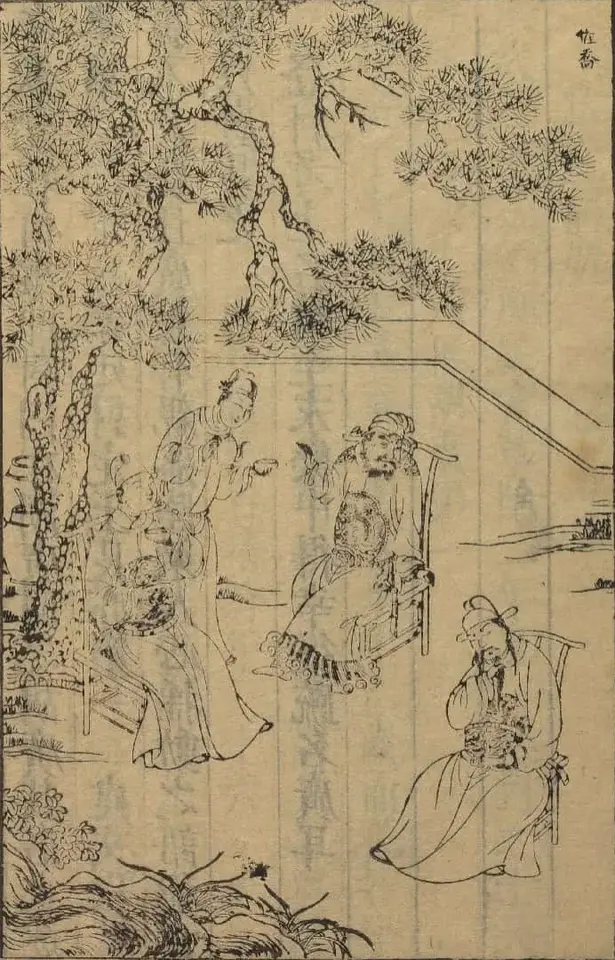
Tall, imposing, and unrestrained in spirit, Zeng Qi was famous for his astonishing capacity for wine, earning the moniker "Wine Zhuangyuan." When a foreign envoy boasted that no one at the Ming court could match him in drinking, the Yongle Emperor ordered Zeng Qi to host him; after several days of continuous drinking, the envoy collapsed in a stupor while Zeng Qi remained completely sober, prompting the Emperor to remark: "Even setting aside his scholarship, his capacity for wine alone qualifies him as Our dynasty's zhuangyuan!" On another occasion, Zhang Fu, Duke of Ying, secretly had a wooden barrel constructed to match the circumference of Zeng Qi's abdomen and poured an equal measure of wine into the barrel for every cup Zeng drank at a banquet; after the barrel overflowed into a second jar late at night, Zeng Qi rode home sober and drank Zhang Fu's escorting servants under the table. Falling fatally ill in the first month of 1432, Zeng Qi called for wine even on his deathbed and died at the age of sixty-one. The Xuande Emperor posthumously promoted him to Left Vice Minister of Rites and conferred the posthumous name Xiangmin. His poetry and prose were preserved in the ten-volume Xishu Ji and five-volume Chaojie Ji.
FIGURES ASSOCIATED WITH THIS DYNASTY