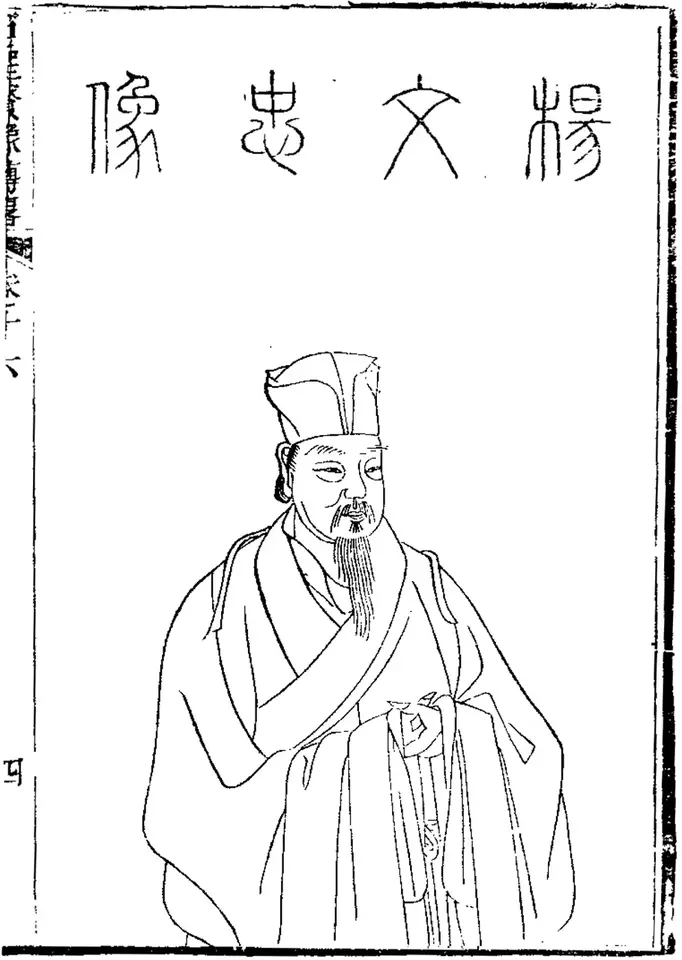
Life and Career
Youthful Prodigy and Hanlin Scholarship
Yang Tinghe was born on October 15, 1459 (19th day of the 9th month, 3rd year of Tianshun) in Xindu County, Chengdu Prefecture, Sichuan Province, into an established family of scholars and civil officials. His ancestral line originated in Luling, Ji'an Prefecture, Jiangxi Province, having migrated to Macheng, Hubei, during the late Yuan uprisings before settling in Sichuan. His father, Yang Chun, was a prominent scholar who served as Chief of the Messenger Office and Education Intendant of Huguang, instilling strict classical education within the household. Demonstrating extraordinary intellect, Yang Tinghe began classical studies at age four, reading classical histories with remarkable comprehension and retaining entire texts after a single reading.
In 1470 (6th year of Chenghua), the twelve-year-old Yang Tinghe sat for the Sichuan provincial examinations. The chief examiner was so impressed by the analytical depth, structural balance, and classical diction of his essays that he placed him among the highest successful candidates. The twelve-year-old youth became celebrated throughout the southwest as an unmatched prodigy. Huang Mingshan, an Assistant Director of the National University, recognized his immense future potential and betrothed his daughter to the young scholar.
In 1478 (14th year of Chenghua), at age nineteen, Yang Tinghe traveled to Beijing, passed the metropolitan examinations, and was awarded the jinshi degree, subsequently gaining appointment as a bachelor in the prestigious Hanlin Academy. He took temporary leave to travel to Yunnan to complete his marriage, where his father-in-law Huang Mingshan was serving as education intendant. When the powerful eunuch Qian Neng and Duke of Qianguo Mu Cong attempted to curry favor by offering gifts of silver and precious jade, the young scholar firmly refused them, establishing a lifelong reputation for incorruptibility.
Following his training, Yang Tinghe was appointed a Hanlin compiler. In the capital, he immersed himself in the imperial archives, studying dynastic statutes, legal jurisprudence, and frontier military defenses. In 1489 (2nd year of Hongzhi), he was promoted to Hanlin Senior Compiler, participating in the compilation of the Veritable Records of Emperor Xianzong and the monumental administrative compendium Collected Statutes of the Ming Dynasty. His meticulous editorial scholarship earned the admiration of Minister of Rites Qiu Jun and Grand Secretaries Li Dongyang and Wang Ao.
In 1489, the imperial court selected upright Hanlin scholars to tutor Crown Prince Zhu Houzhao. Renowned for his moral composure and erudition, Yang Tinghe was appointed Right Mentor in the Spring Supervisorate and lecturer in the Eastern Palace. For over a decade, Yang Tinghe delivered daily expositions on the Confucian Classics and historical models of sage governance, consistently admonishing the crown prince to practice self-restraint and avoid flattering sycophants. The Hongzhi Emperor Zhu Youzheng deeply valued Yang Tinghe's integrity, granting him special audiences and treating him as a vital pillar for the future reign.
Entering the Grand Secretariat and Opposing Liu Jin
In 1505 (18th year of Hongzhi), Emperor Xiaozong passed away, and the fifteen-year-old crown prince Zhu Houzhao ascended the throne as the Zhengde Emperor. Spirited, impulsive, and disdainful of court ritual, the young monarch fell under the sway of the "Eight Tigers", a faction of manipulative palace eunuchs led by Liu Jin, Ma Yongcheng, and Gu Dayong. Liu Jin catered to the emperor's passion for archery, riding, and exotic spectacles, gradually seizing the power of imperial red-ink approvals. Liu Jin instituted the Neixingchang secret police, purged upright scholar-officials, and imposed oppressive extractions throughout the empire.
In October 1507 (2nd year of Zhengde), Yang Tinghe was summoned from his post as Left Vice Minister of Personnel in Nanjing to Beijing and appointed Grand Secretary of the Wenyuan Hall, entering the Grand Secretariat. At that time, Senior Grand Secretary Li Dongyang was struggling alone against Liu Jin's despotism. Yang Tinghe joined forces with Li Dongyang, skillfully utilizing procedural regulations to shield loyal bureaucrats from execution or exile. When Liu Jin attempted to bypass the civilian ministries to issue arbitrary imperial edicts, Yang Tinghe stood firm, refusing to draft unlawful decrees and mitigating punitive taxation clauses.
In 1510 (5th year of Zhengde), Prince of Anhua Zhu Zhifan rebelled in Shaanxi. The court dispatched the eunuch Zhang Yong and Censor-in-Chief Yang Yiqing to suppress the uprising. Yang Tinghe astutely advised promoting the frontier general Chou Yue, successfully sowing discord among the rebel ranks and enabling Chou Yue to capture the prince. Meanwhile, Yang Yiqing persuaded Zhang Yong to turn against Liu Jin. Upon returning to the capital, Zhang Yong presented an indictment listing seventeen capital crimes committed by Liu Jin. The enraged emperor ordered Liu Jin's arrest and execution.
Following Liu Jin's downfall, Yang Tinghe took charge of drafting the comprehensive imperial pardon. His decree dismantled the Neixingchang, rescinded Liu Jin's punitive tax codes, exonerated hundreds of falsely accused ministers, and recalled banished officials to imperial service, swiftly restoring institutional order to the Ming government.
During his tenure drafting imperial decrees, Liu Jin had conspired with Minister of Personnel Zhang Cai and Grand Secretary Jiao Fang to bypass standard administrative channels and issue directives directly from the Directorate of Ceremonial. Yang Tinghe resisted these encroachments vigorously, shelving arbitrary appointment decrees and softening punitive measures. When Liu Jin's residences were searched, uncovering counterfeit imperial seals and hidden daggers, a massive backlog of factional dossiers threatened widespread purges. Yang Tinghe insisted on strictly confining legal proceedings to direct accomplices, preventing malicious score-settling and shielding hundreds of innocent officials from imperial retribution.
Senior Grand Secretary and Defending Civilian Rule
In December 1512 (7th year of Zhengde), upon Li Dongyang's retirement, Yang Tinghe succeeded him as Senior Grand Secretary, assuming the concurrent offices of Grand Secretary of the Huagai Hall and Minister of Personnel. The empire was engulfed in crises: the massive Liu Six and Liu Seven agrarian rebellions swept across northern China, threatening Beijing, while Zhao Sui rose in Henan. Yang Tinghe coordinated central military logistics, removed incompetent generals, and appointed capable commanders such as Lu Wan and Peng Ze to encircle and crush the insurgent armies.
Meanwhile, the Zhengde Emperor retreated into reckless behavior. In 1514 (9th year of Zhengde), after the Qianqing Palace was incinerated by an accidental fire, the emperor constructed the expansive "Leopard House" (Baofang) in the Western Park, immersing himself in entertainments and adopting the self-created title "Generalissimo Zhu Shou". He patronized frontier commanders Jiang Bin and Xu Tai, bringing frontier garrisons into the capital and threatening civilian bureaucratic authority. In response, Yang Tinghe urged the emperor to repent, open avenues for honest advice, and curtail commercial extractions by palace agencies.
In August 1517, the emperor secretly slipped out of Beijing to roam the northern frontier at Xuanfu. Alerted to his departure, Yang Tinghe and Grand Secretary Jiang Mian galloped on horseback to Juyong Pass to intercept him, only to find the pass gates locked on imperial orders. Undaunted, Yang Tinghe submitted successive memorials detailing the perils of frontier warfare and maintained administrative stability within the capital.
In June 1519, Prince of Ning Zhu Chenhao rebelled in Nanchang, Jiangxi. Prompted by secret reports from Censor Xiao Huai, Yang Tinghe had earlier drafted an imperial warning demanding that the prince submit to inspection, forcing the conspirators to strike prematurely. When the emperor insisted on leading a southern punitive expedition accompanied by Jiang Bin, Yang Tinghe led the ministers in kneeling outside the palace gates in protest. Though the monarch departed, Yang Tinghe directed central military finances, covertly supporting Southern Gan Governor Wang Shouren (Wang Yangming) in swiftly suppressing the rebellion before the imperial entourage arrived, thereby neutralizing Jiang Bin's plots to seize regional authority.
On the Lantern Festival of 1514, when the Qianqing Palace burned to ashes, the Zhengde Emperor stood at the Xihua Gate and joked that it was "a magnificent fireworks display." Mortified by the sovereign's levity, Yang Tinghe led the entire ministry to kneel outside the Wenhua Hall, imploring the monarch to retire to a side palace, issue an edict of self-reproach, and cancel palace textile procurement. Later, when the emperor conferred the title of Count of Pinglu on Jiang Bin and constructed a military headquarters in Xuanfu, Yang Tinghe presented repeated memorials condemning the degradation of imperial majesty and safeguarding the civilian institutional framework of the dynasty.
Decisive Succession and the Enthronement of Jiajing
In the autumn of 1520, the Zhengde Emperor fell into the river while boating at Qingjiangpu, contracting a fatal lung infection. In January 1521, the emperor collapsed while conducting the suburban sacrifices in Beijing. The thirty-one-year-old monarch had no sons, nor were there surviving male heirs in the Hongzhi line. Critically, Jiang Bin commanded the capital garrisons, stationed tens of thousands of frontier troops around Beijing, and kept constant vigil beside the emperor's deathbed, plotting to seize imperial power upon his demise.
Confronting this supreme dynastic emergency, Yang Tinghe acted with magnificent political daring. On March 13, 1521, as the emperor lay dying, Yang Tinghe conferred secretly with the Directorate of Ceremonial, consulting dynastic statutes. Citing the explicit provision of "succession of younger brother to elder brother" in the Ancestral Injunctions of the August Ming, he identified the sole legitimate heir: fourteen-year-old Zhu Houcong, the eldest son of Prince of Xing Zhu Youtuan (a younger brother of the Hongzhi Emperor).
On the morning of March 14, the Zhengde Emperor died in the Leopard House. Prepared in advance, Yang Tinghe drafted the imperial valedictory edict, announcing the mourning protocols and securing an edict from Empress Dowager Zhang to summon Zhu Houcong from Anlu to Beijing. To eliminate Jiang Bin, Yang Tinghe orchestrated a ruse: on March 15, he summoned Jiang Bin into the inner palace under the pretext of discussing border troop bonuses, where concealed guards arrested him. Jiang Bin was imprisoned in the imperial penitentiary and his weapons seized, extinguishing the threat of an armed coup without spilling blood in the streets.
Sweeping Reforms and the Thirty-Seven-Day Interregnum
During the thirty-seven days between Zhengde's death on March 14 and Jiajing's arrival on April 22, Yang Tinghe served as acting regent at the head of the Grand Secretariat. Seizing this window of executive authority, he launched the comprehensive "Jiajing New Administration" to dismantle years of accumulated misrule.
Yang Tinghe ordered Generals Wang Xian and Guo Xun to secure the palace and capital gates against disturbance, rewarded and dismissed foreign embassies, and closed the Leopard House, liberating its captive wild beasts. In the imperial valedictory and accession edicts, he abolished all "royal estates" (huangzhuang) established since the Chenghua era, returning tens of thousands of hectares of arable land to peasant cultivators.
Furthermore, he abolished all arbitrary palace-sponsored commissions (chuanfengguan), purging over 162,000 ghost-soldier salaries in the capital garrisons and Brocade Guard. He repatriated border regiments to their posts, dismissed thousands of fraudulent court monks and magicians, released confined palace maidens, and remitted millions of bushels of unpaid back taxes across the provinces.
In personnel, he appointed incorruptible ministers such as Qiao Yu, Sun Jiao, Lin Jun, Yang Yiqing, and Fei Hong to lead the civilian ministries, restored the reputations of Hongzhi elder statesmen Liu Jian and Xie Qian, and ennobled Wang Shouren as Earl of Xinjian. On the frontiers, he posted capable governors, including Li Chengxun in Shaanxi, Li Yue in Xuanda, and Chen Jiuchou in Gansu. Observers hailed the transformation, recording that "the realm praised the new era as a genuine restoration of sage governance."
During the interregnum, Yang Tinghe demonstrated exceptional economic stewardship. Facing soaring grain prices, he directed Minister of Revenue Sun Jiao to open imperial granaries and sell millions of bushels of grain at subsidized rates, breaking merchant cartels and feeding hundreds of thousands of impoverished residents. He abolished illicit eunuch toll barriers across the provinces, prohibited secret police patrols from extorting salt merchants, and released long-term political prisoners in Nanjing and Fengyang, allowing the civilian population to recover from decades of fiscal exploitation.
The Great Rites Controversy and Resignation
On April 22, 1521, Zhu Houcong arrived outside Beijing. A dispute immediately erupted when the Ministry of Rites arranged for him to enter through the Dong'an Gate as crown prince. The young monarch halted at the suburbs, insisting: "The edict summoned me to succeed to the imperial throne, not to be an imperial son!" Responding flexibly, Yang Tinghe persuaded the court to alter the protocol, welcoming Zhu Houcong through the central Daming Gate to assume the throne as the Jiajing Emperor.
Soon after his accession, the emperor insisted on bestowing the posthumous title of "Imperial Father Emperor Xingxian" on his biological father, triggering the bitter three-year Great Rites Controversy. Yang Tinghe, supported by Minister of Rites Mao Cheng and the Grand Secretariat, opposed the move. Drawing upon the classical precedents of Cheng Yi, Emperor Xuan of Han, and Emperor Guangwu of Han, Yang Tinghe argued that since the monarch succeeded to the dynastic line as an imperial nephew, ritual orthodoxy required him to designate Emperor Xiaozong as his ritual father, while addressing his biological father as "Imperial Uncle".
The headstrong young emperor refused to accept his uncle as his ritual father. New scholars such as Zhang Cong and Gui E submitted memorials aligning with the emperor's desires, splitting the bureaucracy. Viewing ritual orthodoxy as the indispensable foundation of moral and political order, Yang Tinghe submitted dozens of petitions and engaged in intense palace debates, refusing to bend the law to indulge imperial preferences.
The emperor attempted to sway Yang Tinghe with lavish honors, offering to promote him to Grand Preceptor and addressing him as "Teacher to the Emperor". Yang Tinghe declined each offer. Realizing that the monarch's resolve was unyielding, Yang Tinghe submitted his resignation in January 1524 (3rd year of Jiajing). The emperor accepted his departure, granting him imperial carriages and an escort to his home in Xindu. On the day of his departure, thousands of civilian officials and scholars lined the capital roads in tears to bid him farewell.
During the height of the controversy, the Jiajing Emperor sent a trusted eunuch bearing a handwritten decree to the Grand Secretariat, offering to grant a hereditary military commission to Yang Tinghe's son and elevate Yang Tinghe to Grand Preceptor if he endorsed the imperial title for Prince Xing. Yang Tinghe knelt, held the decree with both hands, and returned it to the eunuch, stating: "I am past sixty; I would rather retire to cultivate my native soil than subvert the eternal ancestral laws of the realm for private gain!" In 1523, when the emperor conferred on him the supreme rank of Grand Preceptor, Yang Tinghe submitted four consecutive memorials declining the honor, commanding the profound respect of the entire court.
Exile in Hometown and Posthumous Rehabilitation
Months after Yang Tinghe's retirement, the Great Rites dispute reached a violent climax. In July 1524, over two hundred officials knelt at the Zuoshun Gate to protest imperial policy; the enraged monarch ordered severe floggings that killed sixteen ministers. Yang Tinghe's eldest son, the renowned scholar Yang Shen, survived two brutal floggings and was exiled permanently to Yunnan.
In 1528 (7th year of Jiajing), the emperor promulgated the Minglun Dadian, systematically purging opponents of the Great Rites. Prompted by Zhang Cong, the emperor issued an edict accusing Yang Tinghe of factional arrogance, stripping him of all official ranks and reducing him to commoner status.
Confronting political persecution, Yang Tinghe remained serene at his residence in Xindu, spending his final years in literary pursuits without uttering words of bitterness. On July 25, 1529, he passed away peacefully at age seventy-one. In 1567 (1st year of Longqing), Emperor Muzong rehabilitated the victims of the Great Rites, restoring Yang Tinghe's official titles, awarding nine sacrificial rituals, conferring the rank of Grand Guardian, and bestowing the posthumous title Wenzhong (later adjusted to Wenxian).
Major Achievements
Child Prodigy and Scholarly Foundation
Yang Tinghe demonstrated remarkable intellectual brilliance early in life, passing the Sichuan provincial examinations at the unprecedented age of twelve and securing the jinshi degree at nineteen. His early achievements did not lead to complacency; instead, he spent over a decade in the Hanlin Academy studying imperial jurisprudence, economic taxation, and frontier geography, contributing to the compilation of the Veritable Records of Emperor Xianzong and the Collected Statutes of the Ming Dynasty. This profound legal and administrative training provided the structural foundation for his later ministerial leadership.
Instructing the Crown Prince in the Eastern Palace
Serving as tutor in the Eastern Palace for over a decade under Emperor Xiaozong, Yang Tinghe provided classical instruction to Crown Prince Zhu Houzhao. He emphasized moral restraint, public virtue, and classical statecraft, earning the profound respect of both the sovereign and his pupil. Despite the Zhengde Emperor's later eccentricities, he retained an instinctive reverence for his former tutor, which enabled Yang Tinghe to restrain executive excesses during turbulent years.
Countering Liu Jin and Restoring Dynastic Justice
Entering the Grand Secretariat in 1507 amidst the apex of eunuch tyranny under Liu Jin, Yang Tinghe collaborated with Li Dongyang to resist despotic initiatives and protect innocent bureaucrats. In 1510, he facilitated the suppression of Prince of Anhua's rebellion, aiding the downfall of Liu Jin. Following the eunuch's execution, Yang Tinghe drafted the sweeping imperial amnesty that dismantled the Neixingchang secret police, rescinded extortionate levies, and rehabilitated hundreds of unjustly persecuted officials, restoring integrity to the central government.
Steadfast Leadership as Senior Grand Secretary
Assuming the leadership of the Grand Secretariat in 1512, Yang Tinghe confronted concurrent internal crises, including the devastating Liu Six and Liu Seven agrarian rebellions and the burning of the Qianqing Palace. He deployed competent military commanders to restore domestic peace while establishing firm procedural barriers against the emperor's erratic directives from the Leopard House. By systematically blocking unconstitutional decrees (chuanfengguan), he safeguarded civilian administrative authority against imperial overreach.
Curbing Military Favorites and Preventing Sedition
During the mid-Zhengde period, favorite general Jiang Bin sought to station tens of thousands of northern frontier troops in Beijing, creating a dangerous precedent of military interference in dynastic politics. Yang Tinghe utilized bureaucratic controls over troop allocations, supplies, and promotions to contain Jiang Bin's influence. He confronted the emperor at Juyong Pass and supervised logistics during the Ning rebellion. Following the emperor's death, Yang Tinghe lured Jiang Bin into the palace and arrested him, neutralizing the threat of a military coup.
Securing the Succession of Emperor Shizong
In March 1521, when the Zhengde Emperor died childless, the Ming dynasty faced its most perilous succession crisis since the Tumu Crisis. Acting with absolute composure, Yang Tinghe cited the "succession of younger brother to elder brother" clause from the Ancestral Injunctions of the August Ming, secured the consent of Empress Dowager Zhang, and summoned Zhu Houcong from Anlu to succeed as the Jiajing Emperor. His deployment of loyal commanders to secure the capital gates ensured an orderly transition, averting widespread domestic bloodshed.
Implementing the Thirty-Seven-Day New Administration
During the thirty-seven-day interregnum before the Jiajing Emperor arrived in Beijing, Yang Tinghe exercised executive authority to implement the "Jiajing New Administration". Through the imperial valedictory and accession decrees, he executed treasonous favorites, abolished 162,000 redundant military salaries, repatriated border forces, expelled fraudulent magicians, and recalled veteran statesmen such as Liu Jian, Xie Qian, and Wang Shouren, producing an era celebrated as the "Imperial Renewal of Governance".
Abolishing Royal Estates and Relieving Civilian Burdens
Recognizing that royal estates (huangzhuang) had dispossessed countless peasant households across the metropolitan region, Yang Tinghe ordered their complete abolition, returning over ten thousand hectares of arable land to private farmers. Furthermore, he remitted millions of bushels of accumulated back taxes and authorized subsidized grain sales from state granaries to combat inflation. These fiscal reforms eased intense class friction and stimulated agricultural recovery throughout central China.
Defending Ritual Orthodoxy in the Great Rites Controversy
During the protracted Great Rites Controversy, Yang Tinghe defended Confucian ritual propriety and ancestral succession laws against the young emperor's efforts to elevate his biological lineage. Grounding his arguments in the classical jurisprudence of Cheng Yi and Han dynasty precedents, he maintained that imperial succession required adherence to the principal line. Despite intense sovereign pressure and promises of supreme honors, Yang Tinghe refused to compromise dynastic law for personal favor.
Moral Fortitude and Historical Vindications
Retiring to Sichuan in 1524, Yang Tinghe endured the banishment of his son Yang Shen and his own political disenfranchisement with serene dignity, avoiding recrimination and living modestly until his death. Under Emperor Muzong, his career was fully rehabilitated, and he received the rank of Grand Guardian and the posthumous title Wenzhong. Historians regard him alongside Shang Lu and Xu Jie as one of the most capable and principled prime ministers in Ming history.