Biography
Family Allegiance and the Huaixi Band
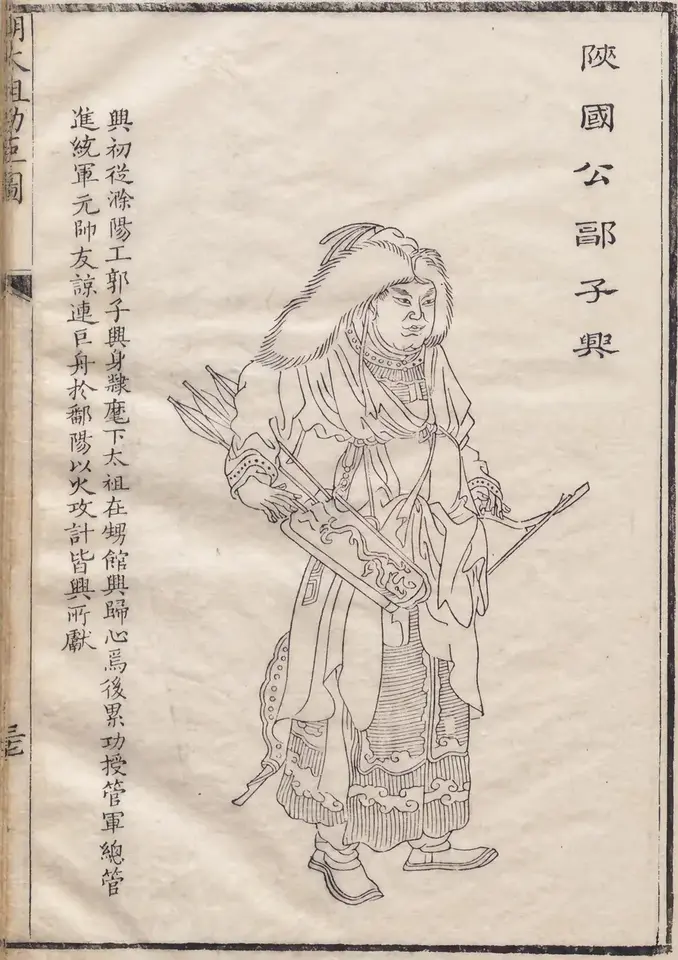
Guo Xing was born in 1331 in Haozhou (modern Fengyang County, Anhui Province). Originally named Guo Zixing, later historical records referred to him exclusively as Guo Xing to avoid conflation with the Red Turban chieftain Guo Zixing, Prince of Chuyang. Possessing robust physical power, natural agility, and expertise in archery and sword combat, he was celebrated in his youth for formidable martial prowess.
In 1353, the Red Turban Uprising destabilized the Huai River basin, and Haozhou emerged as a center of regional warfare. Guo's father, Guo Shanfu, was an accomplished physiognomist of high regional standing. When Zhu Yuanzhang entered Guo Zixing's army and married his foster daughter (the future Empress Ma), Guo Shanfu encountered Zhu and was awestruck by his countenance, remarking privately to his family: "This man's demeanor is noble beyond description; he is destined to become the sovereign of all under Heaven!" Without hesitation, Guo Shanfu betrothed his daughter (the future Noble Consort Guo) to Zhu Yuanzhang as a secondary consort and ordered his sons Guo Xing and Guo Ying to devote their lives to Zhu's service.
In 1354, seeking to establish an independent strategic base, Zhu Yuanzhang departed Haozhou to march south toward Dingyuan. He selected twenty-four of his most trusted and valiant officers—historically remembered as the "Twenty-Four Generals of Huaixi"—among whom Guo Xing and his brother Guo Ying were prominent leaders. Guo Xing fought in the vanguard, participating in the capture of Chuzhou and Hezhou, becoming one of Zhu's primary field commanders.
Campaigning South of the Yangtze and the Ordeal of Changzhou
In June 1355, Zhu Yuanzhang launched his strategic crossing of the Yangtze River. Guo Xing commanded frontline shock detachments, storming ashore at Caishi and capturing Taiping. Moving rapidly through southern Jiangsu, he participated in the reduction of Lishui and Liyang, repeatedly breaching Mongol defensive lines, for which Zhu Yuanzhang appointed him General Manager of Troops and shortly thereafter promoted him to Unified Military Marshal.
In 1356, Guo accompanied the main force in capturing the strategic southern metropolis of Jiqing (Nanjing). To the east, the wealthy warlord Zhang Shicheng controlled the fertile plains of southern Jiangsu, with Changzhou serving as his primary western bulwark. In 1357, Zhu Yuanzhang dispatched Xu Da to lay siege to Changzhou, assigning Guo Xing to direct the central assault columns. Zhang Shicheng dispatched veteran relief forces who engaged in brutal sorties against the besieging army.
Confronted with relentless counter-attacks and terrible weather, Guo demonstrated iron fortitude. For seven consecutive months, he remained on the frontline ramparts, wearing his heavy iron armor day and night without ever removing it, sleeping with his weapons at hand. Inspired by his endurance, the troops fought with unyielding determination, eventually breaking through Changzhou's outer fortifications and storming the citadel. Following this success, Guo campaigned across Ningguo, Jiangyin, and Yixing, while securing major victories in the pacification of Wuzhou, Anqing, and Quzhou.
The Decisive Turning Point: Fireship Attack at Lake Poyang
In the summer of 1363, the titanic confrontation between Zhu Yuanzhang and Chen Youliang erupted on the waters of Lake Poyang. Chen mobilized his entire armed forces, allegedly numbering 600,000 men, deploying a fleet of monumental multi-decked warships known as "tower ships" (louchuan). Clad in heavy iron sheeting and towering high above the water, Chen's armada was chained together into a vast floating fortress spanning several li.
During the initial phase of the engagement, Zhu's fleet, composed of smaller and lighter vessels, suffered catastrophic damage from Chen's superior artillery and boarding rams. Several Ming commanders were killed, and Zhu's own flagship was surrounded and heavily damaged. Demoralization swept through the ranks, and some officers even advocated retreating to defend the capital.
At this existential juncture, Guo Xing climbed the rigging to survey the enemy's deployment and environmental conditions. Noting that Chen's vessels were bound tightly together with iron chains and that a strong northeast gale was brewing, Guo recognized an opportunity mirroring the ancient Battle of Red Cliffs. Rushing to Zhu Yuanzhang's cabin, Guo submitted a decisive tactical proposal: "The enemy ships are vast and linked as one; this formation grants them immense defensive mass, yet deprives them of maneuverability and leaves them utterly vulnerable to fire. This afternoon a violent northeast wind will rise across the lake. If we load light skiffs with reeds, sulfur, and gunpowder, and drive them into the enemy's flanks under the wind, their chained fleet will be engulfed in flames and incapable of escape!"
Zhu Yuanzhang immediately recognized the brilliance of the strategy and prepared seven fireships manned by suicide squads. On the afternoon of August 13, 1363, as the northeast gale roared across the waters, the seven fire-vessels were launched at full sail into Chen's chained fleet. The fireships ignited upon impact, releasing towering sheets of flame that swept across Chen's warships. Trapped by their iron chains, the Han vessels burned uncontrollably, resulting in tens of thousands of enemy casualties and the total collapse of Chen's armada. Guo Xing's fireship strategy altered the balance of power in late Yuan China, securing Zhu Yuanzhang's triumph and paving the way for the founding of the Ming dynasty.
Northern Expedition and Defense of the Northwest
Following the victory at Lake Poyang, Guo accompanied Xu Da in the final campaign against Zhang Shicheng, storming Pingjiang (Suzhou) in 1367. For his distinguished service, he was elevated to General of Pacifying the Nation and Assistant Commissioner of the Chief Military Commission.
In 1368, the Ming dynasty was officially established. Zhu Yuanzhang dispatched Xu Da and Chang Yuchun on the grand Northern Expedition to liberate the Central Plains. Guo joined the expeditionary force, capturing Bianliang (Kaifeng) and subsequently taking charge of defensive garrisons across Henan. When Deputy General Feng Sheng secured Shaanxi, Guo was transferred to hold the strategic defile of Tongguan, repelling multiple assaults launched by Northern Yuan commander Wang Baobao (Köke Temür).
Subsequently, Guo was reassigned to garrison Gongchang in Gansu, stabilizing the devastated borderlands, pacifying displaced populations, and constructing border fortifications. In 1370, Emperor Taizu appointed him Military Tutor to the Prince of Qin (Zhu Shuang) and concurrent Assistant Commissioner of the Shaanxi Branch Chief Military Commission. In the winter of 1370, during the grand distribution of noble titles, Guo was enfeoffed as the Marquis of Gongchang (Gongchang Hou) with an annual stipend of 1,500 shi of grain and granted a hereditary iron certificate.
Western Conquest of Sichuan and Northern Defense
In 1371, Emperor Taizu launched a campaign to extinguish the regional Xia regime in Sichuan, dispatching Right Chancellor Tang He and Deputy General Liao Yongzhong. Guo Xing was recalled to command the northern land route through the rugged Golden Ox Pass, advancing with great speed to capture Hanzhou (modern Guanghan) and laying siege to the Xia capital of Chengdu, which compelled the young monarch Ming Sheng to surrender.
In 1373, as Northern Yuan raiding parties threatened the northern borders, Guo accompanied Xu Da to garrison Beiping. Operating in tandem with General Chen De, Guo ambushed Mongol cavalry forces at Dalahaikou, capturing thousands of pack horses and securing Beiping's northern perimeter. In 1378, he oversaw troop drills at Linqing in Shandong, and in 1383, at the age of fifty-three, he carried out extensive inspection tours of the northern border fortifications.
In the winter of 1384, exhausted by decades of relentless campaigning across the empire, Guo Xing fell gravely ill in Nanjing. He passed away on December 22, 1384, at the age of fifty-four. Emperor Taizu mourned his passing deeply, suspending court audiences and posthumously honoring him as the Duke of Shan (Shan Guo Gong) with the posthumous name Xuanwu. He was interred with full state honors on the western slopes of Mount Jubao outside Nanjing.
Major Achievements
Vanguard Pillar of the Huaixi Twenty-Four
Guo Xing stood as one of the fundamental founding pillars of the Ming military establishment. Joining Zhu Yuanzhang in 1353, he formed part of the elite twenty-four commanders who broke away from the fractious Red Turban leadership to carve out an autonomous dynastic realm.
His decades of service—from early infantry skirmishes around Chuzhou to amphibious operations along the Yangtze—established the foundational military cohesion that enabled Zhu Yuanzhang to rise from a regional commander to the founder of an empire.
The Decisive Fireship Strategy at Lake Poyang
The strategic counsel submitted by Guo Xing during the Battle of Lake Poyang in 1363 represents one of the most consequential tactical interventions in Chinese military history. Confronted by Chen Youliang's seemingly invincible floating fortress of ironclad tower ships, Guo recognized that the enemy's locked mass constituted an insurmountable vulnerability to fire.
His proposal to unleash seven fireships under the northeast gale transformed an impending defeat into an annihilating triumph, burning Chen's fleet, killing the rival warlord, and securing Zhu Yuanzhang's undisputed mastery over southern China.
Indomitable Fortitude at Changzhou
Guo was celebrated throughout the army for extraordinary discipline and resilience under extreme combat conditions. During the seven-month siege of Changzhou in 1357, he refused to remove his heavy iron armor day or night, remaining on the frontline parapets in full combat readiness.
His endurance galvanized his troops to overcome fierce resistance and storm the fortress, creating a military standard of perseverance that characterized Ming shock forces throughout the founding wars.
Consolidation of the Northwestern Frontiers
Following the Northern Expedition, Guo played an indispensable role in securing the nascent empire's western and northern frontiers. By defending Tongguan, garrisoning Gongchang, and leading the northern strike column into Sichuan to conquer the Xia regime, Guo stabilized the vast frontier region stretching from the Central Plains to the Tibetan borderlands.
His joint victory at Dalahaikou in 1373 neutralized Northern Yuan counter-offensives, protecting Beiping during its critical early consolidation.
Historical Evaluation
Guo Xing was revered by contemporary statesmen and later dynastic historians as a brave, loyal, and profoundly strategic commander.
Ming Grand Secretary Liu Sanwu recorded in the official commemorative epigraph: "Whenever Heaven raises a sovereign of momentous destiny, it must give birth to formidable and valiant generals to assist in the completion of the dynastic enterprise. When the Yuan dynasty collapsed, heroes arose across the realm. At that moment, our Emperor arose in Fengyang, gathering peerless commanders to unite their counsel and strength. Marquis Guo Xing of Gongchang possessed unmatched personal courage, submitted brilliant stratagems at Lake Poyang, and established dynastic stability across the Jiang-Han basins, his merits enduring alongside the state."
The official editorial commentary in the History of Ming (Ming Shi) concluded: "In the chaotic dawn of the dynasty, these commanders discerned the mandate of Heaven and entrusted their lives to an enlightened ruler, winning victories, taking strongholds, and achieving extraordinary merits through their wisdom and valor. The brothers Guo Xing and Guo Ying, bound by ties of imperial affinity, distinguished themselves in the ranks across hundreds of battles. Guo Xing was brave yet calculating; his fireship counsel at Lake Poyang secured total victory, while his governance of the Guan-Shaan frontier brought peace to border populations—he was truly a magnificent general of his age."
Modern military historians emphasize that Guo Xing's significance transcends conventional field bravery; his ability to formulate the fireship maneuver amidst the panic of Lake Poyang proved his status as a strategic thinker whose quick adaptation fundamentally altered the course of Chinese history.