Birth in Gui County
Born into a prosperous Hakka agricultural family in Beishanli, Gui County, practicing martial arts and literature.
石达开
Shi Dakai (石达开, 1831–1863), childhood name Yada and nicknamed Shi Gandang, was a native of Gui County (modern Gangbei District, Guigang, Guangxi) of Hakka heritage originating from Heping, Guangdong. From youth, Shi Dakai mastered classical military strategy and martial arts while demonstrating remarkable generosity and upright leadership among local villagers and mining communities. In 1847, he answered the call of Hong…
Shi Dakai (石达开, 1831–1863), childhood name Yada and nicknamed Shi Gandang, was a native of Gui County (modern Gangbei District, Guigang, Guangxi) of Hakka heritage originating from Heping, Guangdong. From youth, Shi Dakai mastered classical military strategy and martial arts while demonstrating remarkable generosity and upright leadership among local villagers and mining communities. In 1847, he answered the call of Hong Xiuquan and Feng Yunshan to join the God Worshipping Society, dedicating his family's wealth to the revolutionary cause. Following the Jintian Uprising in 1851, he was designated Commander of the Left Army. Later that year during the Yong'an organizational investiture, he was titled the Wing King Five Thousand Years at the remarkable age of twenty, standing as the youngest member of the supreme leadership council. Renowned for his strategic acumen and administrative capability, Shi Dakai achieved historic military victories. In 1852, he secured the Shuiluzhou victory outside besieged Changsha, breaking the Qing counter-encirclement and driving forward eighteen hundred li in twenty-eight days to capture Wuchang and advance on Nanjing. In 1853, he commanded the Western Expedition from Anqing, establishing the celebrated Anqing Administrative Reform and instituting orderly local governance. At the Battle of Hukou and Jiujiang in 1855, he crushed the Xiang Army naval fleet and forced Zeng Guofan to attempt suicide, conquering over fifty counties across Jiangxi. After lifting the siege of Tianjing by routing the Jiangnan Camp in 1856, he returned to the capital following the bloody Tianjing Incident to direct governmental affairs with fairness and broad benevolence. Fearing escalating paranoia from Hong Xiuquan and the Hong brothers, Shi Dakai withdrew from Tianjing in 1857, leading an independent expedition across southern and southwestern provinces. Trapped by unseasonal floods along the Dadu River in Sichuan in May 1863, Shi Dakai surrendered himself to Qing camps to preserve the lives of his troops. On June 27, 1863, he met slow execution by dismemberment with unflinching dignity at Chengdu at age thirty-two, remembered as one of modern China's greatest heroic figures.
Born into a prosperous Hakka agricultural family in Beishanli, Gui County, practicing martial arts and literature.
Visited by Hong Xiuquan and Feng Yunshan, dedicating his family assets to organize local converts.
Led four thousand Gui County volunteers to Jintian, establishing standard-worshipping platforms to enlist commoners.
Inaugurated the Taiping Heavenly Kingdom; appointed Left Army Commander and created Wing King at Yong'an.
Relieved the Changsha siege via amphibious operations, leading the march that captured Wuchang and advanced downriver.
Commanded western regional operations, captured Luzhou, and instituted three-tier local administrative systems and practical taxation.
Divided and destroyed Zeng Guofan's naval fleet at Hukou, overrunning eight prefectures and fifty counties in Jiangxi.
Destroyed the Jiangnan Camp; lost family during the Tianjing Incident; returned to stabilize the state as chief director of government.
Departed Tianjing to avoid palace intrigues, conducting diversionary campaigns across Jiangxi, Zhejiang, and Fujian.
Invaded Hunan to divert the Xiang Army from Anqing; retreated to Guangxi following a protracted siege.
Penetrated Sichuan across Guizhou and Yunnan, crossing the Jinsha River to threaten Chengdu.
Trapped by torrential floods at the Dadu River; negotiated surrender to spare his army; executed by slicing on June 27.
Shi Dakai was born in March 1831 in Beishanli, Gui County, Xunzhou Prefecture, Guangxi, into an affluent Hakka agricultural family. His ancestors had migrated from Heping County in Guangdong several generations earlier. Having lost his father at an early age, Shi Dakai managed the extensive household estate with maturity and exceptional fairness, gaining widespread respect throughout his native community. Alongside his classical studies in statecraft and military strategy, he trained intensively in martial arts, mastering footwork and hand-to-hand combat. In local society, Shi Dakai frequently mediated clan disputes, protected vulnerable peasants, and established cordial ties with secret society leaders like Luo Dagang and local miners across the Pingtian Mountain area, establishing an extensive base of popular support.
In autumn 1844, Feng Yunshan arrived in the Thistle Mountain region of Guiping to propagate the God Worshipping Society. When Hong Xiuquan returned to Guangxi in 1847, staying at nearby Cigu Village, both leaders heard of Shi Dakai's outstanding repute and visited his home. Though only sixteen years old, Shi Dakai was profoundly inspired by their egalitarian vision and anti-Qing revolutionary objectives. He immediately embraced the faith, donated his resources, and emerged as the primary organizer in Gui County. During Feng Yunshan's subsequent imprisonment, Shi Dakai actively organized legal defense and financial bail, attracting the scrutiny of local imperial magistrates and deepening hostilities between converts and local gentry militia.
In the summer of 1850, Hong Xiuquan ordered all followers to gather at Jintian for military mobilization. Shi Dakai established ceremonial review platforms at Nabang Village to mobilize the populace, calling on followers to overthrow bureaucratic tyranny. Liquidating his family lands and assets into the common treasury, Shi Dakai personally led over four thousand volunteers to the Jintian assembly.
On January 11, 1851, celebrating Hong Xiuquan's thirty-eighth birthday, the collective leadership initiated the Jintian Uprising and proclaimed the Taiping Heavenly Kingdom. In March 1851, upon Hong Xiuquan's formal enthronement at Dongxiang, Shi Dakai was appointed Left Army Commander at age nineteen. Serving as vanguard alongside Xiao Chaogui, Shi Dakai directed tactical maneuvers through mountainous passes, breaking imperial blockades and capturing the city of Yong'an in September. In November 1851, Hong Xiuquan instituted aristocratic honors at Yong'an, officially conferring upon Shi Dakai the title Wing King Five Thousand Years, symbolizing his role as an indispensable pillar of the revolutionary state.
In April 1852, the Taiping army broke out from Yong'an to advance northward through Guilin and Quanzhou into Hunan. In September, Western King Xiao Chaogui was mortally wounded during the siege of Changsha, leaving the main Taiping forces surrounded and starved of provisions before the provincial capital. In this desperate crisis, twenty-one-year-old Shi Dakai ferried his troops across the Xiang River to secure agricultural stockpiles on the western bank, entirely resolving the famine. Furthermore, he ambushed senior Qing commanders Xiang Rong and Zhang Guoliang at Shuiluzhou in mid-river, scoring a crushing victory that shattered the imperial perimeter and permitted the safe withdrawal of the entire Taiping army.
Following the Changsha breakthrough, Shi Dakai served as vanguard and rear guard, driving swiftly northward to capture Yuezhou, Hanyang, and Wuchang. Setting sail down the Yangtze River from Wuchang toward Nanjing, the Taiping armada covered eighteen hundred li in just twenty-eight days under Shi Dakai's relentless offensive, scattering imperial garrisons along the river. Qing officials and imperial forces trembled at his name, universally hailing him as "Shi Gandang."
In March 1853, the Taiping army stormed Jiangning, which Hong Xiuquan established as the capital, renamed Tianjing. Shi Dakai remained at court assisting Eastern King Yang Xiuqing in formulating civil institutions. While several princes engaged in extravagant palace construction and acquired personal retinues, Shi Dakai conducted himself with ascetic discipline, remaining uncorrupted and gaining tremendous respect from both military rank-and-file and civilian residents.
In autumn 1853, confronted by mounting Qing pressure along the Upper Yangtze, Shi Dakai was appointed to command western operations from Anqing. Observing that earlier Taiping campaigns had concentrated on fluid movement and city assaults while ignoring regional base-building, Shi Dakai transformed the military doctrine into a systematic, consolidative strategy. He directed the capture of Luzhou (modern Hefei), the provisional capital of Anhui, driving celebrated Qing general Jiang Zhongyuan to suicide.
During his tenure in Anhui, Shi Dakai pioneered the famous Anqing Administrative Reform. He conducted household registers, instituted the selection of local gentry and community elders as township magistrates, and organized a comprehensive administrative structure spanning provincial, prefectural, and county tiers. To integrate the scholar-gentry class, Shi Dakai instituted official civil service examinations at Anqing, attracting talented literati into Taiping governance. Economically, he replaced rigid communal egalitarianism with a practical system of standard land taxation approved by the Heavenly King, safeguarded commercial traffic, restored urban marketplaces, and maintained immaculate military discipline. These measures restored agricultural productivity and generated abundant tax revenue for the defense of Tianjing. The leadership subsequently endorsed Shi Dakai's administrative models across all controlled territories.
In autumn 1854, Zeng Guofan led tens of thousands of elite Xiang Army water and land forces eastward, recapturing Wuchang and threatening Jiujiang and Hukou. Faced with this grave crisis, Shi Dakai returned to the front to command all western forces. Recognizing that the Xiang Army held naval superiority, Shi Dakai built long-hulled warships and rigorously trained amphibious forces. Concurrently, he constructed a massive floating boom across the mouth of Poyang Lake. In early 1855, Shi Dakai lured light imperial gunboats into the inner lake, severed the floating barrier, and destroyed the trapped vessels with fire rafts. He then launched an assault against the main fleet in the Yangtze, capturing Zeng Guofan's flagship, official documents, and seals. Zeng Guofan leaped into the river in despair, narrowly rescued by aides, and fled toward Nanchang.
Following this triumph, Shi Dakai recaptured Wuchang in March 1855 and swept into Jiangxi. Over four months, his army liberated eight prefectures and more than fifty counties, trapping Zeng Guofan in besieged Nanchang. Due to Shi Dakai's strict prohibitions against looting and his respectful treatment of civil society, regional literati and peasants joined his ranks in droves, expanding his force from ten thousand to over one hundred thousand combatants. In March 1856, he defeated Xiang Army forces under Zhou Fengshan at Zhangshu. However, as total victory seemed imminent, he was summoned to Tianjing to break the imperial siege. In June 1856, Shi Dakai coordinated with Qin Rigang to crush the Jiangnan Camp, completely destroying the Qing cordon around Tianjing.
Following the destruction of the Jiangnan Camp, internal rivalries erupted within the Taiping leadership. Eastern King Yang Xiuqing became increasingly authoritarian, demanding that Hong Xiuquan bestow upon him the imperial title of Wan Sui. Hong Xiuquan secretly summoned Northern King Wei Changhui, Wing King Shi Dakai, and Yan King Qin Rigang to return and curb Yang's ambitions. In September 1856, Wei Changhui entered Tianjing by night, assassinated Yang Xiuqing, and initiated a bloodbath that slaughtered more than twenty thousand of Yang's retainers and innocent followers.
Upon rushing back from the front, Shi Dakai sternly rebuked Wei Changhui for unprovoked fratricide. Enraged, Wei Changhui branded Shi Dakai a conspirator and attempted to assassinate him. Shi Dakai scaled the city walls under cover of darkness to escape, but his entire family and household retainers left inside Tianjing were massacred by Wei Changhui's troops. Reaching Anqing, Shi Dakai mobilized an army of righteous retribution, demanding that Hong Xiuquan execute Wei Changhui to appease universal indignation. Supported by front-line garrisons, Hong Xiuquan orchestrated Wei Changhui's execution and sent his severed head to Anqing.
In November 1856, Shi Dakai returned to Tianjing amidst overwhelming public adulation. The court unanimously petitioned to honor him as "Righteous King," an honorific he firmly declined, assuming office as Wing King and Chief Director of State Affairs. Acting as regent, Shi Dakai demonstrated extraordinary magnanimity. Adopting a policy of punishing only principal conspirators while sparing subordinates, he protected the surviving kin of Wei Changhui and restored civil harmony. He promoted gifted young commanders such as Chen Yucheng and Li Xiucheng to senior posts, deployed an offensive-defensive strategy across Anhui and Jiangxi, and stabilized the regime within six months.
However, deeply traumatized and suspicious following the crisis, Hong Xiuquan feared Shi Dakai's commanding prestige. Violating the founding statutes of Yong'an, Hong Xiuquan elevated his incompetent brothers, Hong Renfa and Hong Renda, to royal status to supervise and thwart the Wing King, actively plotting against his safety. Unwilling to replicate Yang Xiuqing's violent usurpation or suffer passive destruction, Shi Dakai departed Tianjing in May 1857 to avert civil war.
Shi Dakai departed the capital accompanied by several thousand personal guards, leaving imperial defense garrisons intact. Arriving in Anqing, thousands of admiring troops rallied to his standard. Before marching westward, Shi Dakai transferred strategic defense responsibilities to Chen Yucheng and Li Xiucheng. When Hong Xiuquan sent envoys with a golden tablet urging his return in autumn 1857, Shi Dakai declined, maintaining his formal title as Commander-in-Chief while pursuing independent maneuvers across Jiangxi, Zhejiang, and Fujian to divert imperial armies away from the Yangtze core.
His incursion into affluent Zhejiang alarmed Beijing, forcing the imperial court to reappoint Zeng Guofan to active field command. While Shi Dakai scored initial victories, the fall of Jianchang and Fuzhou in Jiangxi compromised his logistics, compelling him to withdraw into Fujian and Jiangxi. Nevertheless, his broad operations tied down massive imperial forces, providing crucial breathing room for Chen Yucheng and Li Xiucheng to achieve the victories of Sanhe and Pukou. In spring 1859, Shi Dakai initiated the Baoqing Campaign in Hunan with over one hundred thousand men, diverting Xiang Army units from their siege of Anqing. Unable to take fortified Baoqing, his army withdrew to Guangxi, where internal divisions led prominent commanders like Ji Qingyuan and Peng Dashun to return to Anhui with tens of thousands of troops.
Undaunted, Shi Dakai reorganized his remaining forces and launched an expedition to establish a revolutionary redoubt in Sichuan. Between 1861 and 1863, he maneuvered through Guangxi, Guizhou, and Yunnan, crossing the torrential Jinsha River in April 1863 to breach provincial defense lines established by Governor-General Luo Bingzhang.
In May 1863, the Taiping army arrived at Zidadi (modern Anshunchang, Shimian County) on the southern bank of the Dadu River. With the northern bank undefended, Shi Dakai ordered the construction of crossing rafts. That very night, an unprecedented mountain deluge struck the upper reaches, causing the river to swell violently into an impassable torrent. For three days, torrential rain halted all crossings. By the time the waters receded, Qing regular units under Tang Yougeng and local Yi chieftain forces had secured the northern cliffs. Multiple desperate amphibious assaults failed, and with supplies exhausted, the Taiping troops faced starvation.
To save the lives of his starving troops, Shi Dakai resolved to sacrifice himself. Entering the Qing encampment with his young son Shi Dingzhong, he offered his life in exchange for the sparing of his soldiers. However, Qing commanders breached their pledge; after sending Shi Dakai to Chengdu, they ambushed the disarmed camp at Dashubao, slaughtering more than a thousand men. On June 27, 1863, Shi Dakai stood trial before Governor-General Luo Bingzhang and Provincial Judge Chongshi, eloquently castigating the Qing dynasty for systemic corruption and leaving his interrogators humiliated and speechless. Sentenced to death by slow slicing, Shi Dakai endured the execution without uttering a single groan or complaint, displaying astonishing composure until his death at age thirty-two.
Shi Dakai's governance in Anhui during 1853–1854 produced the most sophisticated administrative blueprint in the history of the Taiping Heavenly Kingdom. Transcending the abstract communal doctrines of early programmatic documents, Shi Dakai recognized the necessity of stabilizing production and engaging local civil society. By enlisting native village elites as local officials, opening regular civil examinations, protecting commercial enterprise, and adopting the "pay taxes as before" fiscal model, he established an effective three-tier governmental apparatus that secured vital food and logistical provisions for the capital and set an administrative precedent replicated across all southern territories.
Shi Dakai's victory at Hukou and Jiujiang remains a classic model of asymmetrical amphibious warfare in nineteenth-century Chinese history. Confronting the modernized naval forces of the Xiang Army, he designed deceptive barriers, lured enemy strike craft into interior lakes, and decimated the isolated fleet with light fire vessels. His subsequent sweep through Jiangxi captured fifty-odd counties in four months, severed enemy supply routes, and swelled his ranks to over one hundred thousand soldiers, establishing an unassailable reputation for tactical genius acknowledged even by adversaries like Zeng Guofan and Zuo Zongtang.
During his tenure as chief director of government following the catastrophic Tianjing Incident of 1856, Shi Dakai averted the total collapse of the revolutionary state. His policy of general reconciliation, refusal to engage in factional purges, and systematic protection of innocent households reconciled shattered allegiances. Furthermore, his appointment of rising military commanders such as Chen Yucheng and Li Xiucheng established the operational leadership that sustained the Taiping Heavenly Kingdom for another eight years.
Throughout his six-year independent campaign across southern and southwestern China, Shi Dakai drew large imperial armies away from the Yangtze theater before offering his own life at the Dadu River in an effort to spare his surviving soldiers.
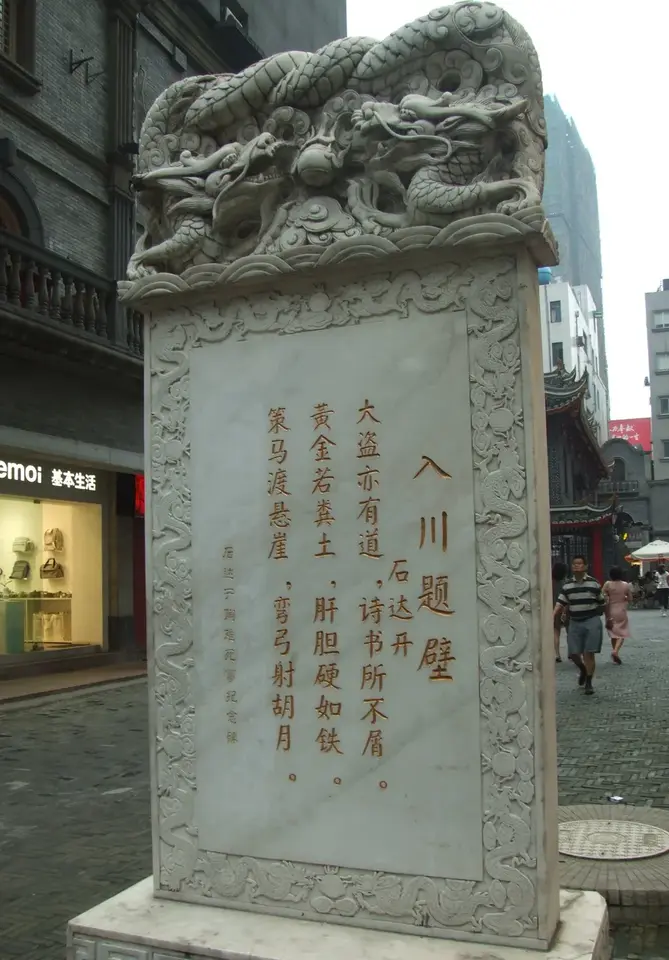
Beyond statecraft, Shi Dakai was a celebrated martial artist and poet. Historical texts record his mastery of the "Chuojiao" kicking system and "Continuous Mandarin Duck Steps," martial traditions he systematically imparted to front-line infantry to enhance hand-to-hand combat prowess. His renowned sparring match with master Chen Bangsen, in which he absorbed powerful blows through internal breath control, became legendary. His surviving poetic verses, including inscriptions at the Bailong Caves in Guangxi and verses composed during banquets with Miao chieftains in Guizhou, reflected a commanding, heroic spirit and deep sympathy for ethnic minorities.
Historical analysis regarding Shi Dakai's independent campaign continues to generate scholarly debate. Sympathetic historians emphasize that his departure from Tianjing was a necessary measure to avoid lethal palace assassinations orchestrated by Hong Xiuquan's brothers, noting that he consistently retained Taiping reign names and pinned down vast imperial armies in the south. Critical commentators argue that his departure fractured the central army and fatally weakened the defense of the lower Yangtze. Regarding his surrender at the Dadu River, authentic archival letters corroborate that his action was a deliberate sacrifice to preserve his soldiers rather than an act of cowardice. His stoic courage under torture inspired generations of revolutionary patriots during the 1911 Revolution, establishing him as an enduring national hero commemorated in monuments and shrines across southern China.
FIGURES ASSOCIATED WITH THIS DYNASTY