Life and Career
Early Allegiance and the Stand at Jieting
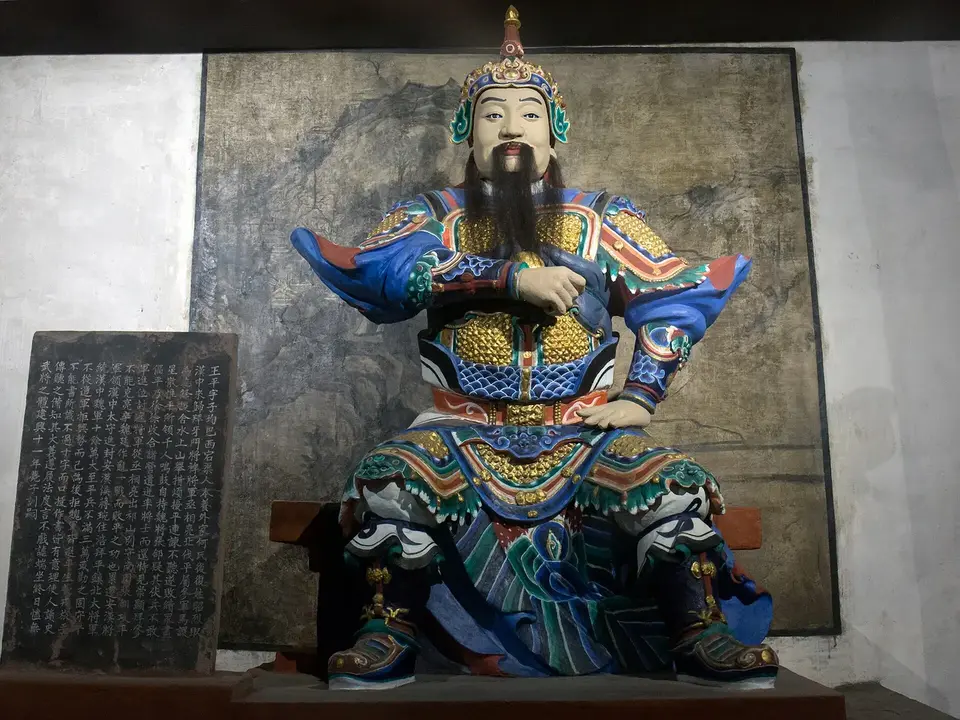
Wang Ping was raised in the household of his maternal grandfather, surnamed He, and was originally called He Ping before resuming his paternal surname Wang in adulthood. In 215, when Cao Cao subjugated Hanzhong, the chieftains of the local Cong people, Du Huo and Puhu, submitted to Cao Cao. Wang Ping accompanied them northward and was granted the rank of acting colonel. In 219, during the prolonged contest for Hanzhong between Liu Bei and Cao Cao, Wang Ping participated in the campaign under the Wei banners. Observing the shifting tide of war, he surrendered to Liu Bei. Recognizing Wang Ping's composure, valor, and intimate familiarity with Hanzhong topography, Liu Bei commissioned him as Gate-guarding General and Vice General.
In the spring of 228, Chancellor Zhuge Liang initiated his First Northern Expedition. He appointed Army Consultant Ma Su to oversee the vanguard defending the strategic throat of Jieting, assigning Wang Ping as his deputy. Exhibiting dogmatic military detachment, Ma Su abandoned nearby waterways and high roads, insisting on encamping all forces atop an isolated mountain. Wang Ping remonstrated urgently with Ma Su multiple times, arguing that abandoning water and transport routes would lead to encirclement and slaughter. Ma Su refused to listen, granting Wang Ping only about one thousand soldiers to establish an auxiliary camp at the base of the heights.
The veteran Wei commander Zhang He arrived swiftly with overwhelming forces, severing the mountain's water supply and setting surrounding brush on fire. Deprived of water, Ma Su's vanguard collapsed in panic. Amidst total chaos, Wang Ping stood firm with his thousand men, ordering his troops to beat war drums vigorously. Suspecting an ambush in the narrow passes, Zhang He refrained from pressing forward. Seizing this hesitation, Wang Ping gathered thousands of routed soldiers, reformed their ranks, and led them in good order back to Hanzhong. Following the defeat, Zhuge Liang executed Ma Su, but singled out Wang Ping for promotion to Army Consultant, placed him in charge of the elite Wudang Flying Army, advanced him to General Who Attacks Bandits, and enfeoffed him as a Village Marquis.
Repelling Zhang He and Quelling Internal Mutiny
In the spring of 231, Zhuge Liang led his fourth northern campaign and encircled Mount Qi. Sima Yi, Grand Commander of Wei, led main forces toward Lucheng while ordering Zhang He to strike the southern redoubt at Mount Qi, held by Wang Ping. Facing relentless attacks by superior Wei forces, Wang Ping maintained unyielding defensive positions. Utilizing the mountainous terrain and the archery prowess of his Wudang troops, he inflicted heavy casualties on the attackers and held the fortification intact. Unable to breach the defense, Zhang He was forced to break off the assault and retreat, preserving the flank of the northern expeditionary army.
In the eighth month of 234, Zhuge Liang passed away during the standoff at Wuzhangyuan. Following Zhuge Liang's secret instructions, the Shu army prepared for a measured withdrawal. However, Senior General Wei Yan refused to retreat, marching ahead of the main army, destroying the plank pathways, and taking position at the southern defiles to block the retreating column while accusing Yang Yi of rebellion.
Facing a civil conflict that threatened the annihilation of the Shu army, Wang Ping was dispatched to lead the vanguard and suppress the uprising. Approaching the pass, Wang Ping rode forward and confronted Wei Yan's frontline troops, shouting: "The Chancellor has barely passed, and his flesh is not yet cold; how dare you men follow this rebel in such treachery!" Conscious of their wrongdoing, Wei Yan's soldiers abandoned their posts and scattered. Wei Yan fled with his sons toward Hanzhong, where he was overtaken and killed by Ma Dai. For his prompt resolution of the dangerous insurrection, Wang Ping was promoted to Rear Supervisor of the Army and General of Anhan, assisting General of Chariots and Cavalry Wu Yi in guarding Hanzhong.
Guarding the Northern Border and the Battle of Xingshi
In 237, Wang Ping was created Marquis of Anhan. Following the death of Wu Yi, the imperial court appointed Wang Ping as General Overseeing the Front, granting him command over the defensive troops in Hanzhong. In 243, as Senior General Jiang Wan relocated his headquarters to Fu County due to deteriorating health, Wang Ping was promoted to Senior General Guarding the North and concurrently appointed Governor of Hanzhong, bearing primary operational responsibility for northern territorial security.
In the spring of 244, Cao Wei Grand General Cao Shuang and General Who Conquers the West Xiahou Xuan mobilized more than one hundred thousand elite troops from the Guanzhong region, marching southward along the Luogu Trail into Hanzhong. At the time, the Shu Han garrison in Hanzhong consisted of fewer than thirty thousand troops. Fearing encirclement, several commanders urged abandoning the outlying mountain defiles and retreating behind the defensive walls of Hancheng and Yuecheng to await reinforcements from Chengdu.
Wang Ping decisively overruled the retreat proposals, stating: "This cannot be done. Hanzhong is nearly one thousand li from Chengdu. If the enemy seizes these natural barriers, our territory will be lost. We must immediately dispatch Liu Min and Du Zhen to secure the choke points at Mount Xingshi, while I command the rear guard to provide support. If the enemy sends a detachment toward Huangjin, I shall reinforce it directly. By the time their vanguard is stalled against our fortifications, relief forces from Fu County and Chengdu will have arrived." The commanders adhered to his directive. Wang Ping occupied Mount Xingshi overnight, establishing defensive works and displaying standards across hundreds of li. Stalled in the precipitous valley with severed pack lines, the Wei army exhausted its supplies, and transport beasts died in droves. Grand General Fei Yi arrived with relief troops to cut off the enemy retreat, inflicting devastating casualties on Cao Shuang's retreating columns. Wang Ping's foresight preserved the territorial integrity of Shu Han.
Upright Character and Strategic Intellect
In 248, Wang Ping passed away while on active duty in Hanzhong. His title of Marquis of Anhan was inherited by his son Wang Xun.
Having spent his formative years in military garrisons, Wang Ping lacked formal tutoring in his youth and could not write, recognizing fewer than twenty written Chinese characters. Nevertheless, he possessed innate intellectual clarity. Whenever official memorials or administrative missives required drafting, he dictated his thoughts to scribes; the resulting prose was invariably cogent, structured, and perceptive. He enjoyed having assistants read aloud chapters from the Records of the Grand Historian and the Book of Han, grasping the broad strategic principles and historical lessons with precision.
In personal deportment, Wang Ping conformed rigorously to standard propriety. He maintained a dignified and solemn posture throughout the day, never engaging in casual levity or joking with subordinates. From dawn until dusk, he sat upright at his administrative dais without displaying fatigue. During this era, Wang Ping safeguarded the north in Hanzhong, Deng Zhi secured the east at Yong'an, and Ma Zhong pacified the south in Nanzhong. The three frontier commanders enjoyed comparable fame and were celebrated across the state as the "Three Border Marquises of Peace".
Major Achievements
Halting the Rout at Jieting and Building the Wudang Elite
The defeat at Jieting was the turning point of Zhuge Liang's First Northern Expedition, carrying the immediate danger of an uncontained route of the entire expeditionary force. Standing firm with a solitary force of one thousand soldiers, Wang Ping ordered his men to beat war drums in defiance, bluffing the experienced Wei commander Zhang He and freezing the enemy pursuit.
This tactical stand allowed Wang Ping to rally scattered remnants and escort several thousand soldiers safely back to Hanzhong. Impressed by his leadership, Zhuge Liang entrusted him with organizing and training the newly submitted southern tribal warriors into the "Wudang Flying Army". Under Wang Ping's rigorous discipline, this mountaineer force was molded into the most lethal shock infantry in the Shu Han military, repeatedly distinguishing itself in subsequent campaigns.
Decisive Victory at the Battle of Xingshi
The Battle of Xingshi in 244 represented the largest military threat faced by Shu Han during the mid-to-late Three Kingdoms era. Cao Wei mobilized over one hundred thousand soldiers from Guanzhong, whereas Wang Ping had fewer than thirty thousand troops at his disposal in Hanzhong.
Wang Ping demonstrated masterly strategic judgment and topographical insight. Rejecting passive containment within city walls, he executed an aggressive forward defense by occupying Mount Xingshi. By locking the Wei forces inside narrow valleys, he neutralized their overwhelming numbers and forced their logistics into collapse amidst rugged terrain. This victory dismantled Cao Wei's invasion plans and broke the political prestige of Regent Cao Shuang, enduring as a classic textbook example of asymmetric mountain defensive warfare.