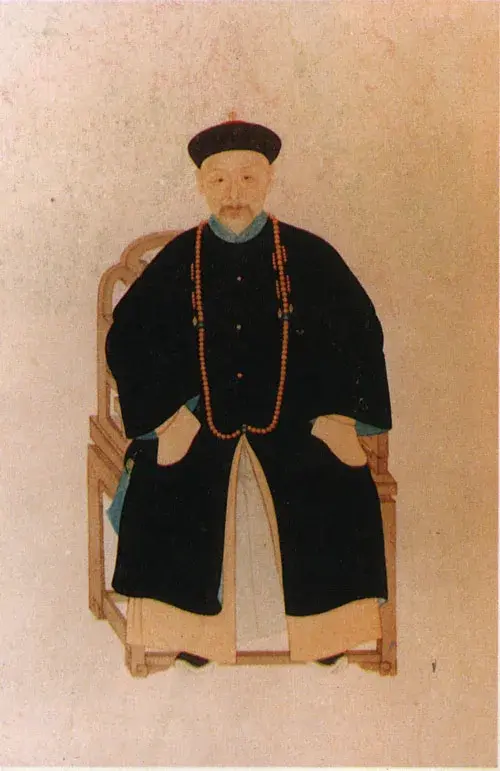
Life and Career
Noble Lineage and Early Stagnation
Ortai hailed from the distinguished Silin Gioro clan of the Manchu Bordered Blue Banner. His ancestors submitted to Nurhaci in the late Ming period and held hereditary company commander positions for generations. His grandfather, Tuyantu, served as a director in the Ministry of Revenue, while his father, Obai, served as chancellor of the Directorate of Education. The family maintained a balanced tradition of martial valor and classic scholarly education. From youth, Ortai demonstrated profound composure, excelling in equestrian archery while thoroughly mastering Manchu and Chinese classical literature.
In 1699, at the age of twenty, Ortai passed the Shun Tian provincial civil examination as a juren. The following year, he inherited the hereditary company commandership and was appointed a third-class imperial bodyguard (rank 5a). Although service as an imperial bodyguard was a prime route to high office for Manchu youths, Ortai was stern and unbending by nature, refusing to flatter court favorites. Amid the factional strife among Kangxi's sons for the succession, he maintained absolute neutrality and steadfastly avoided allegiance to any prince.
Late in the Kangxi reign, Prince Yinzhen (the future Yongzheng Emperor) visited the Imperial Wrestling Division (Shanpuying) on official business and privately requested special accommodation from Ortai, who was then serving as duty officer. Ortai responded impartially: "The matter entrusted by Your Highness affects imperial camp regulations; your humble servant dares not bend them." He politely but firmly declined Prince Yinzhen's request. Although rebuffed, Yinzhen was deeply impressed by Ortai's fearless adherence to discipline. During his later Kangxi years, Ortai was reassigned as a vice director in the Imperial Household Department, languishing in a minor rank 5b post for over twenty years without advancement.
Patronage of Yongzheng and Southwestern Command
In the eleventh month of 1722, the Kangxi Emperor died, and Prince Yinzhen ascended the throne as the Yongzheng Emperor. The new sovereign immediately launched vigorous administrative reforms to rectify fiscal deficits and sought fearless, clean, and capable ministers. Reviewing personnel rosters, the emperor recalled the uncorrupted officer from the Imperial Wrestling Division and promptly penned an imperial order promoting Ortai to Administration Commissioner of Jiangsu.
Arriving in Suzhou in 1723, Ortai confronted deep financial deficits and entrenched malpractices in Jiangnan. Without shrinking before powerful local interests, he conducted rigorous treasury audits and cleaned up grain and salt transport abuses, wiping out provincial debt within a single year. Yongzheng was delighted with his performance, praising him for acting with total devotion and disregarding personal blame, and elevated him to provincial governor.
In the autumn of 1725, the southwestern border areas fell into turmoil. Hereditary Miao and Yi chieftains (tusi) ruled their territories as autonomous bastions, levying cruel private punishments, attacking travel convoys, and defying imperial taxation. Recognizing that the southwest required an extraordinary leader, Yongzheng appointed Ortai Governor of Yunnan, promoting him the following year to Governor-General of Yun-Gui with the title of Minister of War. Ortai traveled swiftly to Kunming, assessed regional geopolitical conditions, and submitted a historic memorial urging fundamental reform. He declared that border instability stemmed entirely from the hereditary chieftains; eliminating them through gaitu guiliu was the only path to long-term tranquility. Yongzheng enthusiastically endorsed the proposal, granting Ortai complete administrative backing.
Frontier Administration and Gaitu Guiliu
Beginning in 1726, Ortai launched the sweeping campaign of gaitu guiliu across the southwest with immense political determination and tactical flexibility.
Hereditary chieftains in Dongchuan, Wumeng, and Zhenyuan had exploited their subjects for centuries. Ortai pursued a strategy of simultaneous suppression and conciliation: he rewarded chieftains who surrendered willingly with imperial stipends and pensions, while deploying crack Manchu, Han, and allied native troops under Generals Zhang Guangsi and Ha Yuansheng to crush recalcitrant rebels.
In the autumn of 1726, imperial troops took Dongchuan, Wumeng, and Zhenyuan, abolishing hereditary privileges. Ortai restructured local governance, reorganizing Dongchuan and Wumeng into regular prefectures administered by circulating civil officials under Yunnan's jurisdiction. He established Green Standard Army garrisons and despatched magistrates to survey landholdings, compile tax rolls, and replace abusive feudal exactions with uniform imperial taxes.
In the autumn of 1730, remnants of the deposed Wumeng chieftaincy incited an insurrection, storming Wumeng city and massacring several thousand imperial troops. Conservative officials in Beijing called for abandoning Wumeng and impeached Ortai for inciting unrest. The Yongzheng Emperor stood firmly by him, consoling him with an imperial rescript: "Those who bear the weight of the realm must endure its criticism. I know your character well; do not be discouraged." Ortai proceeded to the front, directed converging provincial armies, recaptured Wumeng, and hunted down rebel leaders in the mountains. He subsequently renamed Wumeng as Zhaotong Prefecture and Zhenxiong as Zhenxiong Subprefecture, breaking native resistance and solidifying imperial control.
Pacifying the Miao Territories and Governing Three Provinces
In 1728, to deal with unrest in the Qiandongnan Miao territories and Guangxi's border regions, the Yongzheng Emperor issued a special decree commanding Ortai to govern Guangxi concurrently, establishing the unprecedented post of Governor-General of Yun-Gui and Guangxi. Ortai held supreme civil, military, and frontier authority across three vast provinces.
In Guizhou and Guangxi, Ortai directed Zhang Guangsi to pacify the core of the Jiugu Miao territory, constructing fortified military courier routes from Qingjiang to Dujiang. In southern Yunnan, Ortai penetrated the Cheli (Xishuangbanna) region along the Jiulong River, demarcating the Sino-Burmese border and mediating disputes among local chieftains.
In 1729, Ortai successfully petitioned for the creation of Pu'er Prefecture (modern Ning'er, Yunnan) with stationed civil magistrates and regional garrisons. He reorganized tea taxation across the six major tea mountains, ended unlawful exploitation of native growers, established Pu'er tea as official tribute tea for the imperial palace, and implemented tax exemptions to attract interior merchant caravans. Under his administration, the once isolated southwest blossomed into an integrated, prosperous, and secure territory, ending centuries of fragmentation.
Leadership in the Grand Council and Factional Balance
In the spring of 1732, with the pacification of the southwest accomplished and tensions rising on the northwestern Dzungar frontier, the Yongzheng Emperor summoned Ortai back to Beijing.
Upon his arrival, Yongzheng ordered Prince Hongli and Prince Hongzhou to greet him outside the Chongwen Gate. In the Hall of Mental Cultivation, the emperor grasped his hands and lauded him as an irreplaceable Pillar of State. He immediately appointed Ortai Grand Secretary of the Hall of Baohe, Minister of the Imperial Presence, and Grand Councilor, granting him the hereditary rank of First-Class Earl.
At court, Ortai shared the highest ministerial duties with Grand Secretary Zhang Tingyu. While Zhang excelled at drafting institutional rescripts and bureaucratic administration, Ortai was renowned for bold military foresight and decisive leadership. Together, the Manchu and Han statesmen formed the backbone of late Yongzheng governance. In 1733, Ortai also served as Governor-General of Shaan-Gan, overseeing military supplies for campaigns against the Dzungars.
Inevitably, court officials polarized into rival factions. Manchu officials coalesced around Ortai to form the "Ortai Faction", whereas Han scholar-officials gravitated toward Zhang Tingyu to form the "Zhang Faction". Their competition over bureaucratic appointments and policy debates generated silent tension throughout the high bureaucracy into the early Qianlong reign.
Regency under Qianlong and Historical Legacy
On October 8, 1735, the Yongzheng Emperor passed away suddenly at the Old Summer Palace. Ortai, along with Zhang Tingyu and imperial princes Yunlu and Yunli, opened the secret succession box and proclaimed Prince Hongli as the Qianlong Emperor.
Yongzheng's testamentary edict specifically instructed that Ortai, whose loyal character and southwestern conquests had earned extraordinary merit, should serve as guardian-minister alongside Zhang Tingyu and eventually be enshrined in the Imperial Ancestral Temple. Qianlong honored Ortai with high distinction, elevating him to First-Class Earl Xiangqin and relying on his counsel for military campaigns and institutional reforms.
In the spring of 1745, exhausted by decades of public service, Ortai fell gravely ill. He passed away peacefully in his Beijing residence on April 26 at the age of sixty-six. Qianlong wept openly at his memorial, granted ten thousand taels of silver for his funeral, bestowed the posthumous title of Grand Preceptor and the posthumous name "Wenduan", and enshrined his tablet in the Imperial Ancestral Temple and the Shrine of the Eminent and Virtuous.
Ten years later, in 1755, the literary inquisition case involving Hu Zhongzao erupted. Hu was Ortai's former disciple, and Ortai's nephew Echang, Governor of Gansu, was implicated through poetic exchanges. Qianlong seized the opportunity to suppress the lingering influence of the Ortai faction, stripping Ortai of his enshrinement in the Imperial Ancestral Temple and defacing his funerary stele. In 1779, however, Qianlong reevaluated Ortai's monumental achievements in the southwest, restored his tablet to the Shrine of the Eminent and Virtuous, and permitted his grandson to inherit his noble title, restoring his historical honor.
Major Achievements
Formulating and Implementing the Gaitu Guiliu Policy
During the early Qing dynasty, extensive parts of Yunnan, Guizhou, Sichuan, and Guangxi remained under the hereditary control of autonomous tribal chieftains, beyond the reach of standard imperial laws.
As Governor-General of Yun-Gui, Ortai persuaded the throne to implement gaitu guiliu systematically. Employing a strategic blend of military force and diplomatic pacification, he dismantled the hereditary chieftaincies of Dongchuan, Wumeng, and Zhenyuan, replacing them with circulating civil magistrates, military outposts, and regular tax systems across hundreds of thousands of square kilometers. His reforms permanently removed the frontier threats that had troubled Chinese dynasties for centuries and finalized the integration of the southwest into the multi-ethnic empire.
Establishing Pu'er Prefecture and Developing the Tea Frontier
In the early Yongzheng era, the southern Yunnan regions of Cheli were remote and mountainous, with ill-defined boundaries.
Ortai successfully petitioned to establish Pu'er Prefecture in 1729, stationing imperial troops and building fortifications. He regulated tea production and commerce across the six major tea mountains, prohibited private exploitation, and established Pu'er tea as an official imperial tribute commodity. Furthermore, he constructed extensive courier routes connecting Kunming, Pu'er, and Cheli, drawing merchant caravans into the southwestern frontier. His policies transformed Pu'er tea into a renowned global commodity and stimulated the economic and cultural integration of diverse ethnic communities.
Guiding the Grand Council and Fostering the Yongzheng-Qianlong Prosperity
When Ortai entered the Grand Council in 1732, the Qing empire faced intensive military confrontation against the Dzungars in the northwest.
Leveraging his military organizing skills, Ortai directed the Grand Council's operations, coordinating tens of millions of taels in supplies and logistics for the Shaanxi-Gansu armies and ensuring stability on the northwestern frontier. Collaborating with Zhang Tingyu, he aided the Yongzheng Emperor in implementing crucial reforms including the land-poll tax merger, universal labor taxation, and meltage fees return to the treasury, expanding imperial silver reserves manifold and laying the administrative foundation for the flourishing Yongzheng-Qianlong era.
Leading the Manchu Bureaucracy at the Imperial Center
Advancing from a humble provincial graduate to Grand Secretary of the Hall of Baohe and First-Class Earl, Ortai became the foremost leader among Manchu civil officials in the mid-Qing period.
Possessing both civil learning and military command, he upheld the traditional martial rigor of the Eight Banners while engaging constructively with the Han scholarly elite. Highly trusted by both the Yongzheng and Qianlong emperors, he set an enduring benchmark for Manchu statesmen in imperial statecraft.