Born in Taizhou
Born in Nantang, Huangyan County, into an impoverished household; inherited a profound poetic devotion from his father Dai Min.
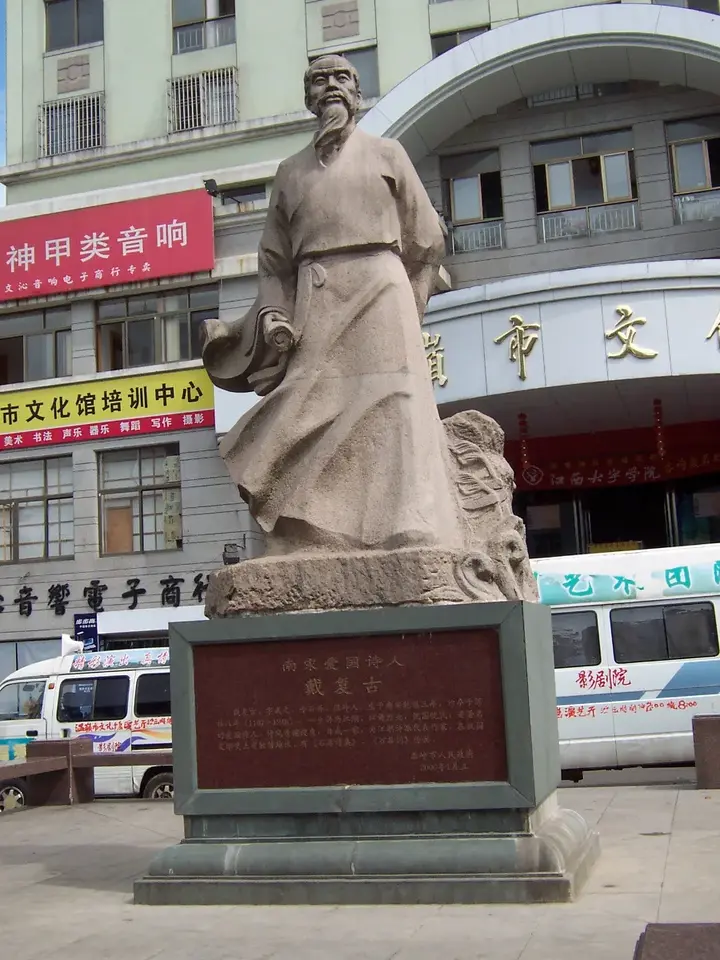
戴复古
Dai Fugu (戴复古, 1167–c. 1248), courtesy name Shizhi (式之) and literary name Shiping (石屏) (later styled Shiping Qiaoyin), was a native of Pingshan, Nantang in Huangyan County, Taizhou (modern Xinhe Town, Wenling, Taizhou, Zhejiang Province). He was one of the most accomplished and influential masters of the Jianghu Poetry School during the mid-to-late Southern Song Dynasty. Born into a humble commoner family and orphaned of both…
Dai Fugu (戴复古, 1167–c. 1248), courtesy name Shizhi (式之) and literary name Shiping (石屏) (later styled Shiping Qiaoyin), was a native of Pingshan, Nantang in Huangyan County, Taizhou (modern Xinhe Town, Wenling, Taizhou, Zhejiang Province). He was one of the most accomplished and influential masters of the Jianghu Poetry School during the mid-to-late Southern Song Dynasty. Born into a humble commoner family and orphaned of both parents in early youth, Dai Fugu inherited the dying lament of his poet-father Dai Min, whose final regret was that his verses would perish without transmission. Deeply stirred, he dedicated himself wholeheartedly to the craft of poetry. Journeying to Shanying, he gained entrance to the household of the supreme patriotic literary titan Lu You, absorbing Lu's impassioned, unyielding concern for the realm and robust poetic cadence. Remaining a commoner throughout his entire life without seeking civil examination laurels, Dai Fugu embarked upon a roaming life starting in the Qingyuan era of Emperor Ningzong. Traveling with sword, zither, and manuscripts, he visited civil grandees and frontier military commissioners across Eastern Wu, Western Zhejiang, Hunan, Hubei, the Xiang-Han valleys, the Huai River borderlands, and the Lingnan south, describing his wandering existence as "forty years adrift across rivers and lakes." His verse acutely reflected the precarious geopolitical dilemma of the Southern Song court clinging to southern appeasement. He mourned the plight of refugees under Jurchen Jin rule, championed the northern reconquest of the Central Plains, and denounced military complacency with tragic eloquence. Artistically, he surpassed the narrow, melancholic confines of the Late Tang style, drawing inspiration from Du Fu and High Tang vigor. In 1237 (the 1st year of the Jiaxi era), Dai Fugu retired to his ancestral home at the foot of Shiping Mountain, spending his final years exchanging verse with local kinsmen and students until passing away at an age exceeding eighty. His legacy is preserved in the Collected Poems of Shiping (Shiping Shiji) and Lyrics of Shiping (Shiping Ci).
Born in Nantang, Huangyan County, into an impoverished household; inherited a profound poetic devotion from his father Dai Min.
Traveled to Shanying to seek instruction from literary patriarch Lu You, who imparted classical poetic techniques and a lifelong patriotic ethos.
Departed his ancestral home to begin an itinerant life as a commoner poet, traveling across eastern and western Zhejiang.
Traveled north to frontline military garrisons in Yangzhou and Huaiyin, observing border defenses and composing stirring frontier poems.
Traveled along the middle Yangzi and the Xiang-Han valleys; ascended the Yellow Crane Tower to compose verse and discuss northern recovery with military commanders.
Imperial clansman Zhao Rudang selected 130 of his poems to compile the Small Collection of Shiping (Shiping Xiaoji), establishing his national literary reputation.
Journeyed to Jiangxi and Fujian, gaining high esteem from eminent Neo-Confucian statesmen including Zhen Dexiu and Zhao Ruteng.
Composed poems lamenting the catastrophic collapse of the Song expedition to recover Luoyang and Kaifeng, castigating reckless military adventurism.
Concluded four decades of wandering to build a thatched cottage at the foot of Shiping Mountain, styling himself the Recluse Woodcutter of Shiping.
Scholar Wu Ziliang composed the preface for the Later Collection of Shiping (Shiping Houji); lived serenely as a village teacher.
Passed away peacefully at his ancestral residence in Taizhou at an age exceeding eighty.
Dai Fugu traced his ancestry to the foot of Pingshan in Nantang, Huangyan County, amidst the coastal mountain landscapes of Taizhou. His father, Dai Min (courtesy name Zengbo), was an erudite scholar celebrated throughout the district for his poetic talent. However, having repeatedly failed in the civil service examinations, Dai Min lived in acute poverty. On his deathbed, looking around his bare room, the dying father wept bitterly that his several hundred carefully crafted poems would vanish into oblivion without transmission. Young Dai Fugu listened to his father's final weeping words, which etched an indelible impression upon his soul. He resolved that he would master the craft of verse and bring posthumous honor to his family line.
Soon afterward, his mother also fell ill and passed away, leaving Dai Fugu an impoverished orphan. Confronting deprivation, he rejected commercial trades and the mechanical composition of examination eight-legged essays, immersing himself instead in classical literature, ancient histories, and poetry. The rugged mountain scenery of Tiantai and the misty maritime horizons of Nantang provided inspiration for his youthful verse. During his adolescence, he became a companion and student to senior local literati, including Lin Xian and Xu Sidao. Under their guidance, he studied the Late Tang poetic style, perfecting verbal parallelism and metrical discipline, quickly distinguishing himself among the educated youths of Taizhou.
Possessing a broad and heroic temperament, Dai Fugu soon felt constrained by the narrow, melancholic aesthetic of the Late Tang stylists. During the Chunxi era, the renowned patriotic poet Lu You retired from Sichuan back to his ancestral home beside Mirror Lake in Shanying. Lu You commanded immense national reverence for his heroic verses yearning for northern recovery and his muscular, resonant poetic cadence, attracting students from across the empire.
Carrying his manuscripts, Dai Fugu journeyed on foot for hundreds of miles to present his poems at Lu You's gate. Reading through the verses, Lu You recognized the young man's authentic brilliance and commended his unbending filial resolve to carry on his father's literary heritage. Lu welcomed him into his household, keeping him as an intimate disciple for several months. Lu You carefully expounded the evolution of Chinese poetics, advising him that true poetry must take Du Fu as its bedrock and maintain deep empathy for the suffering masses and national recovery, rather than squandering talent on decorative trivialities. In Lu You's academy, Dai Fugu's horizons expanded immensely. His poetry shed its precious, fragile embellishments, assimilating Lu's robust vigor, unvarnished emotional sincerity, and heroic grief. This mentorship proved to be the decisive turning point in his artistic life.
In 1195, in his late twenties, Dai Fugu resolved to leave his native village, embarking on an itinerant commoner journey that would span more than forty years. In the late Southern Song, the imperial examinations had grown rigid and dominated by aristocratic clans, making bureaucratic ascension nearly impossible for poor commoners. Concurrently, the loss of northern China to the Jurchen Jin fostered widespread intellectual alienation in the south. The merchant Chen Qi began publishing the works of unregistered commoner poets in Lin'an, giving birth to the "Jianghu Poetry School." Embracing life as a commoner, Dai Fugu owned no estates or agricultural lands. Wearing straw sandals and coarse hemp robes, he carried only a zither and his verse rolls, traversing the empire by boat and horse.
Across the reigns of Ningzong and Lizong, Dai Fugu traveled through nearly half of the Song realm. He traversed eastern Zhejiang, navigated the Qiantang River, sailed down the Yangzi, and lingered in Suzhou and Hangzhou; turning westward, he ascended the river to Jiujiang and Wuchang, sailed the Xiang and Xiao rivers, crossed Lake Dongting, and gazed upon Mount Heng. He ventured north to the military outposts of Xiangyang, Fancheng, Jingzhou, and Huaiyin along the Jin frontier, and in his later years even braved the subtropical reaches of Lingnan. Wherever he went, he climbed historic ruins and meditated upon dynastic rise and fall. Naturally outgoing, generous, and fond of wine, he presented poems to regional administrators and military commissioners. His verses combined trenchant political insight with emotional power, earning him enthusiastic welcomes as an honored guest in the commanderies of the Yangzi and Huai valleys.
Dai Fugu's prolonged wanderings were not idle sight-seeing, but were animated by profound concern for the fate of the Southern Song dynasty and its people. Along the frontlines of the Huai and Jing-Xiang regions, he witnessed the humiliation of unequal peace treaties with the Jin, the negligence of border commanders, and the tearful despair of northern refugees gazing southward for imperial liberation. His heart filled with righteous fury, fueling a sustained output of political satire and patriotic lyrics.
During the Kaixi Northern Expedition, Chancellor Han Tuozhou launched an ill-prepared military assault that rapidly ended in disastrous rout. Dai Fugu composed biting verse analyzing the operational failures of the court. He presented poems and memorials to military leaders and upright ministers, including Meng Gong, Cui Yuzhi, Zhen Dexiu, and Zhao Rudang, urging administrative integrity, military drill, the pacification of displaced peasants, and the consolidation of border defense. His lyric to the tune of Liu Shao Qing (At the Wuchang Market for the Pacification Commissioner) voiced the agony of northern loss with thunderous intensity. Later, during the Duanping campaign when Song troops attempted to recover Kaifeng and Luoyang without logistics, only to be crushed by Mongol cavalry, Dai Fugu penned verse castigating the court for pursuing empty prestige at the expense of soldiers' lives, demonstrating exceptional geopolitical realism.
In 1237, having surpassed his seventieth year, the white-haired poet grew weary of his rootless existence. Reviewing his long journey, he sighed in verse: "Drifting through rivers and lakes for forty years, now growing old before the stone screen." Packing his belongings, he returned to his ancestral home in Nantang, constructing a simple dwelling at the foot of Shiping Mountain, naming his sanctuary the "Stone Screen Woodcutter's Hermitage."
In retirement, Dai Fugu lived in serene simplicity. Young scholars from near and far traveled to his cottage to seek instruction. He enjoyed the quietude of streams and forests, instructing his nephews in verse and spending afternoons angling and composing poetry beside mountain rills. Prominent statesmen and scholars across the empire revered this grand commoner elder. Distinguished literati such as Zhao Ruteng, Yuan Fu, and Wu Ziliang successively sponsored and prefaced subsequent editions of his poetry. Around 1248, Dai Fugu passed away peacefully at his Shiping home at the age of over eighty.
Dai Fugu's foremost contribution to Chinese literature was his stature as the preeminent master and aesthetic reformer of the Southern Song "Jianghu Poetry School." In the middle and late Southern Song, the Jianghu School arose as commercial publishing burgeoned in Lin'an, providing a voice for unplaced commoner scholars. However, many Jianghu poets fell into pedantic imitation of Mid-and-Late Tang poets like Jia Dao and Yao He, producing narrow, bitterly contrived verses marked by gloomy pedantry.
Dai Fugu altered this course with his expansive, muscular artistic vision. Inheriting the legacy of Lu You and the heroic spirit of Du Fu, he insisted that poetry must arise spontaneously from genuine human emotion and engage directly with the tragedies of the age. His seven-character quatrains (qiyan jueju) were peerless, utilizing unpretentious, clear diction while embedding profound philosophical resonance. His ten-volume Collected Poems of Shiping encompassed vivid depictions of pastoral Jiangnan alongside harrowing real-life accounts of corrupt officials and starving refugees. Through his expansive range, Dai Fugu rescued the Jianghu School from delicate triviality, elevating its artistic standing to its historical zenith.
In the genre of ci lyrics, Dai Fugu carried forward the patriotic lineage of Xin Qiji and Lu You. In the late Southern Song, the lyric arena was heavily influenced by the refined, purely decorative styles of Jiang Kui and Wu Wenying, which frequently sidestepped sharp national crises. Dai Fugu adhered to the heroic, unconstrained (haofang) tradition of patriotic lyricism, with his works collected in Lyrics of Shiping (Shiping Ci).
His lyric style was sweeping and heroic, filled with tragic lament for the fragmented empire. In celebrated masterpieces to the tunes of Man Jiang Hong (Meditating on the Past at the Red Cliff) and Mulan Hua Man, he integrated Su Shi's transcendent vision with Xin Qiji's fervent grief. Ascending historical watchtowers, he gave vent to his sorrow over the occupied Central Plains, denounced sycophancy, and called for national restoration. His lyrics were sung widely across the south, directly inspiring the patriotic lyrics of Liu Kezhuang and Wen Tianxiang.
As a lifelong commoner, the sheer geographical breadth of Dai Fugu's travels and the depth of his social associations were virtually unique in Song literary history. His life served as a living chronicle of late Southern Song society. Through decades of travel, he sustained networks of impoverished poets across Jiangnan (such as Liu Kezhuang, Ao Taosun, and Yan Yu), encouraging regional literary societies and poetic anthologies.
Furthermore, he built intellectual bridges connecting commoner intellectuals with frontline regional commanders and court ministers (such as Zhen Dexiu, Meng Gong, and Cui Yuzhi). Leveraging his literary eloquence, Dai Fugu memorialized fallen warriors and petitioned the powerful on behalf of suffering refugees, exemplifying the Confucian ideal that even humble commoners must never abandon their concern for the realm.
FIGURES ASSOCIATED WITH THIS DYNASTY