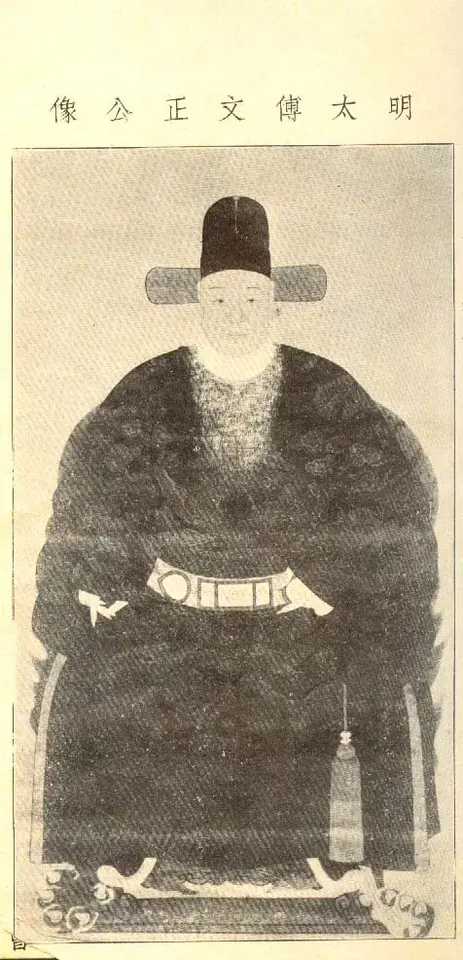
Biography
Early Brilliance and Premier Examination Honors
Xie Qian was born on January 11, 1450 (the 28th day of the twelfth month of the first year of Jingtai) in Simen Town, Dongshan Village, Yuyao County, Shaoxing Prefecture, Zhejiang. He belonged to a lineage claiming descent from Xie An, the celebrated prime minister of the Eastern Jin Dynasty. From his early years, Xie Qian showed exceptional intellectual acuity, reading with remarkable speed and demonstrating consummate mastery of poetic couplets. At age seven, he astonished his grandfather Xie Ying by instantly returning a sophisticated matching couplet.
During his formative years, Xie Qian devoted himself to Neo-Confucian moral teachings and orthodox classical studies. He maintained impeccable moral discipline and integrity. According to local historical records, when he served as a private tutor for an affluent household in Piling during his youth, the daughter of the house secretly admired his refinement and attempted to seduce him; Xie Qian strictly maintained Confucian decorum, firmly and earnestly admonishing her to protect her modesty and virtue, winning widespread acclaim for his upright character.
In 1474 (Chenghua 10), Xie Qian took the Zhejiang provincial examinations and claimed first place (Jieyuan). The following year, in 1475 (Chenghua 11), twenty-six-year-old Xie Qian traveled to the capital to participate in the metropolitan and palace examinations. His comprehensive policy response demonstrated penetrating insight into state affairs and refined prose. Emperor Chenghua personally selected him as the first-place Zhuangyuan of the first class, conferring upon him the office of Senior Compiler (Xiuzhuan) in the Hanlin Academy, initiating his distinguished official career.
Imperial Tutor and Educational Service
Following his entry into government, Xie Qian immersed himself in the editing and compilation of imperial texts in the Hanlin Academy, advancing to the post of Left Deputy Supervisor in the Household of the Heir Apparent. When the future Hongzhi Emperor (Zhu Youtang) was crown prince, Xie Qian was chosen as his daily imperial lecturer, charged with instructing him in Confucian classics and historical lessons of dynastic governance.
Prior to every lecture, Xie Qian would dress in full court attire and meticulously rehearse his exposition, striving with utmost devotion to illuminate moral principles for the crown prince. His presentations were articulate, thorough, and closely tied to practical statecraft, winning deep admiration and trust from Zhu Youtang. After Emperor Hongzhi ascended the throne, Xie Qian was promoted to Junior Supervisor of the Household and Academician Reader-in-Waiting of the Hanlin Academy, attending daily to discuss affairs of state.
In the spring of 1488 (Hongzhi 1), the influential palace eunuch Guo Yong petitioned to recruit daughters from commoner families to expand the imperial harem. Xie Qian immediately submitted an outspoken memorial remonstrating against the proposal, arguing that the late emperor's mausoleum had not yet been fully completed and that ritual propriety dictated restraint; moreover, since the young emperor was in mourning, such matters should be deferred. Minister of Rites Zhou Hongmo and other high officials vigorously supported Xie Qian's remonstrance. Emperor Hongzhi gladly accepted his counsel and decreed an immediate halt to the conscription of concubines, earning Xie Qian widespread acclaim for his ritual wisdom and rectitude.
Ministerial Governance in the Grand Secretariat
In 1495 (Hongzhi 8), Emperor Hongzhi issued an imperial decree appointing Xie Qian and Li Dongyang to the Grand Secretariat to oversee core national governance. At the time, Xie Qian was observing filial mourning at home for his parents; he strictly adhered to ritual codes, repeatedly petitioning to decline the appointment until the mourning period expired. Upon arriving in the capital, he formally assumed his duties and was concurrently appointed Grand Supervisor of the Household of the Heir Apparent.
When the young Crown Prince Zhu Houzhao formally began his palace schooling, the imperial court elevated Xie Qian to Junior Guardian of the Crown Prince, Minister of War, and Grand Secretary of the Dongge. Xie Qian submitted a memorial exhorting the prince to associate with upright scholars, distance himself from sycophants, apply himself diligently to classical studies, and guard against self-indulgence. Emperor Hongzhi expressed profound satisfaction and issued a personal decree of commendation.
In the Grand Secretariat, Xie Qian was renowned for his sharp acumen and persuasive argumentation. When Minister of War Ma Wensheng proposed increasing the commutation tax rates on agricultural revenues in the south to alleviate military supply shortfalls along the northern Datong frontier, Xie Qian raised resolute objections. He maintained that the central government had originally instituted tax commutation to silver precisely because southern burdens were heavy; increasing those levies would place an unbearable burden on agrarian households, emphasizing that true state solvency rested upon fiscal retrenchment rather than extractive taxation. Minister of Revenue Ni Yue concurred, leading to the abandonment of the proposed hike.
Toward the end of his reign, Emperor Hongzhi resolved to eliminate deep-seated bureaucratic corruption. Inner palace storehouses, granaries, and imperial stables controlled by eunuchs were rife with embezzlement and irregularities, while the Imperial Horse Pasture and Four Guard infantries claimed fraudulent military stipends beyond the jurisdiction of the Ministry of War. Xie Qian systematically briefed the emperor on these abuses, recommending rigorous investigative oversight and severe penalties. Emperor Hongzhi embraced his recommendations, initiating an extensive cleanup of the capital garrisons.
Xie Qian was dignified in appearance and uncompromising in integrity. Alongside Senior Grand Secretary Liu Jian and Second Grand Secretary Li Dongyang, he formed an extraordinary triumvirate. Courtiers remarked: "Master Li provides profound foresight, Master Liu possesses decisive execution, and Master Xie excels in articulate, persuasive counsel." The three worked in seamless unity, speaking without fear or favor to steer the empire into the tranquil heights of the Hongzhi Mid-Dynasty Revival.
Resisting the Eunuch Faction and Resignation
In 1505 (Hongzhi 18), Emperor Hongzhi fell gravely ill. On his deathbed in the Qianqing Palace, he summoned Liu Jian, Li Dongyang, and Xie Qian, entrusting the young Crown Prince Zhu Houzhao to their loyal stewardship. Upon the ascension of Emperor Zhengde, Xie Qian was honored with the rank of Junior Tutor and Grand Preceptor to the Crown Prince.
However, the adolescent Zhengde Emperor proved undisciplined and reckless, spending his time riding, hunting, and entertaining performers under the encouragement of the "Eight Tigers" eunuch clique led by Liu Jin. Recognizing that dynastic stability was jeopardized, Xie Qian resolved to confront the crisis without regard for personal safety. Joining forces with Liu Jian, Minister of Personnel Ma Wensheng, Minister of Revenue Han Wen, and dozens of supervising censors, he submitted an impassioned, exhaustive memorial urging the immediate execution of Liu Jin and his faction according to ancestral dynastic statutes.
Regrettably, the young emperor wavered, and when Liu Jin and his confederates wept and pleaded before the monarch late at night, Zhengde reversed course, elevating Liu Jin to lead the Directorate of Ceremonial and the inner palace quarters while turning against the civil officials. Realizing that the imperial mind was immovable, Xie Qian and Liu Jian refused to compromise with eunuch tyranny and jointly submitted their resignations. In the winter of 1506 (Zhengde 1), both statesmen were permitted to retire, departing Beijing for their hometowns.
Political Persecution and Poetic Tranquility
Having seized total control over the imperial court, Liu Jin harbored intense malice toward Liu Jian and Xie Qian, seeking every pretext to ruin them. The treacherous Grand Secretary Jiao Fang, who had aligned himself with Liu Jin, held a personal grudge against Xie Qian for having formerly recommended Wang Ao and Wu Kuan rather than himself. In the second month of 1509 (Zhengde 4), Liu Jin used the recommendation of Yuyao scholars Zhou Li, Xu Ziyuan, and Xu Long by the Zhejiang provincial inspector as a pretext, fabricating treason charges and imprisoning them in the Imperial Prison to implicate Xie Qian and Liu Jian.
Thanks to the delicate and persistent diplomatic intervention of Li Dongyang in Beijing, Xie Qian and Liu Jian escaped execution. Nonetheless, Jiao Fang insisted on harsh measures; Liu Jin exiled Zhou Li and his associates to remote frontiers, penalized recommending officials, and enacted a discriminatory decree forbidding all native scholars of Yuyao from serving in metropolitan posts.
In the twelfth month of that year, Liu Jin fabricated further charges, revoking Xie Qian's official titles, patent documents, and imperial gifts, including ceremonial jade belts and robes. Over six hundred upright officials suffered similar deprivations. While the entire country feared for Xie Qian's survival, he remained entirely serene in his rural retreat in Yuyao, passing his days playing Weiqi and exchanging poetry with local scholars, inspiring admiration across the realm through his steadfast moral composure.
Imperial Recall and Final Days
In the eighth month of 1510 (Zhengde 5), Liu Jin was finally arrested, condemned for high treason, and executed by slow slicing. Emperor Zhengde restored Xie Qian's rank and titles, sending envoys to comfort him, though Xie Qian declined to resume active office. Following the ascension of the Jiajing Emperor, the new sovereign demonstrated immense veneration for the veteran statesman, repeatedly sending imperial letters of inquiry and promoting his eldest son Xie Zheng to Vice Director in the Ministry of Rites, while his second son Xie Pi rose to Senior Vice Minister of Personnel.
In 1527 (Jiajing 6), the Jiajing Emperor issued a special imperial decree dispatching Ministry of War official Li Ren to Yuyao to summon seventy-nine-year-old Xie Qian back to the Grand Secretariat, directing provincial authorities to assist his travel. Unable to decline imperial command, Xie Qian journeyed north. In the capital, Emperor Jiajing accorded him extraordinary deference, exempting him from attending early morning audiences during freezing weather and frequently sending imperial physicians and banquet delicacies.
After serving several months in the Grand Secretariat, Xie Qian repeatedly pleaded for permission to retire due to advanced age and frail health. Emperor Jiajing conferred upon him the title of Junior Guardian and granted him honorable retirement with an official barge escort. Back in Yuyao, Xie Qian remained devoted to local welfare, championing the construction and reinforcement of the vital Dagutang sea-dyke along the Yao River to protect farmlands from flooding, revising genealogical records, and mentoring younger generations of scholars. His literary compositions were collected in the eight-volume Gui Tian Gao. On March 6, 1531 (the 18th day of the second month of Jiajing 10), Xie Qian passed away peacefully at his home at eighty-two years of age. Emperor Jiajing expressed deep sorrow, posthumously conferring the supreme office of Grand Preceptor (Taifu) and the prestigious posthumous name "Wenzheng."
Key Achievements
Premier Scholar and Eastern Palace Mentorship
In 1475, Xie Qian achieved premier honors as the Zhuangyuan of the Chenghua 11 imperial examination, entering the Hanlin Academy as Senior Compiler. He demonstrated profound mastery of Confucian canonical commentaries and historical statecraft.
During his tenure as daily lecturer to the future Hongzhi Emperor, Xie Qian prepared his discourses with consummate devotion, using historical rise-and-fall patterns to cultivate benevolent governance in the young heir apparent. Following the emperor's enthronement, Xie Qian successfully petitioned to halt the recruitment of palace concubines, setting a high standard of ministerial counsel and imperial reception.
Architect of the Hongzhi Mid-Dynasty Revival
Throughout the Hongzhi era, Xie Qian served in the Grand Secretariat alongside Liu Jian and Li Dongyang, establishing the most harmonious and effective ministerial partnership in Ming dynastic history.
The three statesmen complemented each other's strengths. Contemporaries celebrated their cohesion: "Li Dongyang provides strategic foresight, Liu Jian exercises firm decisiveness, and Xie Qian delivers persuasive, principled arguments." Xie Qian demonstrated unyielding resolve on major fiscal policies, halting excessive tax commutation levies on southern agrarian populations and purging fraudulent military payrolls within the palace commanderies, providing indispensable administrative leadership for the "Hongzhi Mid-Dynasty Revival."
Principled Remonstrance Against Eunuch Tyranny
During the early Zhengde reign, the eunuch dictator Liu Jin usurped supreme power, intimidating the court. Xie Qian placed dynastic welfare above personal safety, joining Liu Jian and ministerial leaders to submit an exhaustive indictment demanding Liu Jin's execution.
When the young monarch failed to heed their counsel, Xie Qian chose immediate resignation rather than sycophantic compromise. Even when subjected to vindictive retribution, stripped of honors, and targeted through fabricated regional conspiracy charges, he preserved serene dignity through poetry and chess, providing a timeless model of Confucian courage.
Elder Statesman of the Jiajing Era and Local Benefactor
In his late seventies, Xie Qian was recalled to the Grand Secretariat by Emperor Jiajing, a rare historical testament to the moral prestige and veneration commanded by the veteran statesman.
In his native Yuyao, Xie Qian actively spearheaded the construction of the Dagutang sea-wall embankment, protecting tens of thousands of acres of fertile farmland from catastrophic tidal flooding. He cultivated classical scholarship through his eight-volume Gui Tian Gao, leaving behind an enduring legacy of civic and literary contributions.
Historical Evaluation
Throughout Ming and Qing historical accounts, Xie Qian has been universally extolled as one of the most upright, eloquent, and capable grand secretaries of imperial China.
The History of Ming (Ming Shi) concluded in his biography: "Liu Jian and Xie Qian maintained unyielding rectitude and selfless devotion. When eunuchs threw governance into chaos, they upheld justice through steadfast remonstrance. Though their immediate aims went unfulfilled, their uncompromising integrity remained constant. Among the illustrious chancellors of the Ming, outside the 'Three Yangs,' Peng Shi and Shang Lu came before, while Liu Jian and Xie Qian followed after—truly serving their sovereign according to the moral Dao."
Eminent Ming historian Wang Shizhen remarked: "During the Hongzhi reign, worthy ministers were most abundant. In the Grand Secretariat, Duke Liu Wenjing (Liu Jian), Duke Xie Wenzheng (Xie Qian), Duke Qiu Wenzhuang (Qiu Jun), and Duke Li Wenzheng (Li Dongyang) were all towering figures of the age, celebrated throughout the realm as virtuous chancellors."
The philosopher Li Zhi praised: "During the Hongzhi era, Emperor Hongzhi applied himself diligently to statecraft and employed men of virtue. Within the cabinet, Dukes Liu, Xie, and Li deliberated on national affairs; outside, ministers of integrity exerted themselves in concert. Enlightened ruler and upright ministers met in harmony—a golden age rarely equaled across ten thousand generations."
Qing historian Gu Yingtai observed in Ming Shi Jishi Benmo: "At that time, discernment belonged to Wang Shu and Peng Shao; administrative mastery to Ma Wensheng and Liu Daxia; and consummate elder statesmanship to Liu Jian and Xie Qian."