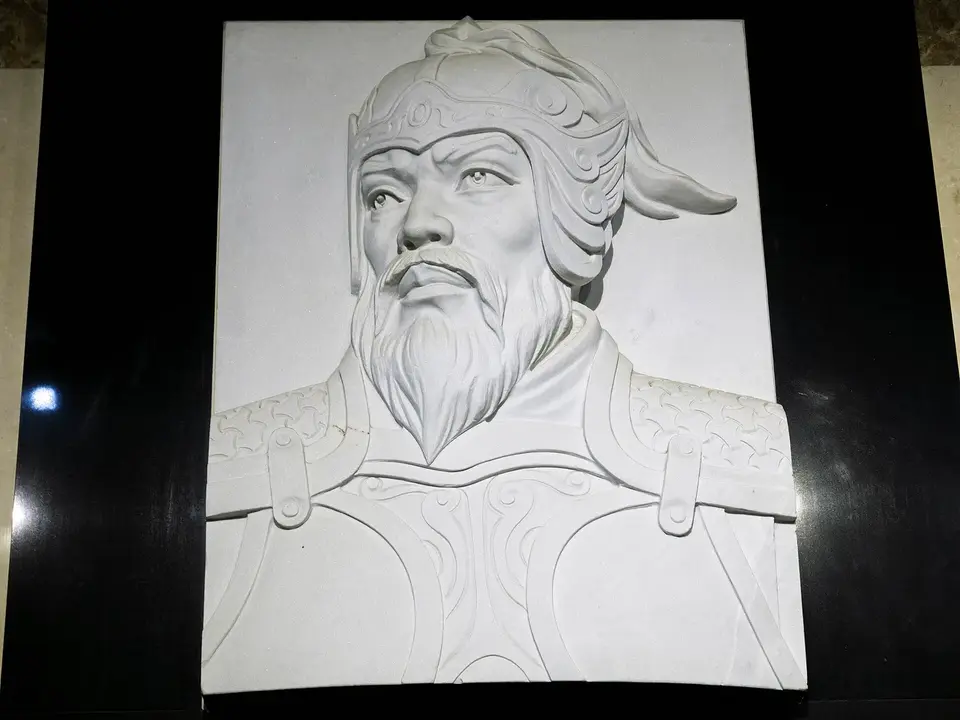
Biography
Early Lineage and Mentorship Under Luo Hongxian
Deng Zilong was born in 1528 in Dengjia Village, Fengcheng County, Linjiang Prefecture, Jiangxi Province. His family had maintained hereditary military service; his grandfather Deng Jinzhen was assigned in the Zhengde era to garrison the frontier outpost of Maxitun in Guizhou, where he died in battle in 1524 while suppressing the Fodingshan tribal uprising. Influenced by this heritage of martial devotion, Deng Zilong demonstrated physical vigor, resolute character, and natural talent in mounted archery and sword combat, while also immersing himself in historical treatises on military arrays and physical geography.
Following his grandfather's early death, the family descended into severe financial hardship, forcing the young Deng Zilong to earn a meager living as an itinerant surveyor and geomancer. During this period, he encountered the renowned Neo-Confucian philosopher and former senior wrangler Luo Hongxian, who was lecturing in seclusion at Mount Qingyuan in Ji'an. Luo recognized Deng's towering presence, articulate grasp of operational strategy, and intense patriotism, urging him to abandon superficial crafts and dedicate himself to the military examinations to serve the realm.
Acting upon Luo's counsel and material assistance, the thirty-year-old Deng sat for the Jiangxi provincial military examination in 1558 and obtained the military provincial graduate degree (wu juren). In the autumn of the same year, when armed brigands raided the commercial hub of Zhangshu Town, Deng responded to the magistrate's call for volunteers, recruiting local youths to storm the bandit hideout and pacifying the disturbance, thus commencing his four-decade career in the imperial military.
Pacifying the South and Frontier Clashes
Between the late Jiajing and early Wanli eras, although the coastal Japanese pirates (Wokou) had been largely quelled, armed insurrections and mountain banditry flared continuously across southern China. Deng was dispatched to Guangdong, serving under Regional Commander Zhang Yuanxun in protracted campaigns across Chaozhou, Huizhou, and Meiling.
Bandit leaders such as Lai Yuanjue, Chen Jinying, and Luo Shaoqing had entrenched themselves in the rugged topography of the Shiwandashan ranges. Deng selected elite shock troops to scale vine-covered cliffs under night cover, executing devastating surprise assaults. When the bandit leader Huang Gaohui fled into precipitous mountain caverns, Deng rode alone at the head of a detachment, scaling the rock faces to capture Huang alive. For these merits, he was promoted to Squad Leader of Guangdong and subsequently advanced to Guard Commander of Tonggushi.
During this period, ethnic disturbances erupted in Mayang in Huguang, where Miao insurgents raided border outposts. Deng was redeployed to Huguang, executing fluid mountain envelopments to pacify the region. Shortly thereafter, garrison soldiers in Liping, Guizhou, mutinied over unpaid wages and expelled their commanders; Deng marched with speed, executing the mutiny instigators while petitioning for the release of overdue stipends, swiftly calming the crisis. In recognition of these achievements, he was promoted in the early Wanli era to acting Assistant Regional Military Commissioner directing the Zhejiang Regional Military Commission. However, his unbending personal integrity and disdain for bureaucratic sycophancy provoked envy among court censors, who fabricated charges against his promotion. Deng quietly retired to his hometown to study military treatises and author works on operational theory.
Defending Western Yunnan and the Battle of Panzhihua
In the early Wanli reign, the Toungoo dynasty of Burma expanded aggressively under kings Bayinnaung and Nanda Bayin, repeatedly invading the southwestern borders of Ming China and subjugating local native chieftains (tusi). In early 1583, Burmese armies mobilizing vast infantry, cavalry, and hundreds of armored war elephants invaded western Yunnan, overrunning Longchuan, Shidian, and Shunning, directly threatening Yongchang and Dali.
Yunnan Grand Coordinator Liu Shizeng urgently memorialized the throne, recommending Deng Zilong as the sole commander capable of turning the tide. Emperor Shenzong issued an imperial edict commissioning Deng as Assistant Regional Commander of Wujing, stationed at Yongchang and concurrently commanding Jinteng. Confronting an overwhelming enemy armed with war elephants, Deng analyzed that while the beasts possessed terrifying momentum, their bulk made them cumbersome in rugged gorges, and their instincts made them violently allergic to sudden concussive gunfire.
Deng led three thousand veteran troops into the bottleneck pass of Yaoguan, erecting fortified timber stockades and digging deep pits concealed with brush and sharpened bamboo stakes, while positioning concealed batteries along flanking cliffs. In December 1583, the Burmese vanguard advanced toward Panzhihua Stockade outside Yaoguan. Deng deployed light cavalry detachments to feign disorderly retreat, drawing the enemy's war elephants into the narrow defiles.
When the trap was sprung, Deng sounded the war drums, and concealed troops unleashed a storm of fire arrows, rocket launchers, and heavy arquebus shot. Terrified by the blinding flashes and roaring concussions, the war elephants stampeded backward, trampling the Burmese central infantry into chaos. Deng brandished his long sword, leading his vanguard into the melee. Ming forces decapitated enemy general Han Qian, routed the Burmese main force, captured dozens of live war elephants, and killed over a thousand elite warriors.
Panzhihua stood as the decisive turning point in the Ming-Burmese border war. Pursuing the retreating invaders across the Salween River, Deng re-established control over Mengmi, Mubang, and Longchuan, securing the frontier and prompting Emperor Shenzong to elevate him to Regional Vice Commander of Yunnan.
Tribal Pacification and Bureaucratic Disgrace
In 1590, native Yi chieftains Dingjie and Baigai mobilized tens of thousands of tribesmen in Xinhua (modern Xinping, Yunnan), raiding county seats and massacring imperial officials from fortified mountain redoubts. Recalled to service, Deng conducted thorough topographical reconnaissance, establishing a strategy of blockading supply routes and launching multi-pronged vertical assaults. Leading a flying column with bamboo scaling ladders and ropes, Deng scaled cliffs to storm the main stockade, incinerating enemy camps with incendiary arrows and restoring order with minimal casualties.
In 1592, Burmese forces launched a fresh riverine invasion against the border dependencies of Mengyang, Manmo, and Mengmi. Deng campaigned thousands of li through tropical jungles, deploying flotillas along the Irrawaddy river branches and using heavy artillery to bombard enemy river-crossing forces, crushing the invasion and securing the border. He was promoted to Regional Commander.
However, long-term frontier deployments exposed Deng to factional court jealousy. In 1593, garrison troops in Yao'an and Tengchong mutinied over chronic pay arrears withheld by civil bureaucrats. Intendant officials shifted total blame onto Deng, falsely accusing him of administrative negligence and warmongering. Under censorate pressure, the Wanli court cashiered the veteran general, expelling him from office and returning him to Fengcheng in disgrace.
The Final Campaign in Korea and Martyrdom at Noryang
In 1592, Japanese ruler Toyotomi Hideyoshi unleashed a catastrophic invasion of Korea, precipitating the Imjin War. Following Hideyoshi's death in autumn 1598, Japanese expeditionary forces prepared to evacuate southern Korea, concentrating at Suncheon and Sacheon under ferocious Allied naval and land blockades.
Hearing that the court was mobilizing all available maritime forces for a final campaign, the seventy-one-year-old Deng Zilong volunteered for frontline duty, petitioning the throne: "Though aging, this servant can still wear armor and draw the bow; I seek to command an isolated detachment across the sea to extinguish the invaders!" Moved by his fierce loyalty, Emperor Shenzong commissioned Deng as Vice General of the Naval Expedition, placing him under Fleet Admiral Chen Lin with three thousand Jiangxi sailors.
Arriving in Korea, Deng established an immediate bond of profound mutual trust and tactical coordination with Korean naval hero Yi Sun-sin. Deng shared advanced Ming gunpowder formulas, assisted in retrofitting warships, and coordinated Allied joint maneuvers.
In late November 1598, Japanese general Konishi Yukinaga found his garrison besieged at Suncheon. Japanese commander Shimazu Yoshihiro assembled a relief armada of over five hundred warships to break through the blockade. Chen Lin, Yi Sun-sin, and Deng Zilong coordinated a massive naval ambush in the narrow waters of Noryang Strait.
On the night of December 16, 1598, Deng Zilong took command of three massive multi-decked flagships (juliujian) carrying two hundred hand-picked shock troops, thrusting into the enemy's western flank under favorable winds. As cannon fire echoed across the strait, Deng's guns destroyed numerous Japanese vessels. However, in the chaotic night fighting, an errant artillery shell fired from a friendly vessel struck Deng's flagship, igniting the rigging.
Witnessing the flagship aflame and isolated, Shimazu's vessels converged from all directions, sending hundreds of samurai boarding parties up the scorched hulls. Towering over the burning deck with snowy white hair and heavy armor, the seventy-one-year-old Deng fought with unmatched ferocity, wielding his sword to strike down dozens of boarding enemies. When his retainers were cut down and his body covered in wounds, Deng fell in martyrdom, alongside his two hundred retainers. Admiral Yi Sun-sin rushed to his relief, only to be struck down by a Japanese bullet, dying in shared martyrdom.
The Battle of Noryang was an overwhelming Allied victory, sinking over four hundred Japanese vessels and ending the war. Emperor Shenzong issued a deeply sorrowful imperial decree, posthumously promoting Deng to Assistant Commissioner of the Chief Military Commission, awarding the posthumous name Zhongzhuang, and establishing ancestral shrines in his honor. In Joseon, King Seonjo erected the Chungnyeolsa Shrine on Gogeum Island, venerating Deng Zilong alongside Yi Sun-sin in eternal honor.
Major Achievements
Strategic Triumph at Panzhihua: Securing Southwest Borders
The Battle of Panzhihua in 1583 was the most significant defensive triumph along Ming China's southwestern frontier during the late imperial era. Confronting Burmese armies equipped with formidable war elephants, Deng demonstrated innovative tactical brilliance.
By integrating fieldworks, concealed elephant-trapping pits, and concentrated volley fire from firearms, he completely neutralized the psychological terror of animal cavalry. The victory halted the Toungoo advance, preserved Yunnan's territorial integrity, and stabilized the Sino-Burmese frontier for decades.
Heroic Service at Age Seventy-One
Among the celebrated commanders in Chinese history, Deng Zilong stands unique for volunteering for overseas maritime combat at the age of seventy-one. Setting aside personal comfort and factional grievances, Deng crossed the Yellow Sea to defend an imperial ally.
In Korea, his modesty, rigorous discipline, and respectful collaboration with Admiral Yi Sun-sin fostered seamless integration between Chinese and Korean forces, creating an Allied naval force that decisively altered the maritime campaign.
Immortal Sacrifice at Noryang Point
The Battle of Noryang Point in December 1598 remains one of the largest naval engagements in pre-modern world history. Leading the spearhead into an armada of five hundred enemy vessels, Deng's sacrifice pinned down the Japanese vanguard.
Even when his flagship was engulfed in flames, Deng fought to the last breath, demonstrating heroic valor. His sacrifice provided the decisive tactical window that enabled Allied fleets to close the trap, ensuring the total destruction of the Japanese fleet.
The Scholar-General: Poetry and Tactical Treatises
Deng Zilong was a true scholar-general (rujiang). Over forty years of active campaigning, he composed extensive poetry reflecting his experiences. His surviving poetry collection, Heng Ge Ji (Brandishing the Spear), captures the raw realities of frontier warfare, tribal terrain, and naval engagements with vivid historical authenticity.
Furthermore, he codified his military experience into the treatise Zhen Fa Zhi Zhi (Direct Guide to Tactical Formations) and authored Feng Shui Shuo (Treatise on Terrestrial Geography), leaving valuable intellectual contributions to Chinese military science.