Birth into an Illustrious Lineage
Born into an elite scholar-official gentry family in Tongcheng, Anqing, initiated into classical studies by his uncle Yao Fan.
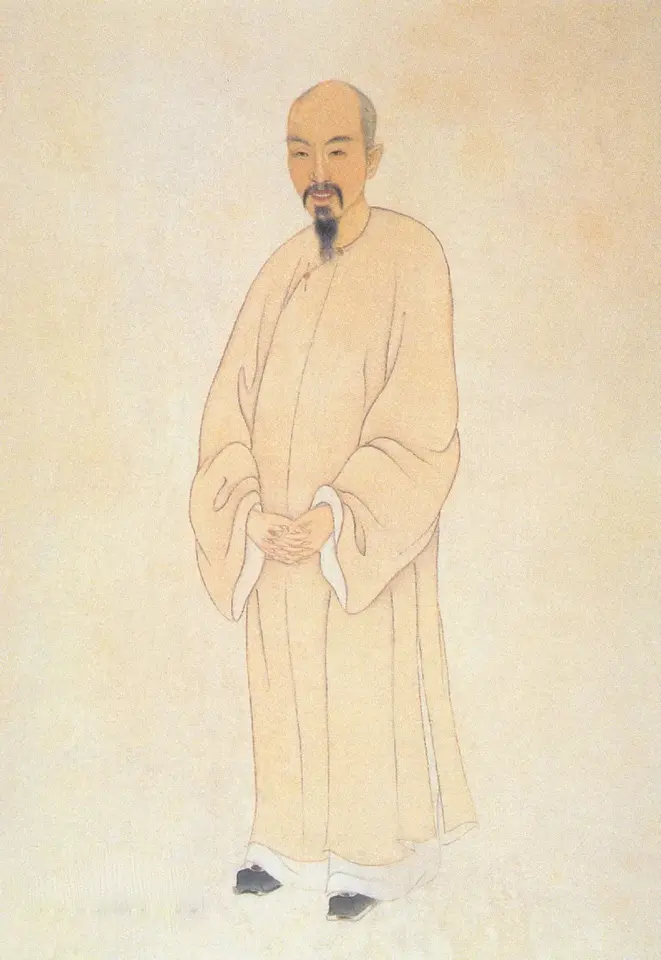
姚鼐
Yao Nai (姚鼐; December 17, 1731 – October 15, 1815), courtesy name Jichuan and Menggu, studio name Xibaoxuan, was a native of Tongcheng, Anqing Prefecture, Anhui Province. He was one of the paramount literary masters, prose stylists, and classical scholars of the middle Qing Dynasty. Standing alongside Fang Bao and Liu Dakui, he was revered across the empire as one of the "Three Patriarchs of the Tongcheng School." Yao Nai…
Yao Nai (姚鼐; December 17, 1731 – October 15, 1815), courtesy name Jichuan and Menggu, studio name Xibaoxuan, was a native of Tongcheng, Anqing Prefecture, Anhui Province. He was one of the paramount literary masters, prose stylists, and classical scholars of the middle Qing Dynasty. Standing alongside Fang Bao and Liu Dakui, he was revered across the empire as one of the "Three Patriarchs of the Tongcheng School." Yao Nai synthesized and perfected the foundational literary theories of ancient prose (guwen), establishing the renowned three-pillar aesthetic system that harmonized Neo-Confucian moral principle (yili), evidentiary textual philology (kaoju), and refined literary rhetoric (cizhang). He further formulated the philosophical and stylistic dichotomy of the "Yin-Yang, Hard and Soft" (yinyang gangrou) theory, expanding the expressive horizon of Chinese classical prose. After obtaining the degree of presented scholar (jinshi) in 1763 and serving as a compiler in the Siku Quanshu Office (also known as the Siku Quanshu Compilation Bureau), Yao Nai resigned from government service in 1774 to dedicate the remaining four decades of his life to higher classical education. He compiled the seminal seventy-five-volume anthology Classical Writings Compiled by Type (Guwenci Leizuan), which served as the absolute canonical standard for prose composition for two centuries. Presiding over elite institutions such as the Meihua Academy and the Zhongshan Academy in Nanjing, he trained generations of illustrious scholars, transforming the Tongcheng School from a regional literary circle into the dominant national prose movement of late imperial China.
Born into an elite scholar-official gentry family in Tongcheng, Anqing, initiated into classical studies by his uncle Yao Fan.
Passed the Jiangnan provincial civil service examination at age twenty, obtaining the degree of provincial graduate (juren).
Succeeded in the metropolitan examination, graduated as a presented scholar (jinshi), and was appointed a bachelor in the Hanlin Academy.
Promoted to Secretary in the Ministry of Rites and subsequently Secretary in the Ministry of Punishments; served as deputy examiner in provincial examinations.
Appointed compiler in the Imperial Siku Quanshu Pavilion, collating canonical works alongside paramount evidentiary scholars.
Resigned from ministerial office on grounds of illness; climbed Mount Tai in deep winter and composed the masterpiece Ascending Mount Tai (Deng Taishan Ji).
Began his forty-year academy teaching career, successively lecturing at Meihua, Jingfu, and Ziyang academies.
Assumed leadership of the renowned Zhongshan Academy in Nanjing for over two decades, nurturing prominent disciples including Fang Dongshu and Mei Zengliang.
Passed away on October 15 at Zhongshan Academy in Nanjing; interred at Ruanjiafan in Zongyang, revered as the definitive master of Qing prose.
Yao Nai was born into the prestigious Shude Hall branch of the Yao clan at the southern gate of Tongcheng County. His great-grandfather Yao Wenran had risen to Minister of Punishments during the Kangxi reign and was enshrined in the Temple of Eminent and Virtuous Worthies. His grandfather Yao Shiji served as a county magistrate known for upright incorruptibility. Endowed with acute intellect, Yao Nai received rigorous schooling from his paternal uncle Yao Fan, an academician and Hanlin compiler who had earned the jinshi degree in 1741. Yao Fan systematically instructed the youth in the Four Books, the Five Classics, and Song Neo-Confucian moral metaphysics, instilling in him profound philological and ethical discernment.
Beyond his family tutelage, Yao Nai formally apprenticed himself to Liu Dakui, the towering master of the early Tongcheng School. Liu Dakui initiated Yao into the profound secrets of pre-Qin, Han, Tang, and Song classical prose composition, rhythmic modulation, and tonal cadence. Astonished by young Yao's sweeping erudition and stylistic vigor, Liu famously remarked that though the youth had barely donned the adult cap, he already possessed the mighty wings to soar across heaven. Under this rigorous dual mentorship, Yao integrated canonical doctrine with exquisite literary craft, dedicating his life to the realization of moral truth through literary art.
In 1750, at the youthful age of twenty, Yao Nai achieved success in the Jiangnan provincial examination, earning the provincial graduate (juren) degree. However, his subsequent journey through the imperial examination system proved protracted and demanding. Between 1750 and 1760, he traveled north to Beijing four times to participate in the triennial metropolitan examinations, falling short on each attempt. During these extensive stays in the imperial capital, Yao cultivated deep friendships with prominent scholars and officials such as Zhu Xiaochun (later Prefect of Tai'an) and the celebrated calligrapher and poet Wang Wenzhi, engaging in extensive literary exchanges and touring historical sites.
In 1763, during his fifth attempt, the thirty-three-year-old Yao Nai achieved stellar success, passing the examination and obtaining the degree of presented scholar (jinshi). Selected as a bachelor in the prestigious Hanlin Academy, he pursued advanced imperial scholarship. In 1766, upon concluding his academy probation, he was initially assigned as Secretary in the Ministry of War, swiftly transferred to Secretary of the Bureau of Ceremonies in the Ministry of Rites, and subsequently promoted to Secretary in the Yunnan Bureau of the Ministry of Punishments, eventually rising to Director. He was renowned for his judicial acumen, earning the deep respect of Senior Grand Secretary Liu Tongxun. Concurrently, he served as Deputy Grand Examiner for the provincial examinations in Shandong and Hunan, and as associate examiner for the metropolitan examination, winning renown for his fairness and talent selection.
In 1773, Emperor Qianlong decreed the establishment of the Imperial Siku Quanshu Pavilion to compile the massive imperial compendium. Recognized for his superlative scholarly attainments, Yao Nai, along with evidentiary luminaries such as Dai Zhen, Shao Jinhan, Zhou Yongnian, and Cheng Jinfang, was specially selected as a compiler (zuanxiuguan). During his tenure in the Pavilion, Yao engaged in daily scholarly disputations and editorial collations across thousands of canonical, historical, philosophical, and literary treatises. This unique imperial appointment afforded him unrestricted access to the rarest manuscripts and palace archives of the Forbidden City, vastly expanding his textual perspective.
Within the Siku Quanshu editorial bureau, Yao was primarily responsible for editing and verifying classical and literary collections. He exhibited penetrating philological expertise while expressing profound concern over the growing tendency among court philologists to drown in minor textual minutiae while neglecting the core moral philosophy of the sages. Engaging in rigorous debate with Chief Editor Ji Yun and Grand Secretary Lu Xixiong, he upheld the essential balance between empirical evidence and Song Neo-Confucian moral principles.
Amid his collation duties, Yao observed the contentious polarization between Han Evidentiary Learning (Hanxue) and Song Neo-Confucianism (Songxue). To construct a canonical guide for Chinese literary composition, Yao devoted exhaustive labor to assembling an authoritative anthology of prose spanning from the pre-Qin and Western Han through the Tang, Song, Yuan, and Ming up to the early Qing Dynasty. He categorized these masterworks into thirteen functional genres based on pragmatic moral utility and artistic structure, creating the monumental seventy-five-volume work Classical Writings Compiled by Type (Guwenci Leizuan).
Despite holding a coveted post at court and receiving lucrative patronage offers from Grand Secretaries Yu Minzhong and Liang Guozhi, Yao harbored a deep distaste for factional sycophancy and bureaucratic maneuvering. Furthermore, the suffocating atmosphere of literary inquisitions and the arbitrary imperial expurgation of classical texts grieved him intensely. In autumn 1774, at the age of forty-four, Yao submitted a petition to resign on the pretext of poor health, permanently renouncing bureaucratic ambition.
En route back to his native south, Yao traveled through Tai'an to visit his intimate friend Zhu Xiaochun, then serving as Tai'an Prefect. In the depths of winter, with heavy snow blanketing the mountains, Yao and Zhu embarked on a perilous foot ascent of the southern slopes of Mount Tai in late December. Trudging through blizzards and scaling steep passes, they reached the Sun-Viewing Peak at the summit. The following morning, witnessing the magnificent spectacle of the crimson sun erupting from the sea of clouds over snow-crested peaks, Yao composed his immortal travel masterpiece, Ascending Mount Tai (Deng Taishan Ji). Combining geographical rigor with sublime atmospheric imagery, the essay stands as a pinnacle of Chinese landscape prose.
Returning to his ancestral heartland, Yao steadfastly refused all future imperial summons, dedicating the remaining forty years of his life to higher learning and the dissemination of the ancient prose canon. In 1776, at the invitation of Zhu Xiaochun, he assumed the headmastership of the newly refurbished Meihua Academy in Yangzhou. In 1780, he transferred to lead the Jingfu Academy in Anqing, where he compiled the Anthology of Four Books Essays (Sishu Wenxuan). In 1788, he accepted the invitation of the Prefect of Huizhou to preside over the Ziyang Academy in Shexian.
In 1790, Yao was appointed to head the most celebrated academy of Jiangnan: the Zhongshan Academy in Nanjing. During his more than two decades at Zhongshan, Yao's intellectual authority attained imperial renown. Scholars from every corner of China traveled great distances to enroll under his guidance. Yao emphasized moral cultivation alongside practical prose mastery, teaching disciples through individualized instruction. Except for a brief return to Jingfu Academy between 1801 and 1804, he lectured at Zhongshan until his death. Under his tutelage emerged a brilliant cohort of literary giants, including Guan Tong, Mei Zengliang, Fang Dongshu, and Yao Ying, permanently consolidating the Tongcheng School as the premier national literary tradition of the Qing Dynasty.
In his twilight years, Yao resided peacefully in Nanjing. Even beyond the age of seventy, he remained tirelessly committed to writing, commentary, and lecturing. In 1810, at the age of eighty, he attended the Luming Banquet for successful provincial graduates, and the imperial court conferred upon him the honorary rank of Chief Minister of the Fourth Rank in recognition of his towering erudition and integrity. At eighty, he retained keen vision, sharp hearing, and robust vitality.
On October 15, 1815 (Jiaqing 20, the thirteenth day of the ninth lunar month), Yao Nai passed away peacefully at the Zhongshan Academy in Nanjing at the advanced age of eighty-five. Over a hundred devoted disciples attended his funeral rites, interring him in Ruanjiafan, Yijin Town, Zongyang County, Anhui. While Yao's demise marked the culmination of the classical prose era of the High Qing, the literary lineage and educational discipline he established were later revitalized by Zeng Guofan, dominating Chinese literary thought for another century.
Yao Nai's most profound contribution to Chinese literary theory was his formulation of the tripartite doctrine integrating moral principle (yili), evidentiary textual philology (kaoju), and refined literary rhetoric (cizhang). In the mid-Qing era, the ascendance of empirical Han Learning led scholars to immerse themselves in exhaustive phonetic and lexicographical trivia, divorcing scholarship from ethical and pragmatic governance. Conversely, late Song Learning adherents engaged in speculative moralizing while producing crude, ungrammatical prose. Building upon Fang Bao's focus on moral principles and Liu Dakui's emphasis on stylistic rhythm, Yao established that authentic classical prose must possess Neo-Confucian moral substance as its soul, rigorous evidentiary proof as its factual bedrock, and exquisite literary technique as its expressive form.
In his celebrated Letter in Reply to Lu Jiefei, Yao systematically expounded that moral principle governs universal order, philology verifies concrete entities, and rhetoric crafts persuasive language. Without moral principle, writing lacks structural backbone; without philological rigor, content becomes baseless speculation; without literary beauty, ideas cannot endure or circulate. He famously argued that empirical philologists who discarded fundamental moral truth were blindly chasing minor shells while tossing away the pearl. This theoretical synthesis effectively resolved the intellectual antagonism between the Han and Song schools, providing an enduring aesthetic canon for late imperial Chinese letters.
In the domain of prose aesthetics and stylistic taxonomy, Yao innovated the "Yin-Yang, Hard and Soft" (yinyang gangrou) theory. He argued in his writings that the fundamental order of Heaven and Earth rests upon the dynamic interplay of Yin and Yang, the yielding and the firm. Literature, as the spiritual quintessence of nature, is the conscious manifestation of this cosmic tension. He classified prose styles into two primary aesthetic modalities: the Yang (firm, masculine) mode, which resembles soaring storms erupting from valleys, thunderous hailstorms, and precipitous cliffs, characterized by majestic vigor and expansive momentum; and the Yin (soft, feminine) mode, which evokes rising mists, murmuring crystal springs, and gentle breezes brushing through bamboo groves, marked by subtle serenity and reserved elegance.
Yao insisted that a consummate writer should encompass both modalities, modulating tone naturally according to subject matter and emotional tenor. He posited that the interplay of hardness and softness reflects the author's internal temperament and spiritual virtue. While an individual work may lean toward masculine grandeur or feminine subtlety, it must attain authentic purity without collapsing into bluster or enervation. Yao's personal prose favored the refined clarity and musical resonance of the Yin mode, distinguished by noble serenity and unhurried composure. By integrating the philosophical cosmology of the Book of Changes (Yijing) into literary criticism, Yao achieved a monumental breakthrough in classical Chinese prose aesthetics.
Yao Nai's monumental seventy-five-volume anthology, Classical Writings Compiled by Type (Guwenci Leizuan), represents the most influential and widely read anthology of classical Chinese prose in late imperial history. Departed from conventional chronological or biographical classifications, Yao structured the collection around pragmatic administrative, historical, and intellectual functions. He established thirteen distinct genres: Disputations, Prefaces and Postscripts, Memorials, Epistles, Presentation Prefaces, Edicts and Decrees, Biographies, Inscriptions and Epitaphs, Miscellaneous Records, Admonitions and Mottos, Eulogies and Paeans, Rhapsodies (Fu), and Elegies. The selections stretched from the Warring States period, Qu Yuan, and early philosophers through the Western Han, Tang, Song, and Ming dynasties, concluding with early Qing masters like Fang Bao and Liu Dakui.
Yao's introductory prefaces to each category systematically traced the historical evolution and stylistic criteria of each genre, serving as an authoritative handbook for scholars empire-wide. Adhering to the principle of "elegance and purity" (yajie), he strictly excluded ornate parallelisms and vulgar colloquialisms, prioritizing rhythmic coherence and structural concision. Reprinted in hundreds of editions throughout the nineteenth century, the anthology became required reading in academies across the realm. Later expanded by Zeng Guofan into his Miscellaneous Selections of Classics and History, Yao's anthology defined the orthodox prose standard of imperial China for two hundred years.
Yao's forty-year career as head of imperial academies established an unprecedented model for the integration of higher education and literary movements. Presiding over the Meihua, Jingfu, Ziyang, and Zhongshan academies, he developed a comprehensive curriculum for classical prose education. Prior to compositional instruction, Yao prioritized moral integrity, emphasizing that a scholar must direct his will toward the Great Way (dao). He admonished his pupils that those who comprehend that human virtue outweighs poetic craft will compose truly weighty works.
In pedadogical methodology, Yao mandated intensive recitation and reading aloud (yinsong). He formulated the method of "seeking the vital breath through acoustic cadence" (yin sheng qiu qi), noting that silent reading cannot convey the dramatic fluctuations of emotional rhythm and structural momentum. Fast chanting revealed expansive vigor, while measured chanting unlocked exquisite spiritual resonance. Through these teachings, his disciples spread across Jiangsu, Zhejiang, Anhui, Jiangxi, Hunan, Hubei, Shandong, and Henan. Prominent students such as Fang Dongshu produced foundational defenses of Confucian orthodoxy; Mei Zengliang led the influential Xuannan literary circle in Beijing; Guan Tong presented fearless court memorials; and Yao Ying administered frontier defense in Taiwan and Tibet. Through this brilliant diaspora, the Tongcheng School expanded from an Anhui local circle into a dominant nationwide literary empire.
Confronting the Qianlong-Jiaqing empirical wave that assaulted Song Neo-Confucianism in favor of minute etymology, Yao Nai stood as a towering bulwark for moral balance. In celebrated epistles such as his Preface Presented to Qian Xianzhi and Letter in Reply to Jiang Songru, he leveled severe criticisms against contemporary Han philologists who chopped away roots to pursue twigs, arguing that devoting thousands of words to glossing a single character failed to rectify moral conduct or benefit governance. Yao maintained that Song commentators, interpreting the grand meaning of the classics through compassionate reason and literary nuance, achieved closer fidelity to the original spirit of the ancient sages.
He championed an intellectual middle way: adopting Cheng-Zhu Neo-Confucianism as the supreme moral compass while integrating the rigorous evidentiary techniques of Qing philologists. In this manner, moral principles remained grounded in concrete reality rather than dissolving into vacuous mysticism, while empirical research retained ethical direction. This moderate, synthesist stance preserved the moral authority of the Tongcheng tradition and provided the intellectual framework that sparked the mid-nineteenth-century statecraft (jingshi) resurgence.
In the field of poetic composition and criticism, Yao Nai distinguished himself as an independent and perceptive theorist. Championing "criticism through literary sensibility," he vigorously opposed the excessive pedantry championed by Weng Fanggang, who stuffed verses with dense historical and epigraphic allusions. Yao maintained that profound erudition must be completely assimilated into a poet's internal sensibility, manifesting naturally without artificial pretension. He advocated the expression of authentic personal sentiment grounded firmly in the classical Confucian ideal of gentle moderation and moral uprightness.
Stylistically, Yao's poetry favored transcendent purity, subtle depth, and philosophical discourse. While his youthful verse reflected the High Tang models championed by the Ming Seven Masters, his mature works absorbed the formal precision of Huang Tingjian and Su Shi, combined with the rugged moral sinew of Han Yu and Meng Jiao. His ten-volume Xibaoxuan Poetry Collection exhibits crystalline elegance, inner strength, and restrained emotion. Zeng Guofan warmly praised Yao for infusing classical prose discipline into poetic meter, establishing an enduring poetic voice in the middle Qing period.
Yao Nai achieved exceptional stature in Chinese calligraphy as one of the preeminent representatives of the mid-Qing model-book (tiexue) tradition. Adhering to orthodox calligraphic heritage, he internalized the brush techniques of Jin masters Wang Xizhi and Wang Xianzhi, alongside Ming masters Dong Qichang and Zhao Mengfu. Proficient in regular, running, and cursive scripts, his characters featured expansive, effortless balance and crisp, moist brushwork, radiating the serene composure of a refined scholar.
In his early period, he modeled his work after Dong Qichang and Zhao Mengfu, producing masterpieces such as the Letter to He Daosheng. In his middle years, he studied the Tang calligrapher Li Yong's Yuelu Temple Stele, tempering Li's sharp inclinations into dignified running-regular forms. Later, he assimilated the robust outward tension of Yan Zhenqing's Draft on the Contention for Seats. In his advanced years, his small regular script traced back to Ni Zan and Zhong Yao, while his running-cursive script attained the sublime ease of the Two Wangs. In The Double Oars of the Art Boat (Yizhou Shuangji), Bao Shichen ranked Yao's calligraphy at the pinnacle of the "Untrammeled Category," praising it as capturing the very soul of the Lanting Pavilion, tranquil, airy, and remote. Modern calligraphers similarly laud his composition and crystalline spirit as supreme examples of Qing literati calligraphy.
Beyond prose and academy lecturing, Yao left extensive scholarly contributions in Confucian exegesis, Daoist philosophy, and historical collation. His written corpus includes the nineteen-volume Explanations of the Nine Classics (Jiujing Shuo), three volumes of Supplementary Notes on the Three Commentaries, one volume on Laozi, ten volumes on Zhuangzi, sixteen volumes of Xibaoxuan Literary Collection, twelve volumes of Sequel Literary Collection, ten volumes of Xibaoxuan Notes, and eighteen volumes of poetry anthologies.
In classical exegesis, Yao practiced the rigorous method of "interpreting the classics through the classics themselves," conducting meticulous verifications of ancient institutions, official hierarchies, and textual variants. In educational philosophy, he respected individual student talents, observing that while the technical path of prose composition can be mastered through diligent application, innate creative capacity is endowed by Heaven. He exhorted pupils to ground themselves in classical discipline while applying relentless personal focus to transcend innate limitations, nurturing generations of statesmen and scholars who served society with distinction.
Yao Nai's prose legacy is distinguished not only by philosophical disputation but also by superlative landscape travelogues. His crown jewel, Ascending Mount Tai (Deng Taishan Ji), composed in mere hundreds of characters, opens with the hydrological contours of the Wen and Ji rivers, chronicles the ancient stone stairways and celestial gates, and captures the breathtaking spectacle of emerald peaks blanketed in glistening snow illuminating the southern sky, followed by the majestic sunrise over the sea of mist. Another celebrated work, Record of the Meibi Spring (You Meibi Quan Ji), vividly describes dynamic rock formations resembling galloping steeds shaking their manes. These compositions broke through the rigid formal constraints that occasionally marked earlier Tongcheng prose, synthesizing exacting observation, delicate imagery, and philosophical wonder into timeless landmarks of Chinese literature.
In the composition of commemorative inscriptions, epitaphs, and biographies (beizhuanwen), Yao opened a magnificent new chapter for Tongcheng narrative art. Over his lifetime, he authored numerous tomb inscriptions, formal conduct accounts, and spirit way steles. Notable among these were the Epitaph of Yuan Suiyuan (Yuan Suiyuan Jun Muzhiming) written for Yuan Mei, and the biography of his intimate friend Zhu Xiaochun. Although Yao and Yuan Mei advocated fundamentally divergent literary philosophies—moral principle versus unrestrained personal sensibility—Yao approached Yuan's life with magnanimous fairness. In the epitaph, he straightforwardly praised Yuan's extraordinary poetic talent and vivacious spirit while gently critiquing his excessive self-indulgence, displaying solemn benevolence and unyielding rectitude.
Yao rigorously rejected the widespread contemporary vice of crafting sycophantic, paid eulogies, adhering strictly to the principle that commemorative writing must honor genuine virtue and adhere to moral truth. If an individual lacked integrity or violated ethical standards, Yao resolutely refused requests regardless of lavish financial inducements. Under his brush, the subjects' historical actions, familial filial piety, and civic contributions were depicted with profound psychological depth and balanced proportion, establishing Tongcheng biographical prose as a pinnacle of Chinese biographical literature following Han Yu and Ouyang Xiu.
FIGURES ASSOCIATED WITH THIS DYNASTY