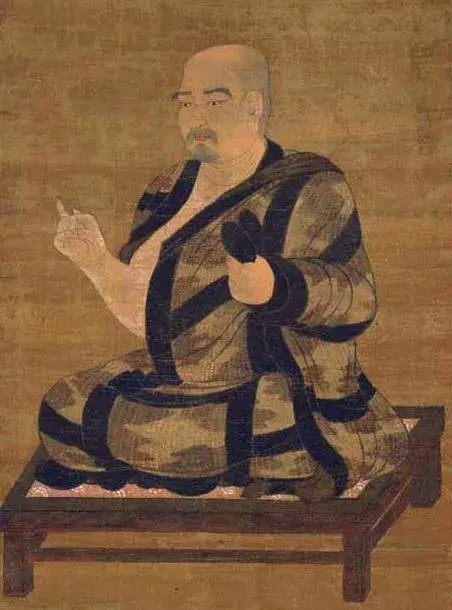
Biographical Narrative
Kshatriya Lineage and Early Coronation
Shi Subhakarasimha was born in 637 (the eleventh year of the Zhenguan era of Emperor Taizong of Tang) in the Odra Kingdom in East India (modern Odisha). His ancestral heritage was extraordinarily noble and sacred, tracing its roots directly to the Kshatriya royal lineage of the Shakya clan; his remote ancestor was King Amṛtodana, a younger brother of King Śuddhodana and paternal uncle to Shakyamuni Buddha. Several generations prior, a branch of Amṛtodana's descendants fled civil war in Magadha, moving east into Odra, where their military prowess and moral virtue led the local populace to enthrone them as monarchs.
From early childhood, Subhakarasimha possessed an imposing stature, dignified bearing, and deep spiritual inclinations. During his early years, he displayed exceptional filial devotion, benevolence, and martial intelligence. His royal father recognized his rare qualities, frequently testing him with military and civil administrative responsibilities.
At the young age of ten, Subhakarasimha was commissioned by his father to command royal troops to suppress border uprisings, enforcing strict discipline and tactical brilliance that won universal acclaim. In 649, upon the death of his father, the thirteen-year-old Subhakarasimha was formally crowned King of Odra with the unanimous support of the court and army.
As a young sovereign, Subhakarasimha exhibited political vision far beyond his years. He abolished predatory levies, punished corrupt magistrates, lowered land taxes, and provided relief for the destitute and widowed, listening directly to the grievances of his subjects. Under his governance, the kingdom enjoyed commercial flourishing, judicial fairness, and peaceful frontiers, winning the heartfelt veneration of his people.
Forgiving Treason and Renouncing the Throne
However, during this era of peace, a violent succession crisis erupted within the royal family. Subhakarasimha's elder brothers, consumed by jealousy over their younger brother's enthronement and soaring popularity, conspired against him. Colluding with regional warlords and foreign mercenaries, they launched a surprise armed insurrection, marching on the capital to seize the throne.
Confronted with fratricidal betrayal, the young king remained composed, personally leading the royal guards to confront the rebels. In the decisive engagement, Subhakarasimha fought on the front lines; despite being struck and severely wounded by an enemy arrow, he pressed forward, crushing the rebel forces and capturing the conspirators, including his own elder brothers.
According to the ancient penal statutes of Odra, high treason was punishable by immediate execution. Yet beholding his brothers trembling before the throne, Subhakarasimha felt overwhelming grief and compassion. He refused to allow fraternal bloodshed to stain his hands, declaring a royal pardon: he spared their lives, released them from imprisonment, and restored their personal freedom.
This brutal family feud disillusioned Subhakarasimha with the transient illusions of royal power. He realized that worldly authority was merely a snare that bound souls to the fires of karmic suffering, and that only the transcendent truth of the Buddha offered ultimate liberation.
Gathering the Queen Mother and the imperial ministers, Subhakarasimha announced his irreversible decision: he would surrender the throne to the elder brother he had just pardoned, dedicating his life to the monastic path. Seeing his resolve, the Queen Mother wept and granted her permission, secretly bestowing upon him the royal heirloom—a precious wish-fulfilling jewel (cintāmaṇi). Casting aside his royal robes, Subhakarasimha donned simple garments and walked out of the palace gates to enter the Sangha.
Training at Nālandā and Receiving the Esoteric Transmission
Free from royal burdens, Subhakarasimha embarked upon an arduous spiritual pilgrimage across the subcontinent.
He first traveled to the southern Indian seashore, building a thatched hermitage to cultivate the Lotus Samādhi (Fahua Sanmei) amid the crashing waves, his consciousness becoming radiant and tranquil. Subsequently, he wandered across dozens of kingdoms throughout southern and central India, visiting meditation centers and mastering the four dhyānas and eight samāpattis. Selling the royal jewel given by his mother, he distributed the immense proceeds to build monasteries, carve Buddha images, and feed impoverished pilgrims, retaining only a single alms bowl and robe.
Eventually, Subhakarasimha arrived at Nālandā Monastery in Magadha, the supreme academic and spiritual center of classical Indian Buddhism.
Nālandā housed over ten thousand monastics. At that time, its supreme abbot was Elder Dharmagupta, celebrated throughout the Five Indias as the direct lineage successor to Nāgārjuna. Dharmagupta held the ultimate esoteric transmissions of the Womb Realm and Vajradhātu (Diamond Realm) mantras, mudras, and three-secret yoga.
Subhakarasimha bowed before Dharmagupta, serving him with complete humility. Under Dharmagupta's guidance, Subhakarasimha mastered Sanskrit linguistics, the Tripitaka canons, and Buddhist logic (Hetuvidyā). Recognizing his disciple's vast intellect, spotless moral purity, and total freedom from royal arrogance, Dharmagupta conducted a solemn abhiseka initiation in a consecrated vajra-mandala, transmitting the fivefold Womb Realm mantras, mudras, and esoteric lineage to Subhakarasimha.
Upon completing his training, Dharmagupta charged him: "Your karmic affinity with India is complete. The great Tang Empire in China possesses vast cultural splendor and deep spiritual roots, yet the esoteric Mahayana mantras have not yet been fully transmitted there. You must take these supreme teachings, cross the northern deserts, and journey to the Great Tang to deliver gods and humans!" Weeping in gratitude, Subhakarasimha packed his Sanskrit palm-leaf manuscripts and embarked upon the perilous overland journey to China.
Journey across the Silk Road and Reception by Xuanzong
Carrying his sacred texts, Subhakarasimha journeyed through northern India, scaling the treacherous Karakoram and Pamir ranges and braving the vast wastes of the Taklamakan Desert.
Across thousands of miles along the Silk Road, he endured freezing tempests, sandstorms, and bandit ambushes, repeatedly averting death through his meditative composure and mantra practice. Passing through Central Asian oasis states and nomadic confederations, kings and chieftains were awed by the venerable Indian master's majestic presence, eagerly inviting him to establish altars to administer lay precepts and esoteric blessings.
In 716 (the fourth year of Kaiyuan), after years of travel, the eighty-year-old Subhakarasimha arrived safely in Chang'an, the imperial capital of the Tang Dynasty.
Emperor Xuanzong dispatched court dignitaries to escort the master into the capital with the highest diplomatic honors. Xuanzong received him in the Zichen Hall; observing his youthful vigor, penetrating gaze, and serene dignity despite his advanced age, the emperor was deeply captivated, accommodating him at Bodhi Monastery and later Ximing Monastery with the revered status of Imperial Preceptor.
During his initial residence in Chang'an, Subhakarasimha translated the esoteric manual Method for the Recitation of the Great Dharani of the Heart of Akasagarbha Bodhisattva for Fulfilling All Vows, which became immensely popular among scholar-officials for enhancing intellectual memory, inspiring countless practitioners, including the young monk Yixing.
Translating the Scriptures in Luoyang and Founding Tangmi
In 724 (the twelfth year of Kaiyuan), Emperor Xuanzong journeyed to the eastern capital of Luoyang, commanding Subhakarasimha to accompany the court and designating Dafuxian Monastery as his dedicated translation academy.
In Luoyang, Subhakarasimha's mission attained its historic zenith. To translate the complex Indian Tantric texts into flawless, authoritative Chinese, Subhakarasimha petitioned Emperor Xuanzong to appoint the preeminent scholar-monk Shi Yixing as chief editor and scribe.
From 724 to 726, the translation bureau at Dafuxian Monastery maintained rigorous standards. Subhakarasimha held the ancient Sanskrit palm-leaf manuscripts, reciting the sacred verses and explaining their hidden meanings; Yixing sat before him, rendering the Sanskrit into sublime classical Chinese; eminent scholars Baoyue, Zhiyan, and Huiguan verified the Sanskrit grammar and doctrinal accuracy.
Through their harmonious collaboration, the supreme foundational scripture of Chinese Esoteric Buddhism—the seven-volume Mahāvairocana Sūtra (Da Ri Jing)—was completed.
Subsequently, the translation team completed the three-volume Susiddhikara Sūtra (Suxidi Jing) and three-volume Subāhuparipṛcchā Sūtra (Subahu Jing), forming the "Three Womb Realm Scriptures" of Chinese Esoteric Buddhism.
Through these master translations, Subhakarasimha systematically introduced the cosmology of the Six Great Elements, the Ten Stages of Mind, and the doctrine of "Attaining Buddhahood in This Very Body," while establishing strict liturgical codes for mandala consecration, abhiseka initiations, and protective rituals. This marked the formal inception of Chinese Esoteric Buddhism (Tangmi). In his spare time, Subhakarasimha established Womb Realm mandalas at Dafuxian and Ximing monasteries, transmitting secret initiations to imperial princes, ministers, and elite monastics.
Miracle-Working Compassion and Entombment at Longmen
Beyond his translational achievements, Subhakarasimha left numerous legends of miracle-working compassion that protected the realm and common people.
During the summer of 722, Chang'an suffered an excruciating drought; scorching heat baked the earth for months, parching crops and terrorizing the populace. Emperor Xuanzong dispatched eunuch Gao Lishi to Ximing Monastery to plead with Subhakarasimha to pray for rain. Observing the severity of the drought, Subhakarasimha placed a small bronze bowl filled with water in the courtyard, immersed a miniature bronze dragon, and formed esoteric mudras while chanting secret mantras.
Within minutes, the water in the bowl bubbled fiercely, and a crimson dragon over a foot long leaped into the sky. Instantly, thunder rolled across Chang'an, clouds gathered, and torrential rain poured down for three days and nights, rescuing the crops. Emperor Xuanzong applauded in awe, leading his ministers to bow toward the master's monastery.
On another occasion, a monstrous serpent infested Mount Mang north of Luoyang, emitting pestilential vapors and devouring travelers, causing widespread panic. Subhakarasimha ascended the mountain holding his khakkhara staff, establishing a protective mandala and chanting mantras before the serpent's lair. The beast trembled and surrendered its venomous rage; Subhakarasimha administered the Buddhist refuges and precepts to the serpent, which died peacefully, permanently ending the scourge.
In 732 (the twentieth year of Kaiyuan), aged over ninety-five, Subhakarasimha repeatedly petitioned Emperor Xuanzong to allow him to return to India. Revering his master's presence, Xuanzong refused to let him depart, maintaining him in luxurious comfort at Dashengshan Monastery in Luoyang.
On December 14, 735 (the seventh day of the eleventh month of the twenty-third year of Kaiyuan), the founding patriarch of Chinese Esoteric Buddhism passed away peacefully in the lion posture at Dashengshan Monastery in Luoyang at the age of ninety-nine, having spent eighty years in the monastic order.
Emperor Xuanzong was devastated, suspending court audiences and dispatching imperial attendants to supervise the funeral. The emperor posthumously conferred upon him the high rank of Director of the Court of State Ceremonial (Honglu Qing), financing a magnificent state funeral from the imperial treasury. In the tenth month of 740, his disciples and officials entombed his uncorrupted body at Guanghua Monastery on the western slopes of Longmen, erecting a memorial stupa.
Subhakarasimha's esoteric lineage flourished across the centuries. His chief disciple Yixing authored the monumental Commentary on the Mahāvairocana Sūtra; the lineage was transmitted to Huiguo at Qinglong Monastery, who combined the Womb and Diamond realms and passed the unified transmission to the Japanese monk Kūkai. Founding the Shingon School on Mount Kōya, Kūkai honored Subhakarasimha as one of the Eight Patriarchs of Shingon. In 1988, Japanese Shingon delegations erected a commemorative stele at his tomb at Guanghua Monastery in Luoyang, and in 2009, the Kaiyuan Three Masters Memorial Hall was built, allowing Subhakarasimha's radiant virtue to link Eastern cultures across millennia.
Major Achievements
Translating the Mahāvairocana Sūtra to Found Chinese Esoteric Buddhism
Subhakarasimha's primary historical achievement was directing the translation of the seven-volume Mahāvairocana Sūtra (Da Ri Jing), the supreme scriptural foundation of the Womb Realm (Garbhadhātu).
Prior to Subhakarasimha, Chinese Buddhism possessed only isolated spells and incantations lacking coherent philosophical ontology and systematic contemplative praxis.
Bringing original Sanskrit palm-leaf manuscripts to China, Subhakarasimha translated the scripture alongside Master Yixing at Dafuxian Monastery in Luoyang. Elucidating the cosmic ontology of the Six Great Elements and the doctrine of attaining Buddhahood in this very body, this text stands as the paramount foundational scripture of Chinese Esoteric Buddhism.
Translating the Susiddhikara to Establish Esoteric Liturgical Codes
Alongside foundational doctrinal scriptures, Subhakarasimha translated the definitive ritual manuals of esoteric practice: the three-volume Susiddhikara Sūtra and three-volume Subāhuparipṛcchā Sūtra.
The Susiddhikara Sūtra was revered alongside the Mahāvairocana and Vajraśekhara sutras as one of the three foundational esoteric scriptures, systematically codifying the construction of mandala altars, mudra formations, mantra recitations, and protective rituals.
Applying these codes, Subhakarasimha constructed authentic mandala altars at Ximing Monastery in Chang'an and Dafuxian Monastery in Luoyang, embedding authentic Indian esoteric ritual practice into Chinese soil.
Cultivating Yixing and Lineage Disciples to Establish the Tangmi Tradition
As the pioneer patriarch of the Womb Realm lineage, Subhakarasimha prioritized the cultivation of brilliant disciples to ensure the continuity of the esoteric Dharma.
He transmitted the secret Womb Realm initiations to the genius scholar Yixing, supervising Yixing's composition of the twenty-volume Commentary on the Mahāvairocana Sūtra, which harmonized Indian Tantra with Chinese philosophy.
He also nurtured outstanding disciples including Xuanchao, Yilin, and Zhiyan. Through Master Huiguo at Qinglong Monastery, this lineage was transmitted to the Japanese monk Kūkai, establishing the Shingon School and making Subhakarasimha's legacy an enduring international Buddhist treasure.
Establishing Imperial Translation Bureaus and Performing State Rituals
During his residence in Tang China, Subhakarasimha integrated esoteric spiritual cultivation with state welfare and the peace of the empire.
He established translation bureaus at Bodhi, Ximing, Dafuxian, and Dashengshan monasteries across the two capitals, drawing elite scholars and civil ministers into translation activities.
During severe droughts, he answered Emperor Xuanzong's summons to perform rainmaking rituals that relieved agricultural crises, while taming the pestilential serpent at Mount Mang. His compassionate actions won the sovereign's devotion, earning him the title of Imperial Preceptor and the posthumous rank of Director of the Court of State Ceremonial.