Birth in Flanders
Born in Pittem near Bruges, Spanish Netherlands (modern Belgium), demonstrating an early aptitude for mathematics.
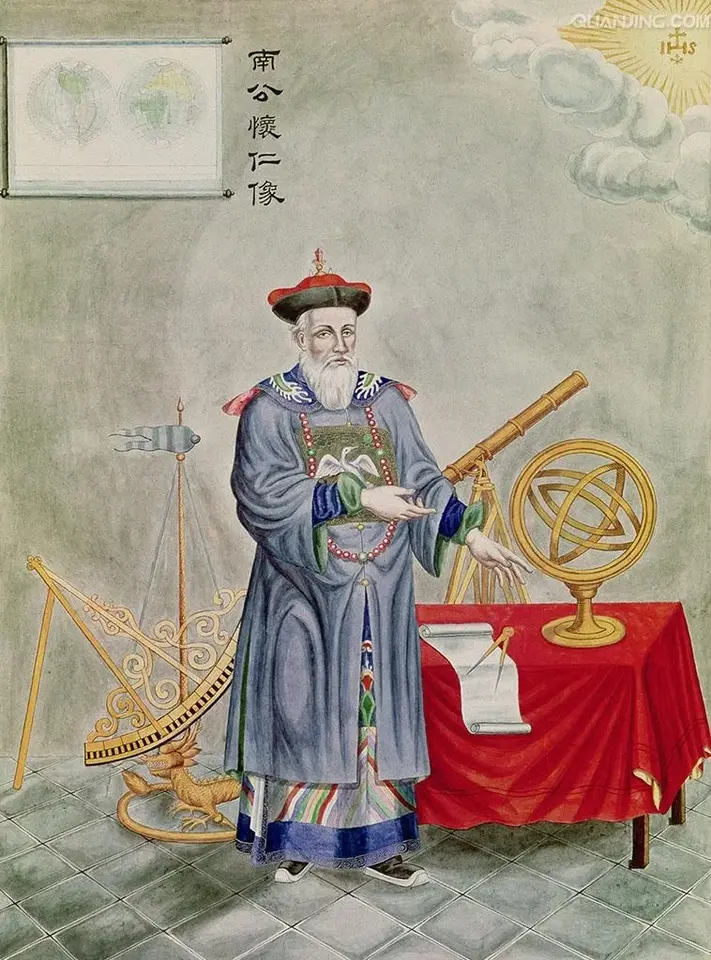
南怀仁
Ferdinand Verbiest (南怀仁, October 9, 1623–January 28, 1688), courtesy names Dunbo and Xunqing, posthumous name Qinmin, was a prominent Flemish Jesuit missionary, mathematician, astronomer, and mechanical engineer who served at the imperial court of the early Qing dynasty. After undergoing rigorous theological, astronomical, and mathematical education in Leuven and Rome, he arrived in Macau in 1658 and was summoned to Beijing…
Ferdinand Verbiest (南怀仁, October 9, 1623–January 28, 1688), courtesy names Dunbo and Xunqing, posthumous name Qinmin, was a prominent Flemish Jesuit missionary, mathematician, astronomer, and mechanical engineer who served at the imperial court of the early Qing dynasty. After undergoing rigorous theological, astronomical, and mathematical education in Leuven and Rome, he arrived in Macau in 1658 and was summoned to Beijing in 1660 to assist Johann Adam Schall von Bell at the Imperial Astronomical Bureau. During the Calendar Case of the early Kangxi era, Verbiest was imprisoned alongside fellow Jesuits under trumped-up charges orchestrated by conservative literati led by Yang Guangxian, but was pardoned following the massive Beijing earthquake of 1665. In 1668, the young Kangxi Emperor organized an open astronomical contest at the Meridian Gate; Verbiest's precise predictive calculations thoroughly outperformed the erroneous traditional astronomical methods, leading to his appointment as Director of the Imperial Astronomical Bureau. During his tenure, Verbiest designed and cast six monumental bronze astronomical instruments that still grace the Beijing Ancient Observatory, supervised the casting of hundreds of modern artillery pieces during the Revolt of the Three Feudatories, and served as the personal science tutor to the Kangxi Emperor. He passed away in Beijing in 1688, becoming the only Western missionary in Chinese imperial history to be honored with an official posthumous title.
Born in Pittem near Bruges, Spanish Netherlands (modern Belgium), demonstrating an early aptitude for mathematics.
Entered the Jesuit novitiate at Mechelen, studying philosophy, higher mathematics, and theology in Leuven and Rome.
Landed in Macau after an arduous ocean voyage, later traveling into the interior to proselytize in Shaanxi.
Arrived in Beijing upon the recommendation of Schall von Bell to assist in calendar computation at the Astronomical Bureau.
Imprisoned with fellow Jesuits following xenophobic accusations brought by Yang Guangxian and Regent Oboi.
Spared execution and released after an earthquake in Beijing prompted an imperial general amnesty.
Vindicated Western astronomical accuracy before the Kangxi Emperor during a public shadow-measurement trial at the Meridian Gate.
Appointed Director of the Imperial Astronomical Bureau, officially reinstating Western astronomical methods.
Completed six monumental bronze astronomical instruments for the Beijing Observatory, publishing Xinzhi Lingtai Yixiangzhi.
Commissioned by imperial decree to cast advanced lightweight cannons for the imperial armies suppressing the Revolt of the Three Feudatories.
Served as chief official Latin interpreter and diplomatic advisor during the arrival of the Russian embassy led by Spathari.
Traveled with the Kangxi Emperor to Shengjing (Mukden), taking precise geographic coordinates along the route.
Died of illness in Beijing at age sixty-six; honored by the Kangxi Emperor with an imperial funeral and the posthumous name Qinmin.
Ferdinand Verbiest was born in 1623 in the Flemish town of Pittem, near Bruges, within the Spanish Netherlands. Raised in a respectable family, he received a classical humanist education at the Jesuit colleges of Bruges and Kortrijk. In 1641, at the age of eighteen, he entered the Society of Jesus at Mechelen. Over the subsequent fifteen years, he pursued advanced studies in rhetoric, Aristotelian philosophy, Euclidean geometry, astronomy, and theology at the prestigious University of Leuven, Seville, and the Roman College.
While studying in Rome, Verbiest was deeply inspired by the pioneering missionary models of Matteo Ricci and Johann Adam Schall von Bell, who leveraged Western scientific knowledge to gain favor among Chinese elites. In 1655, having received approval to join the China mission, Verbiest traveled to Lisbon to secure passage aboard the Portuguese maritime fleet. In 1658, after surviving the perilous voyage around the Cape of Good Hope, he arrived at Macau. After studying spoken Chinese and classical texts, he was assigned to missionary work in the inland province of Shaanxi, where his modest demeanor and scientific erudition earned him high esteem among local scholar-officials.
In 1660, Schall von Bell, who served as Director of the Imperial Astronomical Bureau in Beijing, found his health declining under the burden of state calendar administration. Recognizing Verbiest's profound competence in spherical geometry and celestial mechanics, Schall von Bell petitioned the Shunzhi Emperor to transfer Verbiest to Beijing. The imperial court assented, and Verbiest took up residence at the South Church in Beijing, assisting in astronomical calculations and observations.
Following the death of the Shunzhi Emperor, the juvenile Kangxi Emperor ascended the throne under the regency of four conservative Manchu lords led by Oboi. Taking advantage of the shifting political winds, the conservative scholar Yang Guangxian filed a virulent memorial in 1664 entitled A Plea to Execute the Heterodox Sect, accusing Schall von Bell and Verbiest of treason and alleging that European astronomical calculations violated ancestral traditions. The regents arrested Schall von Bell, Verbiest, Lodovico Buglio, and Gabriel de Magalhaes, condemning several Chinese Christian astronomers to death in what became known as the "Kangxi Calendar Case." During grueling interrogations, Verbiest defended his colleagues with unwavering courage and intellectual rigor.
In the spring of 1665, as the court prepared to execute the Western missionaries, a violent earthquake struck Beijing, igniting fires within the Forbidden City. Empress Dowager Xiaozhuang intervened, reprimanding the regents for executing innocent scholars, which prompted an imperial general amnesty that freed the Jesuits. Schall von Bell died shortly after release, while Yang Guangxian was installed as head of the Astronomical Bureau. However, Yang and his deputy Wu Mingxuan lacked mathematical training, producing astronomical calendars riddled with severe errors in solar terms and planetary cycles.
In late 1668, having resolved to assume direct personal rule, the fourteen-year-old Kangxi Emperor intervened to restore celestial order. He ordered an open observational trial in the Forbidden City, directing Yang Guangxian and Verbiest to independently predict the length and angle of the gnomon shadow at noon on the following day. When high ministers assembled at the Meridian Gate to verify the results, Verbiest's predictions proved accurate to the millimeter, whereas Yang's calculations missed completely. Over the ensuing days of tracking planetary conjunctions and eclipses, Verbiest's astronomical methods triumphed without exception. The emperor immediately dismissed Yang Guangxian and elevated Verbiest to head the Imperial Astronomical Bureau, restoring the Western calendar system to official primacy.
Upon assuming directorship in 1669, Verbiest found that the existing astronomical instruments at the Beijing Observatory, which dated from the Song and Yuan dynasties, had suffered severe wear, rendering precise observations impossible. He submitted detailed proposals to recast the entire observational apparatus. Between 1669 and 1673, Verbiest drafted architectural plans, adjusted copper alloy formulas, and guided Chinese artisans in casting six monumental bronze instruments: the Equatorial Armilla, the Ecliptic Armilla, the Altazimuth, the Horizon Azimuth, the Sextant, and the Celestial Globe. These magnificent instruments seamlessly synthesized European Tycho Brahe-style mechanical frameworks with classical Chinese dragon-and-cloud artistic motifs. Verbiest documented their principles and operational methods in his sixteen-volume masterwork Xinzhi Lingtai Yixiangzhi.
In late 1673, Wu Sangui initiated a widespread insurrection in Yunnan, triggering the Revolt of the Three Feudatories across southern China. Imperial forces struggled in the mountainous terrain of Hunan, Jiangxi, and Guizhou, as heavy Ming-era bronze cannon could not be transported across rugged trails. Recognizing Verbiest's expertise in mechanics and metallurgy, the Kangxi Emperor summoned him in 1674 to supervise imperial cannon foundries.
Although initially hesitant due to his religious vows, Verbiest complied with imperial command. Applying mathematical calculations to chamber thickness, bore rifling, and gunpowder charges, he authored treatises on ballistics such as Shenwei Tushuo. Verbiest directed the manufacturing of hundreds of lightweight, highly mobile cannon, known as the "Shenwei General" and "Wucheng Yonggu Grand General" cannon. These artillery pieces could be dismantled and carried across alpine trails by pack mules, yet delivered devastating long-range accuracy. The Kangxi Emperor personally observed target practice at Jingshan, commending their performance. These weapons were rapidly dispatched to the front lines, playing a pivotal role in smashing rebel fortresses and securing victory for the Qing dynasty.
Throughout his tenure, Verbiest maintained an extraordinary relationship with the young Kangxi Emperor, acting as his primary tutor in Western science. For several years beginning in the 1670s, Verbiest entered the imperial palace early each morning, spending hours in the South Study instructing the emperor in Euclidean geometry, arithmetic, optics, mechanics, and astronomy. To facilitate imperial comprehension, Verbiest translated the first six books of Euclid's Elements into the Manchu language. Kangxi's lifelong fascination with mathematics and his benevolent policies toward Western missionaries stemmed largely from Verbiest's patient and lucid pedagogy.
Verbiest also played a critical role in early Qing foreign diplomacy. Between 1675 and 1678, when the Russian diplomatic mission led by Milescu Spathari arrived in Beijing to negotiate trade and border issues, Verbiest served as chief Latin translator and diplomatic advisor, ensuring accurate protocol and communication. In 1682, he accompanied the Kangxi Emperor on an extensive progress to Shengjing (Mukden), utilizing mercury barometers to measure elevations and charting the geographic coordinates of Northeast Asia.
Worn out by decades of relentless administrative, scientific, and theological labor, Verbiest died in Beijing on January 28, 1688, at the age of sixty-six. Deeply grieved, the Kangxi Emperor suspended court, contributed silver and fine silk for the funeral, bestowed upon him the nominal rank of Right Vice Minister of Works, and conferred the posthumous title of Qinmin ("Diligent and Keen"). The emperor composed an official bilingual eulogy praising his unblemished character and indispensable contributions to the empire's astronomical and military affairs. Verbiest was buried with full state honors at the Zhalan Jesuit cemetery outside Fuchengmen, resting beside Matteo Ricci and Johann Adam Schall von Bell.
Verbiest's decisive victory at the Meridian Gate trial in 1668 represented a watershed moment in early modern Chinese scientific history. Confronting widespread conservative xenophobia during the Kangxi Calendar Case, he utilized empirical measurement to demonstrate the superiority of Western predictive astronomy. His triumph not only restored the legal standing of the Shixian Calendar and protected the Jesuit mission from annihilation, but also convinced the young Kangxi Emperor of the indispensability of quantitative empirical sciences, inaugurating a golden era of scientific patronization in the Qing court.
Between 1669 and 1673, Verbiest revolutionized Chinese observational technology by manufacturing six monumental bronze instruments for the Beijing Observatory. Drawing upon the technical designs of European astronomer Tycho Brahe, he introduced equatorial, ecliptic, and altazimuth coordinates with unprecedented vernier scale precision. Decorated with exquisite imperial dragon sculptures cast by master Chinese craftsmen, these instruments bridged European mechanical ingenuity and Chinese metallurgical aesthetics, surviving today as world-class historical treasures of science.
Verbiest's engineering leadership modernized the firearms capability of the Qing empire during the critical crisis of the Revolt of the Three Feudatories. By introducing scientific ballistics, calibrated sights, and optimized bronze alloys, he designed mobile field artillery that overcame the steep terrain of Southwest China. His artillery treatises, including Shenwei Tushuo, established the first systematic ballistics curriculum in the Qing military. The hundreds of cannon cast under his direction proved decisive in crushing the rebellions and later in defending the northern frontier at the Siege of Albazin.
As personal science advisor to the Kangxi Emperor, Verbiest exerted a lasting influence on imperial statecraft and cultural openness. His Manchu translation of European mathematical works cultivated an environment where scientific dialogue could flourish. Furthermore, his seminal geographic treatise Kunyu Tushuo (Illustrated Explanation of the Entire World) provided detailed descriptions of continents, oceans, meteorology, and global flora and fauna, serving as an authoritative window through which seventeenth-century Chinese literati perceived the globe.
FIGURES ASSOCIATED WITH THIS DYNASTY