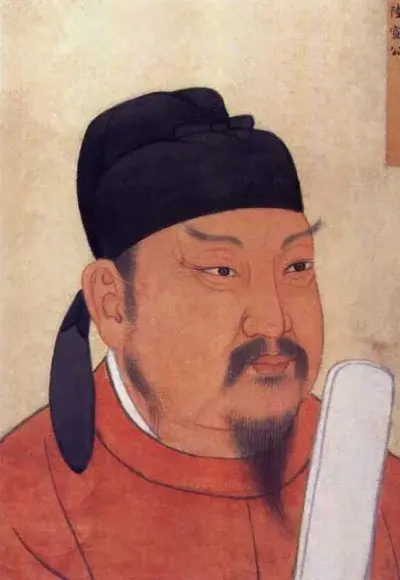
Life and Career
Noble Heritage and Dedicated Youth
Lu Zhi was born in the thirteenth year of the Tianbao era (754) in Jiaxing, Suzhou. His lineage derived from the distinguished Lu clan of Wu Commandery, an illustrious aristocratic family that had produced renowned ministers, generals, and Confucian scholars since the Han, Three Kingdoms Wu, and Six Dynasties periods. By the mid-Tang, however, Lu Zhi's immediate branch had fallen into deep poverty and obscurity.
His father, Lu Kan, had served as magistrate of Liyang but passed away when Lu Zhi was still a young child, leaving the household in straitened circumstances. Ranking ninth among his cousins, Lu Zhi was affectionately known as "Lu the Ninth." He was raised entirely under the tutelage of his mother, Lady Wei, a virtuous and cultured woman from an elite lineage. Despite their material hardship in a humble lane, Lady Wei imposed strict classical training, teaching her son Confucian ethics, self-discipline, and literary composition.
Endowed with early intellectual maturity and resolute character, Lu Zhi recognized that only diligent scholarship and upright action could restore his family and relieve societal suffering. He studied classical commentaries by day and read under lamplight by night, mastering historical institutions, economic administration, and statecraft alongside standard canonical literature. His essays demonstrated lucid argumentation and stylistic elegance, earning him high praise throughout the Jiangnan region.
Unlike contemporaries who pursued empty, ornate rhetoric, Lu Zhi prioritized practical governance. He studied Western Han political discourses, analyzing the deep causes of dynastic rise and decline, agrarian taxation, and military structure. He often observed that scholarship divorced from practical governance was no better than carved wood or painted earth. This pragmatic dedication laid the foundation for his future stature as a preeminent political theorist.
Early Career and Unyielding Integrity
In 771, at the young age of eighteen, Lu Zhi traveled to the imperial capital and passed the rigorous jinshi examination on his first attempt. Soon after, he achieved top honors in the prestigious Boxue Hongci examination, earning an appointment as defender of Zheng County in Huazhou, followed by registrar of Weinan and investigating censor.
While serving in local administration across Guanzhong, Lu Zhi maintained immaculate personal integrity. During the demoralized post-war era, local governance was plagued by bureaucratic bribery, flatteries, and illicit solicitations. Disgusted by these practices, Lu Zhi refused to flatter his superiors or compromise legal standards. Consequently, he was ostracized by corrupt peers and soon resigned his post, returning on foot to care for his mother in Jiangnan.
On his homeward journey passing through Shouzhou, Prefect Zhang Yi, a venerable statesman who had long admired his reputation, arranged a formal reception outside the city walls. Recognizing his extraordinary talent, Zhang Yi engaged Lu Zhi in intimate political discussions for three days and nights, concluding that he possessed the capacity of an imperial chancellor.
Noticing Lu Zhi's ragged clothing and empty purse, Zhang Yi offered him one million copper coins to assist his mother and rebuild their home. Lu Zhi firmly declined the generous sum. When Zhang Yi repeatedly pressed him to accept, Lu Zhi took only a single string of fresh tea leaves worth a few dozen coins from his host, remarking with a smile that the friendship of noble minds was pure as water, and that this token of tea fully sufficed to honor their deep bond. His pristine incorruptibility astonished scholars across the empire.
Returning home, Lu Zhi lived simply with his mother in Jiaxing. He avoided worldly distractions, delving into canonical archives and evaluating the strengths and weaknesses of mid-Tang tax, military, and legal institutions, preparing himself for future service to the realm.
Hanlin Service and the "Inner Chancellor"
In May 779, Emperor Daizong passed away and Crown Prince Li Shi ascended the throne as Emperor Dezong. In his initial months, Dezong pursued vigorous governance, soliciting worthy scholars, abolishing extra tribute, and curbing palace eunuchs. Chancellor Cui Youfu strongly recommended Lu Zhi to the throne, praising him as a genius of statecraft unmatched in contemporary times.
Dezong granted Lu Zhi an audience in the palace, questioning him on urgent matters of state. Lu Zhi's profound grasp of the post-rebellion fragmentation, regional warlordism, and fiscal exhaustion greatly impressed the emperor. Dezong appointed him Literature Scholar to the household of Prince Ding, and within months promoted him to Hanlin Academician, charging him with drafting secret imperial edicts.
During his tenure in the Hanlin Academy, Lu Zhi rapidly became the emperor's most indispensable confidant. Deeply trusting Lu Zhi's strategic counsel, Dezong summoned him to private palace chambers late at night to deliberate military deployments, provincial appointments, and disaster relief. Lu Zhi performed his duties with exceptional discretion, never leaking palace deliberations nor entertaining private visitors.
Aware of Dezong's impatient and headstrong temperament, Lu Zhi consistently offered frank, unvarnished remonstrance rather than subservient agreement. Amazed by his penetrating insight, Dezong once exclaimed that having Lu Zhi was like having the sun and moon in the sky. Court grandees and ministers, uncertain of imperial intentions, quietly sought Lu Zhi's judgment on major state policies, leading contemporaries to revere him as the "Inner Chancellor."
During this period, Lu Zhi voiced prescient warnings regarding Dezong's hasty military campaigns against regional warlords. He cautioned that curbing warlords required domestic stabilization, adequate provisioning, and patient diplomacy, warning that overworking exhausted troops would trigger internal rebellion. Unfortunately, the impatient emperor pressed forward, nudging the empire toward disaster.
The Fengtian Crisis and the Edict That Saved the Realm
In autumn 783, Emperor Dezong's aggressive campaigns backfired. Five thousand troops from the Jingyuan garrison, marching through Chang'an toward the eastern front in torrential rains, were denied adequate supplies and fed coarse gruel. Outraged, the troops mutinied, seized the capital, and proclaimed former general Zhu Ci as emperor of the Great Qin dynasty.
The court collapsed into panic. Escorted by a handful of eunuchs and bodyguards, Emperor Dezong fled through a palace rear gate toward the fortified city of Fengtian. In the driving rain and chaos of retreating crowds and pursuing rebel cavalry, Lu Zhi was separated from the imperial entourage.
Upon reaching Fengtian, Dezong counted his surviving ministers and discovered that Lu Zhi was missing. Overcome with grief, the emperor wept openly before his courtiers, crying that he cared little for the loss of common officials, but that losing Lu Zhi made his own life meaningless. Dezong immediately dispatched search cavalry in all directions, offering a thousand ounces of gold and hereditary office to anyone who could bring Lu Zhi back safely.
Shortly afterward, having traversed enemy cordons on foot in torn shoes and tattered garments, Lu Zhi appeared beneath the walls of Fengtian. Spotting his adviser from the ramparts, Dezong rushed down the city stairs, embraced Lu Zhi, and wept with immense relief. He immediately promoted Lu Zhi to Vice Director of the Bureau of Sacrifices, keeping him in charge of secret state edicts.
Soon, Zhu Ci's rebel army of over one hundred thousand besieged Fengtian, digging trenches, erecting assault towers, and pounding the city gates night and day. Inside the walls, arrows and grain were exhausted, and defensive soldiers ate horseflesh and wild grass. Meanwhile, warlords across Hebei and Henan coordinated their rebellions, threatening the collapse of the dynasty. In utter despair, Dezong turned to Lu Zhi for salvation.
Rejecting Dezong's defeatist laments that dynastic ruin was predestined by Heaven, Lu Zhi insisted that political outcomes depended on human virtue, not celestial fate. He urged the emperor to cast aside royal vanity, issue a solemn edict of self-reproach, confess past fiscal and administrative errors, and grant a general amnesty to reconcile with the realm's armies and people.
Moved to tears, Dezong instructed Lu Zhi to draft the edict immediately. By flickering candlelight inside the besieged fortress, Lu Zhi composed the legendary Fengtian Amnesty, declaring that the sovereign's own shortcomings had brought turmoil upon his blameless people, waiving all overdue taxes, and pledging to share hardship with the soldiers.
Carried by swift post couriers across the provinces, the edict deeply moved garrison commanders and rebel generals alike. Rebellious warlords Wang Wujun and Tian Yue wept openly upon reading the emperor's humble admission of fault, renouncing their rebellion and turning their forces against Zhu Ci. Loyalist forces under generals Li Sheng and Hun Jian rallied with renewed fervor, ultimately crushing the rebellion, liberating Chang'an, and escorting Dezong back to the capital. Historians universally agreed that Lu Zhi's single proclamation had rescued the Tang dynasty from destruction.
Ascent to Chancellor and Institutional Governance
Following his return to Chang'an, Lu Zhi's prestige reached its peak. He advanced through the posts of Grand Master of Remonstrance, Secretariat Drafter, and Vice Minister of War while remaining Hanlin Academician. In April 792, Emperor Dezong officially appointed him Vice Director of the Secretariat and Grand Councilor of the Secretariat-Chancellery, placing him at the head of the imperial administration.
As chancellor, Lu Zhi dedicated himself to repairing the deep institutional wounds of the post-war era. In civil service appointments, he dismantled aristocratic nepotism, instituting meritocratic evaluations and holding recommending officials accountable for the subsequent integrity of their appointees.
In public finance, he analyzed the systemic flaws of Yang Yan's Two-Tax System. In his renowned memorial Six Articles on Equalizing Taxes and Relieving the Common People, he pointed out that calculating taxes in rigid cash quotas during periods of severe copper coin shortages caused devastating deflation, forcing farmers to dump their grain at ruinous prices to obtain coin. He urged the government to accept tax payments in actual agricultural products and eliminate arbitrary supplementary levies.
In personal conduct, Lu Zhi remained incorruptible. Recognizing that administrative decay began with private gifts, he barred his family and gatekeepers from accepting presents from regional commissioners. His austere personal standard set a compelling precedent that revitalized bureaucratic morale.
He also resisted Dezong's private creation of personal inner palace treasuries funded by extra tribute from regional warlords. Lu Zhi boldly argued that all resources within the four seas belonged to the sovereign, and that an emperor had no legitimate reason to build private hoards separate from the public treasury. His fearless defense of public finance incurred the secret displeasure of the increasingly acquisitive monarch.
Palace Confrontation and Denunciation of Corrupt Partisans
Traumatized by his flight from the capital, Emperor Dezong grew suspicious of generals, obsessed with personal wealth, and increasingly receptive to flattery. Revenue official Pei Yanling exploited these psychological weaknesses, fabricating reports of vast surplus treasuries hidden in forgotten provincial warehouses and creating rapacious levies to divert wealth into the emperor's private palace vaults.
Recognizing that Pei Yanling's extortions were bleeding the populace dry and subverting the legitimacy of the throne, Lu Zhi resolved to risk his office and life to remove the corrupt official. He submitted a series of massive memorials, including On the Villainous Extortions of Pei Yanling, detailing how Pei fabricated accounts and plundered commoners.
During an imperial audience in the Yanying Hall, Lu Zhi confronted Pei Yanling in a fierce public debate, exposing the mathematical impossibility of Pei's claims and demanding his immediate dismissal. His outspoken defense of the people won the vocal support of upright ministers such as Zhao Jing and Zhang Bang.
However, blinded by greed, Dezong interpreted Lu Zhi's principled opposition as arrogant factionalism that obstructed imperial revenue. Pei Yanling and his cohort Li Qiyun capitalized on this alienation, constantly whispering slander into the emperor's ear.
In December 794, Dezong dismissed Lu Zhi from the chancellorate, assigning him to the sinecure of Junior Mentor to the Crown Prince. In 795, under renewed slander from Pei Yanling's faction, Dezong issued an imperial edict exiling Lu Zhi as Assistant Prefect of remote Zhongzhou.
Banishment to Zhongzhou and the Practice of Healing
Located deep within the Yangtze gorges, Zhongzhou was an isolated border outpost plagued by rugged terrain and pestilential climates. For an imperial chancellor fallen from the apex of power, such brutal banishment would have broken an ordinary spirit.
Yet Lu Zhi met his misfortune with profound philosophical equanimity. Aware that Pei Yanling's spies continued to monitor his daily life in search of pretexts to inflict further punishment, Lu Zhi closed his doors upon arriving in Zhongzhou, refusing all literary correspondence with scholars and officials.
Observing that the local inhabitants lacked medical care and relied on superstitious rituals to treat lethal fevers, Lu Zhi directed his boundless compassion toward the art of healing. He studied classical medical texts, climbed treacherous cliffs to gather native herbs, and experimented with herbal properties suited to the damp southern climate.
Through dedicated research, he compiled the monumental fifty-volume medical text Prescriptions of Tested Efficacy, recording hundreds of reliable, inexpensive herbal formulas for treating malaria, dysentery, and epidemics. Moreover, he opened his lodge to treat impoverished locals without charge, saving tens of thousands of lives over a decade. Grateful inhabitants revered him as a living saint, displaying his portrait in their homes and honoring him as the "Healer Prefect Lu."
Recall and Immortal Legacy
In January 805, Emperor Dezong passed away and Crown Prince Li Song took the throne as Emperor Shunzong. Having long admired Lu Zhi's extraordinary character and recall of the Fengtian rescue, Shunzong immediately issued an edict exonerating Lu Zhi, summoning him back to the court to serve as chancellor, and dispatching an imperial courier to Sichuan.
However, a decade of harsh climate and exhausting labor had shattered Lu Zhi's fragile health. In May 805, just as the imperial courier was hurrying through the mountain passes, Lu Zhi passed away in his official lodge in Zhongzhou at the age of fifty-two. The entire realm mourned the untimely loss of this peerless statesman.
Deeply grieved, Emperor Shunzong suspended court audiences for a day, granted generous funerary honors, posthumously conferred the rank of Minister of War, and bestowed the posthumous name Xuan, leading subsequent generations to honor him as Duke Xuan of Lu.
His state memorials and edicts were collected into the twenty-two-volume Collection of Duke Xuan of Lu, becoming a sacred textbook of governance for later statesmen. Song Dynasty master Su Shi revered Lu Zhi above all other Tang figures, hand-copying his memorials and proclaiming that Lu Zhi possessed the tactical brilliance of Zhang Liang, the eloquence of Jia Yi, and the practical virtue of an imperial preceptor. In his unyielding integrity, compassionate statecraft, and peerless prose, Lu Zhi established an enduring monument of Chinese Confucian statesmanship.
Major Achievements
The Fengtian Proclamation and Salvation of the Realm
During the 783 Jingyuan mutiny, when Emperor Dezong was trapped in Fengtian and the Tang Dynasty stood on the brink of total collapse, Lu Zhi drafted the immortal Fengtian Amnesty:
Breaking with the ancient imperial tradition of whitewashing monarchical failures, Lu Zhi formulated a humble confession of guilt on behalf of the emperor, acknowledging fiscal overreach and administrative betrayal. This profound sincerity dissolved the rebellion's political momentum, causing rebel warlords to surrender in tears and rallying loyalist forces to liberate Chang'an. Historians regard this proclamation as the supreme masterpiece of political rhetoric in Chinese history.
Critique of Two-Tax Flaws and Equalized Taxation
As a pioneering economic thinker, Lu Zhi discerned the structural flaws of Yang Yan's Two-Tax System, outlining systemic fiscal reforms:
In his Six Articles on Equalizing Taxes and Relieving the Common People, he demonstrated that fixed cash tax quotas during currency shortages generated severe deflation, impoverishing grain-producing farmers. He championed tax conversions based on floating commodity values and advocated abolishing extra palace levies, establishing a humane fiscal framework that prioritized agricultural viability over fiscal hoarding.
Remonstrance Against Bribery and Incorruptible Standards
During his chancellorate, Lu Zhi established an immortal standard of official incorruptibility. When Emperor Dezong suggested that accepting minor gifts such as whips and boots was harmless, Lu Zhi submitted the famous Memorial on Rejecting Gifts:
He elucidated the principle of preventing corruption at its inception, arguing that tolerating minor gifts inexorably opened the floodgates to systemic venality. In his personal life, he declined large fortunes and accepted only a token of tea, demonstrating by example that personal virtue was the indispensable anchor of state legitimacy.
Principled Opposition to Pei Yanling's Extortions
Confronting the corrupt favorite Pei Yanling, who plundered commoners to fill the emperor's private coffers, Lu Zhi risked his life and office to defend the welfare of the people:
He submitted comprehensive memorials exposing Pei's fraudulent claims and confronted him in court debates. Though his defiance led to his demotion and exile, his unyielding courage in resisting tyranny and corruption established an enduring moral beacon for the Chinese scholar-official class.
Frontier Diplomacy and Alliance Strategies
In foreign and military strategy, Lu Zhi demonstrated profound geopolitical foresight regarding the ongoing threat of the Tibetan Empire:
He advocated domestic stabilization as the foundation of defense, opposing reckless offensive expeditions while orchestrating an alliance strategy that united the Uighurs and Nanzhao to isolate Tibet. His guidance facilitated the historic alliance with Nanzhao King Yimouxun at Mount Diancang, permanently securing the southwestern borders of the Tang Empire.
Compilation of Tested Prescriptions and Medical Relief
During his decade of exile in Zhongzhou, Lu Zhi translated his Confucian compassion into active medical relief for the impoverished:
Gathering wild herbs and researching pathology suited to the humid gorges, he compiled the fifty-volume Prescriptions of Tested Efficacy, providing accessible remedies for malaria, dysentery, and fevers. His medical philanthropy saved countless lives and established him as an exemplar of the scholar who continues to benefit humanity even when banished from court.
Philosophy of Human Agency Over Celestial Fate
In political philosophy, Lu Zhi refuted Emperor Dezong's fatalistic excuse that dynastic turmoil was predetermined by Heaven, articulating a progressive doctrine of human agency:
Citing ancient canonical wisdom that Heaven sees through the eyes of the people, Lu Zhi argued that social peace or disorder resulted solely from human governance and popular sentiment. He asserted that a sovereign must align his policies with the desires of the populace, formulating a coherent philosophy of popular sovereignty that influenced Neo-Confucian thinkers for centuries.
Civil Service Meritocracy and Accountability
To combat bureaucratic stagnation and nepotism, Lu Zhi designed a thorough overhaul of the Tang civil service examination and evaluation systems:
He advocated selecting talent based on practical administrative acumen rather than superficial poetic rhetoric. Furthermore, he established a system of joint ministerial recommendation combined with vicarious liability, holding recommending officials accountable for the subsequent corruption of their nominees, thereby invigorating administrative efficiency.
Prose Revolution and Pragmatic Statecraft
Lu Zhi transformed Chinese prose by infusing parallel prose forms with urgent, lucid political analysis:
His memorials balanced elegant structural symmetry with compelling philosophical logic and profound emotional resonance. Sima Guang incorporated thirty-nine of Lu Zhi's memorials into the Comprehensive Mirror in Aid of Governance, and Su Shi praised them as the ultimate guide to practical statecraft, making his works an enduring cornerstone of Chinese administrative literature.